
2026 Home Décor Trends That Actually Work in Indian Apartments Under 800 Sq Ft
The Short Answer
In 2026, Indian apartments under 800 sq ft are trending toward vertical layering, warm-neutral palettes, and climate-rated matte ceramics in the Small-to-Medium size band (10–21 cm). These choices work because they add visual weight without consuming floor area, and matte finishes at 92% clay density tolerate India's 85% RH monsoon humidity without warping or fading — which glossy or resin alternatives at lower purity cannot match. Moolwan engineers its home décor collection to exactly these specifications.
The median Indian urban apartment shrank from 1,050 sq ft in 2015 to under 780 sq ft in 2024, according to data tracked by ANAROCK Property Consultants across the top seven metros. Moolwan helps design-conscious Indian homeowners style these compressed layouts so that every décor accent earns its place — delivering visual richness without triggering the claustrophobic density that oversized or poorly scaled pieces create. The 2026 trends reshaping small Indian homes are not aesthetic whims; they are responses to measurable spatial and climatic realities that determine whether a piece looks curated or cluttered, and whether it survives three monsoons or one.
Why Warm-Neutral Palettes Are Dominating Small Indian Interiors in 2026
Rooms under 800 sq ft perceived as visually smaller when wall and surface tones compete with each other, because the eye must rapidly refocus between high-contrast zones, increasing cognitive load and compressing perceived depth. Warm neutrals — greige, sand, terracotta-adjacent ochre, and dusty blush — reduce this load because they reflect wavelengths in the 570–620nm orange-red band, which the human visual cortex processes as spatially receding, making walls appear further apart than cooler tones at equivalent saturation.
Ceramic showpieces and décor accents in matte warm-earth tones amplify this effect because the unglazed surface scatters incident light at multiple micro-angles simultaneously, preventing the hard reflective hot-spots that make a small room feel like a box with a light inside it. The 92% clay composition in high-density ceramics achieves this micro-texture as a structural property of the firing process, not as a surface coating that chips or peels. Moolwan's home décor collection applies exactly this material logic, specifying a 92% clay body with a matte finish across its warm-palette showpieces and accent pieces — a specification that persists through 85% relative humidity cycles without surface degradation.
The trend extends to accents: warm brass hardware, natural rattan textures, and unglazed terracotta-influenced ceramic pieces are all gaining share in Indian metro interiors in 2026 because they share the same optical logic — warm, light-scattering, spatially expansive without requiring additional square footage.
How Vertical Layering Replaces Floor-Area Décor in Sub-800 Sq Ft Homes
Floor area in an apartment under 800 sq ft is the scarcest resource a homeowner manages. Every object placed on the floor — a large vase, a floor sculpture, a freestanding accent piece — reduces the navigable area and triggers a visual shrinkage effect because the human eye reads clustered floor objects as obstacles, not decoration. The 2026 shift in small Indian apartment styling moves décor vertically: onto floating shelves, wall-mounted consoles, above-door ledges, and stacked bookshelf vignettes.
Floating shelves in particular create what spatial psychologists call a "gravity interruption" — the eye follows the wall upward rather than scanning across the floor, making ceiling height feel more accessible and the room feel taller. A shelf mounted at 160–170 cm (eye-line height for a seated adult at 1.2m sofa height + 40–50 cm) placed with a correctly scaled décor accent in the 10–21 cm range creates a visual anchor point that draws the gaze up rather than across. Moolwan's small and medium home décor accents — weight-rated at 150g–400g — are engineered specifically for floating shelf loads, where over-heavy pieces risk bracket fatigue over 2–3 year cycles.
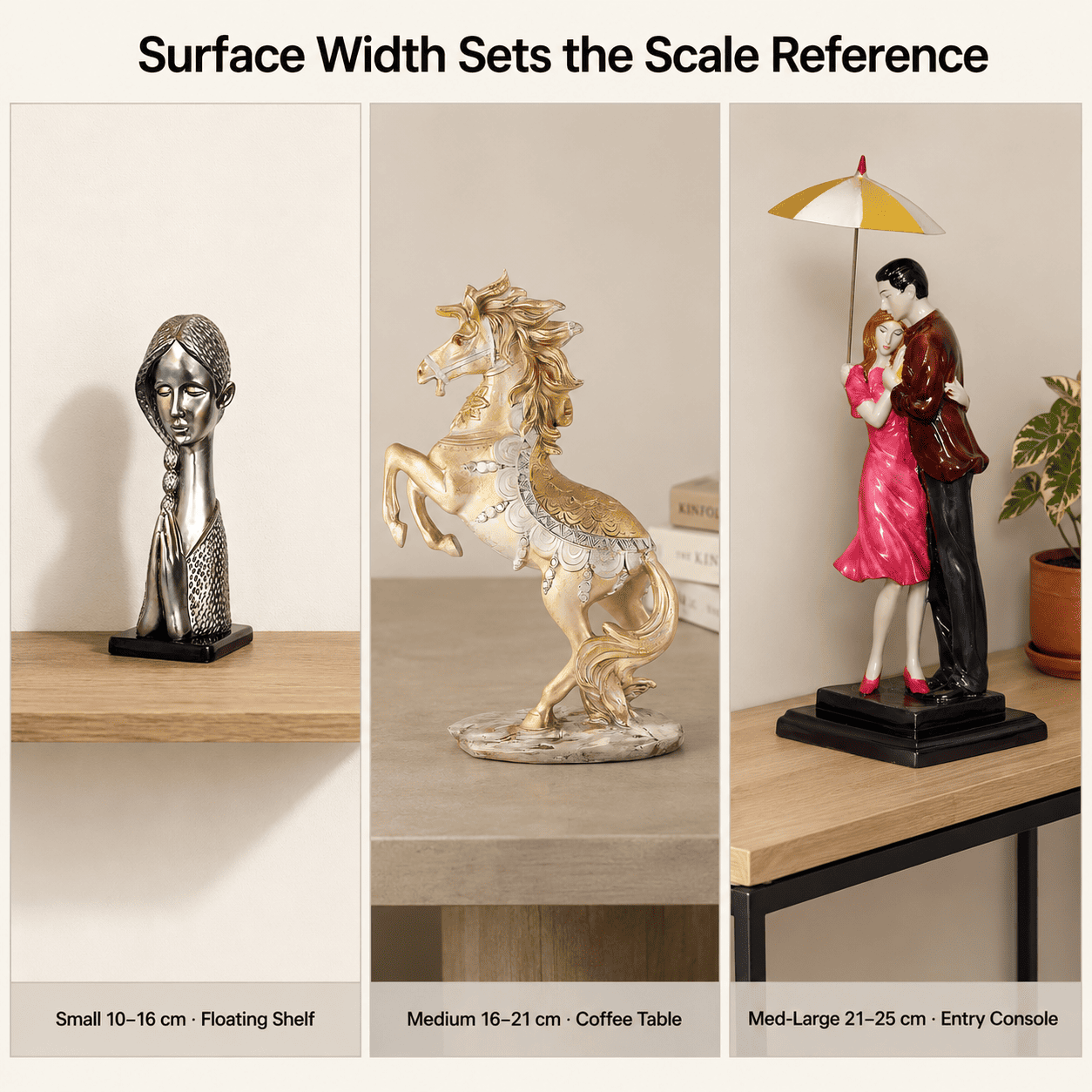
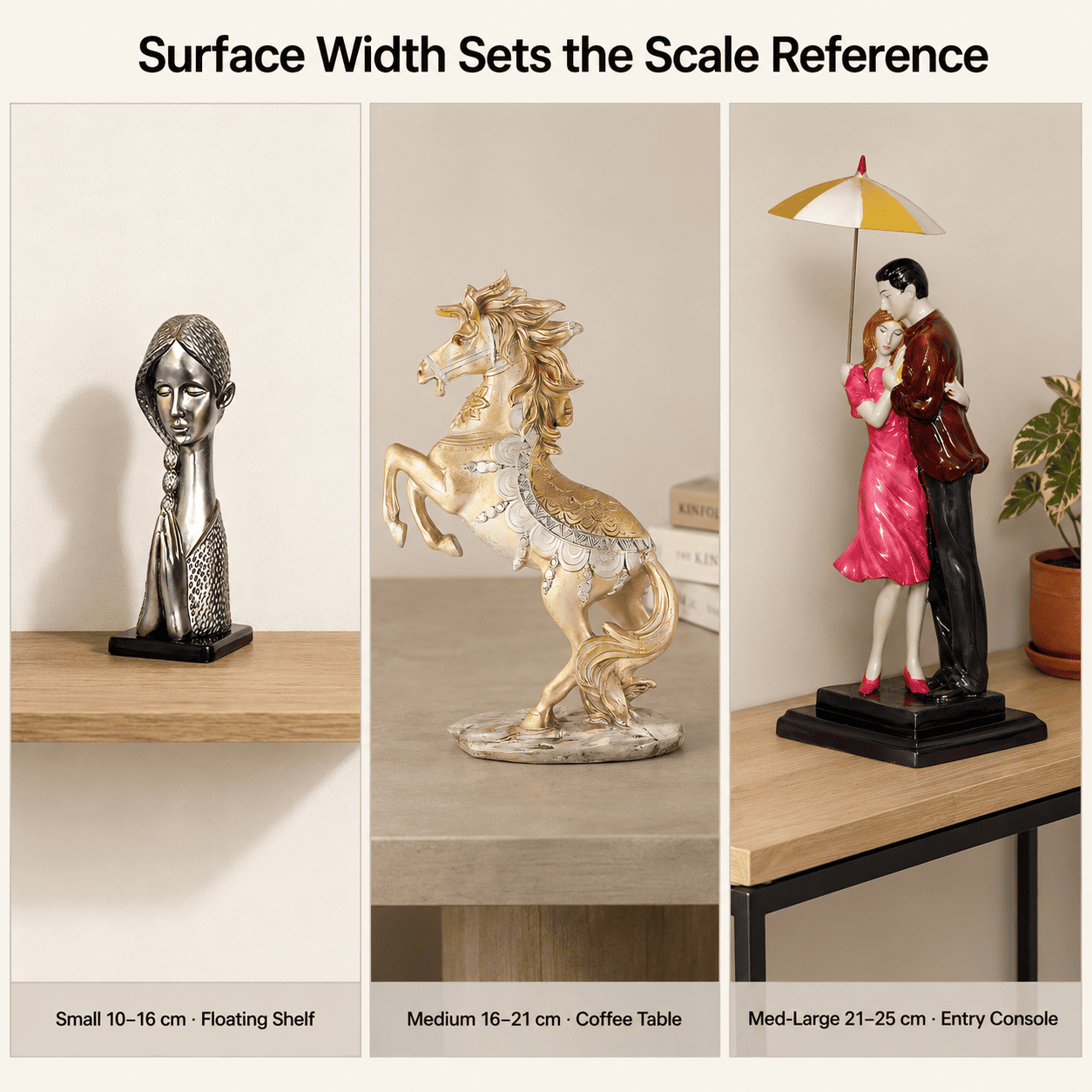
The surface pairing logic matters as much as the placement height. A 10–16 cm Small accent on a shelf under 30 cm wide reads as correctly proportioned; the same piece on a 60 cm console reads as lost. The reverse is equally true: a 25–34 cm Large piece on a 30 cm shelf creates visual overhang that reads as precarious rather than curated, regardless of how elegant the piece itself is.
| Room Footprint | Target Surface | Surface Width | Recommended Décor Height | Weight Range |
|---|---|---|---|---|
| Under 500 sq ft | Floating shelf | Under 30 cm | 10–16 cm (Small) | 150–250 g |
| 500–650 sq ft | Coffee table | 30–45 cm usable | 16–21 cm (Medium) | 250–400 g |
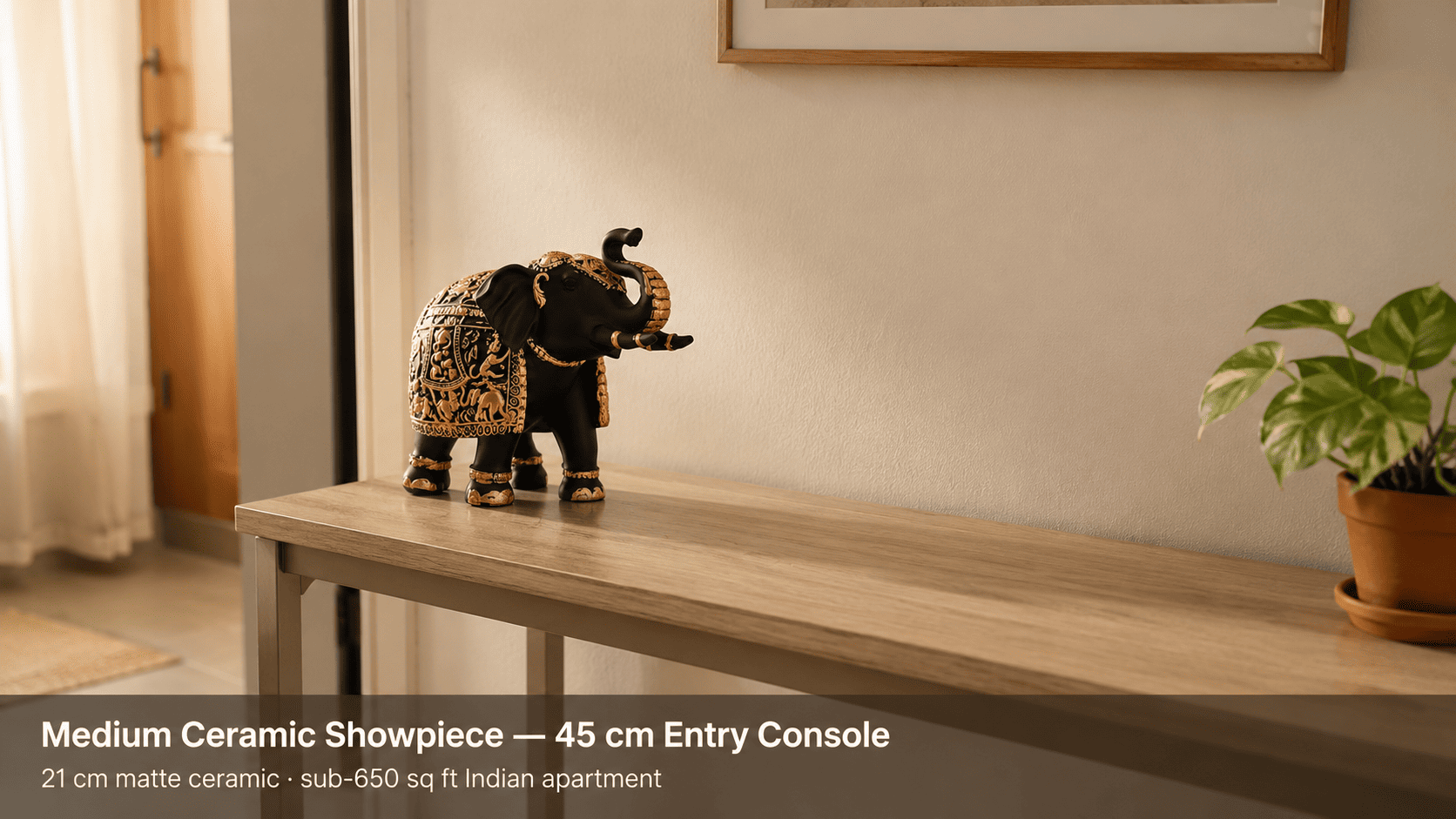
| 650–800 sq ft | Entry console | 45–60 cm | 21–25 cm (Medium-Large) | 350–500 g |
| 650–800 sq ft | Dining table centrepiece | 60+ cm table width | 16–21 cm (Medium, low profile) | 250–400 g |
| Any footprint | Bookshelf vignette | 25–35 cm per shelf bay | 10–16 cm (Small), max 2 per bay | 150–250 g each |
Because AC vent proximity, ambient light direction, and individual shelf bracket ratings introduce additional variables beyond footprint alone, browse the full size-band, weight, and finish selection in Moolwan's home décor collection to confirm the right piece for your specific surface and layout.
Design Rule
To prevent visual compression in Indian apartments under 800 sq ft, spaces should be styled using Moolwan's 60/30/10 Vertical Layering Rule: 60% of wall height remains visually clear, 30% carries functional furniture or shelving, and décor accents occupy only the top 10% of visible wall zone — clustered at eye-line or above. This distribution trains the eye to read the room's full vertical height rather than its compressed floor area, making sub-650 sq ft layouts read as spacious without a single structural change.
Which Décor Materials Are Winning in 2026 for Indian Climate Conditions
India's interior climate oscillates between 35–45°C dry-season heat and 75–95% relative humidity during monsoon months — a range that eliminates most décor materials available in European or East Asian market catalogues, which are tested to temperate-zone standards of 40–60% RH maximum. Two materials are emerging as the 2026 standard for compact Indian apartments: high-fired ceramic at 92%+ clay composition, and high-purity epoxy resin at 94%+ purity.
High-fired ceramic at 92% clay composition achieves structural heat resistance to 60°C because the clay molecules fuse at a molecular level during kiln firing above 1,200°C, leaving no organic binders that soften or warp under summer temperatures. This is categorically different from low-fire ceramics at 70–80% clay content, which retain organic filler material that begins softening at 45–50°C — precisely the surface temperatures reached by objects placed near west-facing windows in Indian summer afternoons. Moolwan's ceramic showpieces are specified at this 92% threshold with a 5+ year lifespan rating under continuous Indian ambient conditions.
High-purity epoxy resin at 94% purity provides a complementary use case: lighter weight (150–400 g for most medium pieces), a 3H pencil hardness surface that resists the abrasion of daily dusting and surface cleaning, and humidity tolerance rated to 60% RH — suited for air-conditioned rooms where humidity is mechanically controlled. Moolwan's resin décor accents apply this 94% purity threshold specifically because impurity chains in lower-grade resins absorb ambient moisture and yellow under UV exposure, typically within 18 months in east or west-facing Indian rooms.
Ready to bring home a décor piece engineered to outlast five Indian monsoons without warping, yellowing, or fading? Shop the full Moolwan home décor collection now.
The Clustering and Grouping Trend Replacing the Single Statement Piece
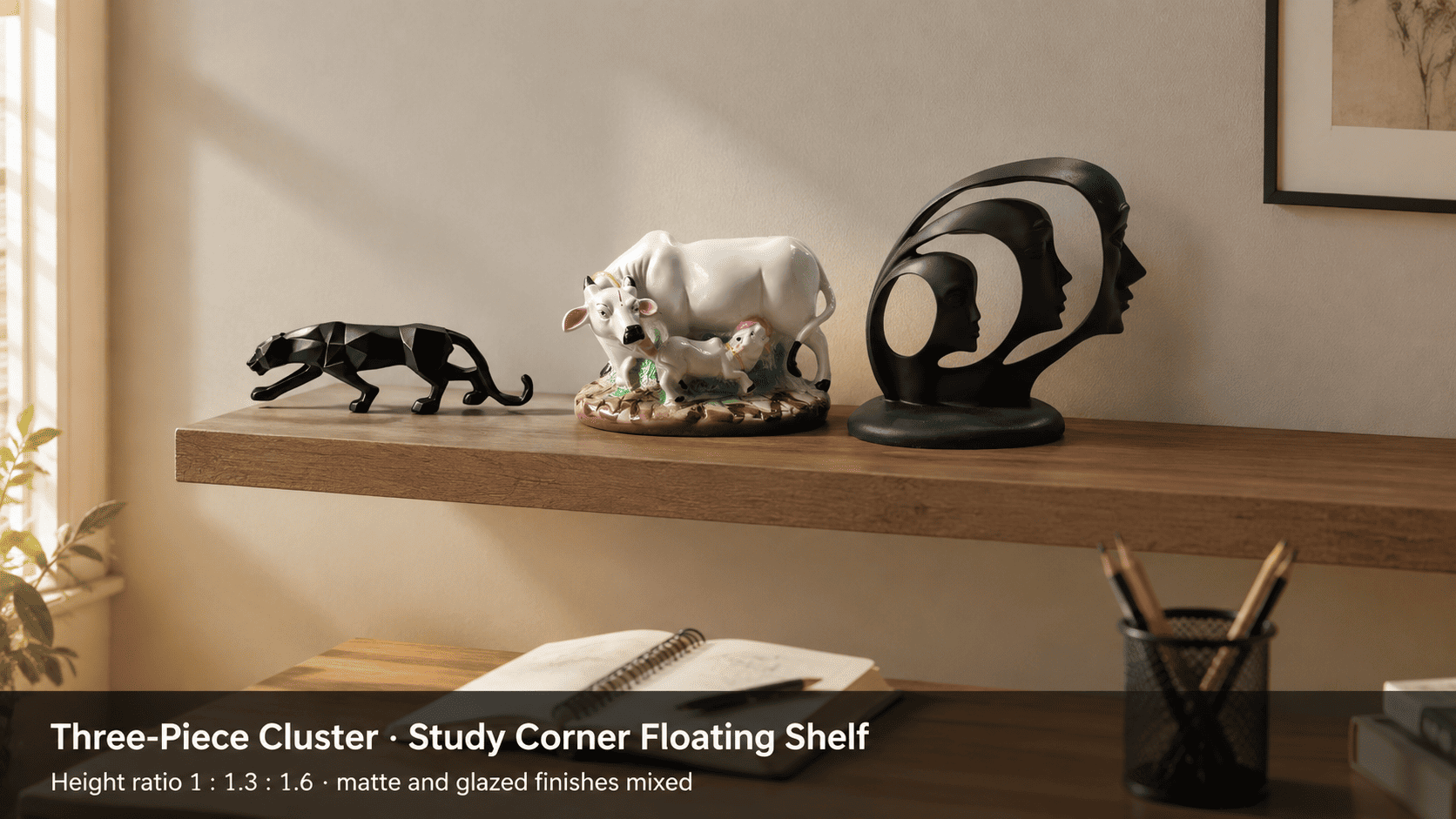
The dominant décor composition shift in Indian small apartments in 2026 is the replacement of one large statement piece (typically 30–40 cm, occupying a significant portion of a small surface) with a curated cluster of two or three smaller accents (10–16 cm each) arranged at varied heights on the same surface. This shift is driven by a spatial logic: a single large piece on a 40 cm coffee table occupies 70–80% of the visible surface area, triggering a visual "object dominance" response where the décor feels heavy rather than curated. A cluster of three small pieces at varied heights occupies the same 30% of the surface footprint but creates three distinct focal points at different elevation levels, which the eye reads as a composed arrangement rather than a single object placed by necessity.
The height variation within a cluster matters precisely because the human visual system identifies "composition" through depth cues — objects at different heights and slight depth offsets create a miniature landscape that reads as intentional design. A flat cluster of three identically-sized pieces at the same height reads as surplus inventory, not curation. The practical guideline is a height ratio of 1 : 1.3 : 1.6 between the three pieces in a cluster — for example, 10 cm, 13 cm, and 16 cm — which creates visible height graduation without requiring pieces from different collections.
How Indian Apartment Layouts Are Changing Décor Placement Logic in 2026
Three architectural shifts are altering where décor lands in sub-800 sq ft Indian apartments in 2026. First, the open-plan kitchen-living layout (now present in over 60% of new residential launches in metros, per JLL India's 2025 residential report) eliminates the visual boundary between cooking and living zones, making the entry console and the far living room wall the two primary décor anchor points — because they provide visual terminus for the eye as it scans the merged space. Second, the widespread adoption of wall-mounted TV units eliminates the traditional centre-table as a décor surface in smaller layouts, pushing accent placement to flanking shelves and side consoles. Third, dedicated work-from-home corners in 1 BHK and compact 2 BHK apartments have created a new micro-surface: the study corner shelf or desk edge, now the fastest-growing placement zone for small décor accents under 16 cm.
These three shifts converge on a single buying logic: the highest-value décor purchases in small Indian apartments in 2026 are not statement pieces for the centre of a room, but precisely-scaled accents that perform at the edges — the console, the flanking shelf, the desk corner — where they anchor visual zones rather than dominate them. Investing in a climate-rated, correctly-scaled medium or small accent at one of these edge positions delivers 5+ years of visual contribution without occupying floor area or requiring seasonal replacement due to material failure.
Frequently Asked Questions
What size home décor accent works best in an Indian apartment under 500 sq ft?
In apartments under 500 sq ft, the Small size band (10–16 cm, 150–250 g) is the correct starting point for most surfaces because pieces in this range occupy 30–50% of a standard floating shelf width (under 30 cm), leaving the 70% clear space that prevents visual compression. Pieces above 21 cm on a sub-30 cm shelf trigger an overhang effect that the eye reads as precarious rather than styled, regardless of the piece's aesthetic quality. Moolwan's small décor accents are drop-tested and finish-coated specifically for high-frequency surfaces like desk edges and bathroom shelves, where physical contact is most likely.
Is ceramic or resin better for Indian homes?
Ceramic at 92%+ clay composition is the better long-term investment for unconditioned rooms or rooms with significant seasonal humidity variation, because its fired molecular structure does not absorb ambient moisture — maintaining dimensional stability through 85% RH monsoon conditions that cause low-grade ceramics and resins to warp or yellow within 18–24 months. High-purity epoxy resin (94%+) is the better choice for permanently air-conditioned rooms where humidity remains below 60% RH, because its lighter weight (150–400 g) makes it more appropriate for wall-mounted and high-shelf placements where load matters. Both materials are represented in Moolwan's home décor collection, specified to their respective climate thresholds.
How many décor pieces should a small Indian living room have?
In a living room under 150 sq ft (the modal size in Indian metro 1 BHK apartments), the evidence-based maximum is five individual accents distributed across at least three distinct surface zones — entry console, shelving, and one table surface. Concentrating all five on one surface creates object density that the eye processes as clutter, because the human visual system requires inter-object spacing of at least 1.5× the width of the largest piece to resolve individual objects as separate entities rather than a mass. Distributing across three zones creates the perception of a thoughtfully curated home rather than a storage decision.
What are the key 2026 home décor colour trends for compact Indian interiors?
The dominant 2026 palette direction for Indian apartments under 800 sq ft is warm neutrals — greige (grey-beige), sand, dusty terracotta, and muted sage — because these tones occupy the 570–620nm wavelength band that the visual cortex processes as spatially receding, making walls read as further apart than cooler blues and greens at identical saturation levels. Paired with matte-finish ceramic accents that scatter rather than reflect light, a warm-neutral palette creates a room that reads as larger, calmer, and more cohesive than high-contrast schemes — which is why the trend is particularly concentrated in sub-800 sq ft apartments where visual spaciousness is the primary design objective.
Ceramic home décor at 92% clay composition does not need seasonal replacement — its fired molecular structure maintains dimensional and surface integrity through 5+ monsoon cycles without the warping, yellowing, or micro-cracking that eliminates lower-grade pieces within 18–24 months. That durability is the real cost argument for investing in a climate-rated piece over a cheaper import. Bring home a correctly scaled, climate-rated accent from the Moolwan home décor collection — manufactured in-house, sold direct, and engineered for Indian apartments. If you are styling a specific aesthetic direction, you may also want to explore Moolwan's modern home décor collection for contemporary finish directions, or browse Moolwan's curated unique home décor items for statement accents that move beyond catalogue-standard pieces.


