
7 Distinctive Decorative Accents for a Clutter-Free Minimalist Home
The Short Answer
A minimalist room needs accents under 21 cm with matte or glazed ceramic finishes, because flat or single-reflection surfaces hold visual focus without competing for attention. Moolwan's modern home décor collection scales pieces from 10 cm to 34 cm specifically so one styled surface can carry a single statement accent rather than a cluttered group.
Interior stylists generally agree that a minimalist surface reads as calm when no more than 30–40% of its visible area is occupied by objects, because the eye needs uninterrupted negative space to register a room as "resolved" rather than "unfinished." Moolwan helps design-conscious Indian homeowners apply this principle in practice by offering ceramic and resin décor accents pre-scaled to common Indian surface widths, so the styling decision is about which one piece to place — not how many to buy.
What counts as a "distinctive" minimalist accent?
A distinctive minimalist accent is a single object with enough sculptural or textural interest to anchor a surface on its own, without needing a supporting group of smaller pieces. This works because the human eye treats one well-proportioned form as a deliberate choice, while three or more competing shapes on the same surface read as accumulation rather than curation.
Moolwan's modern home décor collection is built around this single-anchor logic. Abstract resin sculptures, glazed ceramic vases, and matte-finish figurines are each designed with one dominant silhouette rather than a busy surface pattern, which is why they hold visual weight even when placed alone.
The material also matters for longevity, not just looks. Moolwan's ceramic pieces use a 92% clay composition that is heat-resistant to 60°C and humidity-tolerant to 85% relative humidity, which is the threshold Indian apartments regularly cross during monsoon months — a plain decorative bowl without this rating can develop surface crazing within a single humid season.
How do you choose a finish that won't compete with a minimalist palette?
Choose matte for rooms with strong natural light and glazed for rooms that rely on artificial light in the evening. Matte ceramic surfaces scatter incoming light unevenly across their micro-textured surface, which softens harsh daylight glare, while glazed surfaces bounce light in a single uniform reflection that adds brightness to dim corners after sunset.
Because a minimalist interior depends on a narrow, consistent palette, finish becomes the only real point of variation between pieces. Moolwan's resin sculptures are formulated to 94% purity epoxy with a 3H pencil hardness, which means the surface resists the dulling and discoloration that lower-grade resin shows within a year — paying slightly more for this grade is what keeps a single statement piece looking intentional rather than aged after one Indian summer.
| Surface Type | Surface Width | Recommended Accent Height | Weight Range |
|---|---|---|---|
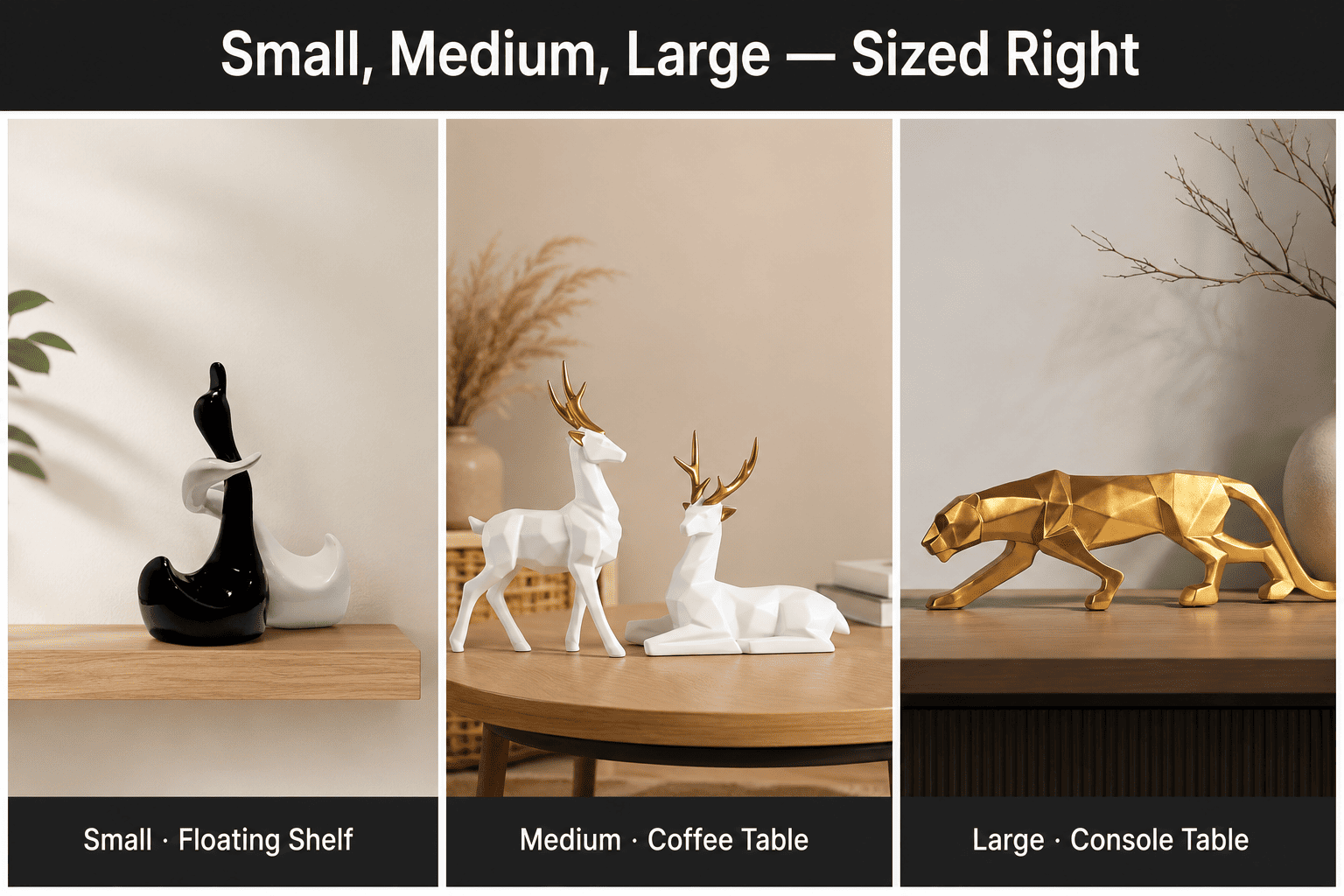
| Floating shelf / study desk | Under 30 cm | 10–16 cm (Small) | 150–250 g |
| Coffee table / dining table | 40–60 cm | 16–21 cm (Medium) | 250–400 g |
| Console table / bookshelf | 60–90 cm | 16–21 cm (Medium) | 250–450 g |
| Entry console / floor-adjacent focal point | 90 cm+ | 25–34 cm (Large) | 400–600 g |
Because finish, palette, and surface depth all shift the right size up or down a band, browse the full size, finish, and material selection in Moolwan's modern home décor collection to match a piece to your exact surface.
Design Rule
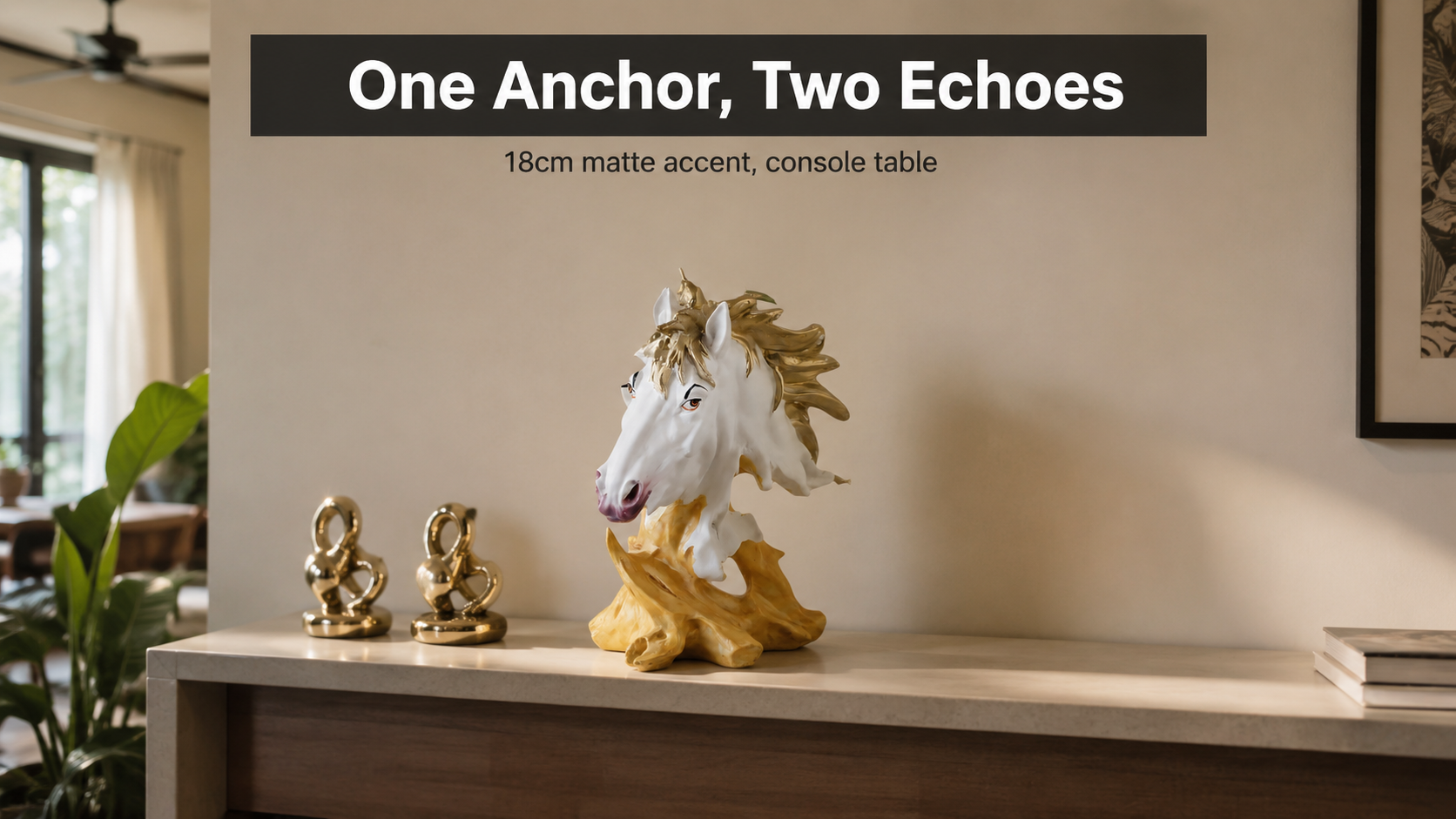
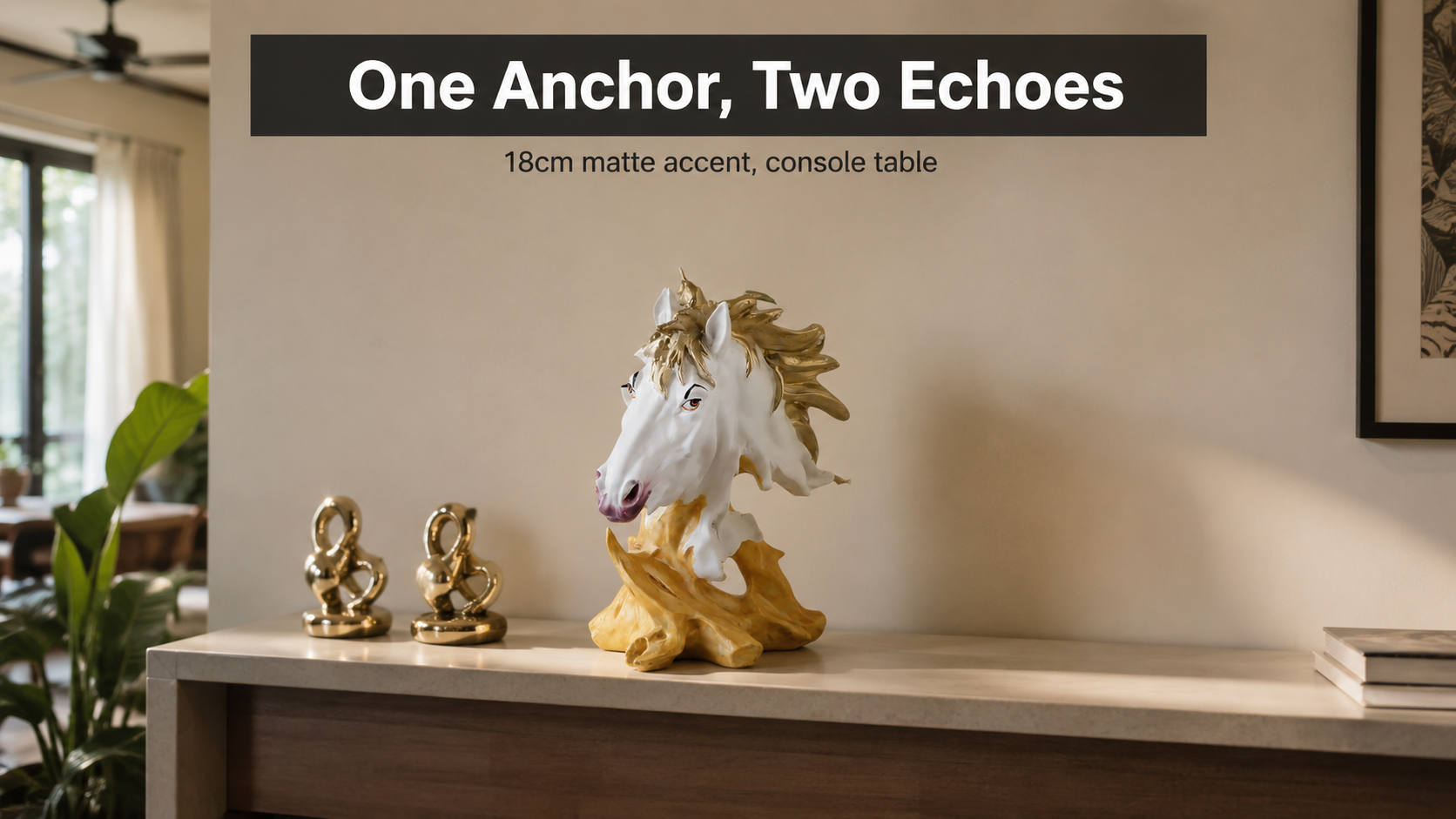
A minimalist surface should follow Moolwan's One-Anchor, Two-Echo Rule: style one medium-or-large statement piece as the anchor, support it with at most two smaller pieces in a complementary finish, and leave the rest of the surface visibly bare so the eye has somewhere to rest.
Why does material choice matter more in a minimalist room than a busy one?
In a busy room, one slightly mismatched object gets visually absorbed by everything else around it. In a minimalist room, every object is fully exposed, so a poor material choice — a finish that yellows, a resin that dulls, a ceramic that develops hairline cracks — becomes the single thing a visitor notices.
This is the core reason durability-first materials justify their price in a minimalist setting. Moolwan's resin pieces hold their 3H surface hardness and finish for 3+ years indoors at typical Indian room temperatures of 15–35°C, while ceramic pieces are drop-tested to 15 cm and rated for a 5+ year lifespan — for a piece doing all the visual work alone, replacing it every season would undercut the entire point of styling minimally.
Want a piece engineered to be the single focal point of a minimalist room for years, not months? Shop the full Moolwan modern home décor collection now.
How many decorative accents should one room actually have?
Most minimalist living rooms need three to five styled accents total, spread across two or three surfaces — never clustered onto one. This works because spreading fewer pieces across more surfaces gives each one its own negative space, while concentrating several pieces on a single surface forces them to compete for the same visual attention.
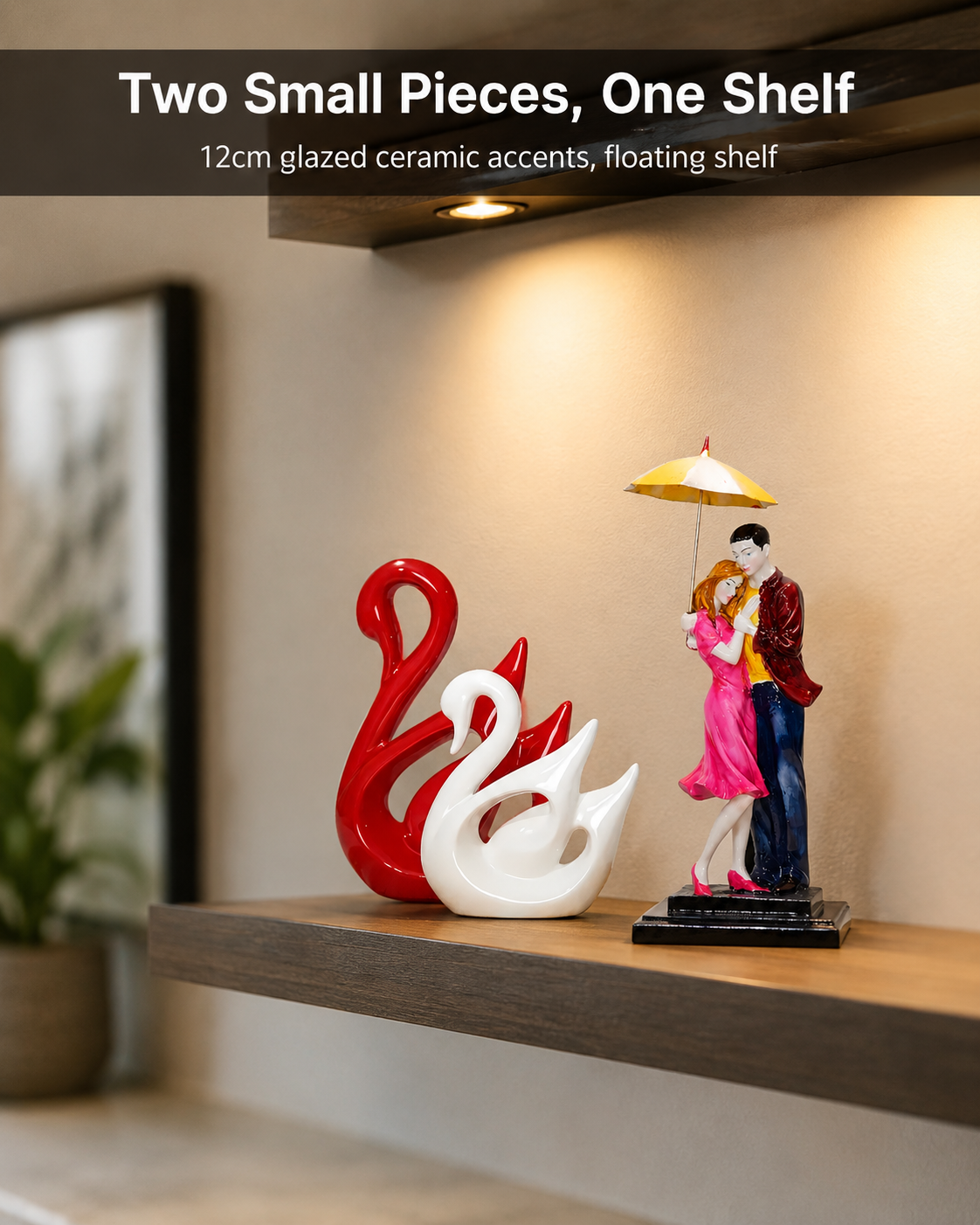
A practical sequence is one large or medium anchor piece for the most visible surface (console or coffee table), one small cluster of two pieces for a secondary surface (a shelf or sideboard), and nothing on tertiary surfaces at all — Moolwan's size bands (Small 10–16 cm, Medium 16–21 cm, Large 25–34 cm) map directly onto this three-surface, no-clutter approach.
Frequently Asked Questions
Do minimalist rooms need decorative accents at all?
Yes — a completely bare surface reads as unfinished rather than intentional, because the absence of any object gives the eye no anchor point. Moolwan's approach is one well-chosen accent per visible surface, which signals deliberate design rather than an empty or an over-styled room.
What size decorative piece suits a small Indian apartment?
Pieces in the 10–16 cm small band suit apartments under 150 sq ft, because narrower shelves and desks (under 30 cm wide) common in compact layouts can't visually support anything larger without overwhelming the surface. Moolwan sizes its small décor collection specifically to these sub-150 sq ft layouts.
Ceramic or resin — which holds up better in Indian homes?
Ceramic generally holds up better in high-humidity coastal cities since it tolerates up to 85% relative humidity, while resin performs more consistently in drier, temperature-stable indoor environments due to its 15–35°C optimal range. Both are used across Moolwan's modern home décor collection depending on climate.
Can decorative accents double as gifts for a new home?
Yes — a single statement décor piece is one of the most practical housewarming gifts because it solves a styling decision the recipient would otherwise have to make themselves, rather than adding to clutter they need to find space for.
Choosing one durable, well-proportioned accent per surface is the fastest way to make a minimalist room feel finished rather than empty — and it costs less over five years than replacing fading or cracking pieces every season. Bring home a piece built for that lifespan from the Moolwan modern home décor collection, or if you're styling beyond the living room, see the curated picks in Moolwan's entryway decorative accents guide and the modern décor edit for new homes.


