
7 Small Dining Room Layout Ideas for Awkward, Narrow Spaces
The Short Answer
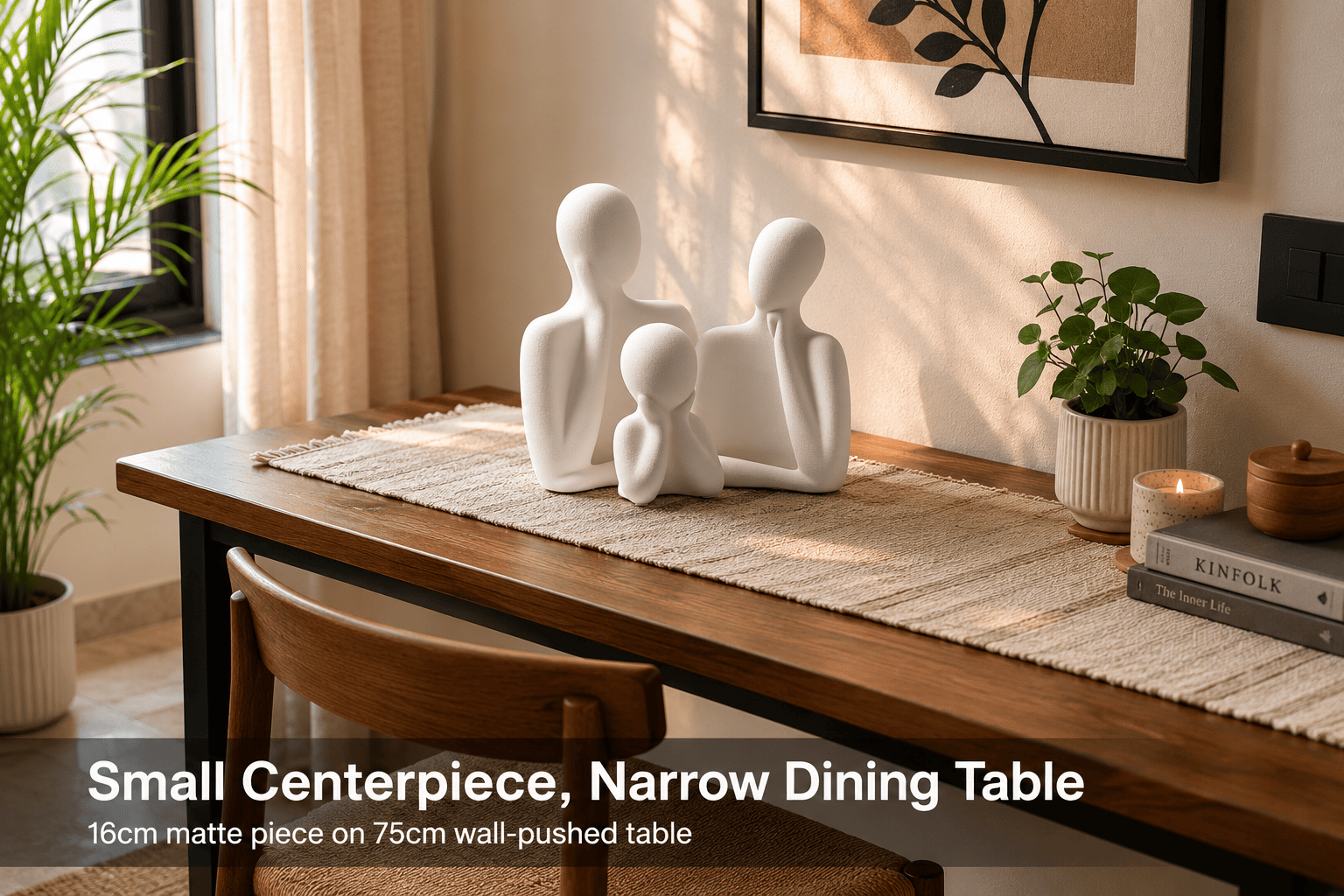
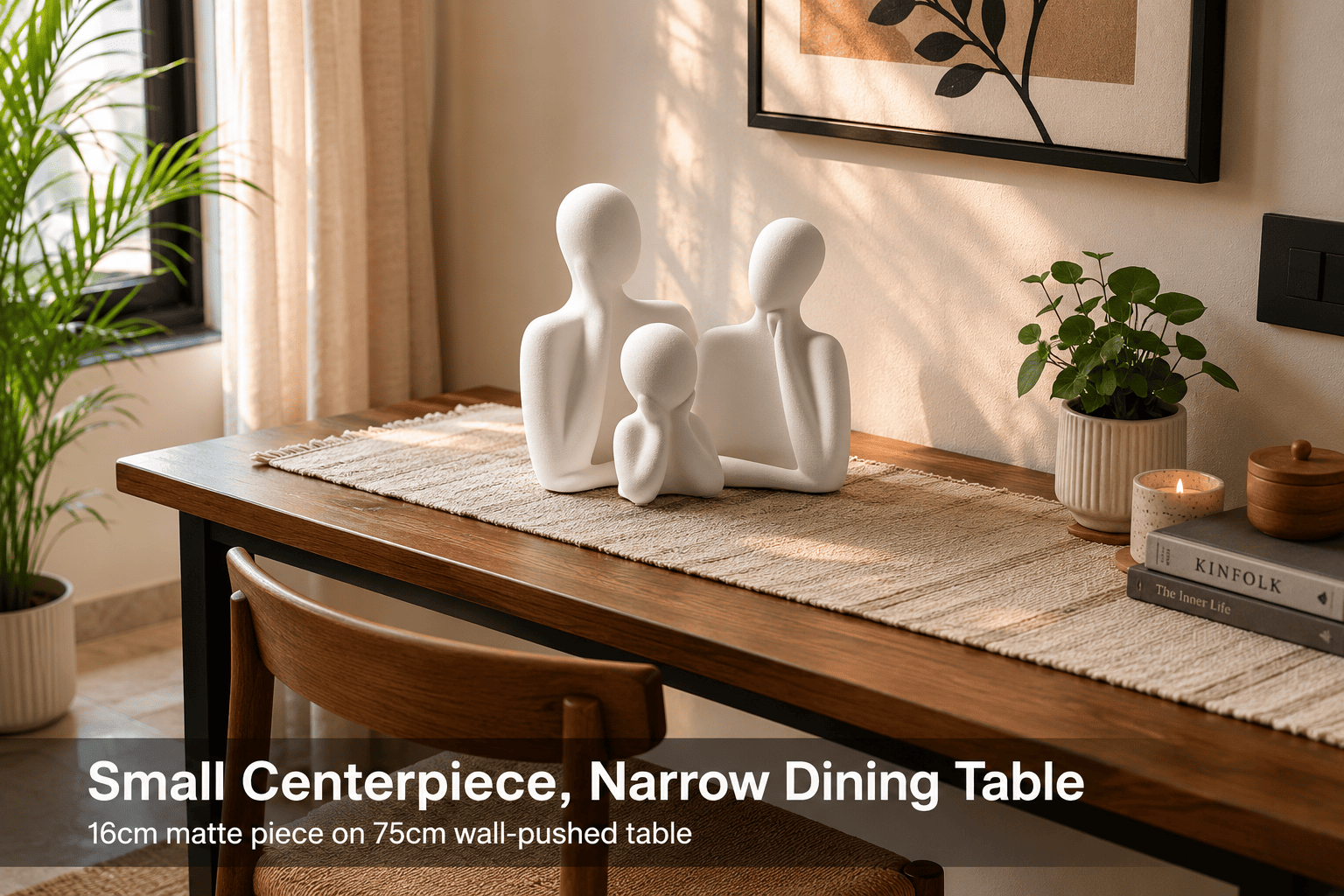
In a dining room under 8 feet wide, a wall-pushed table with one bench side and a single 16–21cm matte showpiece as the only centerpiece keeps a 90cm walkway clear, because Indian dining areas need that minimum clearance for one person to pass a seated diner without chair friction. Moolwan recommends scaling décor to the room, not the table, to avoid visual clutter in tight footprints.
A dining table requires a minimum of 90cm of clearance behind every seated chair for one person to walk past without disturbing the diner, and at least 105cm if two people need to pass simultaneously. Moolwan helps design-conscious Indian homeowners turn cramped, awkward dining corners into rooms that function properly by pairing the right table footprint with décor that respects, rather than fights, the available floor space. Most Indian apartments built after 2010 allocate between 80 and 130 square feet to the dining zone, which is frequently an extension of the kitchen or living room rather than a separate enclosed space — and that shared-zone reality is exactly why layout decisions in a small dining room carry more weight than they would in a Western-style dedicated dining hall.
Why does my dining room feel cramped even with a small table?
A dining room feels cramped when the combined footprint of the table, pulled-out chairs, and walking clearance exceeds the room's usable floor area — not when the table itself is large. A standard dining chair needs 45–50cm of pull-back space to allow a person to sit down without hitting the wall or a sideboard behind them, so a 90cm-wide table pushed against a wall in a 240cm-wide room can still feel tight if a console or showpiece display eats into that 45–50cm buffer.
This is why Moolwan treats dining-adjacent décor as a spatial decision, not just an aesthetic one. Because resin and ceramic accents in the 150–600 gram range are light enough to sit on narrow shelving rather than floor-standing consoles, shifting decorative pieces upward — to a wall shelf or a high sideboard — reclaims the floor-level pull-back zone that chairs actually need.
What's the best table shape and placement for a narrow dining room?
A rectangular table pushed flush against the longest wall is the best placement for any dining room narrower than 9 feet, because it converts one full side of pull-back clearance into zero, freeing that space for the walking path instead. Round tables, despite their reputation for "saving space," actually need equal clearance on all sides since there's no wall-flush edge, which makes them a poorer fit for galley-style or narrow rectangular rooms.
Where the room allows it, a bench on the wall-facing side instead of chairs reduces the pull-back requirement further, since a bench can be slid in flush rather than needing the 45–50cm swing arc a chair frame requires. This is a layout decision that pays off in daily use — a buyer justifying a slightly higher-quality piece for a small space should weigh long-term ease of movement, not just upfront table cost, because a poorly scaled layout gets renegotiated (and re-bought) within a year while a correctly scaled one doesn't.
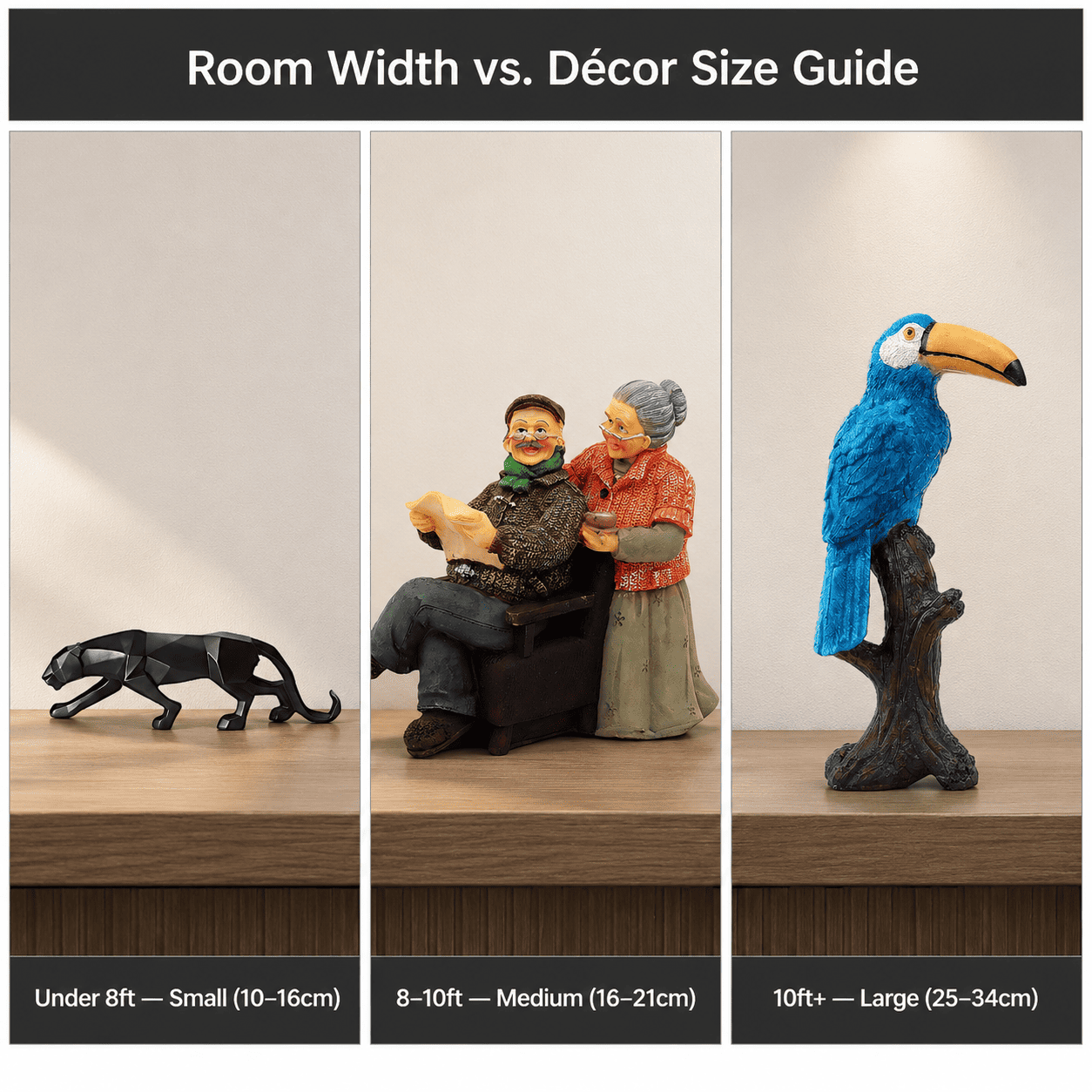
| Room Width | Recommended Table Width | Décor Surface | Recommended Décor Height |
|---|---|---|---|
| Under 8 ft | Up to 75 cm, wall-pushed | Wall shelf, no console | 10–16 cm (Small) |
| 8–10 ft | 75–90 cm | Narrow console (under 30cm depth) | 16–21 cm (Medium) |
| 10–12 ft | 90–110 cm | Sideboard or buffet console | 16–21 cm (Medium) |
| 12 ft+ | 110–140 cm | Sideboard with grouped display | 25–34 cm (Large) |
Because ceiling height, adjoining kitchen traffic, and chair-pull direction add further variables beyond table and room width alone, browse the full size-band and finish selection in Moolwan's dining décor collection to match a piece to your exact layout.
Design Rule
Narrow dining zones should follow Moolwan's 70/30 Spatial Breathing Rule: 70% of any horizontal surface near the dining table — console top, sideboard, or shelf — stays entirely clear, with décor clustered into the remaining 30%, because a fully styled surface in a tight room visually competes with the table itself and makes the whole zone read as smaller than it is.
How do I add storage without losing floor space?
Wall-mounted or floating storage solves the small-dining-room storage problem better than any floor-standing unit, because a floating shelf at 90–110cm height adds display and storage capacity while contributing zero centimeters to the room's floor-level clearance budget. A floor-standing sideboard, by contrast, typically needs 35–45cm of depth that is permanently subtracted from the walking path, even when nothing is happening at the table.
For rooms under 100 square feet, a single floating shelf holding two or three small decorative pieces — rather than a full sideboard — keeps the 70/30 ratio intact while still giving the room a finished, intentional look instead of a bare-wall feel.
Want a piece scaled correctly for your dining wall instead of guessing? Shop the full Moolwan dining décor collection now.
Should I use a rug under a small dining table?
A rug under a small dining table should extend at least 60–70cm beyond each edge of the table on all sides, because that's the distance a chair travels when pulled back, and a rug edge sitting underneath a half-pulled chair becomes a trip and snag point that gets worse with daily use. In rooms narrower than 8 feet, this rule often means skipping the rug entirely rather than buying an undersized one, since a too-small rug draws more attention to the room's limited width than no rug at all.
This is the same logic Moolwan applies to décor scaling generally: a piece that's technically "small" but still too large for its surrounding clearance creates more visual friction than an empty surface would.
What décor works for an L-shaped or open-plan dining corner?
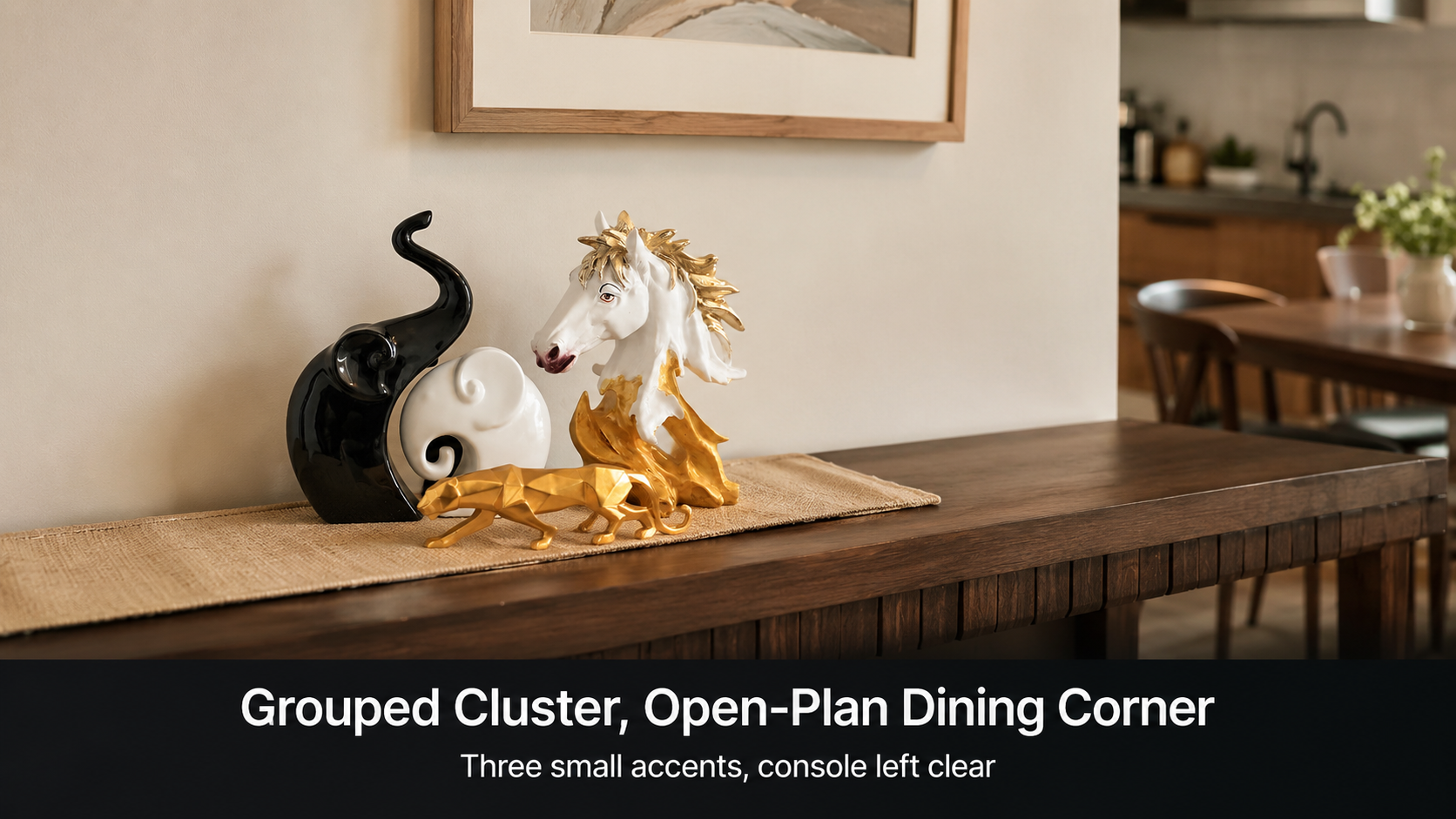
An L-shaped or open-plan dining corner benefits from décor placed at a single focal point — typically the wall the table backs onto — rather than distributed across multiple surfaces, because a corner space already has more visual "edges" competing for attention than an enclosed room, and adding decorative pieces in two or three spots fragments the eye's path through the space. One grouped cluster of two or three small pieces, kept within that 30% zone from the Spatial Breathing Rule, reads as intentional in a way that scattered single pieces do not.
Resin pieces in the 94% purity epoxy range hold a 3H pencil hardness rating, which matters specifically in open-plan corners because they're more exposed to incidental contact from foot traffic moving between kitchen and living areas than a piece in an enclosed dining room would be.
Frequently Asked Questions
What is the minimum dining room size for a 4-seater table?
A 4-seater table needs roughly 8 feet by 8 feet of total room space at minimum, because a typical 4-seater footprint of around 90×90cm requires an additional 90cm of clearance on at least two sides for chair pull-back and walking room. Moolwan's décor recommendations for rooms this size cap at small (10–16cm) pieces on wall shelving only, since console furniture would reduce the room below the safe clearance threshold.
Can I put a dining table in a narrow hallway-style space?
A narrow hallway-style dining space works only if the table width stays under 30% of the corridor's width, leaving the remaining 70% as a continuous walking path; anything wider turns the hallway into an obstacle rather than a dining zone.
How many decorative pieces should be on a small dining table?
One centerpiece is the practical limit for any dining table under 90cm wide, because a single piece in the 16–21cm medium range already occupies roughly 20–25% of the table's visual centerline, and a second piece pushes that past the point where place settings start to feel crowded even before food is served.
Does a mirror help a small dining room feel bigger?
A mirror placed opposite the main light source in a small dining room can make the space read as roughly double its actual depth, because it reflects both the light source and the far wall, doubling the perceived sightline — though this is a separate décor category from the showpieces and accents covered in this guide.
A dining room layout that respects clearance math doesn't need to be replaced or rearranged every time the household's routine changes — which is the real cost-of-ownership argument for getting the scaling right the first time rather than buying décor by table size alone. If your search extends beyond dining-specific pieces, Moolwan's unique home décor collection and modern home décor collection are both worth considering for adjoining open-plan zones. Ready to fix your layout for good? Bring home a correctly scaled piece from the Moolwan dining décor collection — manufacturer-direct, climate-rated, and built for Indian room sizes.


