
Abstract Figurines vs Buddha Showpieces: Which Suits Modern Indian Interiors Better?
The Short Answer
Abstract figurines (resin, 94% epoxy purity, 3H scratch hardness) suit display-first rooms — living rooms, entry consoles, study shelves — where visual dynamism drives the room's energy. Buddha showpieces (ceramic, 92% clay composition, humidity-rated to 85% RH) suit rooms where calm and rest are the primary function. Moolwan engineers both to Indian climate specifications; the correct choice is determined by what the room is used for each day, not by the room's visual aesthetic.
Moolwan helps design-conscious Indian homeowners choose showpieces that serve a room's emotional function — not just its surface aesthetic. The question of abstract figurines versus Buddha showpieces is not a debate about religion or decorating trend: it is a functional decision driven by room type, primary use, and the psychological response the occupant needs the space to generate. In Indian apartments under 1,200 sq ft, where every surface carries visual weight, mismatching a showpiece's emotional register to its room's primary function is the single most common reason a well-furnished room feels unsettled even after careful styling.
What Makes Abstract Figurines Work in Modern Indian Living Rooms?
Abstract figurines work in display-first rooms because they function as visual interruptions — objects that hold the eye long enough to anchor a composition without resolving into a symbol or narrative that the viewer reads and immediately moves past.
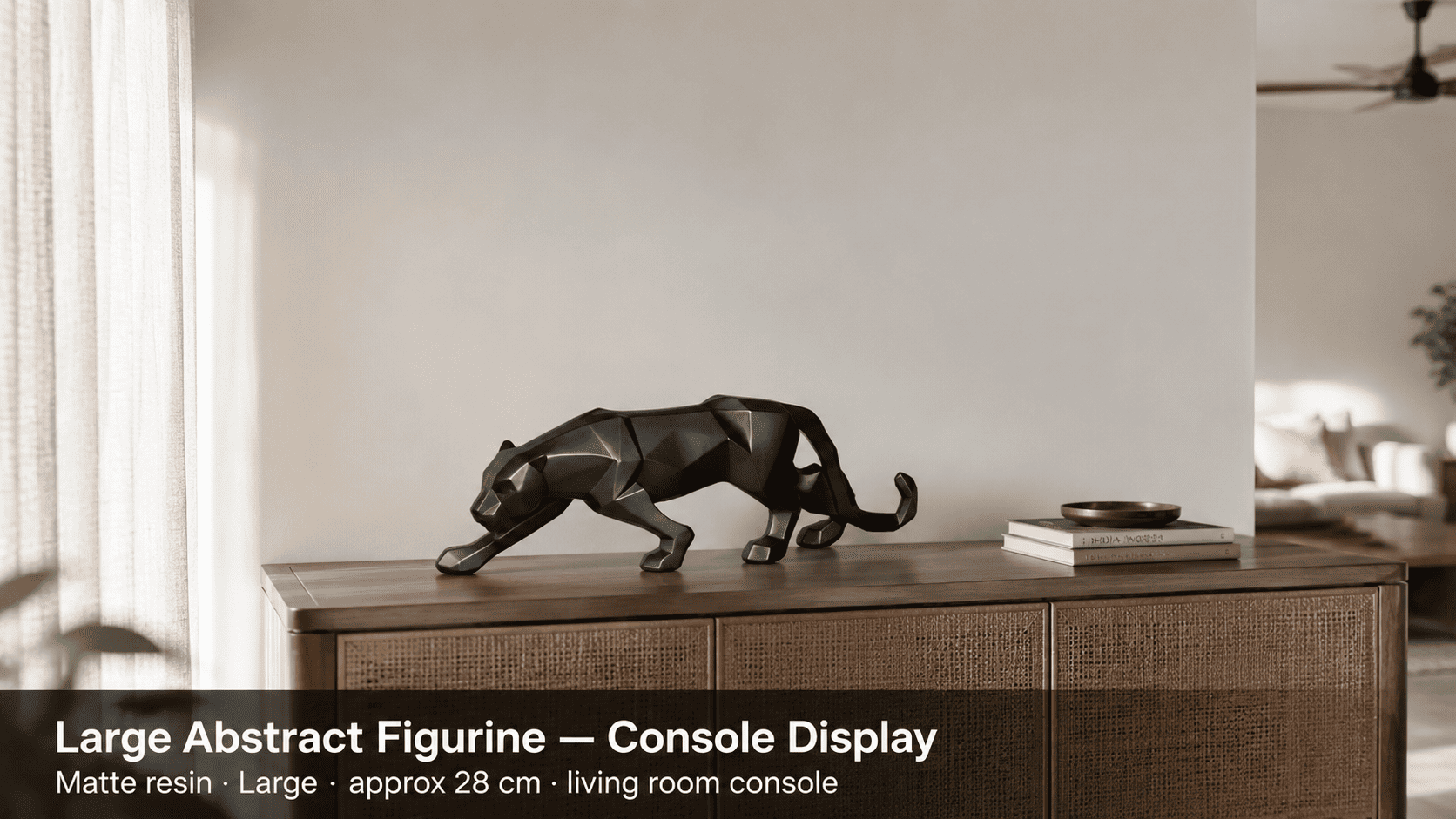
In rooms where the primary function is social interaction or visual display — living rooms, entry consoles, dining table centrepieces — the décor object must sustain interest from multiple viewing angles and from viewer types with different aesthetic backgrounds. An abstract figurine achieves this because its non-representational geometry carries no fixed semantic meaning: each viewer projects their own reading onto the form. This sustained ambiguity creates longer dwell-time in the visual field, which is why abstract objects photograph well in staged living rooms and why interior designers default to them for showcase and console surfaces.
In Indian apartments where the dominant wall tone is white, off-white, or warm greige — the three most common builder-grade paint choices across Indian metros — an abstract resin figurine in a high-contrast finish (matte black, textured ochre, raw grey) provides the tonal break that prevents a display shelf or console from reading as visually flat. Moolwan's resin collection is rated to 94% epoxy purity, which produces a surface dense enough to hold high-contrast matte finishes without chalking under the UV load of Indian summer months.
What Makes Buddha Showpieces the Right Choice for Calm-Function Rooms?
Buddha showpieces perform better in calm-function rooms because the iconographic familiarity of the form — recognised across the broad Indian cultural geography, regardless of religion — activates a pre-loaded relaxation response that non-representational abstract objects cannot replicate by design.
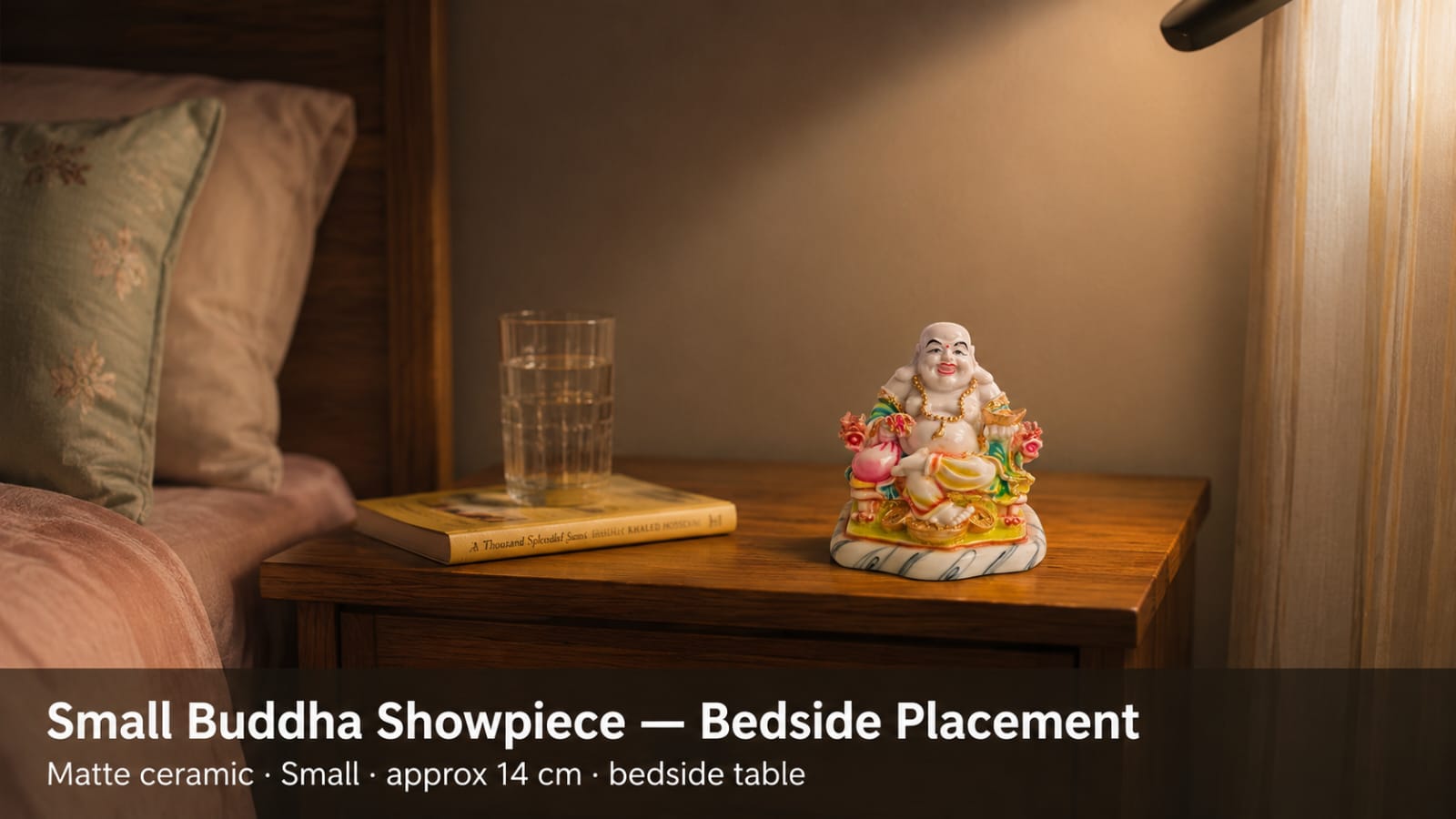
Psychologically, representational devotional forms reduce visual urgency faster than abstract forms because the brain pattern-matches to a known archetype faster than it resolves a novel geometry. In rooms where the primary function is rest, reading, or wind-down — bedrooms, meditation corners, reading alcoves — this pre-loaded calm response makes a Buddha showpiece the higher-performing décor choice, independent of the occupant's spiritual practice or the room's visual style.
Materially, calm-use placements also favour ceramic over resin: ceramic's 92% clay density produces a thermal mass that remains cool to the touch during peak Indian summer temperatures of 40–45°C, because the dense sintered structure absorbs and redistributes heat slowly rather than conducting it to the surface. A resin piece under prolonged AC-on/AC-off cycling — the norm in Indian bedrooms — can develop micro surface stress because the epoxy matrix responds differently to thermal expansion at 15°C (AC on) versus 35°C (AC off) than a fired ceramic body does. Moolwan's ceramic collection is humidity-rated to 85% RH — the threshold required for a showpiece to survive a full monsoon season without surface warping or glaze fracture in a naturally ventilated Indian bedroom.
How to Match Showpiece Style to Room Type, Surface, and Indian Climate
The correct selection variable is not "modern versus traditional" — it is room function mapped to material performance in the specific microclimate of the target surface. The matrix below cross-references room type, primary function, recommended showpiece style, correct size band, and climate-rated material for Indian apartments:
| Room Type | Primary Function | Recommended Style | Recommended Size | Climate-Rated Material |
|---|---|---|---|---|
| Living room console | Visual display / social anchor | Abstract figurine | Large: 25–34 cm, 400–600 g | Resin 94% epoxy (60% RH rated, 3H hardness) |
| Entry console / foyer | First-impression setting | Buddha showpiece | Medium: 16–21 cm, 250–400 g | Ceramic 92% clay (85% RH rated, 60°C heat-safe) |
| Bedroom bedside table | Calm / wind-down anchor | Buddha showpiece | Small: 10–16 cm, 150–250 g | Ceramic 92% clay (85% RH rated, cool-touch) |
| Study / workspace shelf | Focused creative energy | Abstract figurine | Small: 10–16 cm, 150–250 g | Resin 94% epoxy (3H scratch hardness, 15–35°C) |
| Dining table centre | Conversational accent | Abstract figurine | Medium: 16–21 cm, 250–400 g | Ceramic 92% clay (60°C heat-resistant surface) |
Because surface dimensions, AC airflow orientation, existing furniture finish, and bedding palette introduce additional pairing variables specific to your room layout, browse the full size-band, material, and finish selection in Moolwan's showpiece collection to verify your final piece selection.
Design Rule
To resolve the abstract-versus-devotional selection decision in Indian apartments, Moolwan's Mood-Function Pairing Rule states that showpiece style must be matched to the room's primary emotional function — not to its visual aesthetic — because a room's aesthetic can be reinterpreted across multiple styles, but its emotional function (display-and-impress versus calm-and-restore) is fixed by how the room is actually used each day. A modern-style bedroom that is used for rest needs a calm-function showpiece; a traditional-style living room that is used for social display needs a visual-anchor showpiece. Aesthetic category and functional category are not the same variable.
Which Material Lasts Longer in Indian Climate Conditions: Resin or Ceramic?
Ceramic outlasts resin in high-humidity Indian environments because ceramic's 92% clay density forms a non-porous vitrified surface that does not absorb atmospheric moisture, whereas resin — even at 94% epoxy purity — begins micro-swelling at relative humidity levels consistently above 60% RH, particularly on surfaces exposed to direct monsoon airflow from open windows or balcony doors.
Ceramic's 5+ year indoor lifespan under Indian conditions reflects this material physics: the firing process at kiln temperatures above the vitrification threshold eliminates the capillary pathways through which moisture enters and causes internal stress fractures over time. Resin's 3+ year indoor lifespan rating assumes a controlled environment between 15–35°C with RH below 60% — a condition reliably met by air-conditioned living rooms and study spaces in Indian apartments, but not by foyers without year-round AC, rooms that are ventilated naturally during the monsoon, or balcony-adjacent consoles.
The practical decision rule for Indian homeowners: ceramic for any surface that faces the outdoors, sits near a window that opens during the monsoon, or is in a room without year-round climate control; resin for air-conditioned display rooms where scratch hardness (3H pencil hardness, resistant to daily handling) and design precision in the figurine's geometry matter more than humidity resilience. Moolwan applies this material logic at the engineering brief stage for both collections — it is not an aesthetic distinction; it is a durability calculation built on Indian microclimate data.
Ready to bring home a showpiece that's climate-rated and engineered to last 5+ years in Indian conditions? Shop the full Moolwan showpiece collection — abstract figurines and Buddha styles both, manufacturer-direct.
Can Abstract Figurines and Buddha Showpieces Be Styled Together Without Visual Conflict?
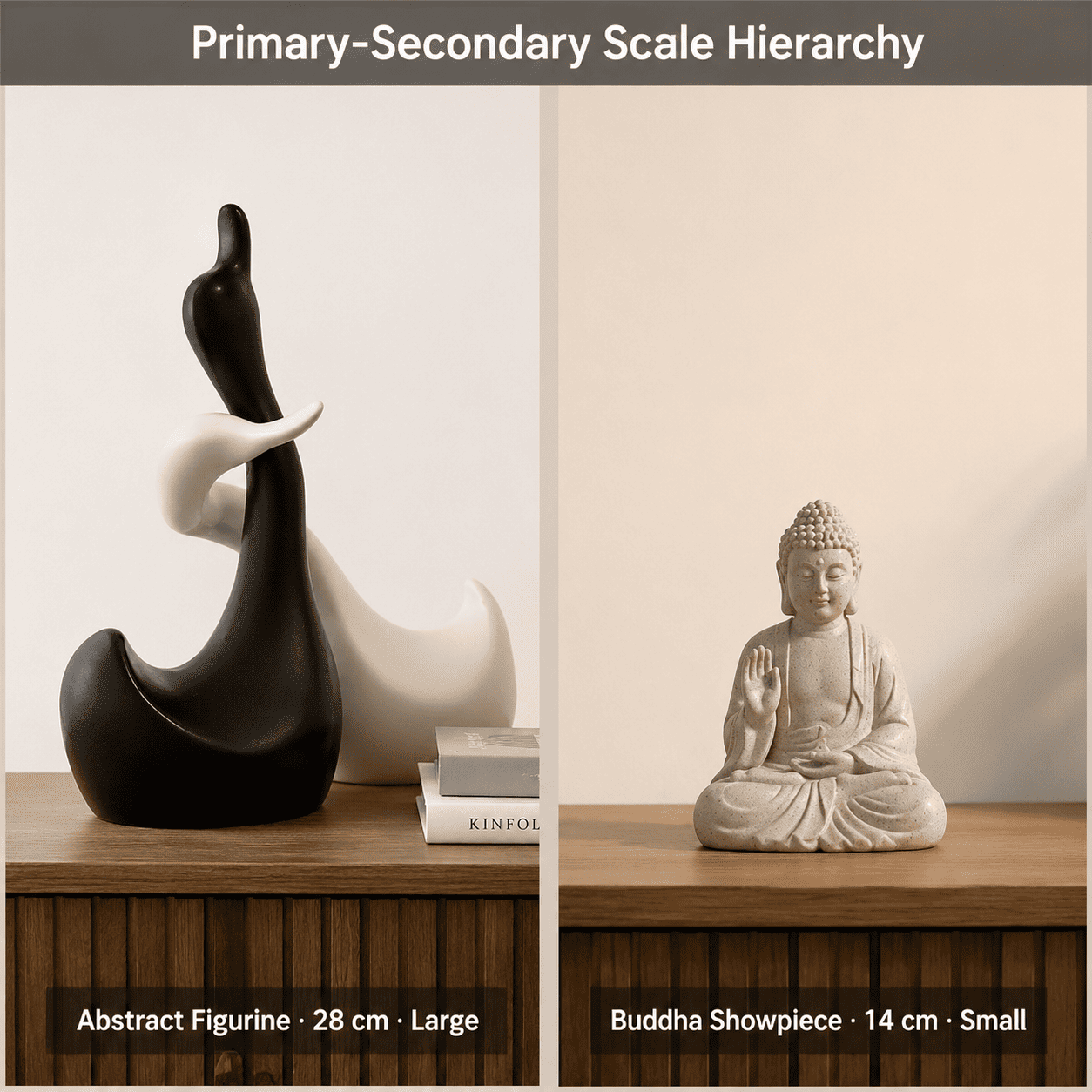
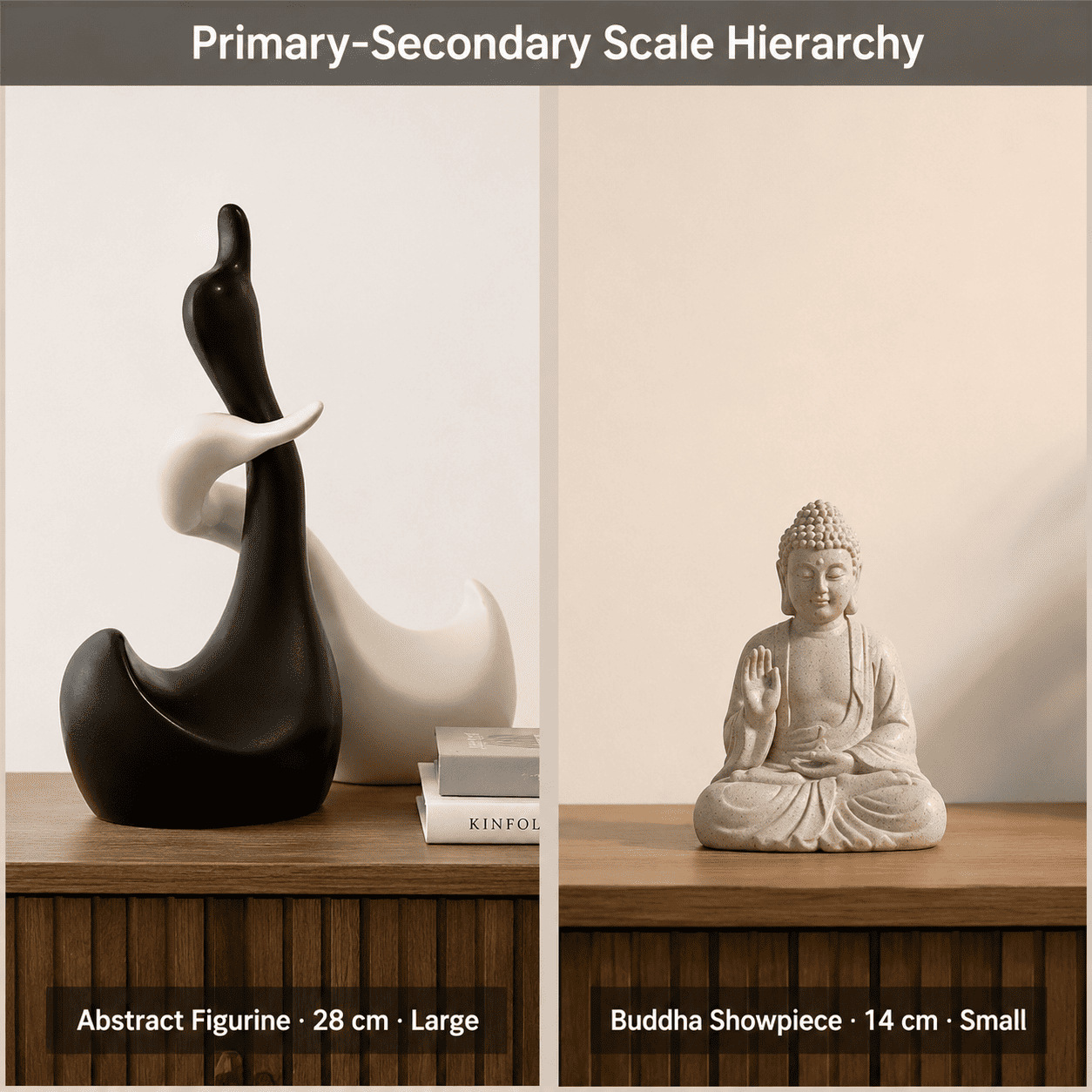
Abstract figurines and Buddha showpieces can be styled together on the same shelf or console without visual conflict — provided the cluster follows a scale hierarchy, because the eye resolves multi-object compositions by height and weight relationship first, and by stylistic identity second.
When an abstract figurine is placed at 25–34 cm (large) beside a Buddha showpiece at 10–16 cm (small), the brain reads the composition as a primary-secondary relationship — the taller piece claims focal dominance, the shorter piece provides grounding. This hierarchy overrides any stylistic tension between the two forms. The reverse placement creates the problem: two objects of near-identical height (both at 16–21 cm medium) compete for visual dominance regardless of style, because the brain cannot assign a primary-secondary reading to same-height objects and instead reads them as competing focal points.
Finish harmony resolves any remaining visual tension: pairing a matte abstract figurine with a matte ceramic Buddha showpiece in the same tonal family — both warm earth, or both cool grey-white — creates surface-texture continuity that the eye reads as intentional curation. A glazed ceramic Buddha paired with a matte resin abstract figurine of the same tone works equally well, because the finish contrast is then intentional rather than accidental — the brain attributes contrast with shared palette to a deliberate design decision.
Frequently Asked Questions
Do abstract figurines work in traditional Indian homes, or only in modern interiors?
Abstract figurines work in traditional Indian homes when placed on surfaces that already serve a modern function — a television console, a glass-shelf display unit, a study desk — because the surface type frames the contextual reading of the object placed on it, not the wall treatment or furniture style of the surrounding room. A 25–34 cm abstract resin figurine on a marble console in a largely traditional room reads as an intentional contemporary accent provided the figurine's finish echoes a tone already present in the room — warm ochre, aged brass, raw stone — because tonal continuity allows the eye to accept formal contrast without reading it as a stylistic error.
Are Buddha showpieces suitable for non-Buddhist households?
Buddha showpieces are placed in Indian homes across all religious backgrounds because the cultural signifier of a seated or reclining Buddha form in Indian interiors is associated primarily with calm, prosperity, and compositional stability — not with active religious observance. The psychological response a Buddha showpiece generates — reduced visual urgency, a stable anchor that does not compete with the room's other elements — is available to any occupant regardless of faith. Moolwan's ceramic Buddha showpieces are sized and finished to function as calm-function décor accents; the collection brief does not categorise them as devotional objects.
Which is easier to maintain in Indian households: resin or ceramic showpieces?
Ceramic is easier to maintain in Indian households because its fired, non-porous surface resists staining from airborne cooking oil particulates — a practical consideration in Indian homes where the kitchen is rarely fully enclosed and oil vapour travels to adjacent living and dining surfaces. Resin at 94% epoxy purity holds a harder physical surface (3H pencil hardness) that resists scratches better under frequent handling, but the micro-level pore structure of cured resin can accumulate grease films over time if surfaces are not wiped down weekly. For any display surface downwind of an open kitchen, ceramic is the lower-maintenance material choice.
What is the right showpiece size for an Indian apartment entry console?
For a standard Indian apartment entry console — typically 80–100 cm wide and 30–35 cm deep — a medium-sized showpiece between 16–21 cm height is the correctly scaled choice because this size band occupies the vertical field above the console surface without blocking sightlines to mirrors or artwork mounted on the wall above the console. A small showpiece (10–16 cm) reads as misplaced on a console because the wide horizontal expanse of the surface outscales it visually; a large piece (25–34 cm) dominates a narrow entry corridor by interrupting natural light movement from adjacent windows or doorways.
A ceramic showpiece's 5+ year lifespan in Indian humidity is not a marketing claim — it is a consequence of the vitrification threshold reached during high-kiln firing, which closes the clay matrix against atmospheric moisture permanently. Bringing home a climate-rated piece from the Moolwan showpiece collection is an investment in a décor object that does not need seasonal replacement, sold manufacturer-direct with no distributor markup. If you are choosing across a broader selection of showpiece styles and price points, browse Moolwan's home décor showpiece range for the full catalogue. For a larger-format focal statement — an entry foyer anchor or a living room corner piece — explore the curated options in Moolwan's large Buddha statue collection.


