
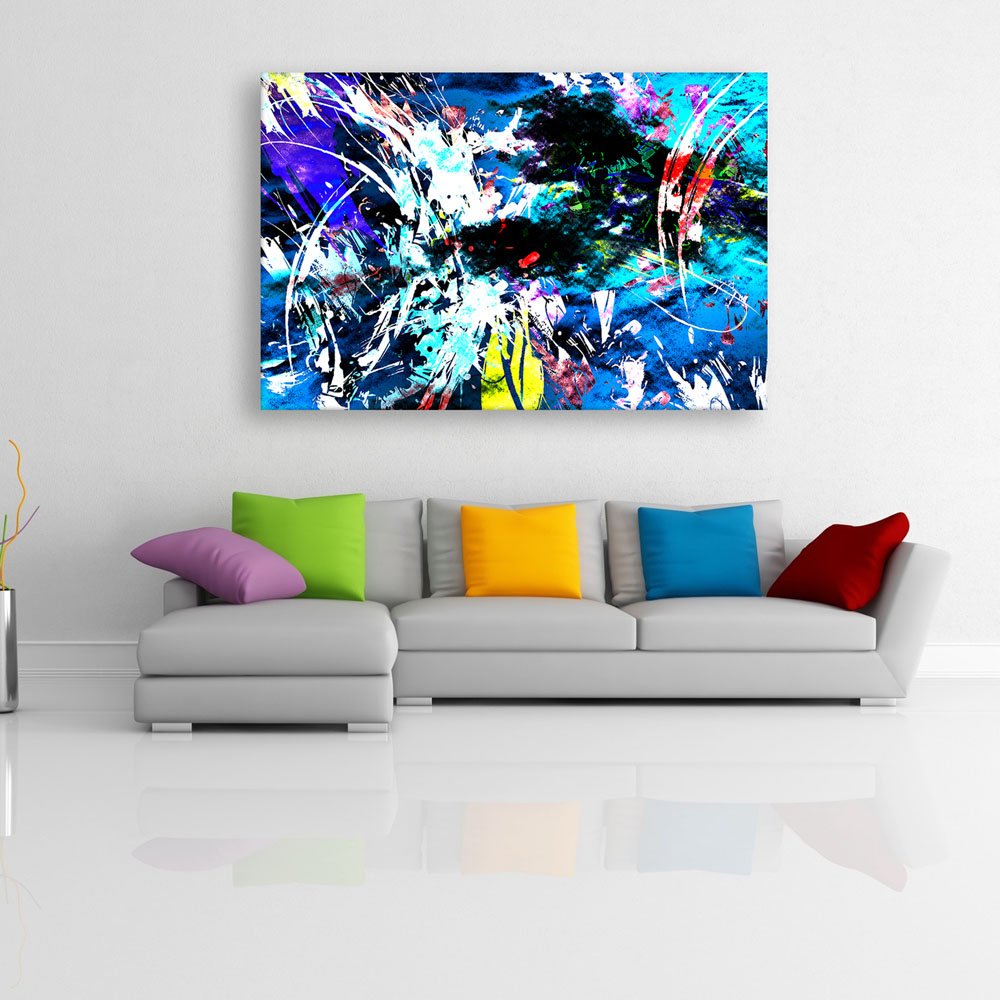

Abstract-tastic Framed Canvas That’ll Bring Walls to Life (91x61cm)
You may also like

Moolwan Abstract Canvas Wall Art Painting (91x61cm) - Bold Multicolor Splash Design
You might have browsed dozens of abstract wall art pieces by now. Some were too small—barely visible above your sofa, looking like an afterthought rather than a statement. Some were too large—overwhelming the wall, making your room feel cluttered instead of curated. You probably kept coming back to pieces around 90cm width—because intuitively, it feels right for your space. But you want to be sure before spending money on something that'll stay on your wall for years.
Your living room wall is probably around 10-12 feet wide. Your sofa is likely 6-7 feet across. And that empty wall above it has been bothering you for weeks, maybe months. This 91x61cm abstract canvas isn't just another piece in your endless scroll of options—it's the size that actually makes visual sense for standard Indian living rooms without dominating them.
Why 91cm Works on 10-Foot Walls (and What Happens If You Go Smaller or Bigger)
Let's do the math your eyes are already calculating. A 10-foot wall is 304cm wide. This canvas at 91cm covers about 30% of that wall width—the sweet spot interior designers recommend for single statement pieces. Here's what that looks like in practice: approximately 106cm of empty wall space on either side, creating visual breathing room that makes the art feel intentional, not squeezed in.
Go smaller—say 60cm—and you're looking at just 20% coverage. The canvas becomes a decorative accent rather than a focal point, lost above a standard 6-7 foot sofa. Go larger—127cm or more—and you risk the artwork extending beyond your sofa's visual frame, creating an unbalanced, top-heavy look.
At 91cm width against a 200cm sofa (roughly 6.5 feet), you get 54cm of sofa extending beyond each edge of the canvas. That proportion feels grounded. The art commands attention without competing with your furniture.
The Color Science: How Ocean Blues and Dynamic Whites Look Against Cream Walls
Here's what most product photos don't show you: how colours actually behave in Indian homes with cream, off-white, or light yellow walls. The deep oceanic blues in this canvas—ranging from navy to bright cyan—create immediate contrast against these neutral backgrounds. They don't blend in or fade away like pastels might.
The white splatter elements serve a specific purpose: they break up the intensity of the blues, preventing the artwork from feeling like a heavy dark rectangle. In morning natural light, these whites will appear crisp and bright. Under warm evening LEDs (the 2700K-3000K bulbs common in Indian homes), they'll take on a slightly creamy tone that actually harmonises with your walls.
The purple and red accents are subtle enough to add visual interest without clashing with brown leather or beige fabric sofas—the most common choices in Indian living rooms.
Installation Takes 15 Minutes (Even If You're Not Handy)
At 400 grams, this canvas is remarkably lightweight—roughly the weight of a water bottle. You won't need heavy-duty wall anchors or professional installation. A single nail or picture hook can hold it securely, which matters if you're renting and need to minimise wall damage.
The canvas arrives framed and ready to hang. No assembly, no separate frame shopping, no hardware store trips. Mark your spot (eye level is typically 145-150cm from floor to centre), drive one nail, hang. Done.
For renters worried about deposits: a single nail hole is easily filled with toothpaste or wall putty before moving out. The lightweight construction means you're not creating the kind of damage that concerns landlords.
How This Compares to Smaller and Larger Sizes You've Been Considering
If you've been looking at 60x40cm canvases thinking they're "safe" choices, consider this: on a 10-foot wall above a standard sofa, that size covers barely 20% of wall width. From across the room—where most guests will view it—it'll appear smaller than it looks on your phone screen right now.
Larger options (120cm+) work in specific scenarios: very large walls (14 feet or more), rooms without sofas centred below, or gallery-style arrangements with multiple pieces. For the typical Indian drawing room layout—sofa against wall, coffee table in front, TV opposite—91cm hits the functional sweet spot.
The single-panel design also avoids a common problem with multi-panel sets: alignment errors during installation that make the artwork look crooked even when each panel is level.
What This Will Look Like in Your Living Room (Not Just Online Photos)
Expectations matter, so here's honesty: this canvas will look slightly different in your home than it does on screen. Your phone or monitor likely has higher colour saturation than reality. The blues will be rich but not electric. The white splashes will be bright but not glowing.
From 3-4 feet away (standing near your sofa), you'll see the texture of the canvas and the detail of the abstract strokes. From 8-10 feet away (across the room), the piece becomes a unified colour statement—the individual elements blend into an energetic whole.
In north-facing rooms with cooler natural light, the blues will appear more intense. In south or west-facing rooms, afternoon sun may bring out warmer undertones in the purple and red accents. Neither is wrong—just different moods at different times.
Quick Specifications
- Dimensions: 91cm (W) x 61cm (H) x 1cm (D)
- Weight: 400 grams (lightweight, single-nail hanging)
- Material: 340 GSM pure cotton canvas
- Frame: Pre-framed, ready to hang
- Finish: Matte (no glare under lights)
- Inks: Eco-solvent, UV-resistant (fade-resistant)
- Delivery: 5-6 days metro cities, 6-8 days tier-2/3
- Climate suitability: Moisture-resistant coating handles 70-85% humidity