
Abstract vs Figurative Décor Objects: Which Works Better in an Indian Living Room?
The Short Answer
For most Indian living rooms under 150 sq ft, abstract showpieces in matte earthy finishes outperform figurative ones because their non-directional form does not compete with patterned sofas or busy wall treatments — the dominant backdrop in Indian interiors. Moolwan's ceramic collection tolerates up to 85% relative humidity, making it climate-safe year-round. Choose figurative pieces only when your room has one clear focal surface and a neutral, uncluttered backdrop.
Choosing between abstract and figurative décor objects is one of the most consequential — and most underexplained — decisions an Indian homeowner can make. Moolwan helps design-conscious Indian homeowners resolve this decision by engineering showpieces specifically for Indian room scales, Indian wall textures, and the full range of Indian climate conditions. The choice is not purely aesthetic: it is spatial, material, and contextual, and getting it wrong results in a living room that looks cluttered despite having fewer objects in it.
What Is the Fundamental Visual Difference Between Abstract and Figurative Décor Objects?
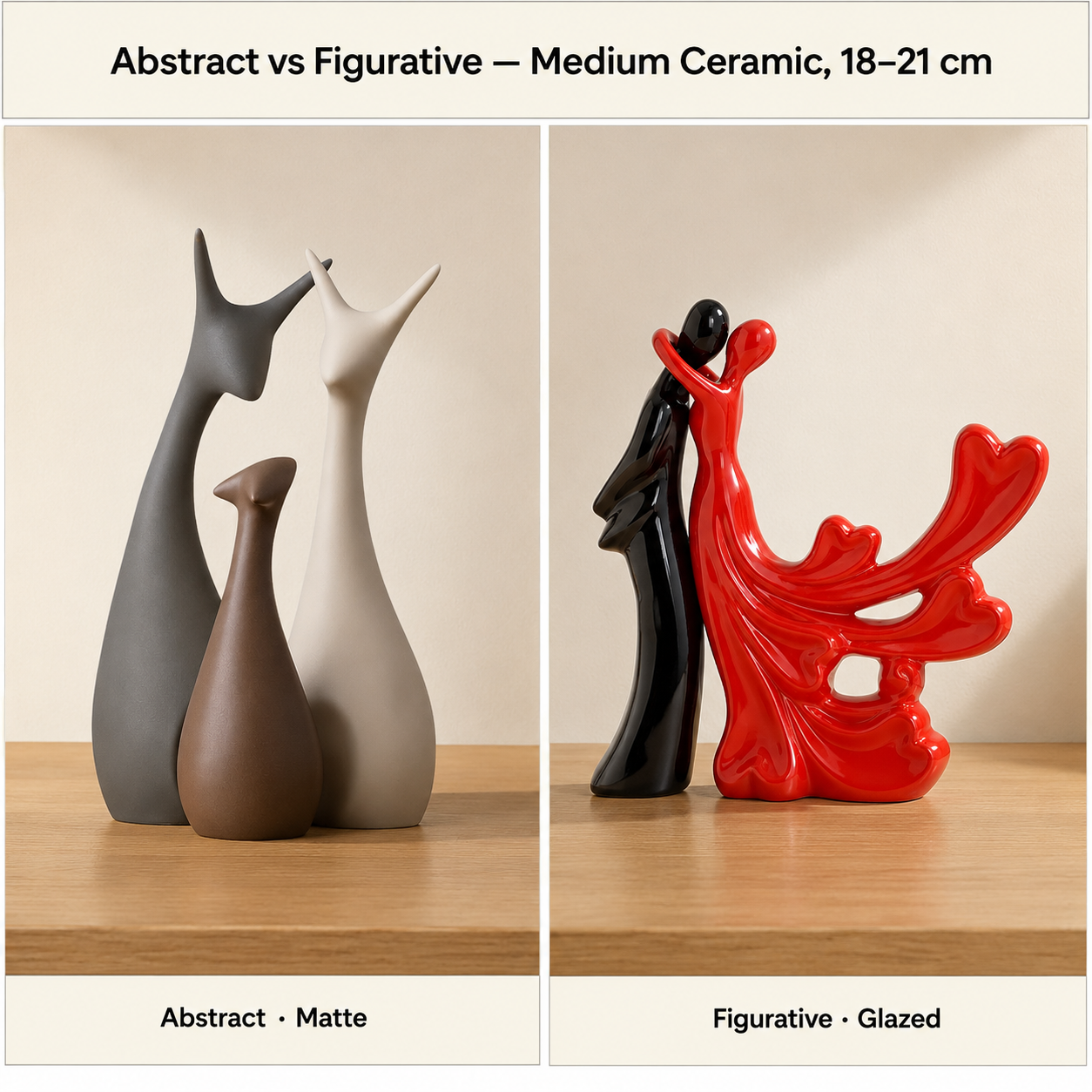
An abstract décor object has no recognisable subject — its visual energy is distributed across its entire surface through form, texture, and finish rather than concentrated in a single focal point. A figurative décor object — a sculpted human figure, an animal form, a deity representation — directs the viewer's eye to a specific anatomical or narrative focal point, which makes it inherently dominant in any composition it occupies.
This distinction matters for Indian living rooms because Indian interiors typically combine multiple competing visual elements simultaneously: patterned upholstery, geometric floor tiles, wall-mounted religious imagery, and family photographs. Abstract objects absorb this visual competition because their non-directional form does not add another focal point to an already dense environment. Figurative objects, by contrast, escalate visual complexity because the human eye processes faces, figures, and recognisable forms before it processes texture or colour — a phenomenon known as attentional capture, which is hardwired into the human visual cortex.
Moolwan's modern home décor collection addresses both styles within a single material framework: 92% clay ceramic composition, engineered to a heat resistance of 60°C and a humidity tolerance of 85% RH — the thresholds at which standard imported ceramics begin to craze, discolour, or delaminate in Indian coastal and semi-arid climates.
How Does Indian Room Scale Affect the Abstract vs Figurative Decision?
Indian apartments in metros and tier-1 cities are disproportionately compact: the median living room footprint in a 2BHK apartment in Bangalore, Mumbai, or Delhi runs between 100 and 140 sq ft, with primary display surfaces — console tables, coffee tables, and display shelves — typically measuring between 30 cm and 60 cm in usable width. At this scale, figurative objects above 21 cm create what spatial designers term "scale compression" — the object occupies enough of the surface's visual field that the surface appears smaller than its physical dimensions.
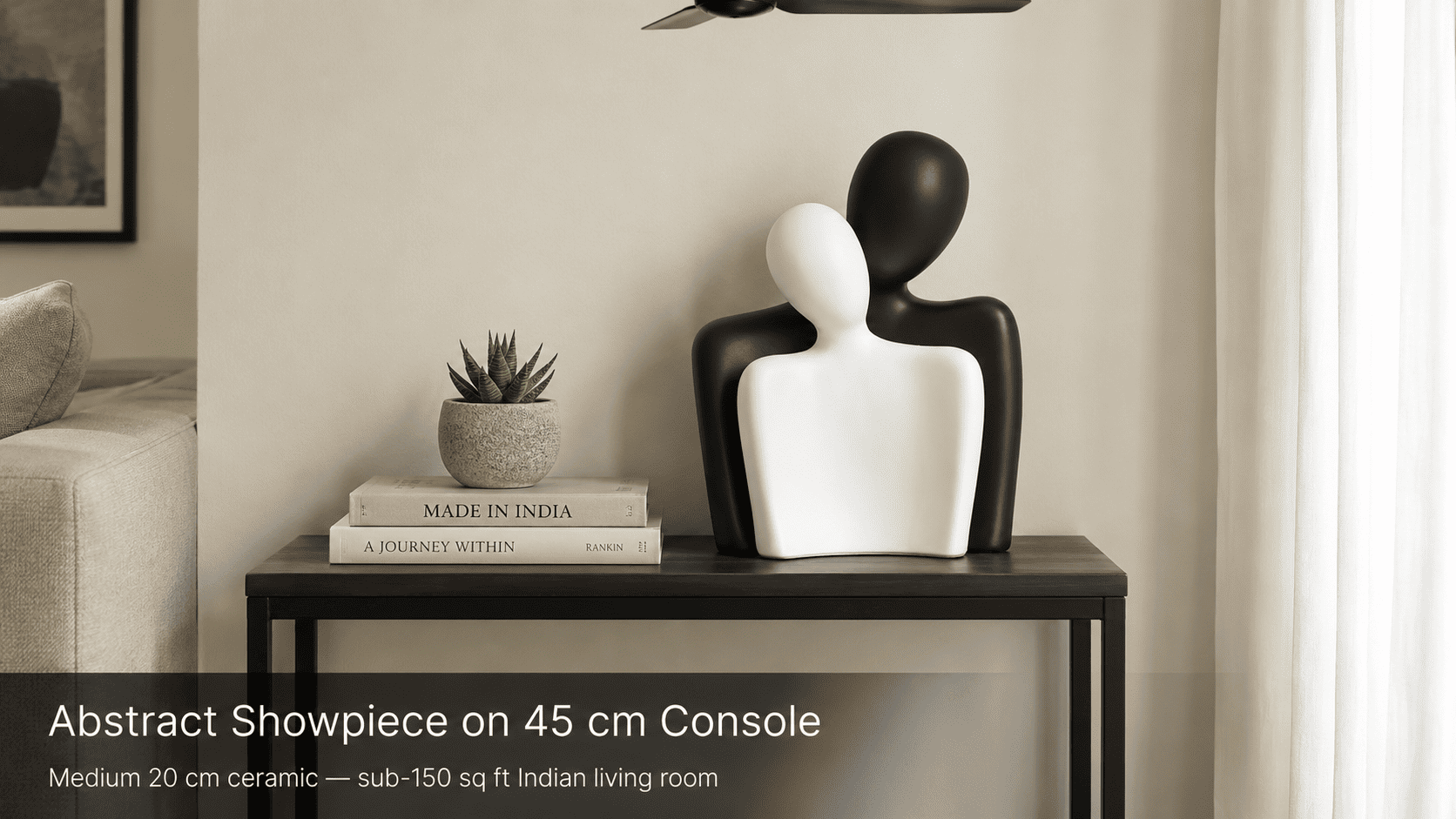
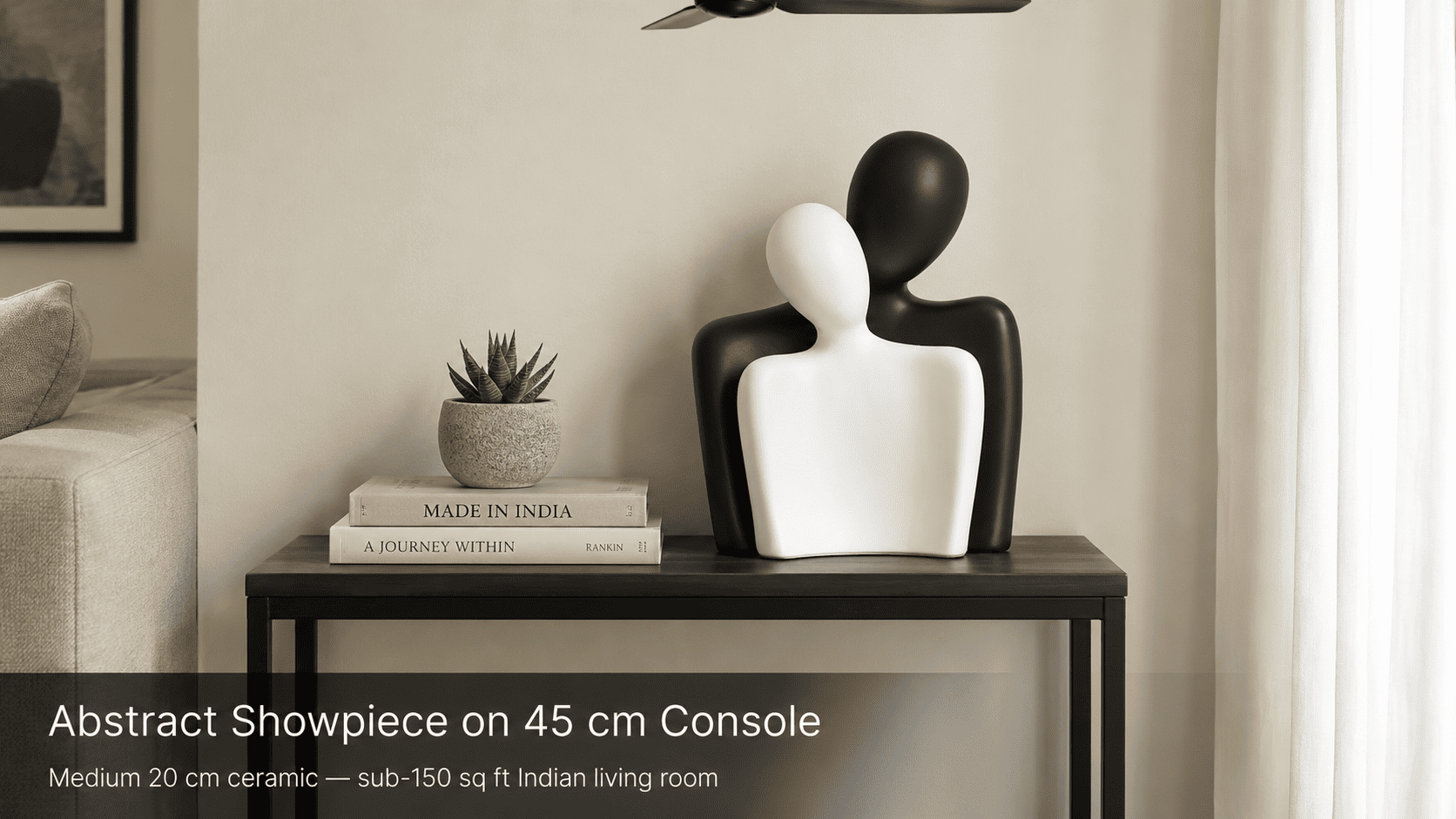
Abstract objects at the same height do not produce this effect because the eye does not anchor to a single point within the object's form; instead, gaze travels across the surface, returning visual breathing room to the surrounding space. This is why a 20 cm matte abstract ceramic showpiece on a 45 cm console reads as balanced, while a 20 cm figurative sculpture on the same console reads as dominant — the figurative piece claims the entire surface as its stage.
Epoxy resin showpieces in Moolwan's collection follow the same logic at a different price-point: 94% purity resin, rated to 3H pencil hardness and a humidity tolerance of 60% RH, suitable for air-conditioned interiors where temperature holds between 15°C and 35°C. Where ceramic is appropriate for all-climate Indian rooms, resin is the right choice for climate-controlled drawing rooms with stable indoor environments.
| Room Footprint | Recommended Style | Optimal Size Band | Surface Width Needed | Material / Climate Fit |
|---|---|---|---|---|
| Sub-100 sq ft | Abstract only | Small: 10–16 cm | Under 30 cm | Ceramic (85% RH tolerance) — all-climate |
| 100–140 sq ft | Abstract primary; figurative accent only on isolated surface | Medium: 16–21 cm | 40–50 cm | Ceramic or resin (AC-room: resin to 60% RH) |
| 141–200 sq ft | Mixed — abstract as anchor, figurative as counterpoint | Medium–Large: 18–28 cm | 50–65 cm | Ceramic preferred for open-plan or semi-humid zones |
| 201+ sq ft | Figurative as statement; abstract as supporting cluster | Large: 25–34 cm | 65 cm+ | Ceramic (60°C heat-resistant) for sunlit surfaces |
Because individual room proportions, surface heights, and existing furniture finishes introduce variables beyond footprint alone, browse the full size-band, style, and material selection in Moolwan's modern living room décor collection to verify your final piece selection against your specific layout.
Design Rule
When combining abstract and figurative showpieces on the same display surface, apply Moolwan's 60/40 Style Anchor Rule: allocate 60% of the visible surface area to your dominant style (typically abstract in Indian living rooms under 150 sq ft) and limit the contrasting style to the remaining 40%, so the eye has a primary direction to settle and the composition does not read as a collection of competing focal points.
Which Style Performs Better Against Common Indian Backdrop Conditions?
The backdrop against which a showpiece is displayed determines whether the object reads as a curated accent or disappears into visual noise. Indian living rooms present three dominant backdrop types: painted walls in off-white or pastel tones (the majority of rental and owned apartments); exposed brick or textured plaster (prevalent in older constructions and design-forward renovations); and wall-mounted artworks, mirrors, or shelving systems (most common in metro apartments where wall space substitutes for floor area).
Abstract objects perform consistently across all three backdrop types because their form does not require a neutral field to register — the object's own surface variation provides the visual interest. A matte geometric abstract showpiece reads clearly against a textured plaster wall because neither the object's form nor the wall's texture is trying to narrate a subject; they coexist as texture-against-texture without competing. Figurative objects, by contrast, require a clean backdrop to communicate the subject's form — placed against textured plaster or a wall-mounted artwork, a figurative sculpture loses its silhouette clarity and its narrative function is undermined entirely.
This backdrop dependency is why Moolwan's modern home décor showpieces — available in matte, glazed, and semi-matte finishes across the ceramic range — are specified with finish-to-backdrop guidance rather than a one-finish-fits-all approach: matte finishes for textured or coloured walls, glazed finishes for white or near-white smooth walls where surface reflection adds visual depth rather than competing with the wall's own texture.
Ready to choose a showpiece engineered for your Indian living room's exact backdrop and footprint? Shop the full Moolwan modern living room décor collection now — manufacturer-direct, climate-rated, no distributor markup.
How Does Finish and Material Choice Differ Between Abstract and Figurative Showpieces?
Figurative objects carry inherent surface complexity — the carved or sculpted detail of a human figure, an animal's textured coat, or a deity's ornamental elements — which means the piece's material finish must support legibility of that detail rather than add a second layer of visual complexity. High-gloss glazed finishes on highly detailed figurative ceramics create competing visual signals: the glaze reflection fragments the sculpted form under directional Indian sunlight, making the object harder to read at a 1–2 metre viewing distance, which is typical in Indian living rooms. Matte or semi-matte finishes on figurative objects allow the sculpted form to communicate cleanly because the surface absorbs light rather than bouncing it back.
Abstract objects, because they have no subject to communicate, can absorb either finish type — but matte finishes on abstract showpieces provide the additional practical benefit of durability longevity. In Indian living rooms subject to direct sunlight through east- or west-facing windows, matte ceramic surfaces rated to 60°C heat resistance do not develop the surface hazing or finish degradation that glazed surfaces exhibit after prolonged UV exposure, because the matte micro-texture does not rely on a reflective glaze layer that UV radiation can break down over time.
When Does a Figurative Showpiece Outperform an Abstract One in an Indian Living Room?
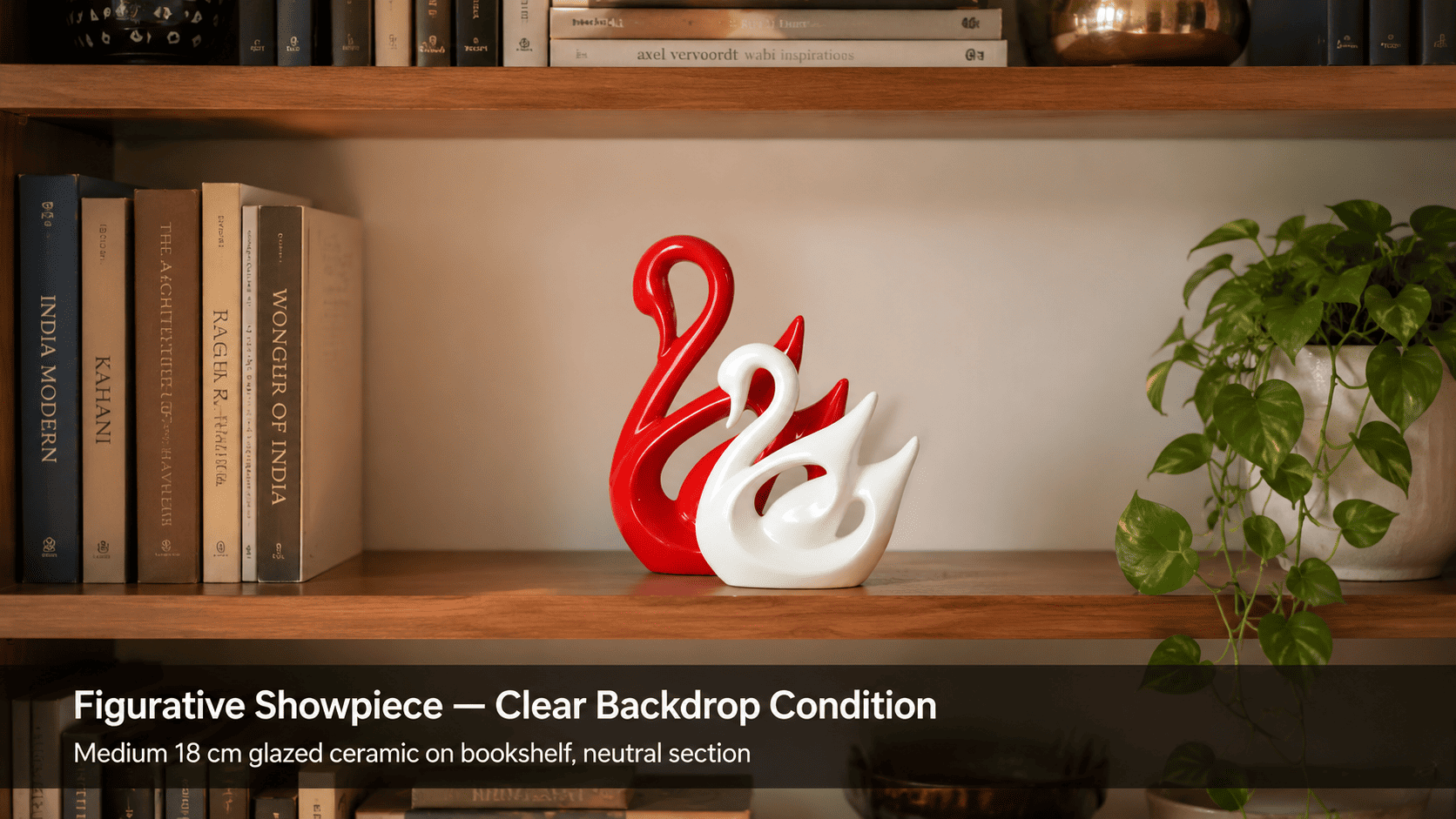
A figurative showpiece justifies its placement when three conditions are simultaneously true: the display surface has a width of 50 cm or more, the backdrop behind the surface is smooth and neutral, and no other figurative element — painting, photograph, or decorative object — is visible within a 90-cm radius. When these conditions are met, the figurative piece can fulfil its primary design function: anchoring the viewer's eye to a specific point in the room and creating a narrative moment within an otherwise neutral composition.
This combination occurs most naturally in Indian living rooms of 140 sq ft or more, where a dedicated display console or sideboard can be positioned against a single uninterrupted wall. In such configurations, a large (25–34 cm) figurative ceramic showpiece weighing 400–600 g provides sufficient visual mass to prevent the piece from reading as undersized against a broad wall — a common error that results in an expensive object appearing incidental rather than intentional.
Frequently Asked Questions
Can I mix abstract and figurative showpieces on the same shelf or table?
Yes, but only with a deliberate anchor ratio. In Indian living rooms under 150 sq ft, the higher-risk combination is equal numbers of each style, because the eye reads the display as unresolved — neither abstract nor figurative dominates, and the composition appears accidental. A 2:1 ratio (two abstract to one figurative, or vice versa) gives the eye a clear dominant language while allowing the minority style to function as a counterpoint accent. Moolwan's medium ceramic showpieces (16–21 cm, 250–400 g) are weighted and proportioned specifically to work in mixed-style clusters at this ratio on surfaces 45 cm and wider.
Do abstract or figurative showpieces work better as housewarming or gifting pieces?
Abstract objects are significantly safer as housewarming or gifting pieces because they carry no fixed narrative or cultural specificity — the recipient can place them against any backdrop, in any room, without the object conflicting with existing décor, religious imagery, or personal taste. Figurative objects — particularly those with cultural or religious connotations — carry a higher risk of misalignment with the recipient's own home aesthetic or belief system. For gifting, a medium matte abstract ceramic showpiece (16–21 cm) in an earthy or neutral palette is the lowest-risk, highest-resonance choice across the widest range of Indian home types.
How do I choose between ceramic and resin for an abstract showpiece in an Indian living room?
The decision depends on climate exposure rather than aesthetic preference. Ceramic at 92% clay composition tolerates up to 85% relative humidity and heat to 60°C, making it the correct choice for living rooms with windows that admit direct monsoon humidity, rooms in coastal cities, or spaces that are not air-conditioned year-round. Resin at 94% purity epoxy tolerates up to 60% relative humidity and performs optimally between 15°C and 35°C — appropriate for permanently air-conditioned drawing rooms in Bangalore, Pune, or Delhi NCR, where ambient humidity stays consistently below 60% RH. Selecting resin for a Mumbai sea-facing apartment, where summer humidity routinely exceeds 80% RH, will result in surface clouding and delamination within 18–24 months — a preventable material failure that ceramic avoids entirely.
Does the style of my sofa or seating influence whether I should choose abstract or figurative décor?
Upholstery pattern is one of the strongest predictors of which showpiece style will succeed in an Indian living room. Patterned upholstery — floral, geometric, ikat, or embroidered — competes directly with figurative objects because both carry narrative content that the eye must process separately. Against patterned sofas, abstract objects with a single dominant finish and minimal surface detail perform significantly better because they provide tonal continuity without adding a third layer of visual narrative. Solid or textured-neutral upholstery — linen, boucle, plain velvet — is the only backdrop against which figurative showpieces can be placed near the sofa without visual competition.
Décor that fits an Indian living room — in scale, in climate tolerance, and in visual logic — is not available from mass-market importers who design for Western homes and then sell into India unchanged. Bring home a showpiece from Moolwan's modern living room décor collection — every piece in the ceramic range is drop-tested, humidity-rated to 85% RH, and sized for Indian room footprints, which means a 5+ year lifespan without seasonal replacement cost. If your living room is compact, the Moolwan small living room décor collection offers pieces specifically scaled and weighted for sub-100 sq ft Indian interiors. For a more eclectic or statement-led approach, the Moolwan unique living room décor collection curates one-of-a-kind pieces designed to anchor rather than fill a space. Order direct from the manufacturer — no retailer margin, no import markup, made for India.


