
Bedroom Decor for Shared Indian Apartments Under 1,000 Sq Ft: What Actually Works
The Short Answer
In shared Indian apartments under 1,000 sq ft, bedroom décor works best when individual pieces stay within the Small (10–16 cm) to Medium (16–21 cm) size band, use matte finishes in neutral or warm earth palettes, and are limited to one or two surfaces per occupant. Moolwan's climate-rated ceramic pieces — engineered to 85% RH humidity tolerance — prevent material warping in India's monsoon-season humidity spikes, which is the primary reason cheaper décor fails within year two in shared bedrooms.
In apartments where a bedroom occupies between 80 and 130 sq ft of a sub-1,000 sq ft floor plan, every surface carries more visual weight than in larger homes, and every décor decision affects how spacious or compressed the room feels for its occupants. Moolwan helps design-conscious Indian homeowners furnish shared bedrooms with pieces that are correctly scaled, climate-tolerant, and visually cohesive — without requiring a renovation budget or a dedicated interior designer. The sizing and material errors most commonly made in shared Indian bedrooms are not matters of taste; they are matters of physics and proportion, and they have measurable solutions.
Why Most Bedroom Décor Fails in Shared Indian Apartments
The median Indian urban apartment bedroom measures between 80 and 120 sq ft, and in a shared occupancy scenario, two persons' furniture — beds, wardrobes, and study surfaces — already occupy 60–70% of floor area before a single decorative piece is introduced. Décor placed in this context faces two simultaneous stresses: spatial compression (where oversized pieces make the room feel smaller) and material stress from humidity fluctuations between 40% RH in AC-cooled winter months and up to 85% RH during monsoon season.
Materials not engineered for this humidity range — mass-market resin below 90% purity, plaster composites, untreated wood — absorb moisture during monsoon months and release it during dry months, causing micro-warping, surface cracking, and finish delamination. Moolwan's ceramic collection uses a 92% clay composition that maintains structural integrity at up to 85% relative humidity because high-density clay has a water absorption rate below 0.5%, preventing the expansion-contraction cycle that destroys lower-grade ceramics over two to three monsoon seasons.
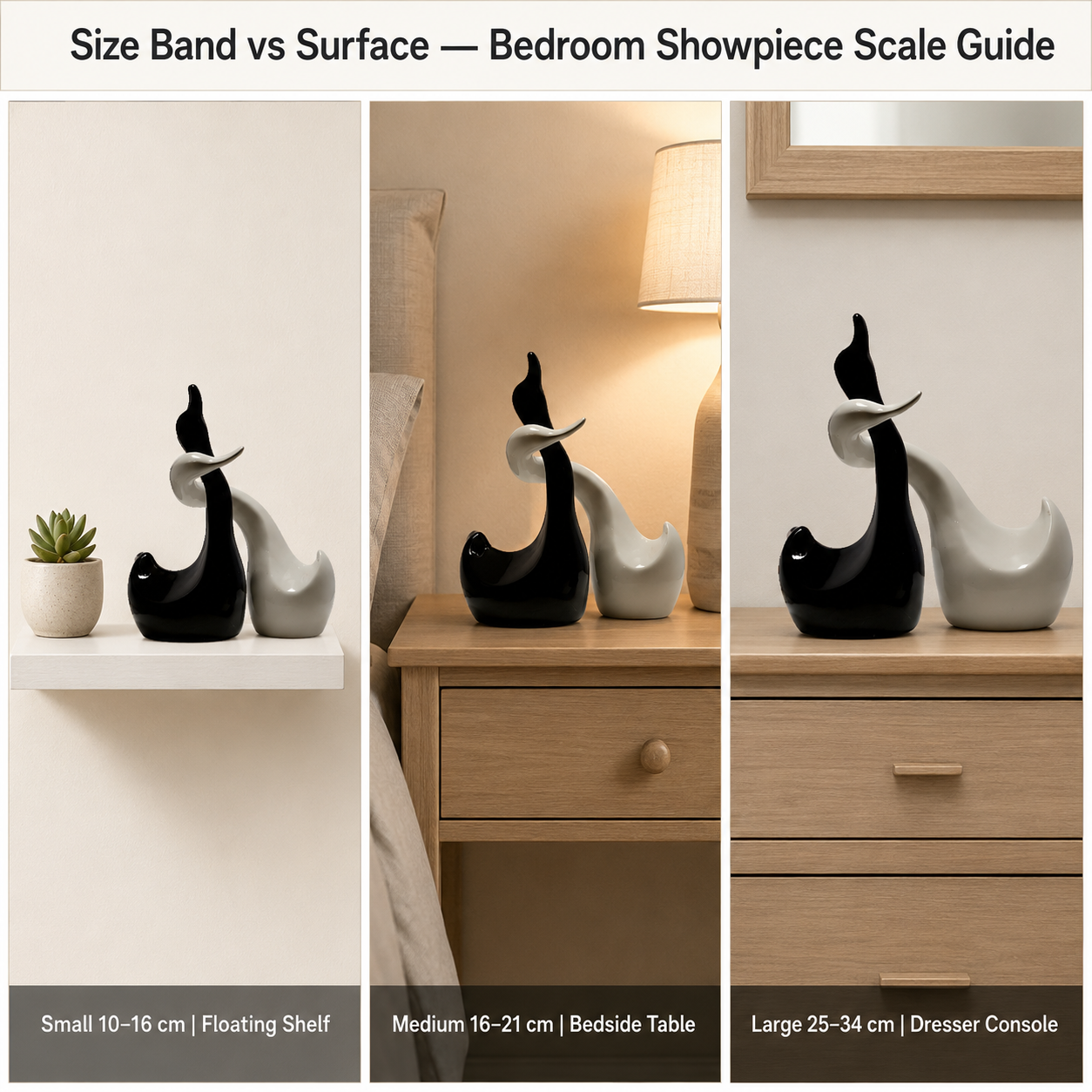
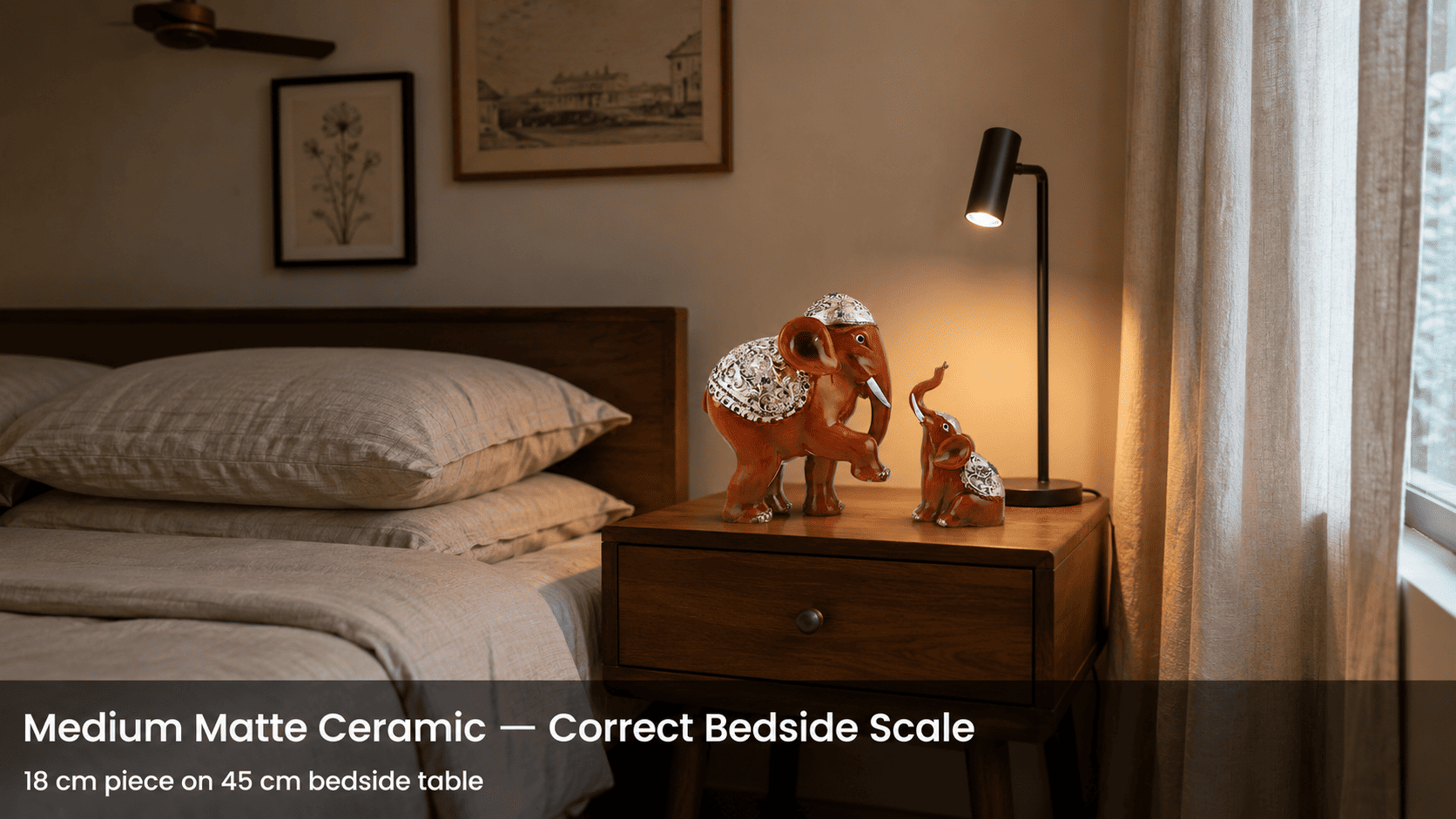
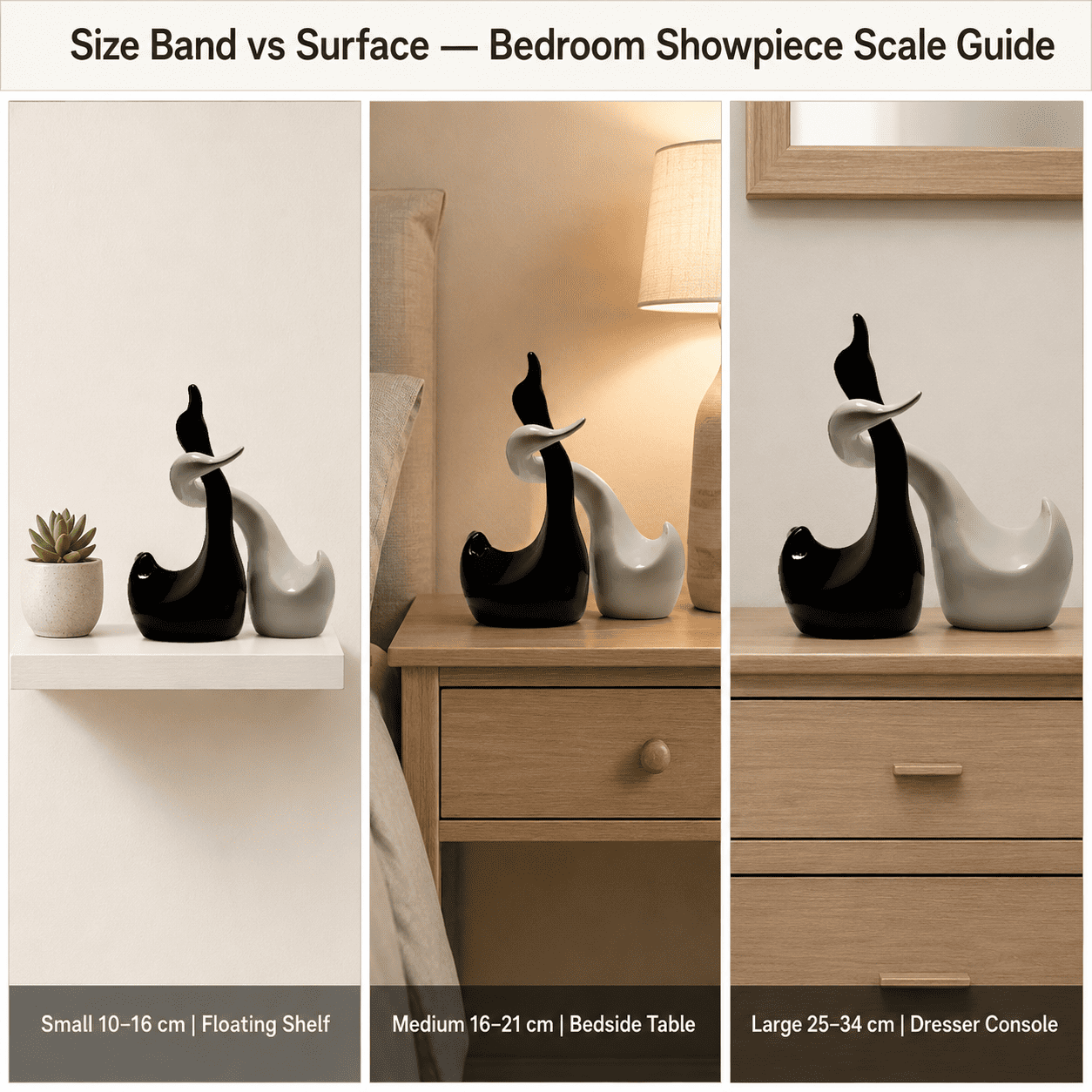
The second failure mode is scale mismatch: a 30 cm showpiece placed on a 40 cm bedside table occupies 75% of the surface width, leaving no usable space for practical items and creating visual clutter that makes the room feel smaller. The correct sizing threshold for a bedside table of 40–50 cm width is a piece no taller than 16–21 cm — the Medium size band — which occupies 35–42% of surface width and preserves the visual breathing room that makes the room read as organised rather than crowded.
How to Choose the Right Size Bedroom Showpiece for a Shared Room
Sizing bedroom décor in a shared apartment is a function of three measurable variables: the room's total floor footprint, the target surface's physical width, and the number of occupants sharing the surface or visual zone. Each variable narrows the acceptable size band independently, and the correct choice satisfies all three constraints simultaneously.
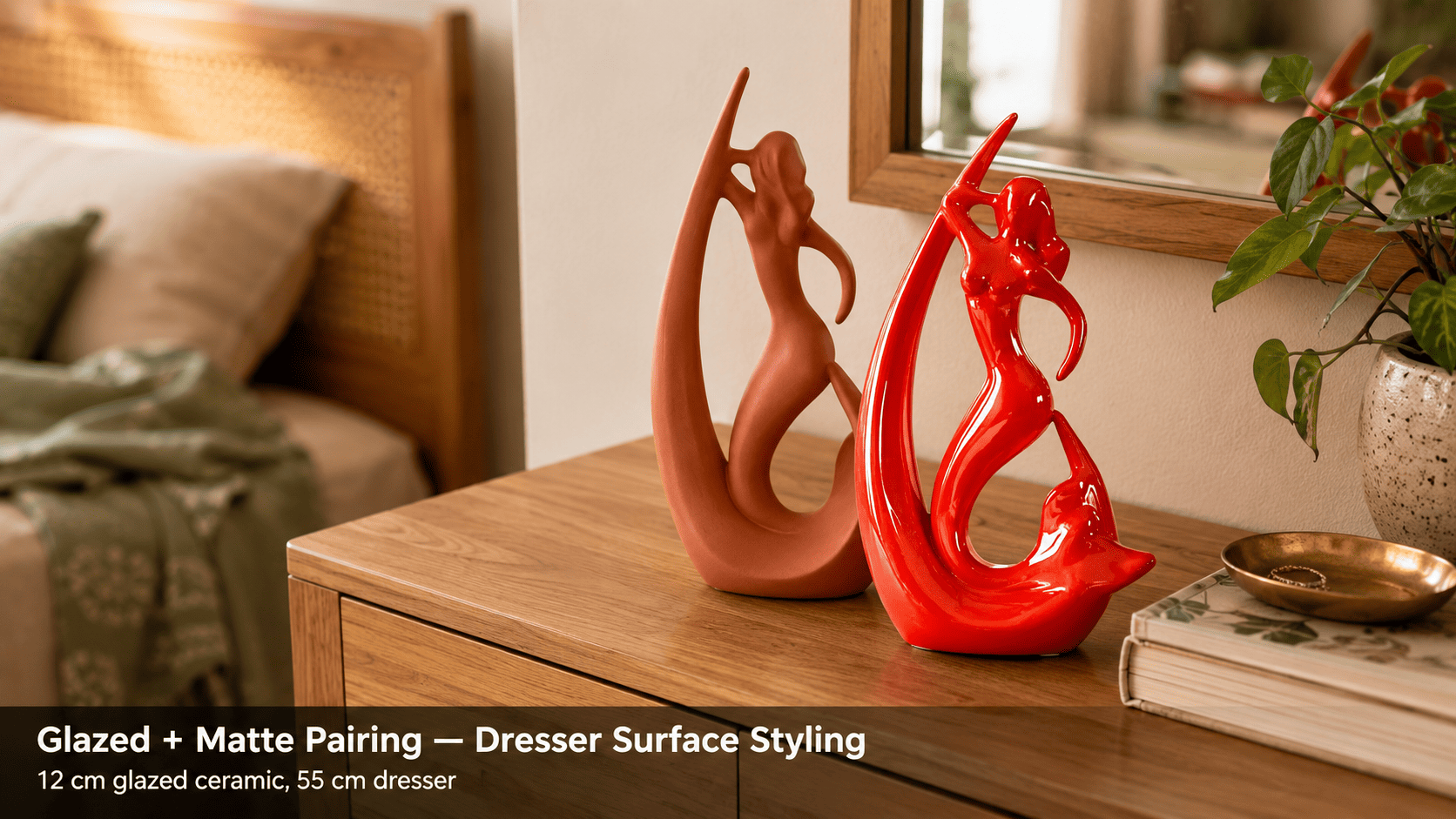
Matte finishes outperform glossy finishes specifically in shared bedrooms because they do not amplify the visual disorder created by multiple people's items being present on a surface simultaneously. A glossy surface reflects surrounding clutter in its finish, doubling its visual presence; a matte surface absorbs ambient light and recedes visually, keeping the focus on form rather than reflection. This is why Moolwan's matte ceramic pieces are specifically suited to shared bedroom environments where surface organisation cannot always be controlled by a single occupant.
Weight is the third variable that is consistently overlooked. In shared apartments where floating shelves and older wall-mounted furniture fittings are common, the structural load capacity of the surface matters. Moolwan's Small and Medium ceramic pieces — weighing 150–400 g — sit within the safe load range for standard Indian floating shelf brackets rated to 3–5 kg, eliminating the risk of shelf sag or bracket failure that occurs when heavier stone or composite pieces are used.
| Room Footprint | Target Surface | Surface Width | Recommended Décor Height | Weight Range |
|---|---|---|---|---|
| Under 80 sq ft | Floating shelf | Under 30 cm | 10–16 cm (Small) | 150–250 g |
| 80–100 sq ft | Bedside table | 30–40 cm | 10–16 cm (Small) | 150–250 g |
| 101–130 sq ft | Bedside table / study desk corner | 40–55 cm | 16–21 cm (Medium) | 250–400 g |
| 131–160 sq ft | Dresser console | 60 cm+ | 25–34 cm (Large) | 400–600 g |
Because AC airflow direction, bedding palette, and wardrobe placement introduce additional visual variables that a table cannot capture, browse the full size-band and material selection in Moolwan's bedroom décor collection to verify your final piece selection against your specific surface dimensions.
Design Rule
In shared Indian bedrooms under 130 sq ft, avoid visual competition between occupants' décor zones by applying Moolwan's 60/40 Shared-Room Neutral Rule: at least 60% of all décor pieces in the room must share a single neutral palette anchor (warm earth, greige, or off-white), with the remaining 40% permitted to introduce one secondary accent tone. This prevents the palette fragmentation that occurs when two occupants independently choose pieces without a unifying colour constraint — the most common reason shared bedrooms look unfinished rather than designed.
Which Finish and Material Survive India's Humidity in a Shared Bedroom
The two materials that consistently outperform all alternatives in Indian shared bedroom conditions are high-fired ceramic and high-purity epoxy resin — but each has a specific humidity threshold that determines where in the bedroom it should be placed. Ceramic tolerates up to 85% RH, making it the correct choice for bedside surfaces and areas near windows that receive monsoon air ingress. Resin, with a humidity tolerance of 60% RH, is better suited to dresser tops, study desk corners, and enclosed wardrobe-top displays where air-conditioning maintains lower ambient humidity.
Moolwan's ceramic collection achieves its 85% RH tolerance through a 92% clay composition fired at temperatures that close surface micropores, reducing water absorption to below 0.5%. This is why the same ceramic piece that warps in a cheaper brand's 70% clay formulation at 75% RH remains dimensionally stable in Moolwan's formulation three monsoon seasons later — the difference is not in aesthetics but in the compactness of the fired clay matrix itself.
For shared bedrooms where both occupants may have different surface preferences, the practical rule is: ceramic for exposed or semi-exposed surfaces within 1.5 metres of a window or external wall, and 94% purity epoxy resin for enclosed interior surfaces. Moolwan's resin pieces carry a 3H pencil hardness rating, meaning they resist surface scratching from everyday contact — the drop zone risk that is significantly higher in shared spaces than in single-occupant rooms.
Want to buy bedroom décor that's been specifically engineered to survive Indian humidity and won't need replacing after the first monsoon? Shop the full Moolwan bedroom décor collection now.
How to Style a Shared Bedroom Without It Looking Cluttered
The primary visual error in shared Indian bedrooms is bilateral symmetry without coordination: each occupant places décor independently on their respective surfaces, producing a room with two competing visual centres rather than one unified spatial composition. The solution is not to eliminate individual expression but to coordinate it through a shared palette anchor and a clear surface hierarchy.
The surface hierarchy principle operates as follows: designate one surface — typically the dresser console or a shared floating shelf — as the primary display zone for Medium or Large pieces (16–34 cm), and restrict all other surfaces (bedside tables, study desk corners) to Small pieces (10–16 cm) only. This creates a visual focal point without requiring occupants to abandon their individual surface preferences. The result is a room that reads as intentionally designed rather than randomly assembled, because the eye is given a clear primary zone to land on before scanning secondary surfaces.
Clustering rules matter more in shared spaces than in single-occupant rooms because each occupant's items can unintentionally compete. When placing two Small pieces on a shared floating shelf, the 30-degree rule applies: pieces should be angled toward each other at approximately 30 degrees rather than placed in a flat parallel line, because angled groupings create a closed visual unit that the eye reads as a single composition rather than two separate objects competing for attention.
What Palette Works Best for Bedroom Décor in a Shared Indian Apartment
Warm earth and neutral palettes — terracotta, greige, off-white, muted sage — outperform high-contrast or saturated palettes in shared Indian bedrooms because they create the maximum number of compatible combinations between two occupants' independently chosen pieces. When both occupants restrict their choices to within the warm earth spectrum, any two pieces placed in the same room will share at least one visual characteristic — undertone, surface texture, or light absorption rate — that unifies them without requiring identical pieces.
Matte finishes within the warm earth palette have an additional physical advantage in Indian conditions: the combination of matte surface texture and earth-tone pigments means micro-scratches and dust accumulation — both significantly more common in shared occupancy — do not register visually at normal viewing distances. A glazed white piece shows fingerprints and micro-scratches within weeks in a shared bedroom; a matte terracotta piece absorbs the same wear without any visible change in surface appearance because the textured surface scatters light at inconsistent angles, rendering surface variation invisible.
Frequently Asked Questions
How many décor pieces should a shared bedroom under 1,000 sq ft have?
In a shared Indian bedroom of 80–130 sq ft, the functional maximum is four to six pieces total across all surfaces — two to three per occupant — because visual density above this threshold triggers compression perception, making the room read as smaller than its measured footprint. Moolwan recommends one Medium piece (16–21 cm) on the primary shared surface and one Small piece (10–16 cm) per individual bedside surface. Each additional piece beyond six should replace an existing piece rather than being added alongside it.
Can resin bedroom showpieces handle Indian monsoon humidity in a shared apartment?
Moolwan's 94% purity epoxy resin pieces tolerate humidity up to 60% RH, which covers most air-conditioned Indian bedrooms year-round. However, rooms that experience intermittent or absent air-conditioning during monsoon season regularly exceed 75–85% RH — the range at which resin below 90% purity begins to show surface clouding and micro-expansion. For shared bedrooms without reliable AC, high-fired ceramic rated to 85% RH is the more durable long-term investment because its low water absorption rate — below 0.5% — prevents the expansion-contraction cycle that degrades resin surfaces over three or more monsoon seasons.
What is the safest décor height for a bedside table in a shared Indian bedroom?
Standard Indian bedside tables measure 45–55 cm in height with a surface width of 40–50 cm. At these dimensions, the correct décor height is 16–21 cm — the Medium size band — which places the top of the piece at approximately eye level when seated in bed, making it a natural visual anchor without obstructing the lamp, charging cables, or practical items that the surface also needs to accommodate. A piece exceeding 22 cm on a 50 cm surface width occupies more than 44% of available width, eliminating functional surface space in a zone that shared occupancy demands remain accessible.
Does bedroom décor need to match in a shared apartment?
Matching is not required; coordinating is. Two pieces from different styles can coexist in a shared Indian bedroom without conflict if they share one of three variables: finish type (both matte, or both glazed), palette family (both warm earth tones, or both neutrals), or height band (both Small, or both Medium). In Moolwan's experience designing for compact Indian homes, palette coordination delivers the strongest unifying effect because colour is perceived at greater distance than texture or size, meaning it creates the first impression of the room before the viewer is close enough to register material or form differences.
Choosing décor that survives five or more years in Indian humidity eliminates the replacement cost that accumulates when lower-grade pieces fail after one or two monsoon seasons — the core reason Moolwan engineers its bedroom pieces to a 85% RH ceramic tolerance and a 94% purity resin standard. Ready to bring home pieces built for the scale, climate, and shared-occupancy realities of Indian apartments? Order from the Moolwan bedroom décor collection — manufactured direct, climate-rated, no distributor markup. If you're considering marble-finish accents for your bedroom surfaces, explore the curated selection at Moolwan's marble-finish bedroom showpiece range. For a broader view of decorative options across styles and size bands, browse the complete Moolwan decorative items for bedroom collection.


