
Bedroom Décor Placement Mistakes to Avoid: A Vastu-Informed Guide for Indian Homes
The Short Answer
The most consequential Vastu bedroom décor mistakes are mirrors facing the bed, heavy or dark artwork directly above the headboard, and clustering multiple showpieces on the north wall — all of which concentrate visual weight at sleep-zone sight lines. Moolwan's bedroom décor collection is sized 10–34 cm and finish-rated for Indian humidity (85% RH), so pieces stay looking calm and unobtrusive across India's full seasonal range.
Traditional Vastu principles for the bedroom are fundamentally a spatial logic system — they define where visual mass, reflective surfaces, and thematic weight should and should not sit relative to the occupant's sleep position and room axis. Moolwan helps design-conscious Indian homeowners make placement decisions that align with these principles without sacrificing the quality or character of the pieces they choose. The five most common placement errors described below each have a precise physical or perceptual cause, which is why correcting them produces a measurable change in how the room feels to occupy.
Why Do Mirrors and Reflective Décor Above or Facing the Bed Cause Problems?
Vastu guidelines consistently discourage mirrors that directly face or are positioned above the sleeping body, and the perceptual science supports this: reflective surfaces that capture movement — including the subtle movement of a sleeping person's breathing — activate the peripheral visual system because the human eye is neurologically wired to respond to motion even during light-sleep states, triggering micro-arousals that fragment sleep architecture.
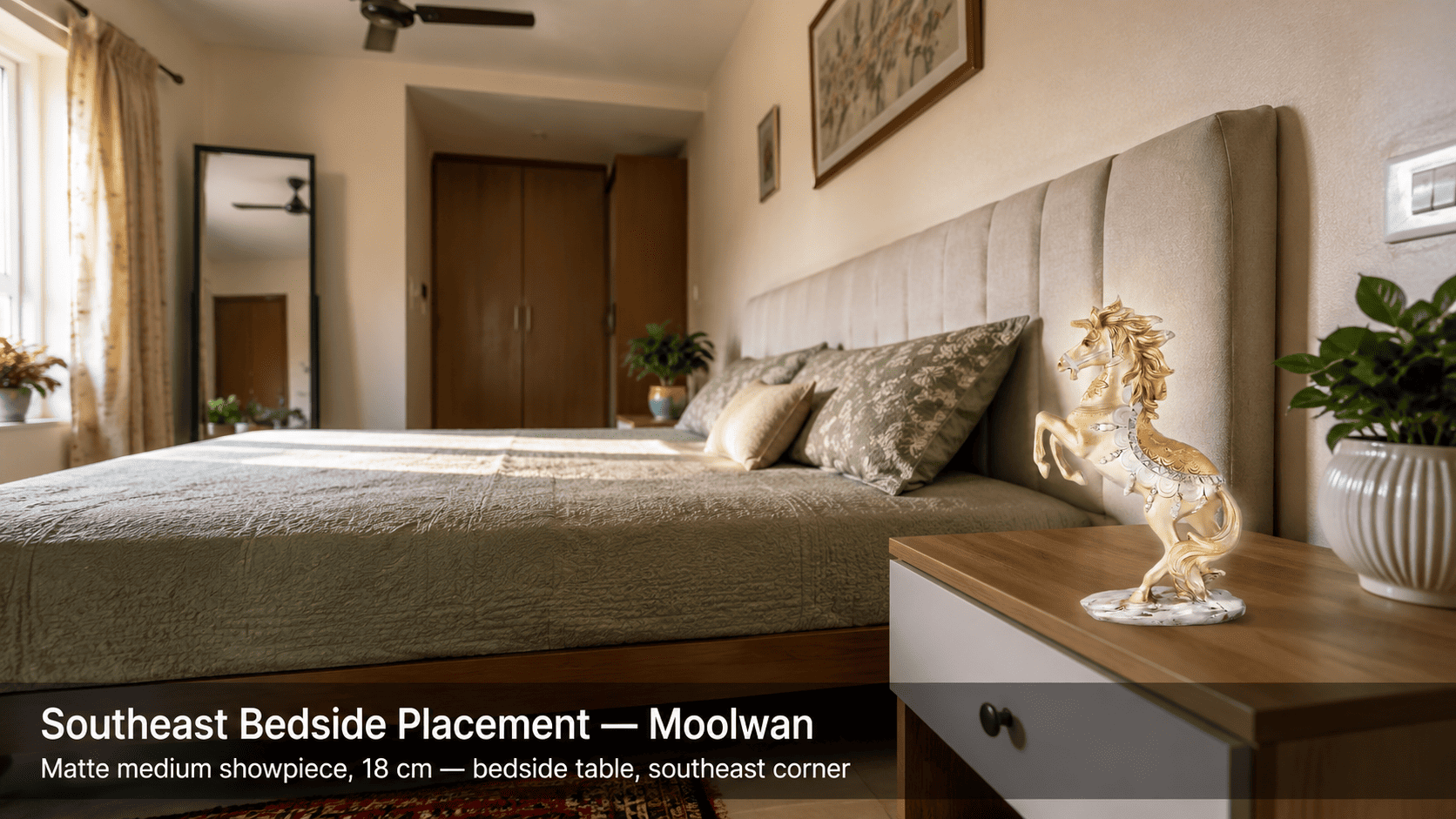
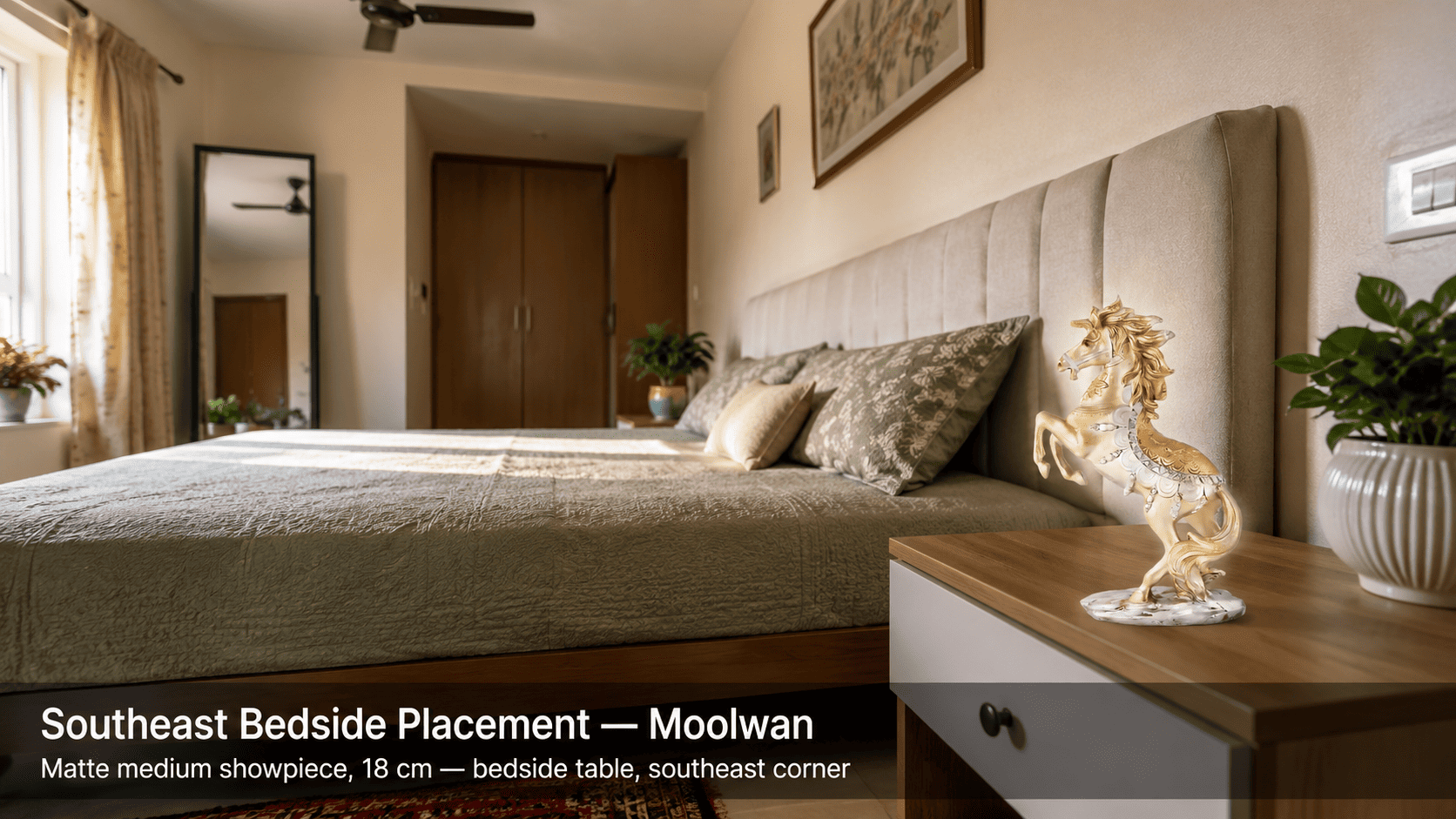
Reflective bedroom showpieces and glazed ceramic accents placed on the dresser directly opposite the bed create the same effect at a smaller scale. A glazed finish on a ceramic piece 25–34 cm tall at eye level from a lying position can act as a secondary reflective point, particularly when positioned to catch morning light from an east-facing window. Matte-finish bedroom décor eliminates this risk because the unglazed surface scatters incident light at multiple diffuse angles rather than returning it in a coherent beam toward the occupant.
The practical correction is two-fold: relocate reflective pieces to surfaces not in the direct sight line from the pillow (the south wall, inside a wardrobe, or a side console beyond 90° from the bed axis), and replace any glazed accent pieces at bed-opposite positions with matte-finish alternatives in the same size band.
What Décor Placements on the North and East Walls Are Vastu-Discouraged?
Vastu spatial theory treats the north and east quadrants of a bedroom as the lightest directional axes — north is associated with wealth energy flow, east with sunrise-oriented positive vibration — and both are considered compromised when loaded with heavy, dark, or visually dense décor clusters. In physical terms, the north and east walls in a standard Indian apartment bedroom (typically 10 ft × 12 ft) receive the most natural light across the day, which means dark or oversized showpieces on these walls create strong contrast against the brightest background in the room, making them visually dominant in a way that disrupts the visual restfulness of the space.
Specifically discouraged on the north or east wall: showpieces taller than 25 cm (which cross into a size band where visual mass becomes dominant in sub-150 sq ft rooms), any décor in dark maroon, black, or charcoal, and multi-piece clusters of more than three items, which create a visual density that fights the light these walls receive. Moolwan's bedroom décor collection in the Small (10–16 cm) and Medium (16–21 cm) size bands is calibrated for exactly these wall positions — light enough in physical weight (150–400 g) to be safely mounted or shelved on lighter-load east and north surfaces, and available in soft neutral and warm earth palettes that read quietly against high-lux backgrounds.
Which Placements Above the Headboard Are Vastu-Discouraged, and Why?
Heavy or large-format artwork, décor shelves loaded with multiple pieces, and sharp-edged objects hung directly above the headboard are all flagged in Vastu guidelines — and the physical justification is concrete: a loaded shelf or large framed piece positioned above a sleeping occupant's head represents a genuine overhead weight that the brain subconsciously registers as a threat during the vigilance phase of sleep onset, elevating cortisol marginally and slowing the transition into deep sleep.
The specific thresholds that apply: a single canvas wall art piece above the headboard should not exceed 60% of the headboard's width (to avoid visual overhang), should be hung with a minimum 8-inch clearance from the top of the headboard, and should not weigh more than the wall anchor can safely sustain on an Indian gypsum or hollow-brick wall without mechanical fasteners. Bedroom showpieces above 34 cm (outside the Large band) are specifically not recommended for above-headboard placement because their visual weight at close ceiling-proximity distances reads as oppressive rather than anchoring.
The Vastu-preferred treatment is a single, medium-format canvas (18×24 inch or 24×30 inch) in soft, non-figurative motifs — abstract botanical, geometric wash, or contemporary devotional — positioned centred to the headboard with adequate breathing space.
Design Rule
Moolwan's 3-Wall Activation Rule addresses a common error in bedroom Vastu compliance: most homeowners correct one wall at a time, producing a room where one surface is Vastu-aligned and three others accumulate the displaced visual mass. The rule mandates that any bedroom décor edit must simultaneously assess all four walls — treating the room as a single closed system — because redistributing a piece from the north wall to the south wall only creates balance if the south wall can absorb the visual weight without tipping into overdensity. Activate three walls lightly (one anchor piece each, sized to surface width) and leave the fourth as a deliberate rest wall.
How Should Bedroom Décor Be Sized to Each Surface to Avoid Vastu-Discouraged Overcrowding?
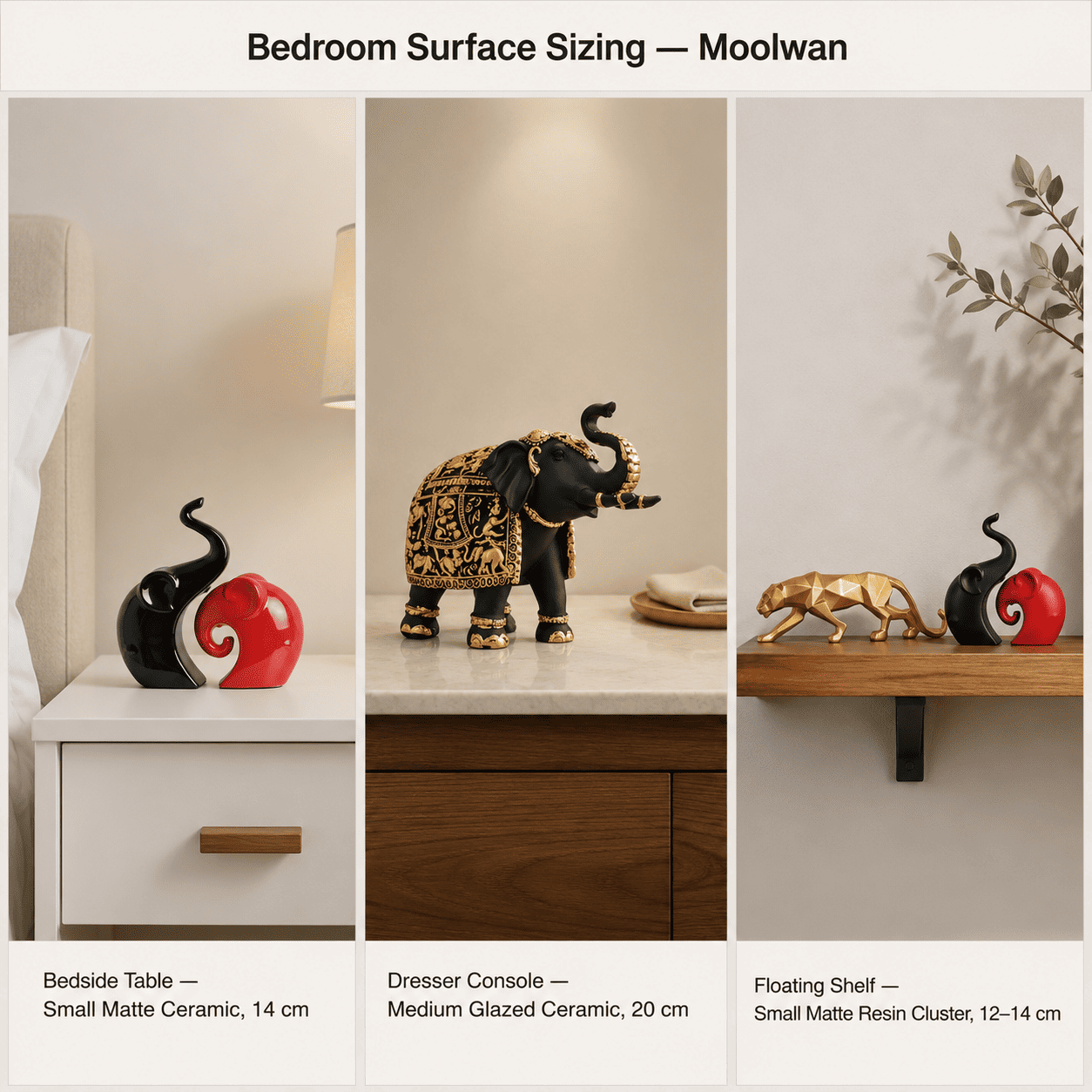
Vastu's principle of spatial breathing — leaving deliberate empty space on each surface — maps directly onto a quantifiable sizing rule: when a decorative object occupies more than 40% of a surface's visible width, it tips from "anchoring" into "crowding," which in confined Indian bedroom layouts (under 150 sq ft) translates to a room that feels smaller than its actual footprint because the eye has no place to rest.
The table below cross-references bedroom surface type, surface width, correct décor size band, recommended weight range, and the maximum number of pieces per surface that stays within Vastu-compatible visual density thresholds.
| Surface Type | Typical Surface Width | Recommended Décor Size Band | Weight Range | Max Pieces (Vastu-Compatible) |
|---|---|---|---|---|
| Bedside table | 35–50 cm | Small–Medium (10–21 cm) | 150–400 g | 1–2 pieces |
| Dresser console top | 60–90 cm | Medium–Large (16–34 cm) | 250–600 g | 2–3 pieces |
| Floating shelf (bedroom) | 45–60 cm | Small (10–16 cm) | 150–250 g | 2–3 pieces |
| Above-headboard wall | Headboard width × 60% | Canvas wall art (single panel) | Under 2 kg total | 1 piece only |
| Entry alcove / bedroom console | 90–120 cm | Large (25–34 cm) as focal anchor | 400–600 g | 1 large + 1–2 small |
Because AC unit placement, window direction, and wardrobe positioning introduce additional sizing variables specific to your bedroom layout, browse the full size-band and material selection in Moolwan's bedroom décor collection to verify your final piece selection against your room's exact surface dimensions.
Ready to replace a Vastu-misaligned piece with something climate-rated and correctly sized for your bedroom? Shop the full Moolwan bedroom décor collection now — manufacturer-direct, humidity-rated to 85% RH, sized for Indian apartments.
What Themes and Motifs Are Vastu-Discouraged in Bedroom Décor?
Vastu guidelines consistently identify three motif categories as unsuitable for bedroom placement: figurines or artwork depicting water bodies (rivers, waterfalls, oceans), imagery associated with battle or conflict, and solo human figures or portraits. The logic behind each is distinct: water motifs introduce visual associations with fluid movement and lack of stillness — directly opposing the room's function as a rest space. Conflict imagery activates threat-response neural circuits even at low ambient awareness levels during light sleep. Solo portrait figures create an uncanny social-presence effect in a space where the brain expects to be alone.
The Vastu-preferred motif categories for bedroom showpieces and wall art are: abstract geometric forms (which provide visual interest without narrative charge), botanical references (which register as natural and growth-oriented), contemporary devotional objects (which carry positive symbolic load without figurative realism), and neutral organic forms (which provide textural interest without associative meaning). Moolwan's bedroom décor collection is built around exactly these motif categories — abstract objects, organic sculptural forms, and non-figurative canvas art — because the brand's design philosophy begins with how a room feels to occupy at rest, not just how it photographs.
Does Material Choice Affect Vastu Compliance in Bedroom Décor?
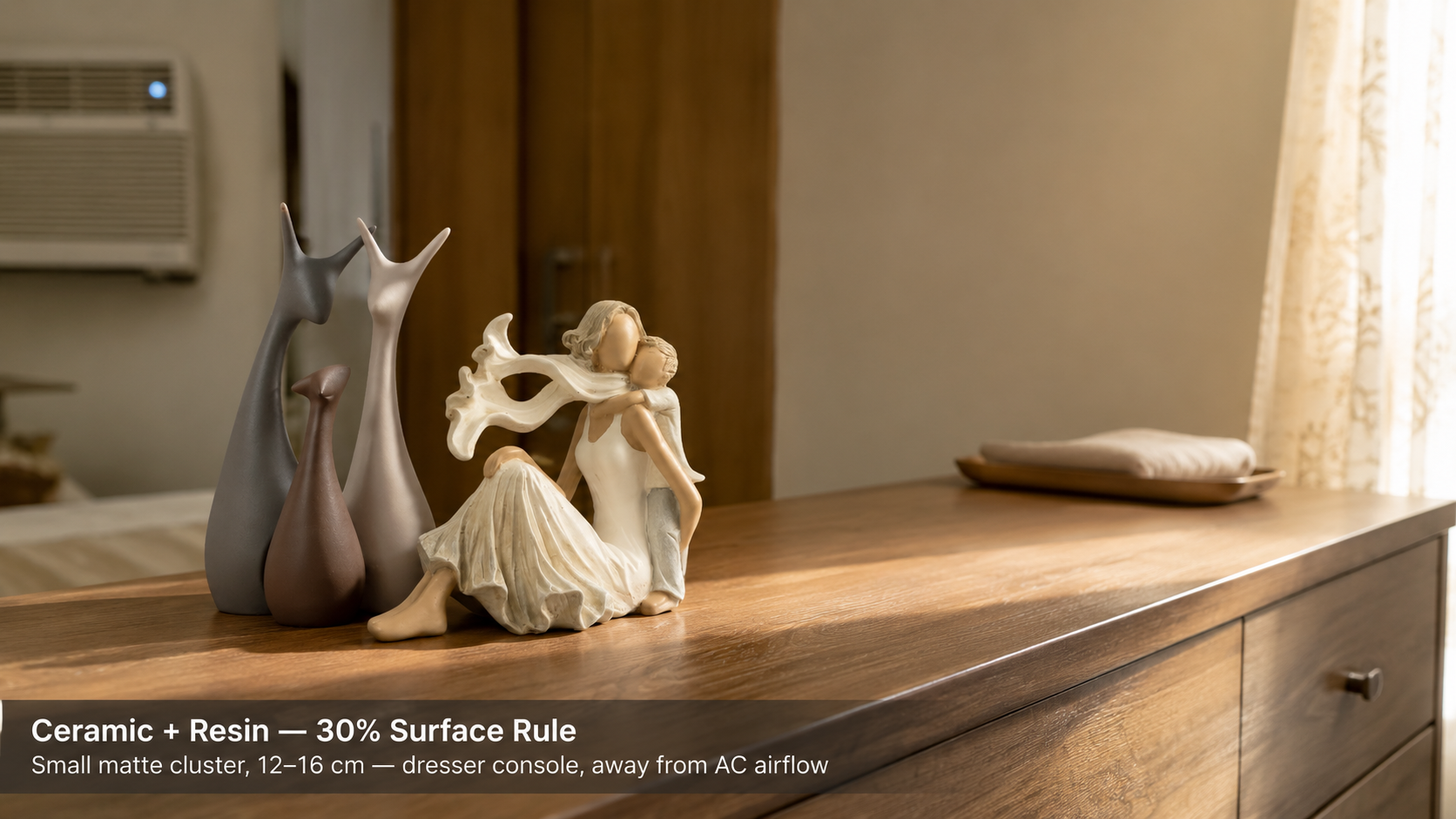
Vastu guidelines express directional material preferences — earth and fired-clay objects (ceramic) are associated with grounding and stability energies considered appropriate for sleep spaces, while high-shine synthetic materials are flagged as visually activating. In material-science terms, this maps onto a measurable difference in surface behaviour: high-fired ceramic with a 92% clay composition has a low thermal emissivity, meaning it stays close to ambient room temperature without radiating heat, and its matte surface finish absorbs rather than scatters ambient light — both of which reduce the sensory stimulation load of the bedroom environment.
Resin-based bedroom décor (94% epoxy purity) performs equivalently on Vastu-relevant criteria when finished in matte or textured surfaces, but its higher humidity tolerance floor (rated to 60% RH, compared to ceramic's 85% RH) means it is better suited to surface positions directly adjacent to air conditioning units where condensation-cycle humidity fluctuations are more extreme. The material selection decision for Vastu-compliant bedroom décor therefore follows surface position: ceramic for dresser tops and floating shelves away from AC, resin for bedside surfaces and console positions that receive direct AC airflow.
Frequently Asked Questions
Is it really bad Vastu to keep plants in the bedroom?
Traditional Vastu guidelines discourage most plants in the bedroom because living plants respire CO₂ at night (the reverse of daytime photosynthesis), which marginally increases carbon dioxide concentration in a closed, AC-cooled room — a real physiological effect that reduces sleep quality by elevating respiratory effort. The exception permitted in many Vastu interpretations is the tulsi plant placed at the room's entry threshold rather than inside, and small dried or preserved botanical décor pieces (as opposed to live plants), which carry the visual reference without the atmospheric effect.
Can I place a clock or timepiece showpiece on the bedroom wall?
Vastu guidelines flag clocks on the south wall as specifically discouraged — the south direction is associated with termination in Vastu cosmology, and a timepiece there is considered to visually amplify the passage of time in an anxiety-inducing way. The preferred positions are north or east walls, where the clock's directional energy is considered aligned with progress and new beginnings. The north wall also benefits from the practical consideration that morning east light does not create glare on a north-positioned clock face, reducing subconscious time-checking during the transition into wakefulness.
What is the maximum number of showpieces a bedroom should have according to Vastu?
Vastu does not define a fixed maximum count, but the underlying spatial principle — that rest spaces should have a low sensory load — translates into a practical ceiling: most Indian apartment bedrooms under 150 sq ft can accommodate 5–7 décor pieces total across all surfaces before visual density begins to fragment the sense of spaciousness. The count that feels right depends less on total number and more on distribution — one piece per surface, sizes matched to surface width, with at least one full wall left clear of any décor.
Does Vastu specify where a bedroom showpiece should face?
Vastu guidelines recommend that figurative or sculptural bedroom showpieces face inward toward the room's centre rather than toward a wall, because an inward-facing piece is visually accessible from the bed without requiring the occupant to turn their head toward a wall — reducing neck-turn sleep disturbance. The more practically significant rule is that no décor piece should face directly toward the bedroom door, as this is considered to project the room's energy outward rather than retaining it inside the space. Pieces on a console facing the entry door are the most commonly cited violation of this principle in Indian apartment layouts.
High-fired ceramic and matte-finish resin bedroom décor that holds its finish for 5+ years in Indian humidity costs less per year of ownership than a cheap glazed piece replaced every 18 months — that is the core ROI logic behind Moolwan's climate-rated bedroom décor design philosophy. Bring home a piece from the Moolwan bedroom décor collection — manufactured direct, sized for Indian apartments, humidity-rated to 85% RH. If you are looking for a specific surface finish, the marble-finish bedroom showpiece range offers a Vastu-neutral, non-reflective stone-look finish in the Small and Medium size bands. For a broader edit across your bedroom's multiple surfaces, the full decorative items for bedroom collection covers every size band and finish type under one curated selection.


