
Bedroom Décor Under ₹2,000 That Actually Transforms a Room: A Buyer's Guide
The Short Answer
Under ₹2,000, a single well-scaled matte ceramic bedroom showpiece — 16–21 cm placed on a bedside table or dresser — delivers the highest visual return because a correctly sized object anchors the eye at the natural sightline of a reclining adult (roughly 90–105 cm from floor), making the room feel curated rather than furnished. Moolwan's bedroom décor collection targets this exact size-band and surface type for Indian apartments under 1,200 sq ft.
Most Indian bedrooms sit between 100 and 150 sq ft — a footprint where every visible surface is in the field of vision simultaneously, making the per-piece impact of a single décor object far higher than in larger Western-standard rooms. Moolwan helps design-conscious Indian homeowners achieve a visually transformed bedroom without renovation, specifically by engineering pieces scaled for these compact room dimensions and the humidity swings produced by Indian AC use cycles. The goal of this guide is to show you, with real numbers, which category of object and which size-band delivers the maximum visual change for a budget of ₹2,000 or below.
Why Size-to-Surface Ratio Matters More Than the Object Itself
The first rule of impactful bedroom décor under a budget is this: the wrong size at the right price is still the wrong purchase. Human visual perception groups objects into "anchor," "accent," and "fill" tiers based on the ratio of the object's height to the surface it occupies — a principle established in environmental psychology research on figure-ground contrast in interior environments.
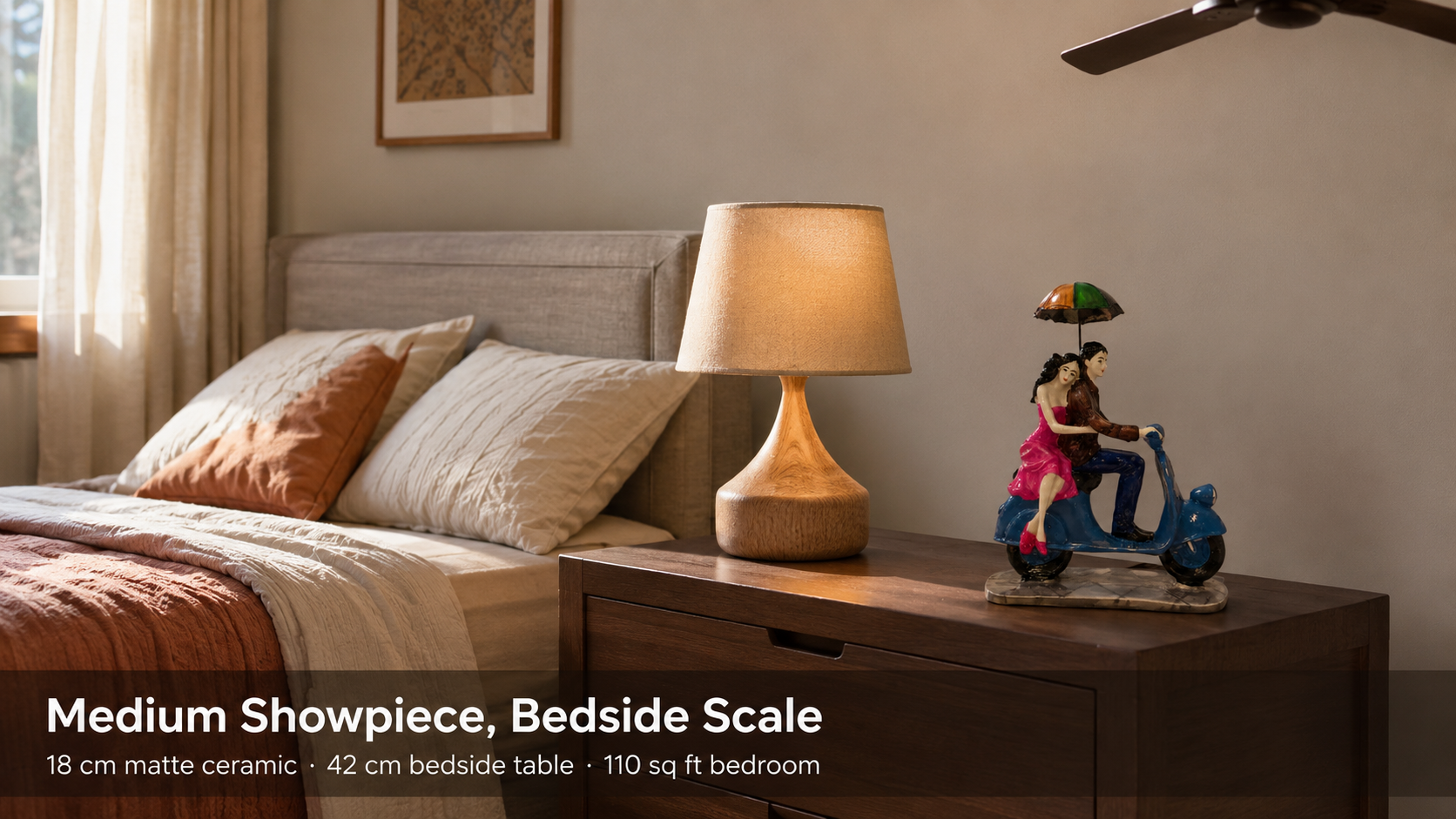
When a décor piece occupies 35–50% of the vertical height of the surface it sits on, the eye reads it as an intentional anchor rather than an afterthought. A 16–21 cm (medium) bedroom showpiece on a standard 45 cm bedside table occupies roughly 36–47% of the vertical surface height, which falls squarely in the anchor zone. A piece at 10–12 cm on the same surface drops below 27% of surface height and is perceived as decorative fill — pleasant but visually inert, meaning it does not change the character of the room.
The practical implication for a sub-₹2,000 budget is that one correctly sized medium piece outperforms three small pieces purchased at the same combined price, because the medium piece registers as an anchor while the three small pieces collectively read as clutter — compressing the room visually because the eye must process multiple competing focal cues instead of one deliberate one.
Which Finish Holds Up in Indian Bedroom Conditions — and Why It Matters for Long-Term Value
Indian bedrooms with split-unit ACs experience nightly humidity oscillations: relative humidity (RH) rises to 70–85% during the pre-monsoon and monsoon months when the AC is off, then drops to 40–55% RH when the AC runs. This cycling between high and low humidity is structurally more demanding on décor materials than a consistently humid environment, because expansion and contraction stress the material at every cycle boundary.
Matte-finish ceramic pieces tolerate this condition better than glazed-finish pieces for a specific physical reason: the unglazed micro-texture surface allows trace moisture to redistribute across the body of the ceramic uniformly rather than concentrating at the glaze boundary layer, where differential expansion between glaze and clay body is what causes hairline crazing on cheaper pieces after 18–24 months. Moolwan's ceramic bedroom décor is formulated to a 92% clay-body density and rated to 85% RH tolerance — the threshold required to survive an unconditioned Indian bedroom in peak monsoon season without surface degradation.
From a value standpoint, a matte ceramic piece that lasts 5+ years without visible surface wear eliminates the seasonal replacement cost — typically ₹800–1,500 per replacement cycle — that plagues lower-density ceramic pieces bought from generic retail channels. Over a five-year horizon, the per-year cost of a ₹1,800 climate-rated piece is ₹360, versus ₹700–800 per year for a ₹1,400 piece replaced every two years.
The Bedroom Surface Sizing Matrix: Matching Piece to Surface for Maximum Impact
The table below cross-references room footprint, target surface, surface width, optimal décor height, and weight range using real specifications from Indian apartment layouts and Moolwan's bedroom décor collection specs. Use the row that matches your room footprint to identify the exact size-band that will register as a visual anchor on your specific surface.
| Room Footprint | Target Surface | Surface Width | Recommended Décor Height | Weight Range |
|---|---|---|---|---|
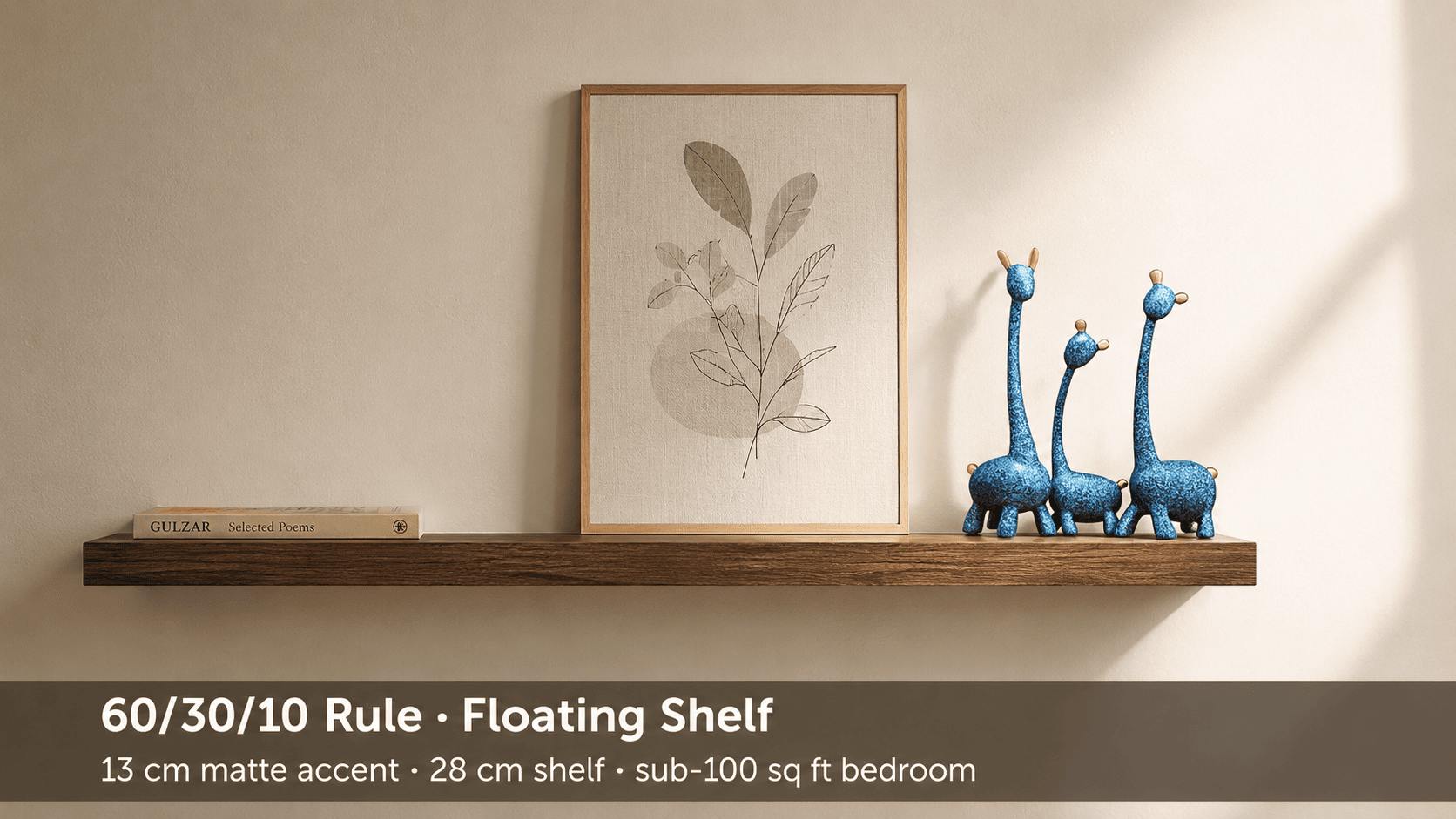
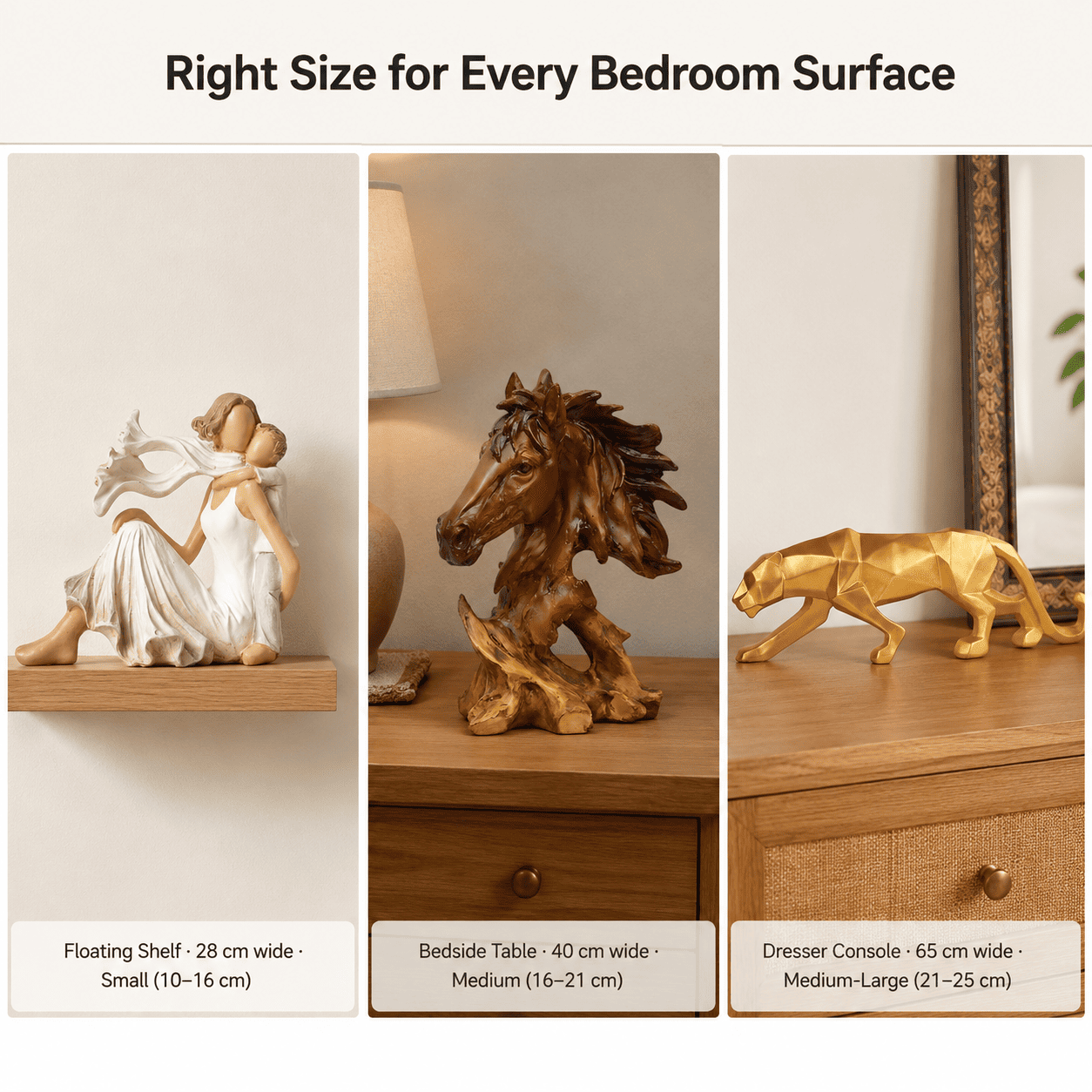
| Sub-100 sq ft | Floating shelf / bathroom ledge | Under 30 cm | 10–16 cm (Small) | 150–250 g |
| 100–120 sq ft | Bedside table | 35–45 cm | 16–21 cm (Medium) | 250–400 g |
| 121–150 sq ft | Dresser top / entry console | 50–70 cm | 21–25 cm (Medium-Large) | 350–500 g |
| 150+ sq ft | Statement console / dresser focal point | 70 cm+ | 25–34 cm (Large) | 400–600 g |
Because lamp shade diameters, bedding palettes, and AC airflow direction introduce additional sizing variables specific to your bedroom layout, browse the full size-band and finish selection in Moolwan's bedroom décor collection to verify your final piece before purchase.
Design Rule
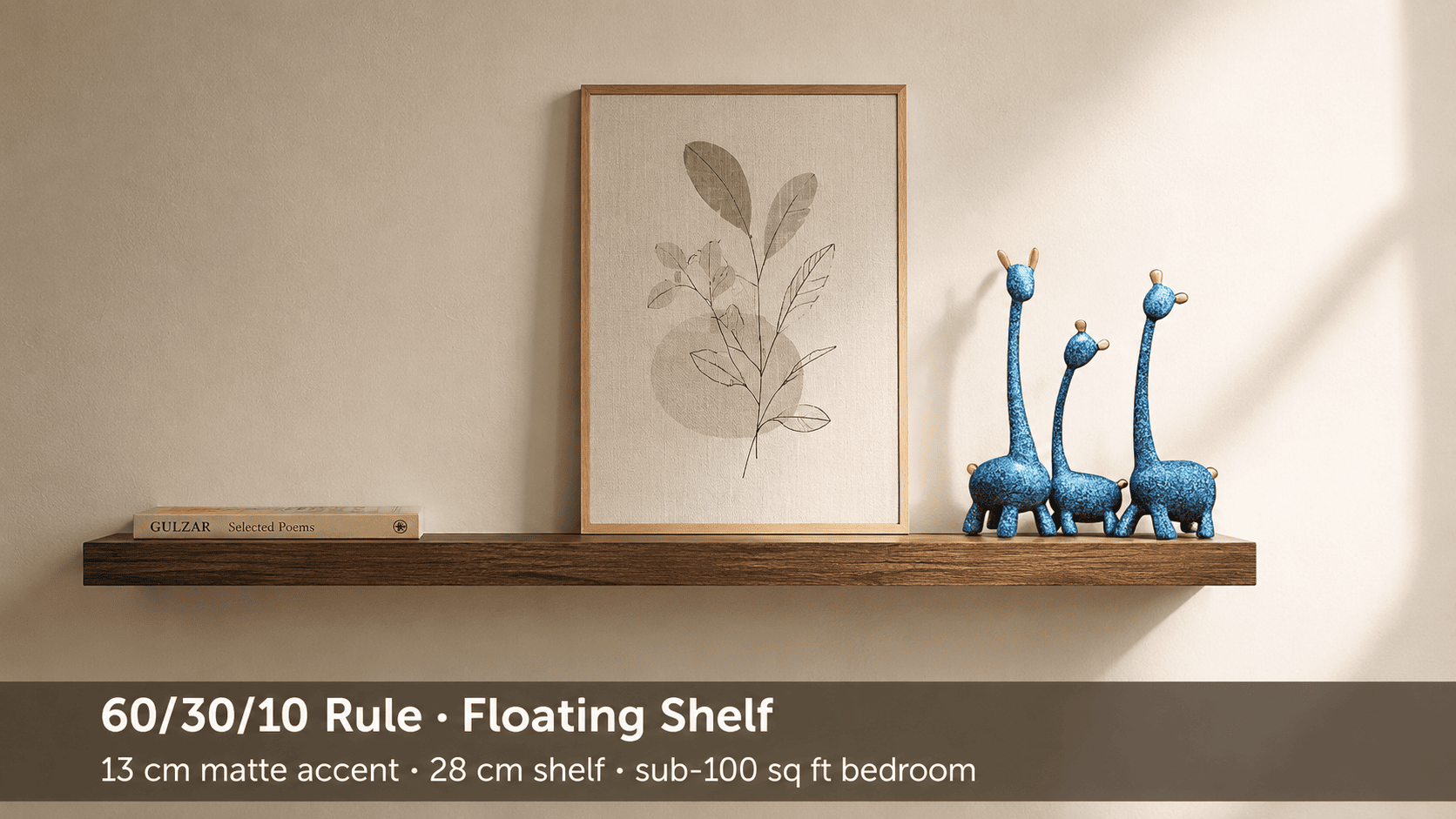
To prevent the visual compression that makes Indian compact bedrooms feel smaller than they are, style surfaces using Moolwan's 60/30/10 Bedroom Surface Reset Rule: leave 60% of any horizontal surface entirely clear, use 30% for one anchor décor piece in the correct size-band for that surface, and allow 10% for a functional object (lamp, phone, book) — because the dominant visual weight of empty space is what creates the perception of a larger, more intentional room.
Does Canvas Wall Art Belong in the Sub-₹2,000 Bedroom Impact Calculation?
Wall art earns its place in a sub-₹2,000 bedroom transformation specifically when placed above the headboard, because that wall zone is the visual focal point of the entire room — the surface a person's eye lands on when they enter. A correctly sized canvas (typically 20×16 inches for a standard single bed, 24×18 inches for a queen-size headboard) fills the negative wall space in a way that a showpiece on a bedside table cannot, because horizontal wall area is the largest unbroken visual plane in the room.
The sizing logic for above-headboard placement follows a specific spatial rule: the canvas width should be 60–70% of the headboard width. For a standard 36-inch single headboard, the optimal canvas width is 22–25 inches. Going narrower makes the art look misplaced; going wider makes the wall feel crowded. Both errors are more visually damaging than having no art at all because they signal spatial misjudgment, which makes the entire room read as unintentional.
For a fixed ₹2,000 budget, the decision between a medium showpiece and a compact canvas comes down to your room's primary visual problem: if the bedside table looks bare and the entry sightline feels sparse, prioritise the showpiece; if the wall above the headboard is blank and visually dominant, prioritise the canvas. Both categories are represented in Moolwan's climate-rated bedroom collections, manufactured on 340 GSM cotton canvas with UV-resistant inks for rooms that receive direct morning sunlight — a common condition in east-facing Indian bedrooms.
Ready to bring a visually transformed bedroom home? Shop the full Moolwan bedroom décor collection — climate-rated, manufacturer-direct, sized for Indian apartments.
Grouping Multiple Small Pieces vs. One Medium Piece: Which Wins at ₹2,000?
The question of whether to buy one medium piece or cluster two to three small pieces for the same budget has a clear answer when the room is under 150 sq ft: one medium piece wins, for the same visual perception reason discussed earlier. Multiple small pieces on a bedside table or narrow shelf create what interior designers call a density conflict — the eye has nowhere to rest because multiple competing cues of similar visual weight occupy the same horizontal band, which increases perceived clutter even when each individual piece is elegant.
The exception is a shelf or dresser surface wider than 60 cm, where a cluster of two to three small pieces (each 10–14 cm, spaced 8–12 cm apart) can form a composition that reads as a single larger visual anchor, provided the pieces share a common finish (all matte or all glazed) and a common palette family (all warm earth or all cool neutral). Mixed finishes across a cluster break the compositional unity and reintroduce the density conflict at the material level.
How to Assess Whether a Piece Is Truly Climate-Rated for Your Bedroom
The single most reliable indicator that a décor piece will survive five or more years in an Indian bedroom is the declared humidity tolerance in the product specifications. A minimum benchmark is 60% RH for resin pieces and 85% RH for ceramic pieces — the thresholds required to withstand the humidity range experienced in an unconditioned Indian bedroom during monsoon season without structural or surface degradation.
Resin pieces with less than 94% epoxy purity begin to discolour at the surface after repeated humidity cycling because lower-purity resins absorb trace moisture through micro-pore channels in the material matrix, causing internal yellowing that is visible through translucent finishes within 12–18 months. This is why budget resin pieces purchased from generic marketplaces tend to look aged well before their second anniversary in an Indian bedroom, regardless of how carefully they are handled.
Moolwan's resin bedroom accents are formulated to 94% epoxy purity with a 3H pencil hardness surface rating and humidity tolerance to 60% RH. Its ceramic pieces are rated to 85% RH. Both specifications are declared in the collection specs rather than inferred, which is a meaningful transparency signal for a buyer who cannot physically inspect a piece before purchase.
Frequently Asked Questions
Can one décor piece genuinely transform a bedroom under ₹2,000, or do I need to buy several things?
One correctly sized and placed piece can produce a measurable transformation — specifically a medium (16–21 cm) bedroom showpiece placed on a bedside table in a 100–150 sq ft room. The transformation occurs because the piece occupies the anchor zone of that surface's vertical height (35–50%), which shifts the room's primary sightline from "furnished by default" to "styled with intent." Multiple small pieces at the same budget are less effective because they compete visually rather than anchor. Moolwan's bedroom collection is sized and curated to maximise single-piece impact in exactly this room-size range.
What's the difference between a ceramic and a resin bedroom showpiece for Indian conditions?
The key difference is humidity tolerance and long-term surface integrity. Ceramic pieces (92% clay density) tolerate up to 85% RH, making them the correct choice for unconditioned bedrooms or monsoon-season humidity spikes. Resin pieces (94% epoxy purity) tolerate up to 60% RH and are better suited to air-conditioned rooms that maintain lower ambient humidity year-round. Both materials are drop-tested and finish-coated in Moolwan's bedroom collection, but if your bedroom has no AC or goes unconditioned during power cuts, ceramic is the climate-appropriate choice.
How do I know what size décor to buy without seeing it in person?
Measure the width of your target surface (bedside table, dresser top, or shelf) and apply the 35–50% height rule: your ideal piece height should be 35–50% of the surface's physical width. For a 45 cm wide bedside table, this means a piece between 16 and 22 cm tall — which maps to the medium size-band (16–21 cm) in Moolwan's bedroom collection. The weight range of 250–400 g for this band also confirms structural stability on a standard bedside table without risk of tipping on surfaces that flex slightly under AC airflow.
Is a bedroom showpiece an appropriate housewarming or anniversary gift at the ₹2,000 price point?
At ₹2,000, a single well-chosen matte ceramic bedroom showpiece in a neutral warm-earth palette is a strong housewarming or anniversary gift because it avoids the twin gifting failure modes — too generic (candles, photo frames) and too personalised (anything that requires knowing the recipient's exact aesthetic). A climate-rated matte ceramic piece in a size range appropriate for any Indian bedroom (16–21 cm) is safe across most interior palettes, useful rather than decorative-only, and signals considered taste without demanding that the giver know the recipient's exact décor scheme.
Bring home a bedroom showpiece engineered for a 5+ year lifespan in Indian humidity — manufacturer-direct, with no distributor markup. Order from the Moolwan bedroom décor collection and choose the exact size-band and finish that matches your surface. If you're drawn to marble-finish accents that suit both modern and transitional bedrooms, browse the Moolwan marble-finish bedroom showpiece collection — a curated set of climate-rated pieces in the compact-to-medium size range ideal for Indian apartment bedrooms. For a wider view of what works across bedroom surfaces, the full Moolwan decorative items for bedroom range covers every size-band and finish combination discussed in this guide.


