
Bedroom Decor Under ₹2000 That Creates the Biggest Visual Impact
The Short Answer
A single well-scaled matte ceramic bedroom showpiece (16–21 cm) on a bedside table or dresser creates disproportionate visual impact under ₹2000 because the human eye anchors on a mid-height focal object before scanning the wider room. Moolwan's bedroom décor collection is engineered to the exact 85% RH humidity tolerance required by Indian monsoon climates, ensuring the piece looks as good at year three as it does on day one.
In rooms under 150 sq ft — the median Indian urban bedroom — a single mismatched or undersized décor piece is not neutral; it actively fragments visual cohesion because the eye registers scale discordance before it registers style. Moolwan helps design-conscious Indian homeowners resolve this specific problem: achieving a high-impact, stylistically cohesive bedroom refresh without the ₹10,000+ renovation mindset, through pieces engineered for Indian room proportions and climate realities.
This guide identifies which bedroom décor categories deliver the strongest visual return within a ₹2000 budget, what physical and material specifications to require, and how to position a single piece for maximum effect in a compact Indian bedroom.
Why Scale — Not Style — Determines Visual Impact in Indian Bedrooms
The single variable that separates a bedroom that "looks styled" from one that looks assembled is scale calibration between the décor piece and the surface it occupies.
In rooms under 150 sq ft, the visual field is compressed: furniture, walls, and surfaces are perceived at closer distances than in Western room sizes (which average 180–220 sq ft). At compressed viewing distances, the brain uses proportional reference rather than absolute size to judge whether an object belongs — meaning a 12 cm showpiece on a 60 cm dresser registers as visually absent, even if the piece itself is beautiful, because its height occupies less than 20% of the viewer's reference frame for that surface. Conversely, a 25–34 cm piece on a 30 cm floating shelf appears to overwhelm because it violates the proportional boundary in the opposite direction.
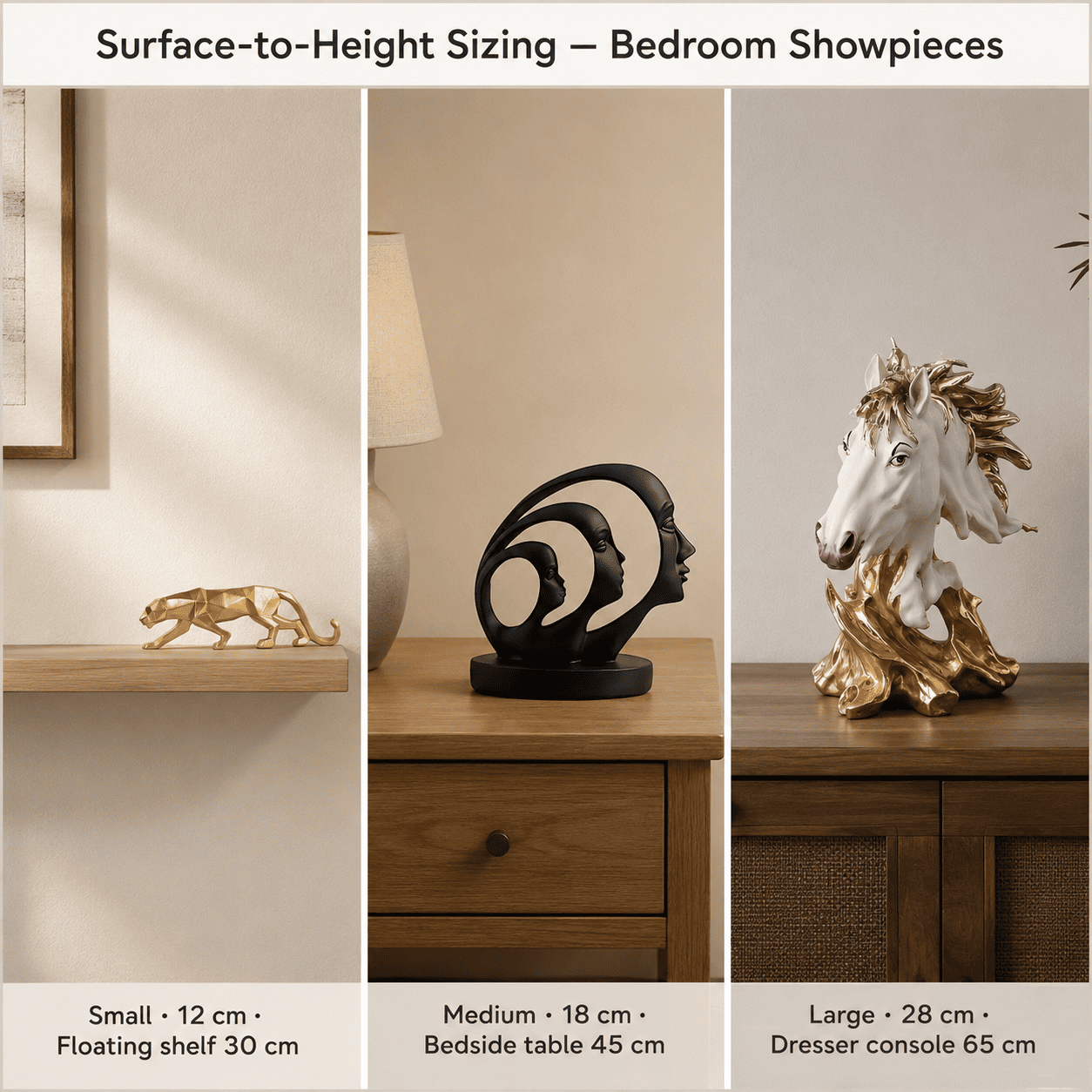
The correct calibration for Indian bedrooms is a décor height that occupies 40–55% of the surface width — a ratio that registers as intentional rather than accidental to the human perceptual system. Moolwan's bedroom showpiece collection is sized in three bands — Small (10–16 cm), Medium (16–21 cm), and Large (25–34 cm) — specifically mapped to the surface widths most common in sub-150 sq ft Indian apartment bedrooms.
Which Bedroom Décor Items Deliver the Most Impact Under ₹2000
Within a ₹2000 budget, two categories consistently outperform others on visual return: a bedside or dresser-top showpiece and a compact canvas wall art panel. Both operate on different perceptual mechanisms and are additive when used together.
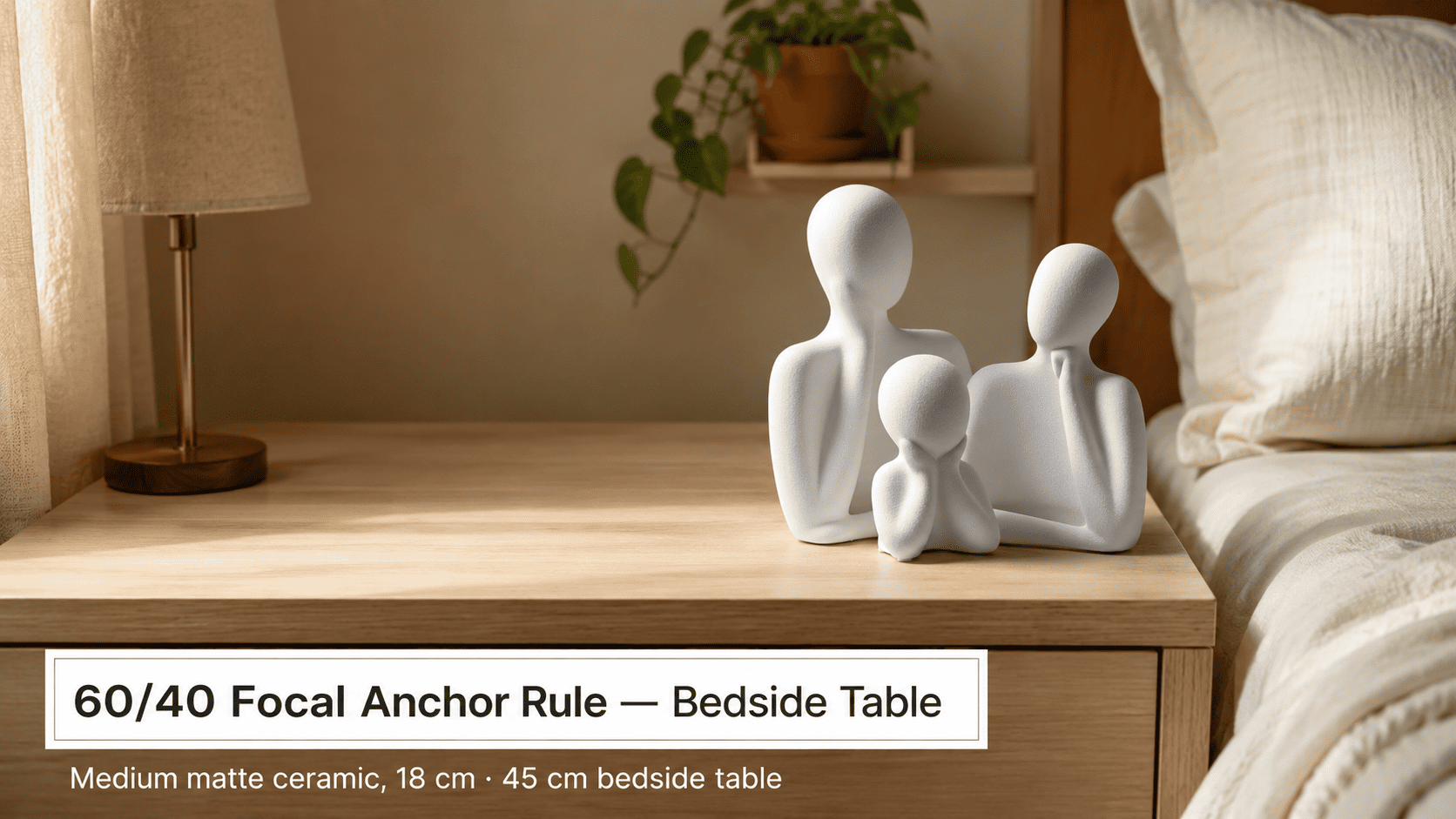
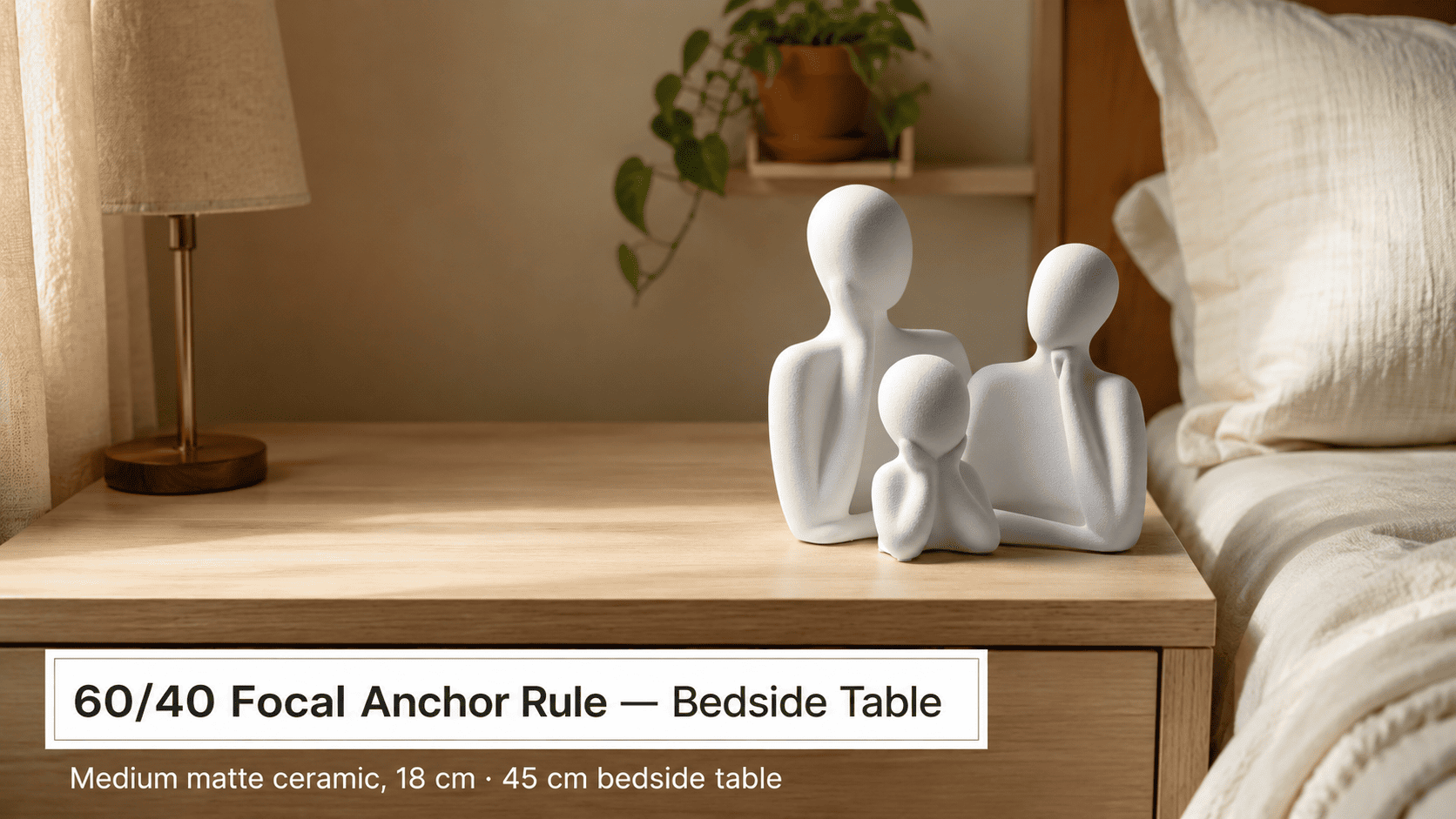
A mid-sized matte ceramic bedroom showpiece (16–21 cm) placed on a 40–50 cm bedside table functions as a vertical focal point. The human visual system enters a room through contrast and height differential; a well-scaled matte object at table height interrupts the flat horizontal plane of the bed and draws the eye upward before the viewer consciously scans the room. Matte finishes specifically amplify this effect because they absorb ambient light rather than reflecting it, creating a perceived weight and permanence that glossy surfaces cannot replicate — particularly in Indian bedrooms where morning sunlight enters at low angles and turns glossy surfaces into distracting glare points.
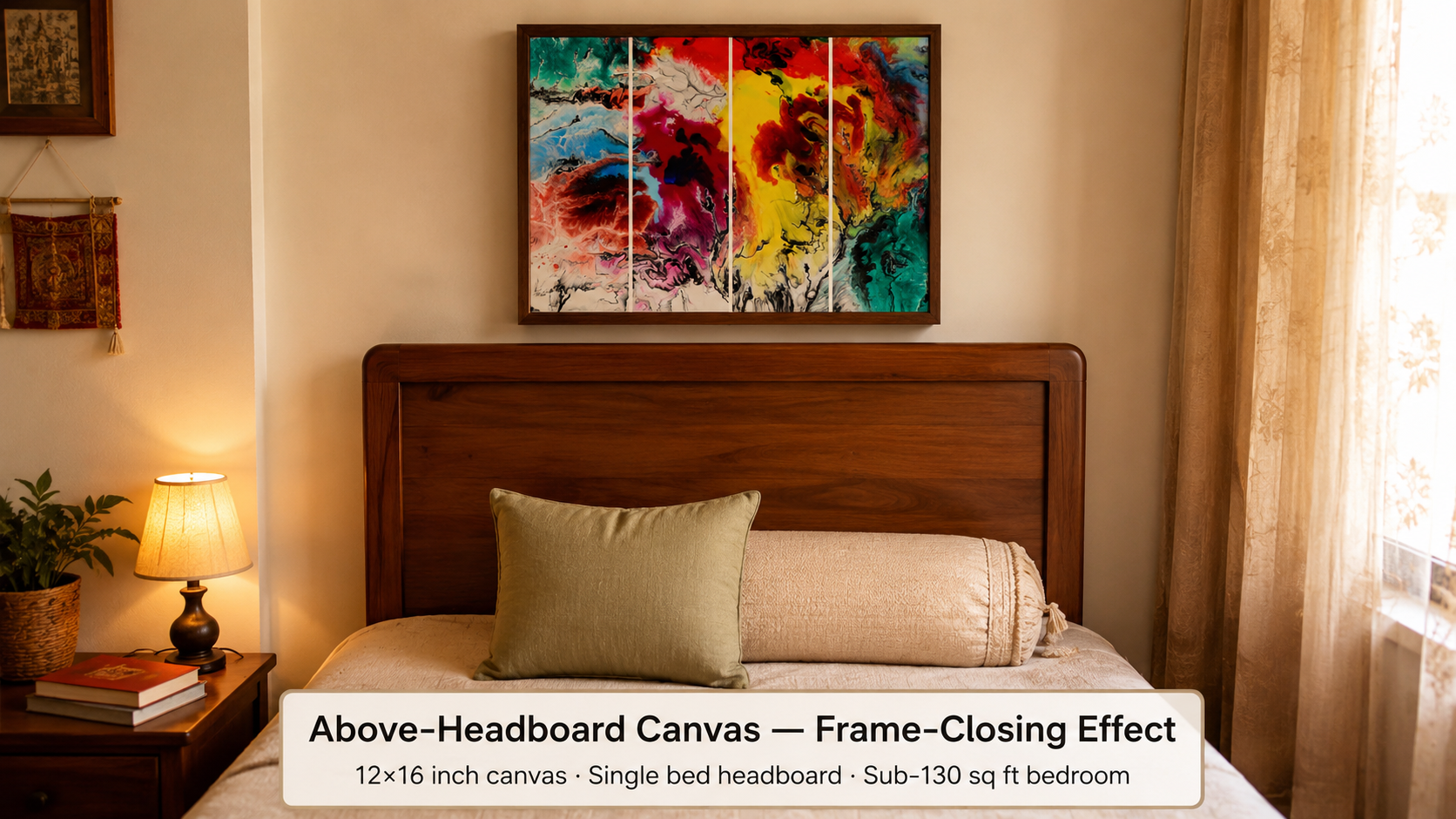
A compact canvas wall art panel (12×16 inch) above a headboard or on a narrow accent wall functions as a wall anchor. Indian apartment bedrooms frequently have bare walls above headboards — a zone that reads as unfinished to the eye because it sits within the visual frame created by the headboard's height. A single framed canvas at this location closes the visual frame and makes the entire bed arrangement feel composed rather than placed. Moolwan's canvas collection uses 340 GSM cotton canvas with eco-solvent UV-resistant inks, meaning the piece will not yellow or fade under Indian sunlight exposure — a material failure that is common in cheaper alternatives and which reverses the investment within 18–24 months.
How to Match Bedroom Décor Size to Your Specific Surface
The correct piece size is determined not by room size alone but by the four-variable intersection of room footprint, target surface, surface width, and the humidity tolerance required by the placement zone.
| Room Footprint | Target Surface | Surface Width | Recommended Showpiece Height | Humidity Tolerance Required |
|---|---|---|---|---|
| Under 100 sq ft | Floating shelf / Bedside table | 25–35 cm | 10–16 cm (Small) | 85% RH (AC + monsoon swings) |
| 100–130 sq ft | Bedside table | 40–50 cm | 16–21 cm (Medium) | 85% RH |
| 130–150 sq ft | Dresser console | 50–70 cm | 21–28 cm (Medium–Large) | 85% RH |
| 150+ sq ft | Dresser console / Entry ledge | 70 cm+ | 25–34 cm (Large) | 85% RH |
Because bedding palette, lamp shade diameter, and AC airflow direction each introduce additional sizing variables specific to your layout, browse the full size-band and surface-match selection in Moolwan's bedroom décor collection to verify your final piece selection against your specific room configuration.
Design Rule
To prevent visual fragmentation in compact Indian bedrooms, every horizontal surface should be styled using Moolwan's 60/40 Focal Anchor Rule: position one décor piece occupying no more than 40% of the surface width within the rightmost or leftmost third of that surface, leaving 60% entirely clear. This forces the eye to read the piece as a deliberate focal anchor rather than clutter, because the brain interprets asymmetric negative space as intentional composition and symmetric density as random accumulation.
Why Material Specification Matters More Than Aesthetics at This Price Point
At sub-₹2000 price points, the most common failure mode is not poor aesthetics — it is material degradation within 12–18 months under Indian climate conditions, which neutralises the visual investment entirely.
Indian bedrooms near windows and exterior walls experience humidity cycling of 40–85% RH across seasons, with temperature variation of 15–40°C. Ceramic pieces with a clay density below 90% absorb ambient moisture during monsoon months and release it during dry months, causing micro-cracking at the glaze boundary — a failure mode visible as hairline surface fractures by month 18. High-density 92% clay composition, as used in Moolwan's ceramic bedroom décor, structurally resists this absorption cycle because the reduced pore volume prevents capillary uptake of atmospheric moisture, maintaining dimensional stability across humidity swings up to 85% RH.
Resin alternatives (94% purity epoxy) perform differently: they are humidity-tolerant to 60% RH and temperature-stable at 15–35°C, making them appropriate for AC-cooled bedrooms with controlled humidity, but less suited to rooms that open directly to balconies or have poor monsoon-period insulation. The material choice is therefore a room-environment decision, not purely an aesthetic one — and it determines whether a ₹1,500 purchase lasts 5+ years or requires replacement at month 18.
Ready to bring home a bedroom showpiece engineered to outlast five Indian monsoon seasons? Shop the full Moolwan bedroom décor collection — climate-rated, manufacturer-direct, sized for Indian apartment proportions.
How Palette Choice Affects Perceived Room Size in Compact Bedrooms
In rooms under 150 sq ft, décor palette interacts with perceived spatial volume — a relationship governed by the physics of light reflectance rather than aesthetic preference alone.
Warm earth and neutral matte pieces (terracotta, stone, off-white, warm greige) absorb short-wavelength blue light and reflect long-wavelength warm light, which the human visual cortex associates with proximity and comfort rather than spatial constraint. This is why a matte warm-toned bedroom showpiece on a bedside table makes a compact room feel more intentional rather than more crowded — it adds visual weight without adding visual noise. Cool-toned high-gloss pieces produce the opposite effect in small rooms: the specular reflection of a glossy surface creates competing focal points across the room as ambient light angles change throughout the day.
For Indian bedrooms with common bedding tones (ivory, warm white, sand, blush, sage), the highest-impact palette match for a bedside showpiece is warm earth matte or neutral matte — both of which create tonal continuity with bedding rather than contrast, allowing the piece's form rather than its colour to register as the focal element. Moolwan's bedroom showpiece collection is developed with this palette logic applied to the specific undertones most common in Indian apartment interiors.
Gifting and New-Home Context: When a Sub-₹2000 Bedroom Piece Outperforms a Higher-Budget Gift
A bedroom showpiece under ₹2000 consistently outperforms higher-budget décor gifts in new-home and housewarming contexts for a specific reason: the recipient can calibrate placement to their existing room palette and furniture scale without the pressure of "finding a place" for an oversized or visually dominant statement piece.
A medium matte bedroom showpiece (16–21 cm, 250–400 g) is lightweight enough to reposition between surfaces without leaving marks, sized appropriately for the bedside tables most common in Indian apartment bedrooms, and palette-neutral enough to work across the three most prevalent Indian interior colour schemes (warm neutral, white-dominant, and wood-tone dominant). These properties make it a functionally versatile gift rather than a decorative obligation. The 340 GSM canvas wall art in compact sizes (12×16 inch) functions similarly as a gift: it is sized for above-headboard placement or narrow accent walls without requiring professional hanging, and the kiln-dried 1.5-inch pine frame resists the humidity-induced warping that renders cheaper framed art unwieldy within one monsoon season.
Frequently Asked Questions
What is the single highest-impact bedroom décor item under ₹2000?
A medium matte ceramic bedroom showpiece (16–21 cm) positioned on a bedside table delivers the highest visual return under ₹2000 because it functions as a vertical focal anchor at the eye-level reference point created by the bed — the room's primary furniture anchor. At this height and surface position, the piece interrupts the flat horizontal plane of the bed, drawing the eye through a vertical sequence that makes the overall bedroom arrangement read as composed rather than incidental. Moolwan's ceramic bedroom showpieces in this size band are rated to 85% RH, ensuring the impact persists across Indian humidity cycles rather than degrading within 18 months like lower-density alternatives.
Should I buy one statement piece or several small pieces for my bedroom on a ₹2000 budget?
One correctly scaled statement piece outperforms several small pieces on a ₹2000 budget in rooms under 150 sq ft. Multiple small objects clustered on a surface in a compact room activate the brain's pattern-detection system, which reads closely spaced disparate objects as visual noise rather than composition — an effect that amplifies rather than reduces the sense of spatial crowding. A single medium piece (16–21 cm) on an otherwise clear surface uses the 60/40 Focal Anchor principle: 60% negative space makes the remaining 40% read as intentional. If multiple pieces are desired, they should be used on a single surface as a curated cluster of three items with a clear height hierarchy (tall, medium, small), not distributed across multiple surfaces.
Does bedroom décor under ₹2000 survive Indian humidity and AC temperature swings?
Material specification determines survival, not price point. High-density 92% clay ceramic tolerates humidity up to 85% RH because its reduced pore volume prevents moisture absorption during monsoon cycling. At this specification, a ₹1,500–2,000 ceramic bedroom showpiece has a tested 5+ year indoor lifespan under Indian conditions. In contrast, low-density ceramic (below 88% clay) and unpainted resin below 90% purity epoxy absorb moisture and degrade surface finish within 12–18 months of monsoon exposure — replacing the visual investment before it has compounded any return.
What palette works best for a bedroom showpiece in an Indian apartment?
Warm earth matte tones (terracotta, stone, warm greige, dusty sage) are the highest-compatibility palette for Indian apartment bedrooms because they create tonal continuity with the ivory, warm white, and sand bedding tones most prevalent in Indian homes. Tonal continuity allows the showpiece's form — its height, silhouette, and texture — to register as the focal element rather than its colour contrast, which is the correct perceptual hierarchy for a bedside accent. Cool-tone high-gloss alternatives create chromatic contrast that can work in high-light rooms but will read as visually loud in rooms smaller than 120 sq ft where viewing distance is under 2 metres.
Because a matte ceramic bedroom showpiece with a 5+ year humidity-rated lifespan eliminates the seasonal-replacement cost cycle common with cheaper alternatives, the ₹1,500–2,000 investment in a correctly specified piece recovers its cost within the first monsoon season it survives intact. Bring home a climate-rated, Indian-apartment-scaled piece from the Moolwan bedroom décor collection — manufactured direct, no distributor markup, made for Indian rooms. If you're also considering a surface-specific accent with a marble-tone finish, browse Moolwan's curated marble finish bedroom showpiece range for pieces engineered to the same humidity and durability standard. For a broader view of what works at every surface in an Indian bedroom, the full Moolwan decorative items for bedroom collection covers accent options sized for floating shelves, dresser consoles, and entry ledges across all three size bands.


