
Best Decorative Showpieces for a New Indian Living Room: A Complete Placement Guide
The Short Answer
For a newly set-up Indian living room under 150 sq ft, start with one medium showpiece (16–21 cm) on the coffee table and one large accent (25–34 cm) on the console or shelf — because contrast in scale creates visual hierarchy that anchors the room without crowding it. Moolwan engineers these pieces to 85% RH humidity tolerance so they hold their finish through every monsoon season.
Moolwan helps design-conscious Indian homeowners build a living room that feels intentional from the very first piece — not assembled by accident from whatever was on sale. A newly decorated living room is the one space that guests read immediately, and the decorative showpiece is its most legible signal. The challenge most Indian homeowners face is not a shortage of options but a shortage of sizing logic: pieces that looked right in a store look wrong at home because they were never calibrated for an Indian apartment's actual surface dimensions, room footprint, or ambient light. In the sub-1,200 sq ft apartments that define urban Indian living, every centimetre of a showpiece's height and every gram of its visual weight carries consequence.
Which Surface in Your Living Room Should Get the First Showpiece?
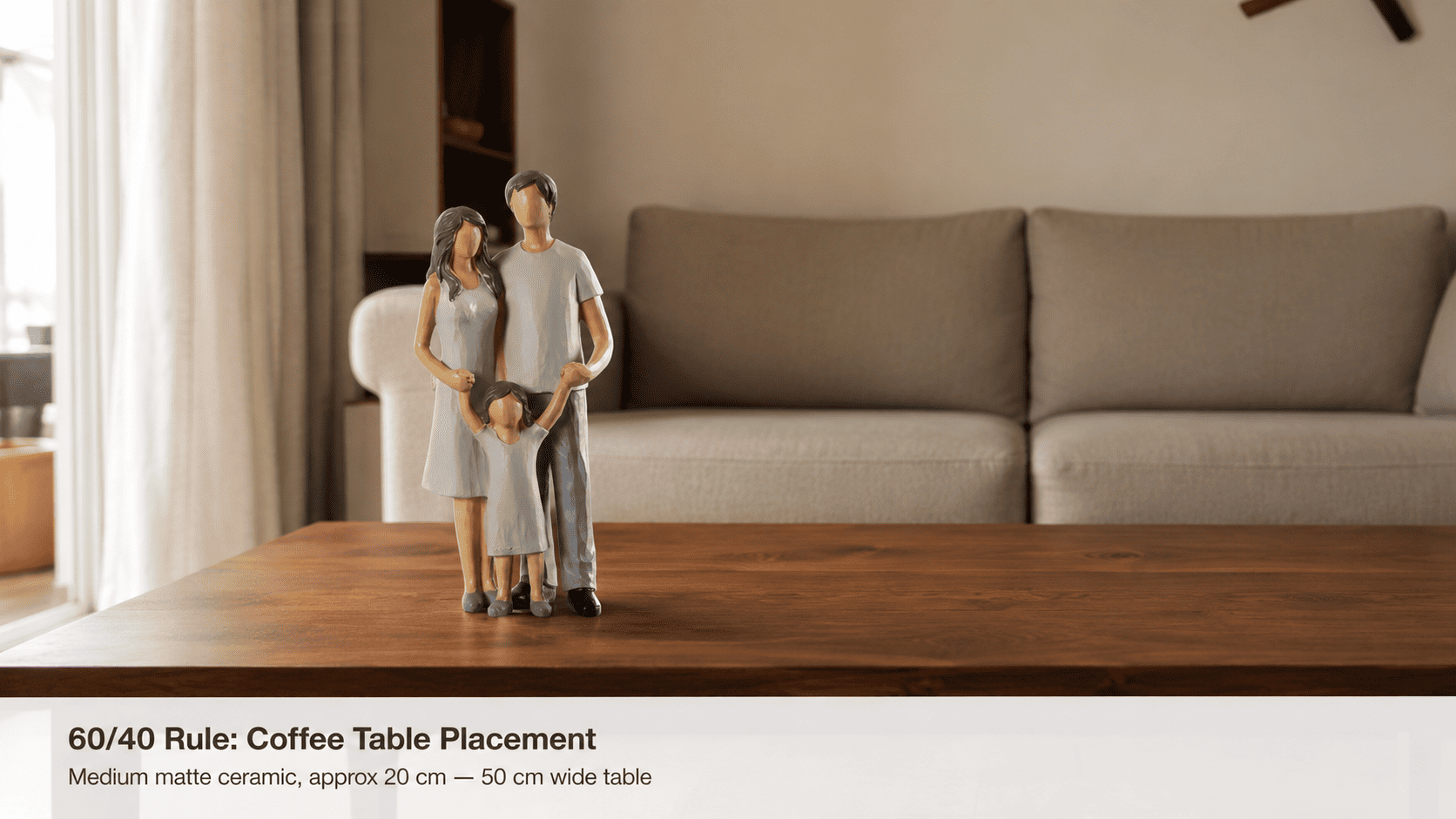
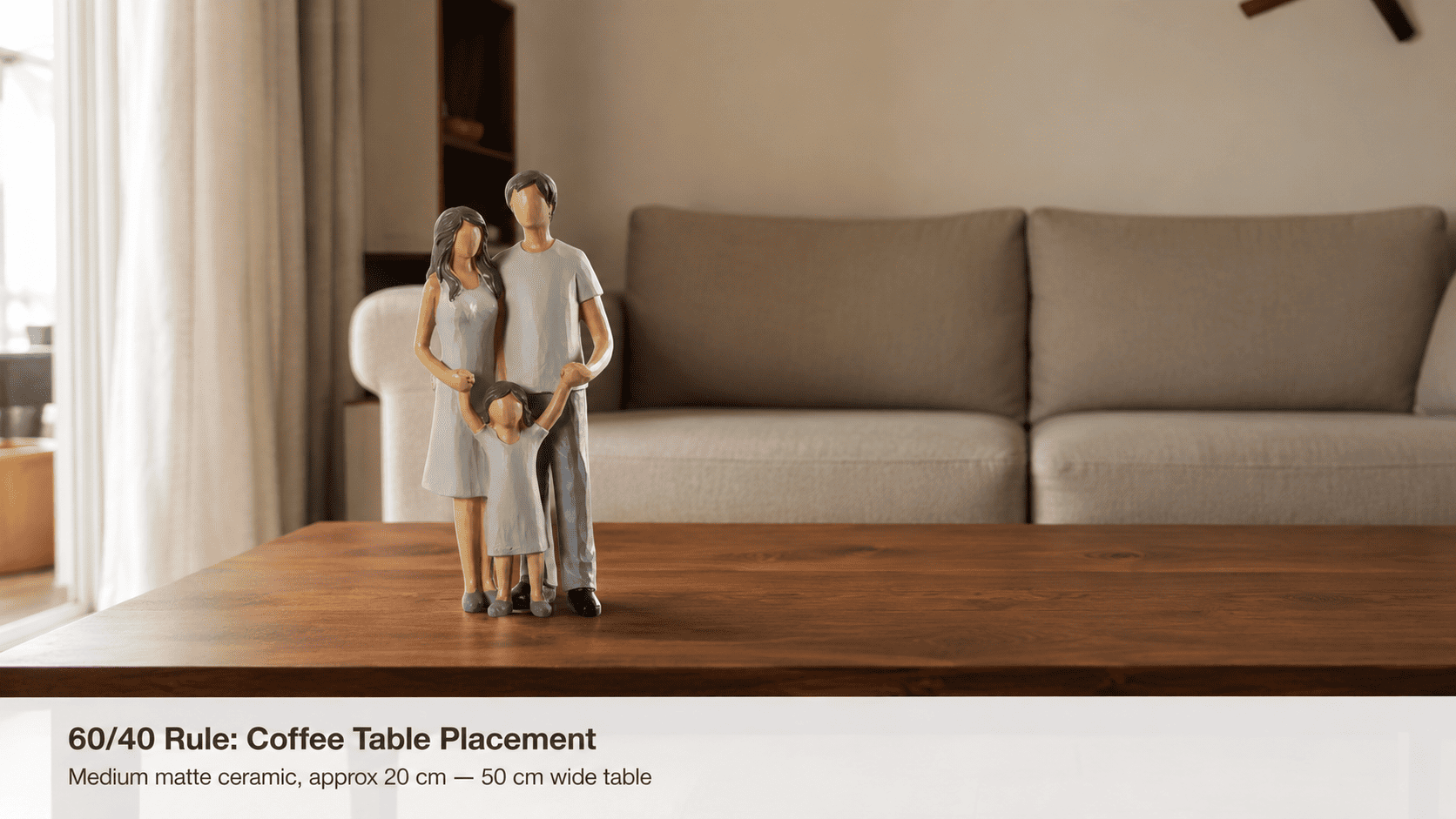
The coffee table, not the shelf, should receive the primary showpiece in a newly set-up Indian living room — because it sits at seated eye level (approximately 40–45 cm from floor to tabletop), which is the only sightline that every person in the room shares simultaneously, making it the most perceptually dominant horizontal surface available.
Indian living room coffee tables average 90–120 cm in length and 45–60 cm in width. A showpiece occupying more than 20% of that surface area creates visual congestion because the eye has no clear resting point when décor competes with functional items like remotes, books, and serving trays. At a coffee table width of 50 cm, a medium showpiece at 16–21 cm height and a footprint under 12 cm diameter occupies the correct proportion — present enough to register, restrained enough to coexist. Moolwan sizes its medium showpieces (16–21 cm) to this exact footprint tolerance using in-house moulding calibrated for Indian apartment furniture scales.
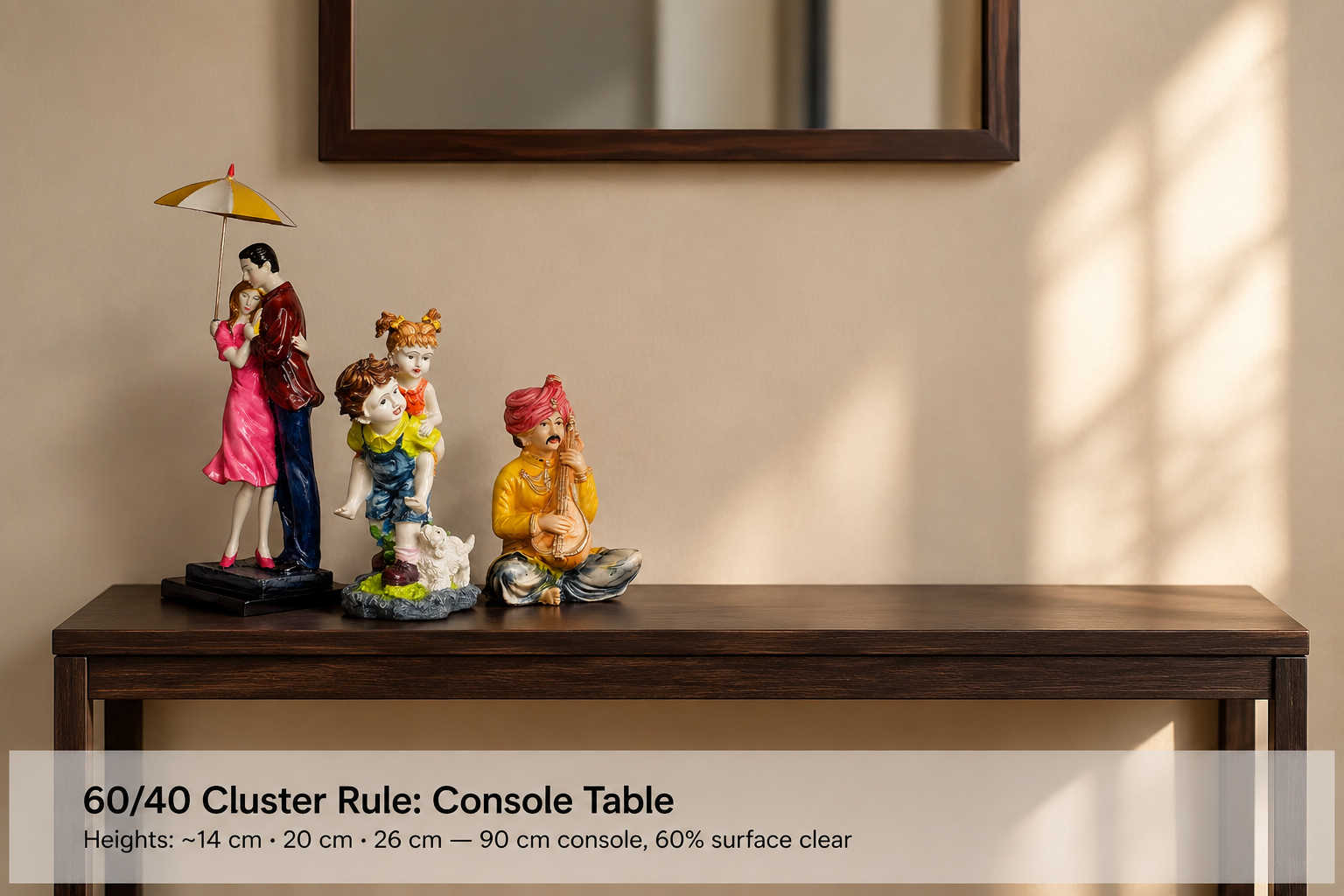
The console table, if present, is the secondary anchor point. At standard console heights of 75–90 cm, a piece in the Large band (25–34 cm) reads correctly because the additional height compensates for the elevated surface and prevents the piece from looking undersized against a wall backdrop. The console's narrower depth (typically 30–40 cm) means depth-heavy sculptural forms should be avoided — flat-backed or low-depth pieces sit flush without overhang risk.
How Do You Choose Between Ceramic and Resin Showpieces for an Indian Living Room?
Material selection for Indian living room showpieces is primarily a climate durability decision, not a purely aesthetic one — because Indian apartments in coastal, humid-belt, and monsoon-affected cities routinely exceed 70% relative humidity (RH) for 4–6 months annually, a threshold at which most low-grade resin formulations begin to show surface micro-cracking and yellowing.
High-density ceramic withstands higher humidity than standard resin because the kiln-firing process vitrifies the clay matrix to a density that resists moisture ingress at the molecular level. Ceramic pieces rated to 85% RH — the threshold achieved by a 92% clay composition — remain dimensionally stable and colour-fast across 5+ years of Indian seasonal cycling. Moolwan's ceramic collection uses exactly this 92% clay composition, drop-tested to 15 cm and heat-resistant to 60°C, which means pieces placed near south-facing windows during summer do not warp, blister, or fade.
Resin showpieces, by contrast, offer superior surface detail, lighter weight (often 150–300 g versus ceramic's 300–600 g range), and a wider palette of translucent or gradient finishes that ceramic cannot replicate. Moolwan's resin collection uses 94% purity epoxy rated to 60% RH and a 3H pencil hardness score — appropriate for non-coastal, air-conditioned living rooms where ambient humidity stays below that threshold year-round. If your living room runs AC through most of the year, resin is a viable and visually richer option. If it doesn't, ceramic is the 5+ year investment.
What Size Showpiece Works for Each Living Room Surface?
Showpiece height must be selected against the surface width and the room footprint together — not independently — because a piece that is correctly scaled to its surface can still overwhelm a small room if its visual mass (the combination of height, colour saturation, and surface texture) exceeds the room's spatial capacity to absorb it.
| Room Footprint | Target Surface | Surface Width | Recommended Showpiece Height | Weight Range |
|---|---|---|---|---|
| Under 100 sq ft | Floating shelf / side table | Under 40 cm | 10–16 cm (Small) | 150–250 g |
| 100–130 sq ft | Coffee table | 45–60 cm width | 16–21 cm (Medium) | 250–400 g |
| 130–160 sq ft | Console table / TV unit top | 60–90 cm | 21–28 cm (Medium-Large) | 350–500 g |
| 160–200 sq ft | Console table / floor shelf | 90–120 cm | 25–34 cm (Large) | 400–600 g |
| 200+ sq ft | Statement corner / floor niche | 120+ cm | 34 cm+ or grouped cluster | 500–600 g per piece |
Because sofa colour, ambient light direction, and existing furniture tones introduce additional visual variables that affect how a showpiece reads in your specific room, browse the full size-band, finish, and material selection in Moolwan's showpiece for living room collection to verify your final piece selection against your actual space.
Design Rule
To prevent visual saturation on any living room surface, Moolwan recommends applying Moolwan's 60/40 Visual Anchor Rule: keep 60% of any horizontal surface completely clear and place showpieces within the remaining 40% — because the eye requires unoccupied negative space to perceive the displayed object as a deliberate focal point rather than as clutter. Without that cleared 60%, even a well-chosen piece reads as part of accumulated mess rather than as intentional décor.
Matte Finish or Glazed Finish — What Works Better in Indian Living Rooms?
Matte finishes outlast glazed finishes in Indian living rooms by a measurable margin because micro-scratches from daily handling scatter light unevenly across a matte surface, rendering surface wear invisible to the naked eye at year three — whereas glazed surfaces reflect light uniformly and highlight every micro-abrasion as a visible dull streak against the surrounding gloss.
Glazed finishes, however, carry a specific advantage in lower-light Indian living rooms where north-facing or interior-facing windows limit natural illumination. The glaze's light-reflective quality amplifies ambient light, making a piece appear more visually present in a dim corner than an equivalently sized matte piece would. The trade-off is that glazed pieces require more deliberate placement away from direct afternoon sunlight through west-facing windows — because sustained UV exposure at temperatures above 40°C can cause surface yellowing in lower-grade glaze formulations over a 2–3 year horizon.
Ready to bring home a showpiece engineered to last 5+ years in Indian humidity and seasonal temperature swings? Shop the full Moolwan showpiece for living room collection now — manufacturer-direct, climate-rated, and sized for Indian apartment surfaces.
How Many Showpieces Does a New Indian Living Room Need?
A newly set-up Indian living room of 100–160 sq ft reaches visual completeness with three to four showpieces distributed across two or three distinct surfaces — because the eye constructs a sense of interior coherence through repeated visual cues across a room, and fewer than three pieces produces a space that reads as unfinished, while more than five creates perceptual noise that undermines each individual piece's impact.
The recommended starting configuration for most Indian urban apartments is: one medium piece (16–21 cm) on the coffee table as the room's primary anchor, one large piece (25–34 cm) on the console table or wall shelf as the secondary statement, and one cluster of two small pieces (10–16 cm each) on a floating shelf or side table as a supporting note. This three-surface distribution prevents any single surface from becoming overcrowded and ensures the room reads as layered rather than sparse or over-decorated.
Within a cluster of small pieces, the height differential between adjacent pieces should be at least 4–6 cm — because uniform height within a group eliminates the visual rhythm that makes a cluster feel intentional. A cluster where every piece stands at 12 cm reads as a row of identical objects; the same cluster where pieces stand at 10 cm, 14 cm, and 16 cm reads as a curated composition.

Frequently Asked Questions
What is the right size showpiece for a small Indian living room under 120 sq ft?
In a living room under 120 sq ft, the maximum recommended showpiece height for a coffee table is 16–21 cm (Medium band), with a footprint under 12 cm diameter — because compact rooms have a reduced depth-of-field between the primary seating position and the focal surface, meaning visual mass registers more intensely than it would in a larger room. A piece exceeding 21 cm in this footprint creates a scale mismatch that makes the room feel crowded rather than curated. Weight should stay under 400 g to prevent surface-tip risk on narrow or lightweight Indian coffee tables.
Can resin showpieces survive Indian monsoon humidity?
Standard resin formulations rated below 60% RH will show surface micro-cracking and a gradual yellowing of light-coloured finishes after 2–3 monsoon seasons in coastal or high-humidity-belt Indian cities, because humidity ingress at the molecular level disrupts the epoxy cross-linking matrix that gives resin its surface hardness. High-purity 94% epoxy resin rated to 60% RH with a 3H pencil hardness score — the specification used in Moolwan's resin collection — remains dimensionally stable in air-conditioned rooms where ambient humidity is managed below that threshold. For unconditioned spaces in Mumbai, Chennai, or Kolkata, ceramic at 85% RH tolerance is the climate-appropriate default.
Should living room showpieces match the wall colour or contrast with it?
Showpieces should contrast with the wall by at least two tonal steps rather than match it — because a piece that merges tonally with the wall behind it loses legibility as a three-dimensional object and reads instead as a wall texture. In Indian apartments where off-white, beige, and greige are the dominant wall tones, warm earth ceramic (terracotta, ochre, sand) provides the minimal contrast required without producing visual tension, while deep-toned resin pieces in charcoal, slate, or forest green create stronger contrast suitable for rooms with a defined accent wall or bolder furniture palette.
How many showpieces is too many for an Indian living room coffee table?
The maximum recommended count on a standard Indian coffee table (90–120 cm length) is two pieces — one medium anchor piece (16–21 cm) and one small complementary piece (10–16 cm) — because the coffee table also functions as a surface for daily objects including remotes, books, and beverages. Exceeding two showpieces on a coffee table forces functional items onto the floor or sofa, degrading liveability. The visual goal on this surface is intentional accent, not comprehensive display — save cluster compositions for the console table or floating shelf where the surface has no competing functional role.
A showpiece that is climate-rated, correctly sized for an Indian apartment surface, and built from high-fired 92% clay ceramic or 94% purity epoxy resin eliminates the replacement cycle that makes low-grade décor expensive over a 5-year horizon. Bring home your first living room anchor piece from the Moolwan showpiece for living room collection — manufacturer-direct, no distributor markup, sized for the surfaces you actually have. If you are also furnishing the wider room, browse complementary pieces in Moolwan's full living room items collection, or explore curated solutions designed specifically for compact apartment proportions in Moolwan's luxury interior décor range for small living rooms.


