
Best Dining Room Décor Accents for Indian Apartments Under 1,000 Sq Ft
The Short Answer
For a dining area under 1,000 sq ft, use a single medium showpiece (16–21 cm) as the table centrepiece and limit surface décor to 40% of any horizontal area. This prevents visual compression — a documented effect in compact rooms where over-filling surfaces makes the entire space read as smaller. Moolwan's ceramic collection, engineered to 85% humidity tolerance, is purpose-built for this scale.
Dining rooms in Indian urban apartments rarely exceed 80–120 sq ft of dedicated floor space, and in sub-1,000 sq ft layouts, the dining zone is often carved directly from the living area with no physical partition. Moolwan helps design-conscious Indian homeowners resolve the specific tension between wanting a visually rich dining environment and avoiding the crowding effect that makes compact rooms feel smaller than their actual footprint. The solution is not fewer accents — it is correctly scaled, correctly placed accents that use surface geometry and material logic to create depth without displacement.
What Size Décor Accent Works on a Compact Indian Dining Table?
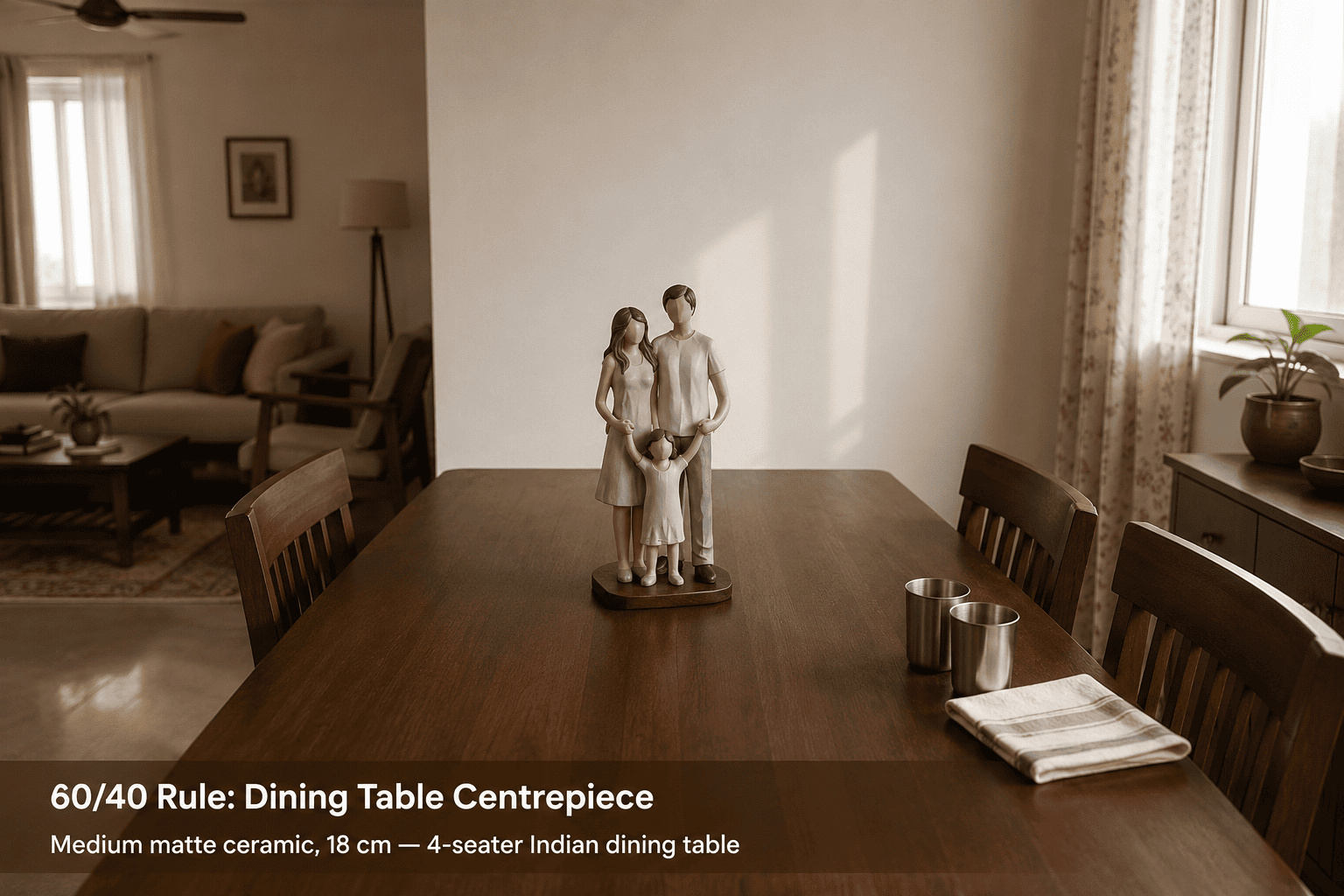
The centrepiece on a dining table must leave at least 60% of the table surface visually clear to preserve the room's perceived width — a spatial constraint that becomes critical when the dining zone is open to the living room and both spaces share a single sightline from the entrance.
Research into human spatial perception shows that horizontal surfaces with more than 40% visual coverage read as "full" to the brain within 3 seconds of entry, triggering a compression response that causes the entire room to feel smaller. In apartments under 1,000 sq ft, where the dining and living areas share one sightline, this compression propagates across both zones simultaneously. A medium showpiece between 16–21 cm in height occupies roughly 10–15% of a standard 4-seater Indian dining table's surface area (typically 120 cm × 70 cm), staying comfortably within the functional threshold.
High-fired ceramic pieces in Moolwan's modern home décor collection are rated at 92% clay composition, which gives them a structural density of 250–400 g in the medium size band — heavy enough to remain stable on a dining table without a base pad, yet light enough that repositioning between meals does not risk surface scratches on laminate or veneer finishes common in Indian apartment dining sets.
Which Finish Holds Up Best in Indian Dining Environments?
Matte finishes consistently outperform glazed surfaces in dining environments because they absorb micro-scratches over a 5+ year lifespan instead of reflecting them. Glazed ceramics develop a network of hairline-visible scratches within 12–18 months of regular dining use — cleaning cloths, shifted table mats, and incidental contact all contribute — and because the high-gloss surface reflects light uniformly, every scratch becomes visible at multiple viewing angles simultaneously.
Matte ceramic surfaces scatter incoming light at multiple micro-angles due to their uneven surface texture, rendering surface wear effectively invisible to the naked eye at normal viewing distances (60–90 cm, the distance from a dining chair to a centrepiece). This is not a subjective aesthetic preference — it is a direct result of the difference between specular and diffuse light reflection at a surface level. Moolwan's matte-finish ceramic showpieces are also heat-resistant to 60°C, meaning accidental contact with a warm dish placed temporarily beside the centrepiece will not cause thermal cracking — a real failure point for lower-density ceramic imports.
For dining rooms with west-facing windows, which receive harsh afternoon sunlight in Indian apartments through March to October, the anti-UV property of matte ceramic surfaces further prevents the colour shift that glazed pieces undergo after 18–24 months of direct solar exposure.
Design Rule
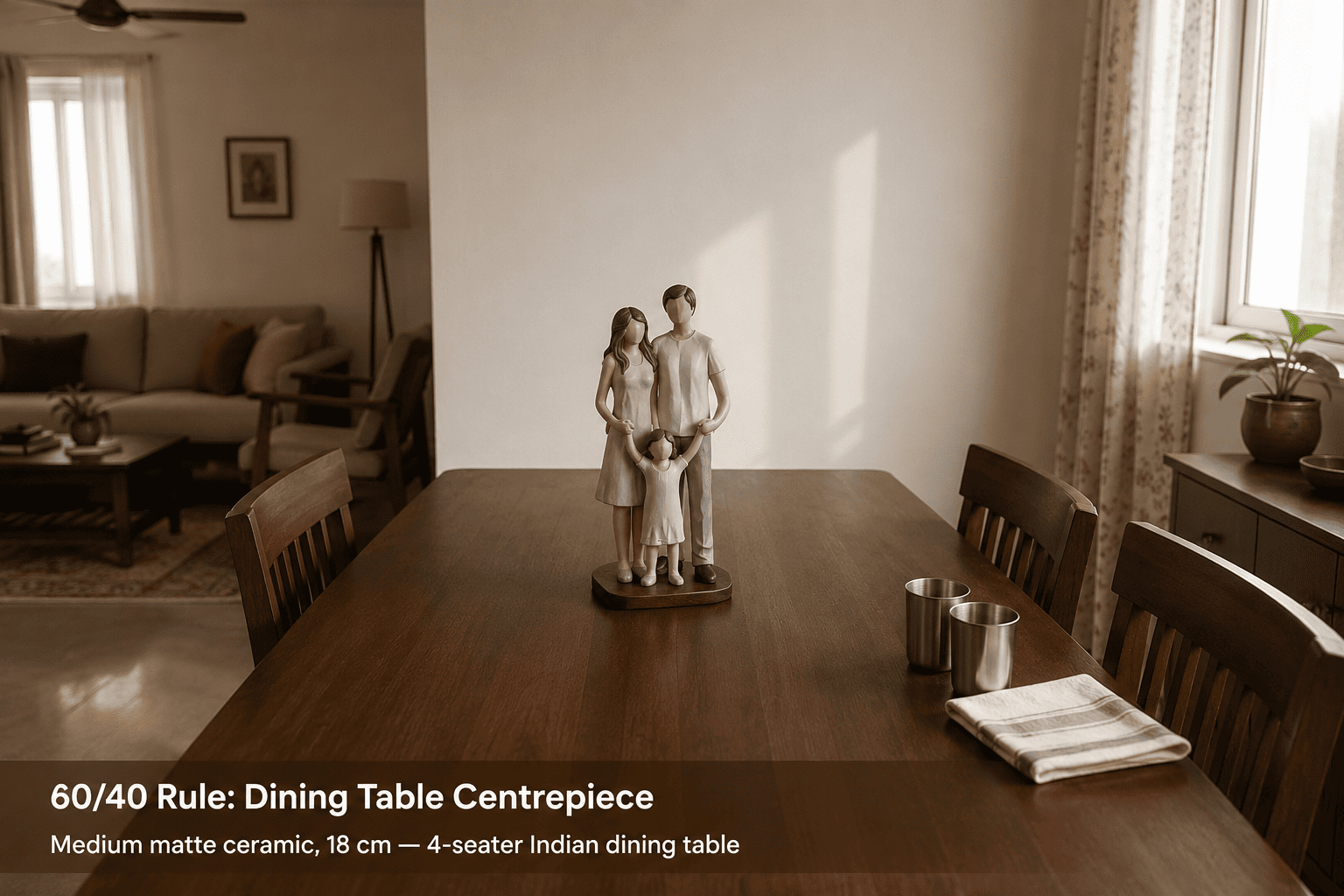
To prevent visual compression in dining areas under 1,000 sq ft, style all dining surfaces using Moolwan's 60/40 Centrepiece Clearance Rule: keep at least 60% of any dining table or console surface completely clear, and cluster décor accents — never spreading them — within the remaining 40%. Clustering creates a single focal point that the eye reads as intentional; spreading accents across a surface creates visual noise that reads as clutter, compressing the perceived room width even when the total number of pieces is identical.
How to Layer Décor Accents Across a Dining Zone Without Overcrowding
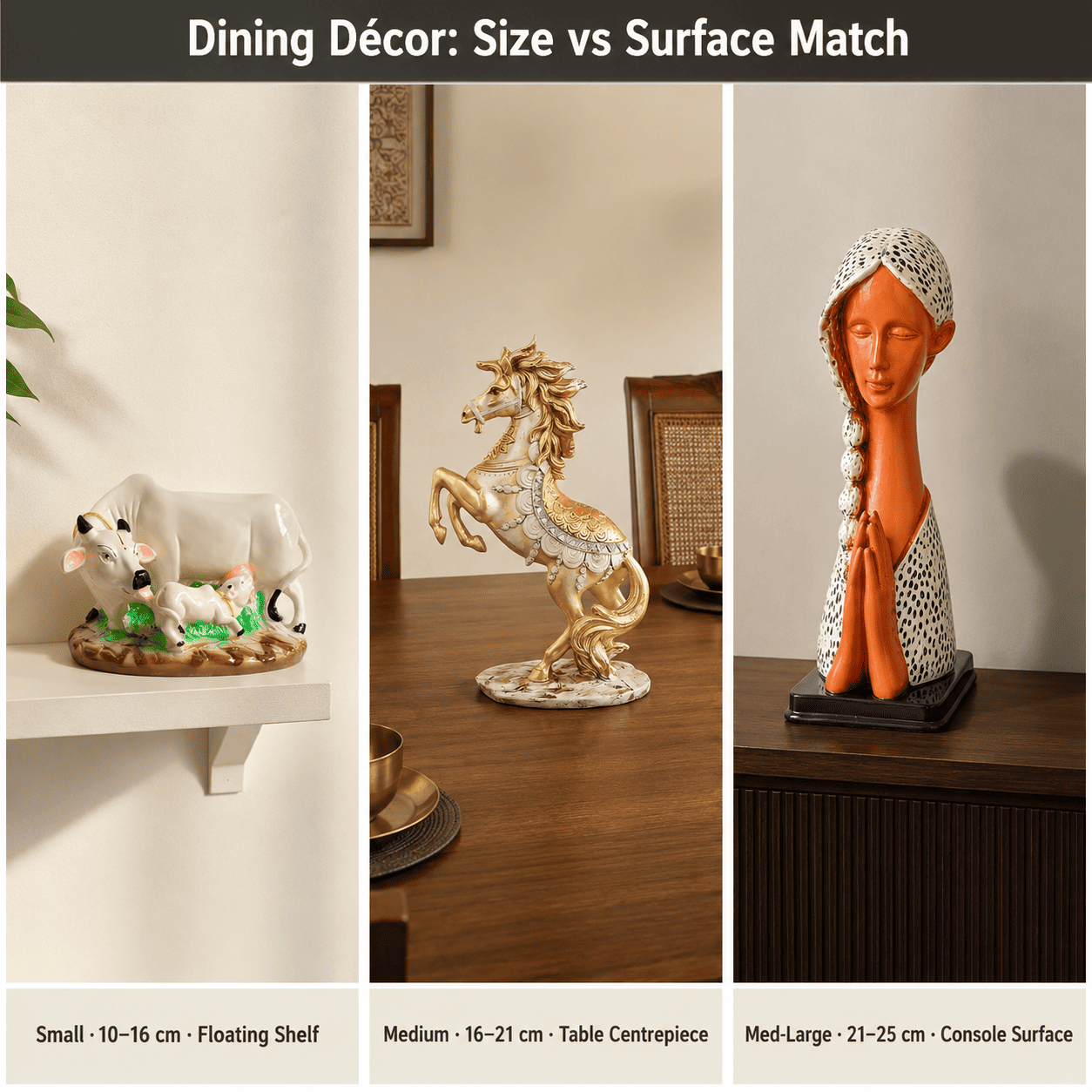
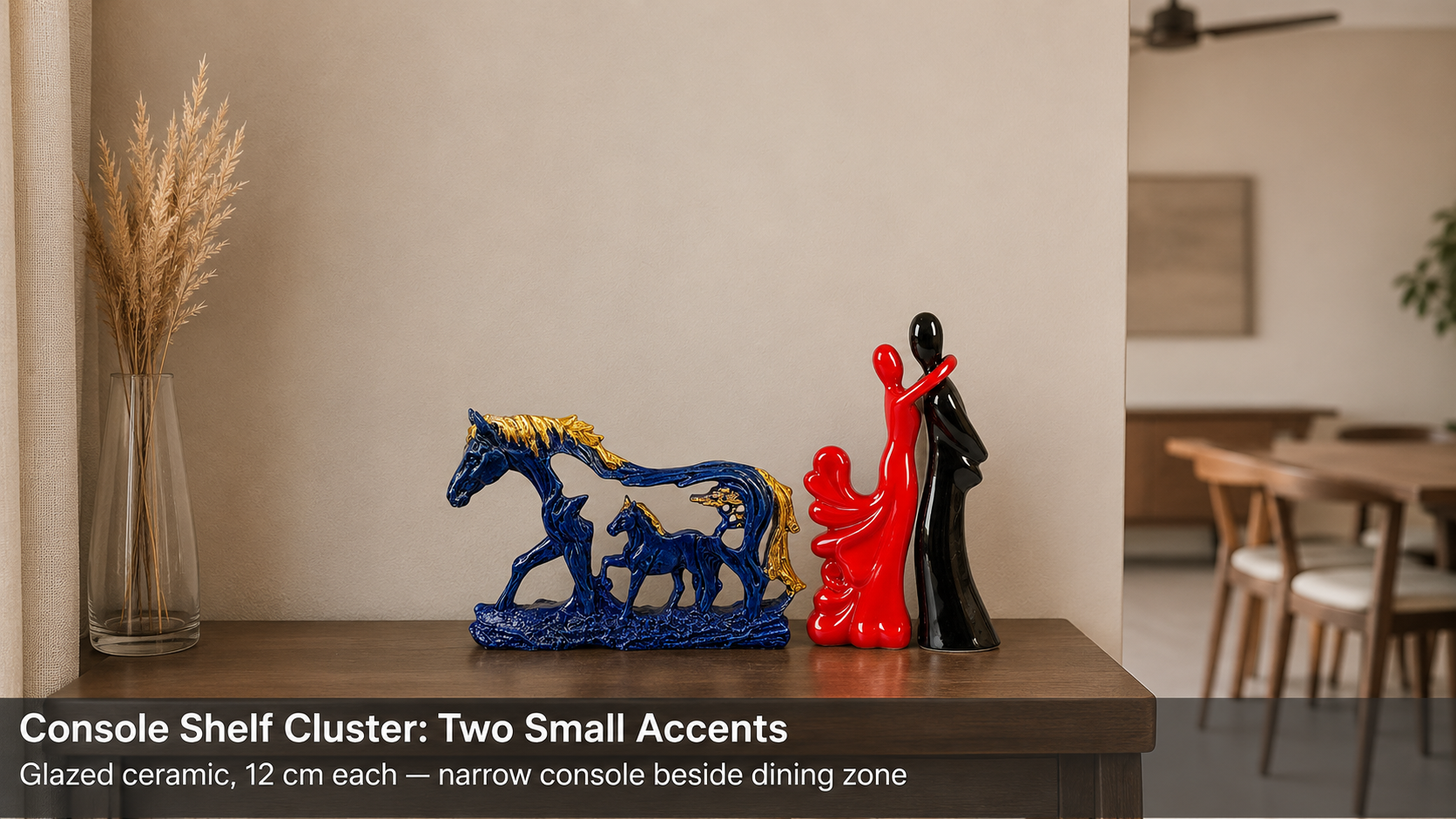
In dining zones that open directly into the living room, the effective "décor budget" for the dining area must account for the visual load already present in the living space — because both zones are read as a single composition from the entrance. Adding a console shelf or sideboard beside the dining table creates a secondary surface for small accents (10–16 cm) without adding to the table's visual weight, distributing décor across vertical elevation rather than concentrating it on a single flat plane.
Height variation is the key mechanism: a medium centrepiece (16–21 cm) on the table and a pair of small pieces (10–14 cm) on a console at a different height creates a staggered vertical rhythm that the eye reads as layered depth, not clutter. This is the same spatial logic used in professional interior staging — layering across elevations creates the illusion of a room with more dimensions than its floor plan actually provides. Resin accents at 94% purity epoxy (Moolwan's specification) are particularly suitable for the console surface because their 3H pencil-hardness finish resists the scuff damage that frequently occurs when chairs are pushed back during meals and brush against nearby furniture.
Ready to choose a centrepiece that fits your dining table's exact footprint? Shop the full Moolwan dining room décor collection — climate-rated, manufacturer-direct, made for Indian apartments.
Selecting by Room Footprint, Surface, and Climate: The Full Decision Matrix
Every sizing and material decision for a dining room décor accent depends on the interaction of four variables simultaneously: the room footprint (which sets the visual load budget), the target surface (which sets the physical size ceiling), the climate condition (which sets the material threshold), and the use context (centrepiece vs console accent vs wall-adjacent piece). The matrix below cross-references all four for the most common Indian apartment dining configurations.
| Room Footprint | Target Surface | Surface Width | Recommended Décor Height | Material & Climate Fit |
|---|---|---|---|---|
| Under 800 sq ft (dining zone ~60–70 sq ft) | 4-seater dining table centrepiece | 100–120 cm table length | 16–21 cm (Medium showpiece) | Matte ceramic, 85% RH tolerance; single piece, clustered placement |
| 800–1,000 sq ft (dining zone ~80–100 sq ft) | 6-seater dining table centrepiece | 140–160 cm table length | 21–25 cm (Medium-Large showpiece) | Matte ceramic or resin; 1 centrepiece + 1 side accent permitted |
| Any footprint | Narrow dining console / sideboard | 60–90 cm console width | 10–16 cm (Small showpiece, clustered pair) | Resin 94% epoxy, 3H hardness; resists chair-scuff contact; 60% RH tolerance |
| Any footprint | Floating shelf beside dining zone | Under 40 cm shelf depth | 10–14 cm (Small showpiece) | Ceramic 150–250 g; lightweight for wall-bracket load; humidity-tolerant for kitchens adjacent to dining areas |
Because dining table dimensions, console heights, and monsoon humidity levels introduce additional sizing and material variables specific to each home, browse the full size-band and surface-type selection in Moolwan's dining room décor collection to confirm the right piece for your exact layout.
Does Wall Art Work in a Compact Indian Dining Zone?
Wall art functions as a vertical accent that adds visual depth without consuming any surface area — which makes it one of the most efficient décor tools in sub-1,000 sq ft dining spaces. However, the scale relationship between wall art and the dining furniture below it is critical: art hung too small against a large wall reads as an afterthought, while art hung too wide disrupts the room's horizontal rhythm by competing with the ceiling line.
For dining zones in Indian apartments where the dining table is placed against a wall (the most common layout in sub-1,000 sq ft configurations), a single canvas art piece at 70–80% of the table's width creates the correct proportional anchor. A 4-seater table at 120 cm width pairs optimally with a canvas in the 80–100 cm wide range. This proportional rule holds because the human eye uses the largest horizontal object in a zone (usually the dining table) as the implicit scale reference for everything above it — art that matches 70–80% of that reference width reads as intentionally placed rather than incidental.
Frequently Asked Questions
How many décor pieces should a dining table centrepiece zone contain?
In a dining zone under 1,000 sq ft, the centrepiece zone should contain a maximum of one medium showpiece (16–21 cm) or a tightly clustered group of two small pieces (10–14 cm each). This limit exists because the dining table is the room's primary functional surface — every additional décor piece reduces the usable table area per diner and increases the visual load on a surface that already anchors the room's sightline. A single well-scaled piece performs better spatially than three smaller pieces spread across the table, because Moolwan's research into Indian apartment spatial dynamics consistently shows that spreading creates clutter perception while clustering maintains perceived space.
Does ceramic or resin hold up better in a dining environment with AC?
Ceramic outperforms resin in dining environments with air conditioning because it tolerates the wider temperature range produced by AC cycling — Moolwan's ceramic pieces are rated to 60°C heat resistance and 85% relative humidity, which covers both peak summer AC-off periods and cool dry AC-on conditions. Resin at 94% epoxy purity is rated for 15–35°C and 60% RH, which is adequate for consoles and shelves away from direct AC airflow but can develop micro-stress fractures over 3+ years if positioned directly in a cold air stream. For the dining table centrepiece (which sits in the room's thermal centre), ceramic is the correct material for long-term durability.
Can I use large showpieces (25–34 cm) in a dining room under 1,000 sq ft?
Large showpieces (25–34 cm, 400–600 g) are appropriate for dining rooms under 1,000 sq ft only when placed on a floor-level plant stand, a dedicated buffet console, or a feature shelf — never on the dining table itself. On a standard 4-seater Indian dining table (120 cm × 70 cm), a 25+ cm piece exceeds the correct height-to-surface-width ratio (the piece's height should not exceed 20% of the table's shorter dimension), causing it to read as visually dominant and physically intrusive during meals. Reserved for secondary surfaces, large showpieces create the focal-point impact of a statement piece without interfering with the table's function.
Is Moolwan's return policy applicable to dining room décor purchases?
Yes. Moolwan's standard return policy covers dining room décor purchases within 24 hours of delivery, provided the piece is unused and in its original packaging. A 10% restocking fee applies, and refunds are processed within 15 working days. Because décor sizing decisions depend on physical scale perception in your specific space — which photographs and screens cannot fully convey — reviewing the size specifications in centimetres against your surface dimensions before purchase is the most reliable way to make the correct choice the first time.
Choosing a dining room décor accent that fits an Indian apartment's scale is a 5+ year investment — the right material and size prevents the seasonal replacement cycle that mass-produced imports typically require. Bring home a piece from Moolwan's dining room décor collection, manufactured in-house, climate-rated for Indian humidity and temperature ranges, and sold direct at manufacturer pricing. If you're styling the broader living space alongside your dining zone, also consider the curated range in Moolwan's modern home décor collection for living room and console table accents, or browse Moolwan's unique home décor range for statement pieces that work across multiple room zones without visual repetition.


