
Most furniture layout advice is written for standard 180–220 sq ft rooms, so it collapses when a living room crosses 300 sq ft. We help design-conscious Indian homeowners take that extra floor area — the kind found in independent houses, duplexes and larger apartment layouts — and turn it into a room that reads as intentional, not half-furnished.
01 Why oversized rooms feel empty without zoning
A single sofa-and-coffee-table arrangement is sized for a room under 220 sq ft. Placed inside a larger room and pushed to the walls, it leaves a dead zone of floor in the middle, and every conversation happens shouting distance apart. The room reads as under-furnished even when it technically has enough furniture in it.
The fix is not more furniture — it's grouping. Any living room past roughly 300 sq ft (about 28 sq m) needs at least two functional zones, each with its own rug, seating cluster and sightline, connected by a clear walking path. This is standard practice in Indian duplex and independent-house layouts, where living rooms routinely run 350–500 sq ft.
Splitting the room into zones also solves a problem specific to Indian homes: a single oversized wall art piece or one showpiece cluster can't visually anchor a room this size on its own. Each zone needs its own focal point, sized to that zone rather than the whole room.
02 The 3-zone layout formula
Use this order — it's sequential because each zone is sized against the one before it, starting from the entry sightline.
- Conversation zone. The primary sofa set, facing inward on a rug at least 8ft across (large enough for all front legs of the seating to sit on it). This is the zone visible from the entry.
- Secondary lounge or media zone. A smaller cluster — two chairs, a media unit, or a reading nook — set 6–8ft from the primary zone, on its own smaller rug so the two zones read as separate rooms-within-a-room.
- Display or console zone. A console table, shelf unit or feature wall, styled with showpieces and wall art at a scale that matches the wall it sits on, not the room's overall size.
Keep a minimum 30–36 inch walkway between zones. Anything narrower forces people to turn sideways; anything past 42 inches starts to feel like a hallway cutting the room in half.
03 Sizing each zone correctly
Conversation zone: rug and clearance
The rug should extend at least 12–18 inches beyond the sofa on each side, with all seating either fully on the rug or with just the front legs on it. Leave 14–18 inches between the sofa and coffee table, and at least 30 inches of clear space behind any chair that needs to be pulled out.
Display zone: scaling wall art and showpieces to the wall
A focal wall in an oversized room needs artwork sized to the wall, not the sofa below it — undersized art on a large wall is the single most common mistake in big Indian living rooms. As a working rule, wall art should span 60–75% of the furniture or wall segment it sits above.
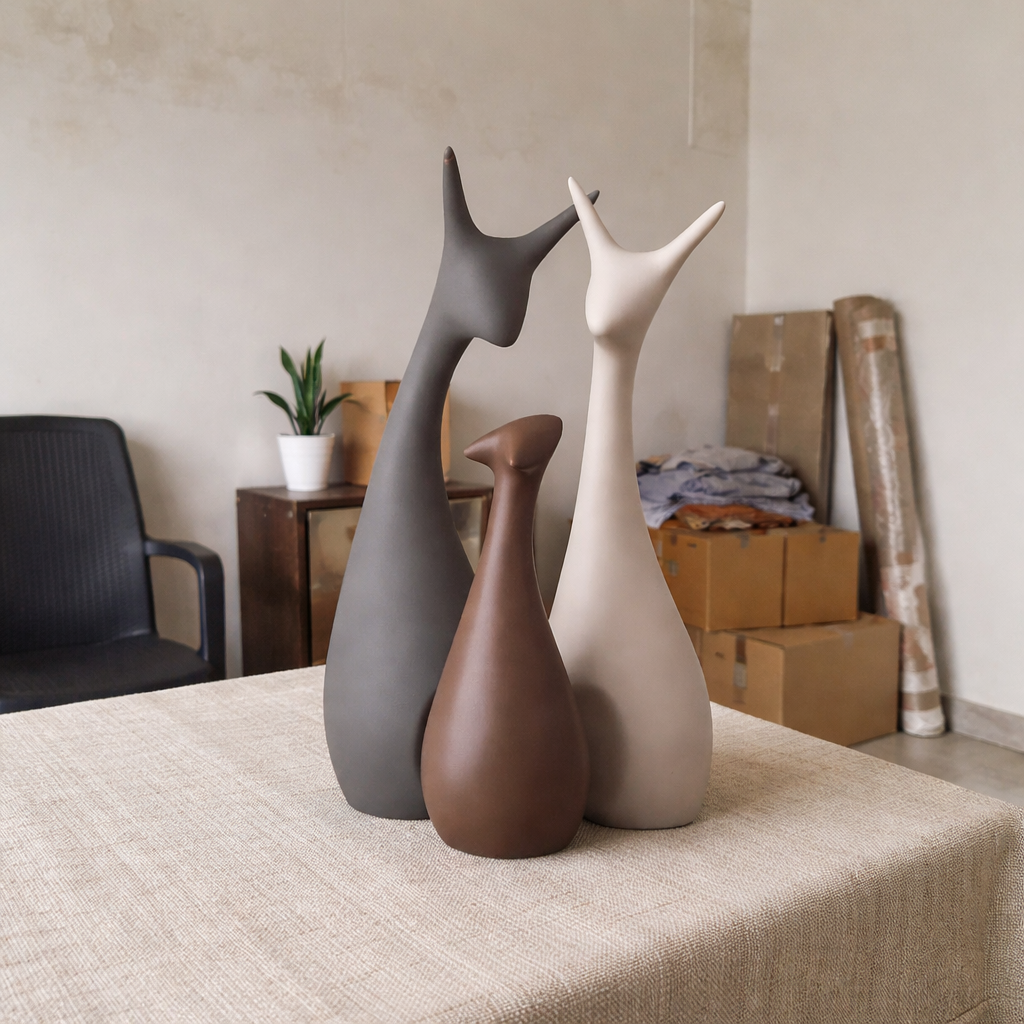
For console and shelf styling within the display zone, group showpieces in odd numbers at mixed heights: one large piece (25–34cm) as the anchor, one medium (16–21cm), and one small (10–16cm) for the shelf edge. Shop showpieces for your living room console in matte or glazed finishes engineered for Indian humidity up to 85% RH.
Media or secondary lounge: keeping it from feeling like an afterthought
This zone fails most often when it's furnished as leftover space rather than a destination. Give it its own rug, its own lighting, and one deliberate decor moment — a curated object or a small gallery cluster — so it reads as a second room, not a corridor with a chair in it. Explore Moolwan's curated unique home decor pieces to give this zone a reason to sit down in it.
04 Zone-based vs. wall-hugging vs. symmetrical layouts
| Layout type | Best for | Walkway needed | Focal point strategy | Common failure |
|---|---|---|---|---|
| Zone-based (recommended) | Rooms 300+ sq ft, rectangular or L-shaped | 30–36" between each zone | One focal piece per zone, scaled to that zone | Zones placed too close, merging into one |
| Wall-hugging | Rooms under 220 sq ft | Center left fully open | Single TV or art wall for the whole room | Dead, unused floor in the middle on larger rooms |
| Symmetrical | Formal, square rooms with a strong centerline | Even spacing on both sides | Matched pairs; one central anchor piece | Feels stiff in irregular or L-shaped Indian floor plans |
05 Layout mistakes that keep an oversized room feeling empty
- Center-facing furniture floating with no rug. Without a rug to anchor it, even a well-placed sofa cluster looks like it's drifting in the room.
- One small painting on a double-height or extra-wide wall. Undersized art disappears against extra wall area; scale up or use a gallery cluster instead.
- Skipping the second zone entirely. One large conversation cluster in a 400 sq ft room still leaves 150+ sq ft of unused, awkward floor.
- Walkways under 24 inches. Technically passable, but it reads as clutter rather than a considered path between zones.
Moolwan designs and manufactures modern home decor, wall art and curated gifts for Indian homes — engineered for local climate, sized for Indian rooms, and sold factory-direct without middleman markup. That's what Moolwan stands for, and it's the reasoning behind the sizing guidance above.


