
Best Lighting Ideas for a Luxurious Living Room in Indian Homes
The Short Answer
A luxurious living room layers three light temperatures — 2700K ambient, 3000K task, and warm 3000K accent — because mixed warm tones mimic natural daylight transitions the eye reads as depth rather than flat office-style lighting. Moolwan recommends pairing this layering with medium matte ceramic or resin accents (16–21 cm) that diffuse warm light evenly, rather than glossy finishes that bounce hard glare across the room.
Light temperature, measured in Kelvin (K), determines whether a room reads as warm and high-end or clinical and flat: temperatures between 2700K and 3000K replicate the amber glow associated with hospitality-grade interiors, while anything above 4000K reads closer to office fluorescence. Moolwan helps design-conscious Indian homeowners translate this lighting science into finished rooms by curating matte and glazed décor accents engineered to scatter warm light evenly instead of throwing hard, distracting glare across a small living room.
Why does light temperature matter more than brightness in a luxury living room?
Light temperature shapes perceived luxury more strongly than raw brightness, because warm-toned light between 2700K and 3000K triggers the same comfort response in the eye that firelight and candlelight do. A 1500-lumen warm bulb can feel cosier than a 2500-lumen cool-white bulb in the same room, because colour temperature — not lumen count — is what the brain associates with relaxation versus alertness.
This is why a single bright ceiling light, however powerful, often reads as cold rather than luxurious: one uniform high-intensity source flattens shadows and removes the depth cues a room needs to feel layered. Moolwan's modern home décor collection is finished in matte and softly glazed surfaces specifically because matte ceramic diffuses this warm light across a wider angle than glossy resin, which instead creates a single hard reflection point.
How should ambient, task, and accent lighting be layered in a small living room?
Three distinct light sources read as luxurious because each one fills a different shadow gap the others leave behind, while a single source leaves the far corners of a sub-150 sq ft Indian living room visibly darker than the centre. Ambient light (ceiling or cove, 2700K–3000K) sets the room's base tone; task light (a floor or table lamp) handles reading or seating zones; accent light highlights a console, shelf, or showpiece.
Because Indian apartment living rooms are frequently under 150 sq ft, the accent layer carries more visual weight per square foot than in larger Western layouts. Choosing a décor accent that physically sits within the throw of a lamp — rather than across the room from it — means the same bulb does double duty as both task and accent light, which is a meaningful cost saving without buying an additional fixture.
| Living Room Footprint | Lighting Setup | Recommended Accent Height | Weight Range |
|---|---|---|---|
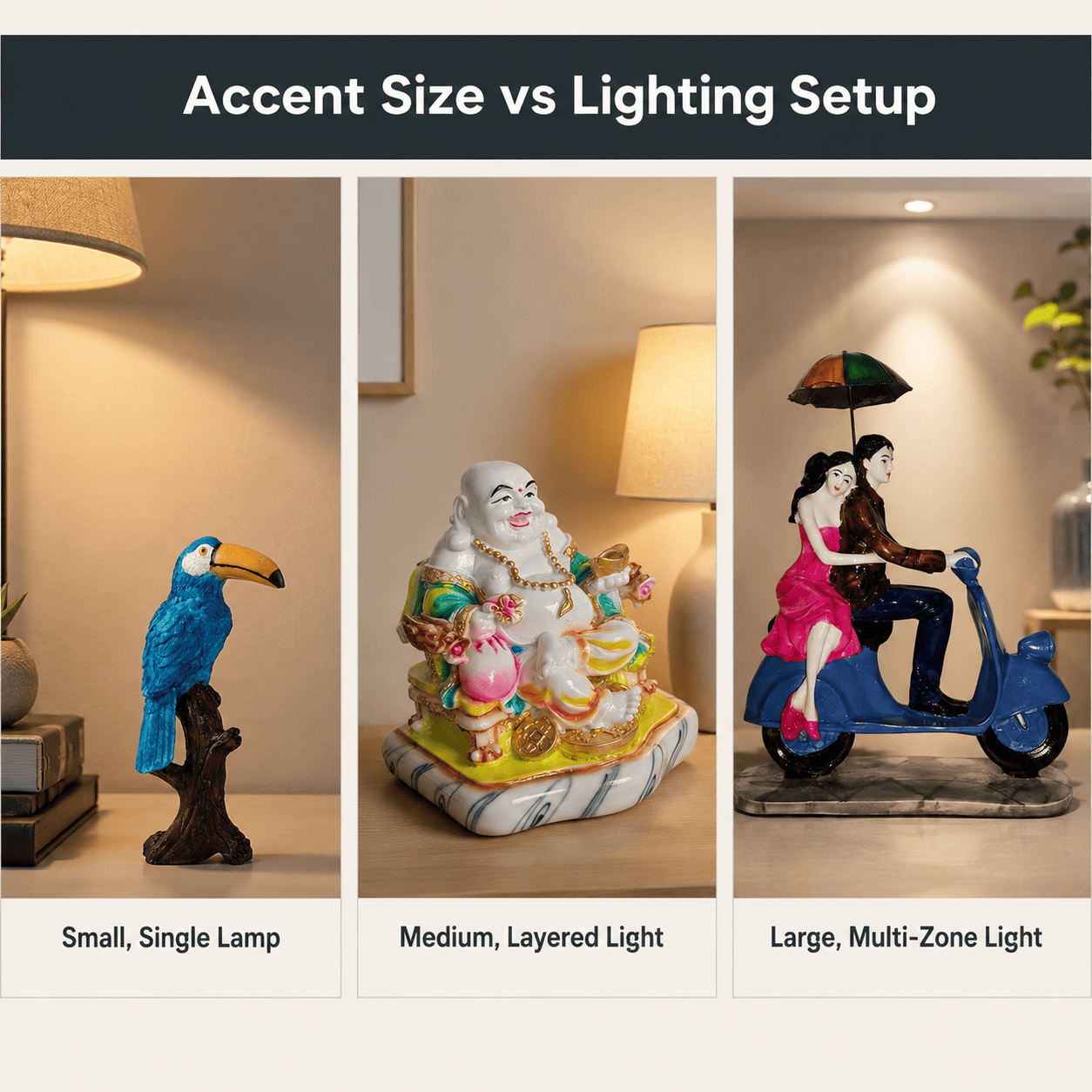
| Sub-100 sq ft | Single warm floor lamp (2700K) + ceiling light | Small accent, 10–16 cm | 150–250 g |
| 101–180 sq ft | Floor lamp + table lamp + cove lighting (2700K–3000K mix) | Medium accent, 16–21 cm | 250–400 g |
| 181+ sq ft / open-plan | Multi-zone ambient, task, and accent (3-source minimum) | Large focal accent, 25–34 cm | 400–600 g |
Because room footprint, light source type, and accent placement distance interact differently in every apartment layout, browse the full size-band, finish, and material selection in Moolwan's modern home décor collection to match an accent piece to your specific lighting setup.
Design Rule
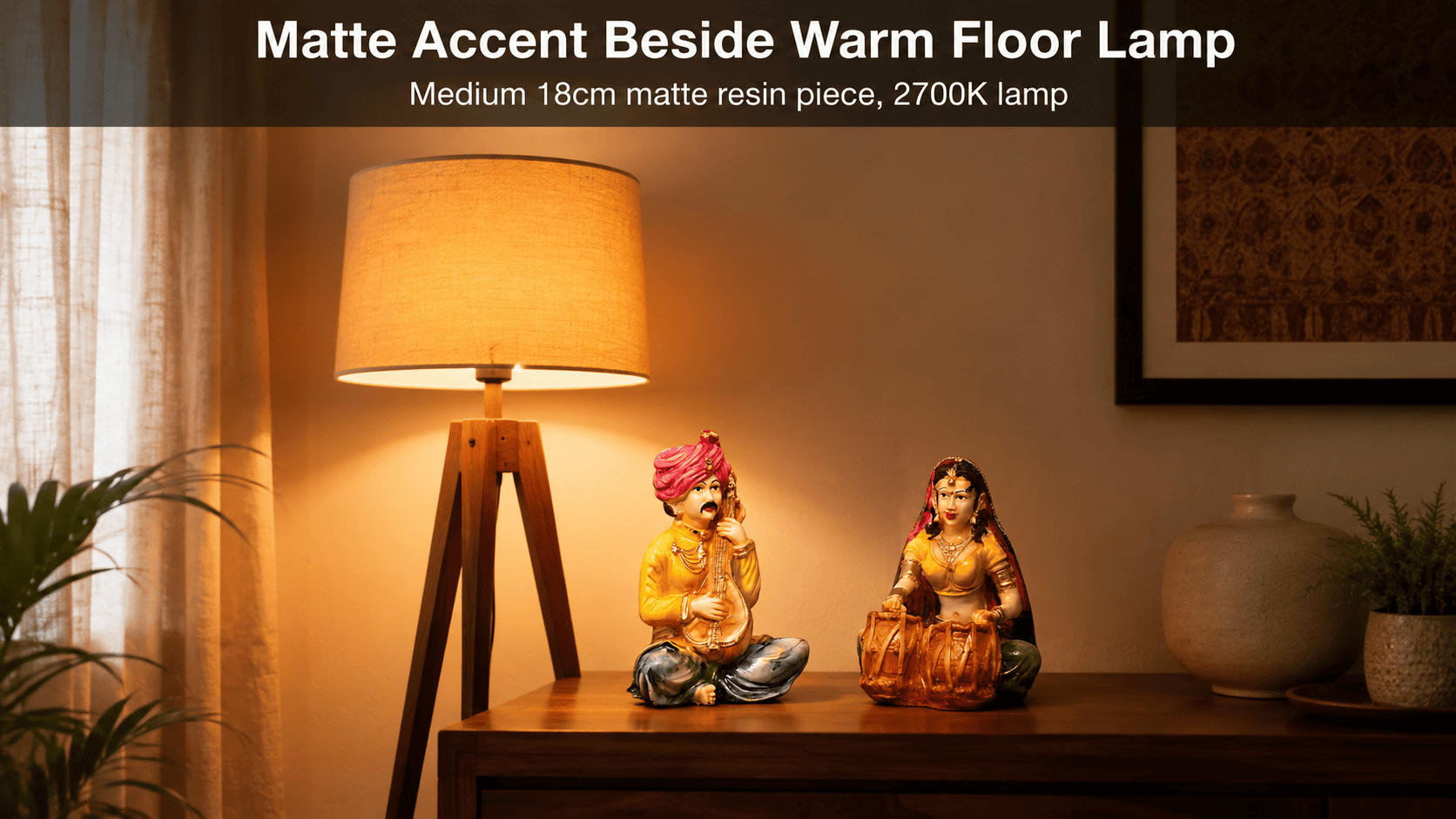
To prevent the flat, single-source glare common in compact Indian living rooms, layouts should follow Moolwan's 3-Layer Luminance Rule, which mandates one ambient source, one task source, and one matte décor accent positioned within arm's reach of a light source so it scatters and softens output before it reaches eye level.
What décor materials behave best under living room lighting?
Matte ceramic and matte resin outperform glossy or metallic finishes under warm interior lighting, because matte surfaces diffuse light across many micro-facets while glossy and metallic surfaces concentrate it into one bright point that draws the eye away from the room as a whole. This matters most in rented and owned Indian apartments where overhead lighting is often a single central fixture rather than a recessed multi-point system.
Because matte-fired ceramic also resists fingerprints and dust shadowing better than gloss under direct lamp light, it holds its finished look over a longer stretch between cleanings — a durability point that justifies the slightly higher cost of a high-fired matte piece over a cheaper glazed alternative, which is the core logic behind Moolwan's climate-and-light-rated material choices.
Want a décor accent engineered to diffuse warm light instead of bouncing it back at you? Shop the full Moolwan modern home décor collection now.
How does living room size change the lighting-décor pairing?
Larger rooms need proportionally larger accents placed farther from each light source, because a small 10–16 cm piece becomes visually lost once it sits more than roughly 30 cm from its nearest light, while a 25–34 cm piece can anchor a room from across a 180+ sq ft open-plan layout. This is the same scaling logic used in the matrix above.
In a compact sub-100 sq ft living room, a single medium accent near the main lamp usually outperforms two small accents spread across the room, because two faint glare-free points read as cluttered while one well-lit medium piece reads as a deliberate focal point.

Frequently Asked Questions
What is the best light colour temperature for a luxurious living room?
Warm white between 2700K and 3000K is the standard for a luxurious living room, because this range replicates candlelight and firelight tones the eye associates with comfort, while temperatures above 4000K read as clinical. Moolwan's matte décor accents are designed to diffuse precisely this warm range without creating glare.
Can ceiling lights alone make a living room look luxurious?
A single ceiling light alone rarely looks luxurious, because one overhead source flattens shadows evenly across the room and removes the depth cues that layered lighting creates. At least one additional task or accent source at a lower height is needed to introduce contrast.
Should living room lighting match décor accents in matte or glossy finish?
Matte finishes generally pair better with warm ambient lighting, because matte surfaces scatter light across a wide angle instead of concentrating it into one reflective point. Glossy finishes work only on smaller pieces placed near softer, indirect light sources.
How many light sources does a small Indian living room need?
A sub-150 sq ft Indian living room typically needs a minimum of two to three light sources — one ambient, one task, and ideally one accent — to avoid the flat, single-shadow look that a lone ceiling light produces.
Because a well-lit room needs accents that hold their finish under years of daily lamp exposure, choosing high-fired matte pieces over cheap glossy alternatives is what keeps a living room looking considered rather than dated. If you'd like accents with more unconventional shapes and textures, also consider Moolwan's unique home décor pieces, or for a fuller room refresh, browse Moolwan's dedicated living room collection. Ready to choose? Bring home a curated, climate-rated accent from the Moolwan modern home décor collection — manufacturer-direct, made for Indian homes.


