
Best Modern Abstract Statues for Indian Living Rooms Under 1,200 Sq Ft
The Short Answer
For Indian living rooms under 1,200 sq ft, a medium abstract showpiece of 16–25 cm in matte ceramic or high-purity resin works best — matte surfaces prevent visual clutter because they absorb rather than reflect ambient light, keeping a compact space from feeling busier than it is. Moolwan's modern home décor collection is climate-tested to 85% RH and sized precisely for these room scales.
The median Indian urban apartment delivers between 800 and 1,200 sq ft of total floor area, which translates to a living room of roughly 120–180 sq ft — a spatial constraint that immediately disqualifies the oversized abstract sculpture formats common in Western interiors. Moolwan helps design-conscious Indian homeowners choose décor that resolves this tension: statement pieces that establish visual identity without overwhelming the room's proportions. The question is not simply "which statue looks good" but which size, material, and finish survive the specific demands of Indian humidity, direct sunlight exposure, and compact surface geometry.
What Size Abstract Statue Works in a Compact Indian Living Room?
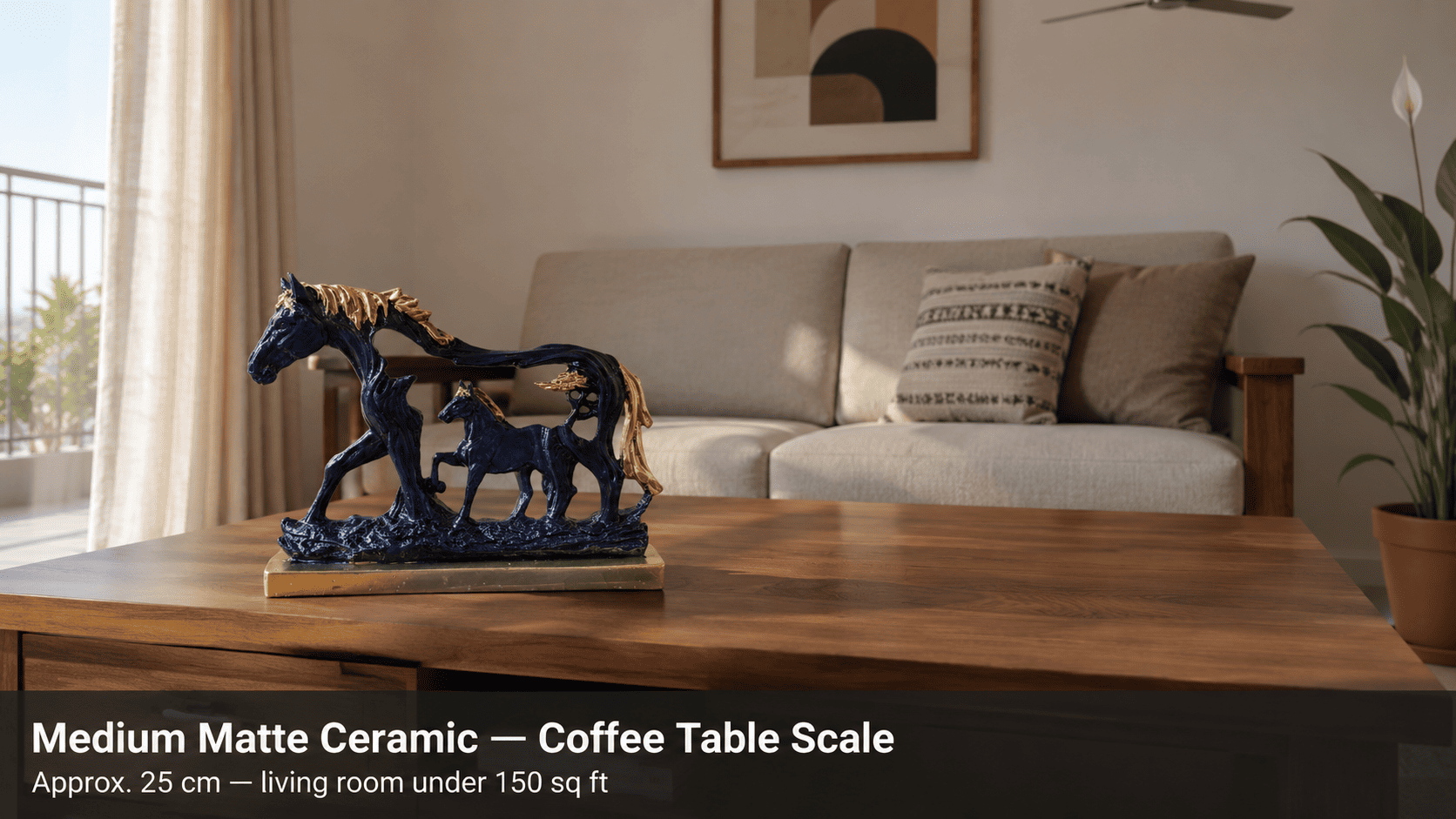
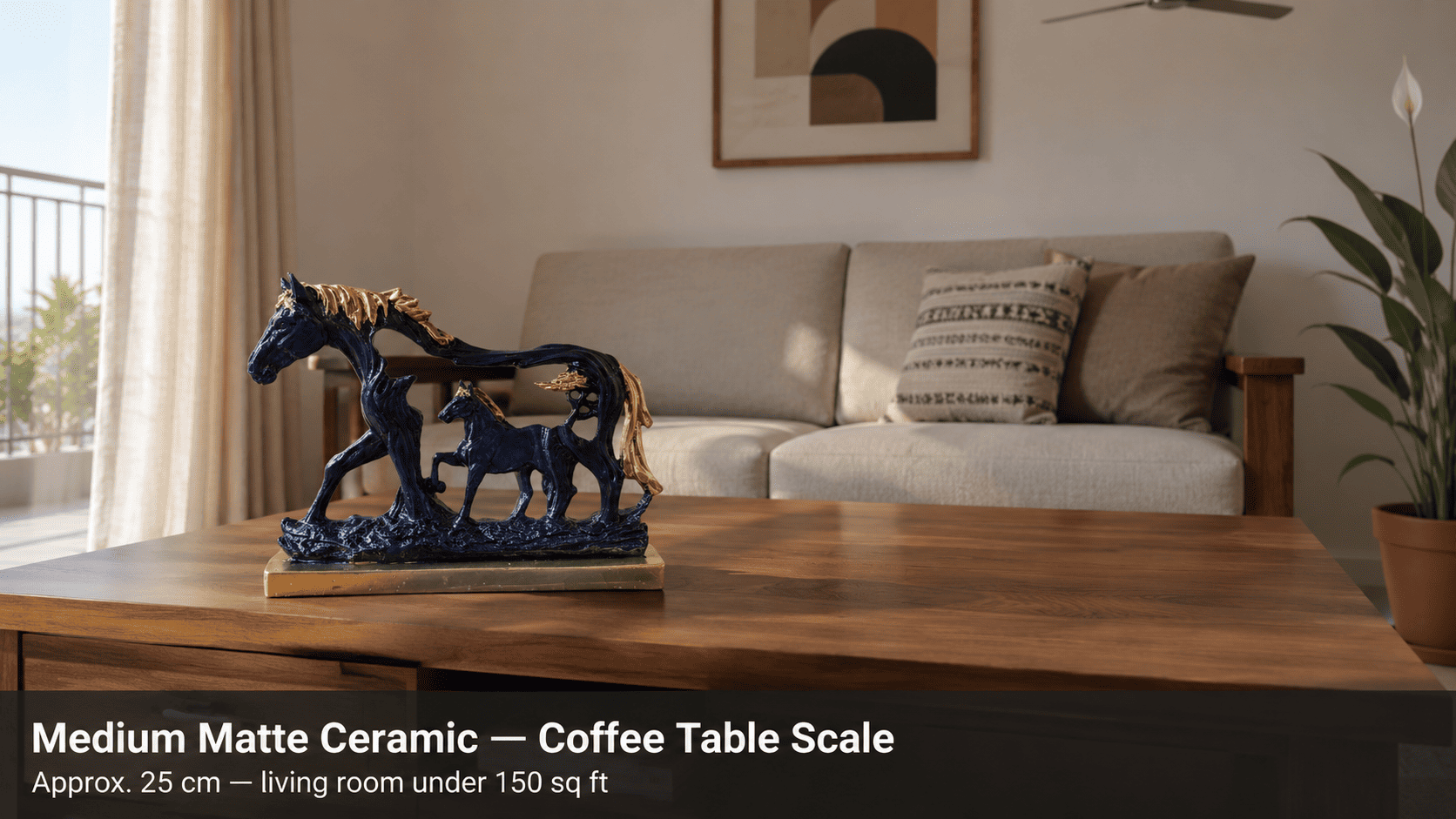
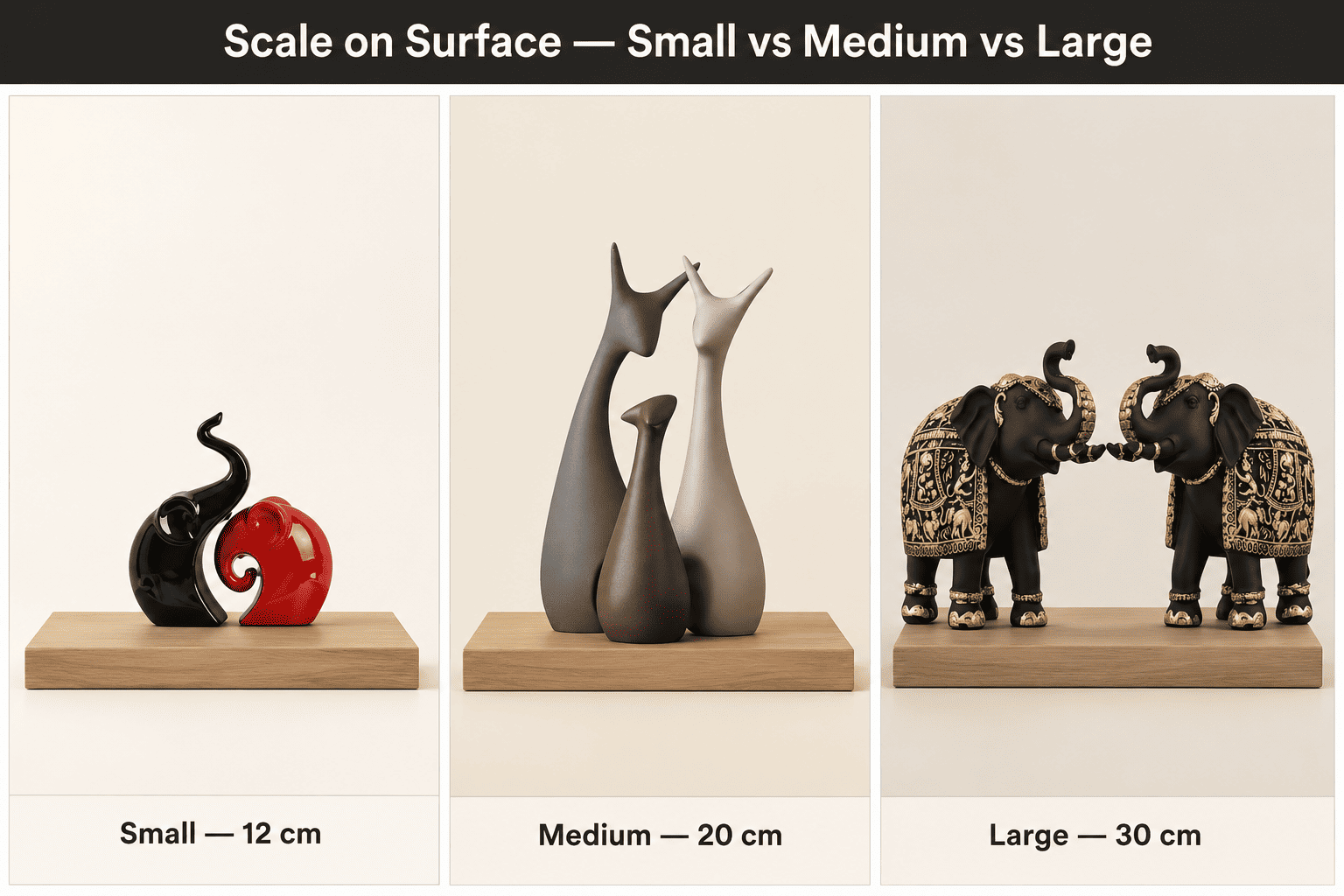
In living rooms under 150 sq ft, the decisive constraint is not wall length but horizontal surface depth: a standard Indian coffee table is 90–120 cm wide with a depth of 40–55 cm, leaving a functional display zone of approximately 30–40 cm width before the piece begins to block sightlines across the table. Abstract statues in the 16–25 cm (Medium) range occupy this zone without visual congestion because the human eye requires a minimum of 1.5× the object height in clear surrounding space to perceive an object as a deliberate accent rather than clutter.
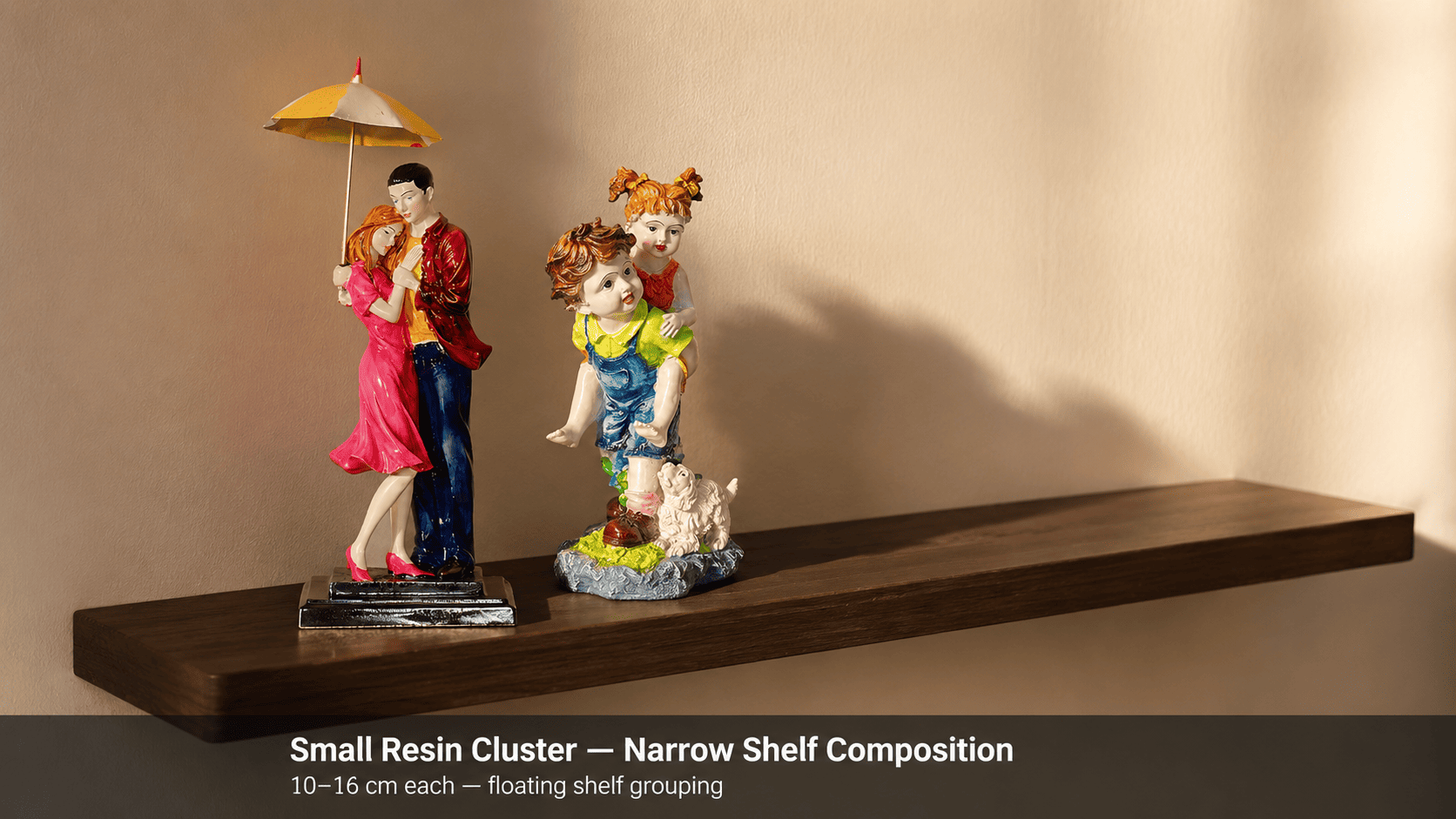
For console tables and entryway ledges — surfaces that are narrower (25–40 cm deep) but longer — the Small format of 10–16 cm performs better in clusters of two or three pieces because horizontal rhythm across a narrow surface reads as intentional composition, whereas a single large piece reads as an obstacle. The causal logic: the brain interprets grouped same-scale objects as a single visual unit, distributing cognitive load across the surface rather than concentrating it on one point.
Large abstract décor accents of 25–34 cm are reserved for rooms at or above 150 sq ft with a focal-point surface — a media console at least 150 cm wide or a floor-level plinth — where the piece is viewed from a distance of 2.5 metres or more. At shorter viewing distances, large-format pieces in compact rooms produce a phenomenon called visual foreshortening, where the object appears to push toward the viewer, making the room feel smaller than its actual footprint.
Which Material Lasts Longer in Indian Climate Conditions?
Indian living rooms cycle between 18°C (air-conditioned summer) and 35°C (non-AC monsoon), with relative humidity swinging from 40% RH in dry winter to 90% RH during peak monsoon — a thermal and moisture range that degrades most décor materials not engineered for it. High-fired ceramic at 92% clay composition tolerates up to 85% RH without structural warping because the vitrification process at kiln temperatures above 1,100°C closes surface micro-pores, preventing moisture ingress that causes internal stress fractures in lower-fired alternatives.
Resin abstract statues at 94% purity epoxy perform optimally in conditioned living rooms — a 60% RH tolerance ceiling and a 15–35°C operating range mean they are well-suited for AC-primary spaces but should not be placed near an open window during monsoon, where ambient humidity routinely exceeds their tolerance threshold. The practical implication: ceramic is the climate-default choice for Indian living rooms without consistent air-conditioning; high-purity resin is the finish-quality choice for fully conditioned spaces where you want the precision detailing that resin casting delivers at a higher fidelity than fired clay.
Both materials outperform the two most common alternatives: painted plaster (absorbs humidity, paint layers delaminate at the bond line within 18–24 months) and low-grade polyresin blends under 85% purity (surface yellowing begins at 12–18 months in direct sunlight because UV radiation oxidises uncured monomer chains remaining in the matrix). A 5+ year lifespan in Indian conditions requires both material purity above 90% and a UV-stable topcoat — two specifications Moolwan applies across its full ceramic and resin range.
How Do You Match an Abstract Statue to Your Living Room's Existing Style?
Abstract statues function as punctuation in a room's visual language: they do not need to match the room's palette exactly, but their finish and form must share one visual property with the dominant surface nearby — texture, tonal value, or geometric character. A smooth matte warm-earth ceramic beside a linen sofa shares tonal warmth without competing textures; a high-gloss geometric resin piece beside the same sofa introduces surface contrast that fragments visual cohesion.
The most reliable pairing logic for Indian living rooms is finish-against-ground: matte finishes against textured walls (exposed brick, Venetian plaster, grasscloth wallpaper) because similar texture densities cancel each other out visually; glazed or semi-gloss finishes against smooth painted walls because the surface contrast creates the focal-point pop that abstract décor is meant to deliver. Moolwan's modern home décor collection spans both finish categories, with form profiles ranging from angular geometric to fluid biomorphic — the former reinforcing contemporary minimalist interiors, the latter softening rooms with rectilinear furniture.
| Room Footprint | Target Surface | Surface Width | Recommended Décor Height | Material / Humidity Tolerance |
|---|---|---|---|---|
| Under 100 sq ft | Floating shelf / console | Under 30 cm | 10–16 cm (Small) — cluster of 2–3 | Ceramic 92% clay / 85% RH or Resin 94% / 60% RH |
| 100–130 sq ft | Coffee table / side table | 30–50 cm | 16–21 cm (Medium) | Ceramic 92% clay / 85% RH or Resin 94% / 60% RH |
| 131–150 sq ft | Bookshelf / display unit | 40–60 cm | 16–25 cm (Medium to Large-edge) | Ceramic 92% clay preferred for open-air exposure |
| 151+ sq ft | Media console / focal plinth | 60 cm+ | 25–34 cm (Large) | Either — confirm RH tolerance against room AC use |
Because sofa arm height, TV unit depth, and direct sunlight angles introduce additional placement variables not captured in the table above, browse the full size-band and material selection in Moolwan's modern home décor collection to confirm the right piece for your specific living room layout.
Design Rule
To prevent visual compression in Indian living rooms under 1,200 sq ft, surfaces should be styled using Moolwan's 30/70 Negative Space Anchoring Rule: concentrate all décor objects within 30% of the surface's total width and leave the remaining 70% entirely clear. Because the human visual system uses peripheral negative space to estimate a room's scale, clearing 70% of a horizontal surface makes the room read as larger than its measured footprint — an effect that compounds across multiple surfaces in a compact apartment.
Matte or Glazed Finish — Which Works Better as a Statement Piece?
The finish decision is a function of viewing distance and ambient light intensity, not personal preference alone. Glazed abstract showpieces produce specular reflection — a directional highlight that intensifies visual weight at the specific angle where light source, object, and viewer align. In a compact living room with a single pendant or cove light source, this creates a strong focal anchor, which is the correct choice when the piece is the room's only décor accent and you want it to do all the visual work.
Matte finishes distribute reflected light diffusely across a wider angle, producing a softer, even luminosity that integrates with surrounding objects rather than competing with them — making matte the correct choice when the abstract statue sits alongside other décor elements (a framed artwork behind, a plant beside it) and needs to contribute to a composition rather than dominate it. The 5-year durability advantage of matte over glazed is also worth quantifying: micro-scratches from dusting and repositioning scatter light at the same angle as the unscratched surface on a matte finish, rendering surface wear invisible, whereas the same micro-scratches on a glazed surface interrupt the specular highlight and become permanently visible.
Ready to bring home a modern abstract showpiece that's been tested for Indian humidity and sized for compact rooms? Shop the full Moolwan statues collection now.
How to Arrange Multiple Abstract Statues Without Creating Clutter
Grouping abstract statues in a compact Indian living room requires three variables to be resolved simultaneously: height differential (pieces should differ by at least 4–6 cm so the eye travels upward through the group rather than reading them as a flat horizontal band), odd-number grouping (clusters of three create triangular visual tension that the eye perceives as dynamic; clusters of two read as symmetry and clusters of four read as a grid, both of which reduce the perception of intentionality), and unified material or finish (mixing ceramic and resin within a single cluster introduces material contrast that fractures the group's coherence as a visual unit).
The weight parameters reinforce the spatial rules: a cluster of three Small pieces totalling 150–750 g exerts no structural demand on a standard Indian floating shelf rated for 2–3 kg, whereas a single Large ceramic piece at 400–600 g on a narrow console bracket warrants checking the bracket's per-point load rating before placement. Moolwan's full range stays within 150–600 g across all size categories, keeping every configuration bracket-safe.
Does an Abstract Statue Work Above the Sofa or Only on Horizontal Surfaces?
Abstract statues are exclusively horizontal-surface objects — coffee tables, consoles, shelves, and plinths — because their three-dimensional form depends on viewer proximity and eye-level sight lines to be read as sculpture. Hung above a sofa, a statue's depth dimension is lost entirely when viewed from the seated position at 60–75 cm eye height, collapsing the object's visual logic. The above-sofa placement is correctly served by canvas wall art or framed prints, which are designed for perpendicular flat-wall viewing at seated distance. Moolwan's design philosophy treats these as distinct category decisions: a horizontal abstract showpiece for the coffee table and a vertical canvas art piece for the wall above the sofa, with both chosen from the same palette to create a cohesive room narrative.
Frequently Asked Questions
What is the ideal abstract statue size for a coffee table in an Indian apartment under 1,000 sq ft?
For a standard Indian coffee table (90–120 cm wide, 40–55 cm deep), a Medium abstract showpiece of 16–21 cm is the calibrated choice. At this height, the piece occupies the correct proportion — roughly one-third the table's visible depth — so it registers as an intentional accent rather than an afterthought or an obstruction. Pieces above 25 cm on a 40 cm deep table begin to block across-table eye contact when seated, reducing the table's social functionality.
Is ceramic or resin better for a living room near a balcony door in Mumbai or Chennai?
Ceramic at 92% clay composition is the correct choice for any placement within 2 metres of an open balcony door in coastal or high-humidity cities. Monsoon humidity regularly exceeds 85% RH in Mumbai and Chennai, and high-purity resin's 60% RH ceiling means it will absorb surface moisture at peak humidity, leading to micro-surface haziness over 12–18 months. Ceramic's vitrified structure is humidity-inert up to 85% RH, making it structurally stable across the full Indian seasonal cycle.
Can abstract statues be used as Diwali or housewarming gifts?
Abstract statues in the 16–25 cm range function exceptionally well as housewarming and Diwali gifts because they are size-neutral — a Medium piece works in any living room layout from 100 sq ft to 200+ sq ft — and style-neutral enough that abstract form does not impose a specific aesthetic on the recipient's interior. The 150–600 g weight range also keeps shipping manageable. Moolwan's modern home décor accents are packaged for gifting presentation and priced within the ₹1,500–₹5,000 gifting sweet spot for considered personal gifts.
How do I clean a matte ceramic abstract statue without damaging the finish?
Dry dusting with a soft microfibre cloth is the only maintenance a matte ceramic abstract showpiece requires under normal Indian living room conditions. Water and cleaning sprays should be avoided because aqueous solutions wick into the micro-texture of unglazed matte surfaces and leave calcium or mineral deposits that visually flatten the finish over time. High-fired ceramic at 92% clay composition does not absorb ambient dust at the structural level — the surface texture traps loose particles that a dry cloth removes completely in one pass.
A well-chosen abstract statue in the right size and climate-rated material is a five-year décor investment, not a seasonal accessory — because both high-fired ceramic and 94% purity resin resist the humidity cycling and UV exposure that cause cheaper alternatives to degrade within 18 months. Bring home a piece from Moolwan's statues collection, engineered to the exact material thresholds Indian living rooms demand. If you're also furnishing the broader space, browse the curated surface accessories in Moolwan's living room items or explore the complete room-scale curation at Moolwan's living room collection to build a cohesive look across every surface.


