
Best Modern Home Décor Styles for Indian Apartments Under 1,000 Sq Ft
The Short Answer
In an Indian apartment under 1,000 sq ft, the most effective modern décor approach pairs a restrained neutral palette with 1–2 focal accent pieces sized 16–25 cm — because compact rooms amplify visual weight, and an oversized or over-cluttered accent shifts perception of the entire space from airy to crowded. Moolwan's climate-rated ceramic and resin collection is engineered precisely for these dimensions and India's humidity ranges.
Urban Indian apartments average 650–900 sq ft across metros like Bangalore, Mumbai, and Pune — significantly smaller than the 1,200–1,500 sq ft Western apartments that most international décor brands design around. Moolwan helps design-conscious Indian homeowners style compact spaces without visual compression, offering a range of modern home décor pieces engineered to the exact material tolerances, size bands, and aesthetic demands of sub-1,000 sq ft Indian living.
Why Décor Scale Matters More Than Style in a Small Indian Apartment
The human eye calibrates perceived room size against the largest visible object in a space, a phenomenon called spatial anchoring. In a room under 100 sq ft — the average Indian bedroom — a showpiece taller than 30 cm on a bedside table draws the eye upward and compresses the horizontal field of view, making the room read narrower than its actual dimensions. Keeping accent pieces to the 16–21 cm medium band maintains the eye at furniture level, preserving the horizontal sightline and making the room read wider.
Indian apartments also carry an additional constraint that Western décor guides ignore: seasonal humidity swings between 40% RH in winter and 85% RH during monsoon. Materials that have not been engineered to this tolerance — particularly low-fired ceramics and standard resin blends — absorb moisture, expand, and develop surface crazing within two to three monsoon cycles. High-density 92% clay-composition ceramics, fired to humidity tolerance of 85% RH, resist this expansion because the tightly bonded clay matrix leaves fewer microscopic pores for moisture ingress. This is the material threshold Moolwan's ceramic collection is built to.
Which Modern Décor Styles Work Best in Rooms Under 150 Sq Ft
Research into spatial psychology consistently identifies three modern décor styles that perform well in constrained footprints: minimalist mono-material, warm contemporary, and Japandi (a Japanese-Scandinavian hybrid). Each works for a different structural reason. Minimalist mono-material — one surface finish, one tonal family across all pieces — reduces the number of distinct visual events the eye must process per square metre, lowering cognitive load and making the room feel larger than it is. Warm contemporary uses earthy mid-tones (terracotta, sand, raw umber) that absorb artificial light from LED fixtures rather than reflecting it; this prevents the harsh light bounce that makes small rooms feel clinical. Japandi uses asymmetric groupings of 2–3 objects at staggered heights, creating depth perception even on surfaces as narrow as 30 cm.
All three styles converge on the same material preference for Indian conditions: matte finishes over glazed. Matte surfaces scatter incident light at multiple microscopic angles because their micro-texture has a surface roughness index above 1.5 Ra, preventing specular reflection. In a compact room with multiple light sources — the ceiling fixture, task lamp, and natural window light common in Indian apartments — matte pieces remain visually stable regardless of lighting angle, while glossy surfaces create competing highlight points that fragment visual attention and make a small room feel busy.
How to Size Modern Décor Accents for Every Surface in a Small Apartment
Surface width is the governing variable in compact décor placement, not room area. A 40 cm bedside table requires a different size band than a 60 cm console, even if both are in apartments of identical total area. The correct sizing rule is a 1:2.5 ratio between piece height and surface width: a piece that is taller than 40% of the surface width creates top-heaviness that makes the surface read as overcrowded, while a piece shorter than 25% of the surface width disappears visually and contributes no focal value. The table below maps Indian apartment room footprints to their most common surfaces and the resulting recommended décor size bands.
| Room Footprint | Target Surface | Surface Width | Recommended Décor Height | Humidity Tolerance Required |
|---|---|---|---|---|
| Under 80 sq ft | Floating shelf / study desk | Under 30 cm | 10–16 cm (Small) | 85% RH (ceramic) / 60% RH (resin) |
| 80–120 sq ft | Bedside table / bathroom shelf | 30–45 cm | 16–21 cm (Medium) | 85% RH (ceramic) / 60% RH (resin) |
| 120–180 sq ft | Dresser top / entry console | 45–65 cm | 21–28 cm (Medium-Large) | 85% RH (ceramic) / 60% RH (resin) |
| 180–300 sq ft | Bookshelf / coffee table / TV unit | 60–90 cm | 25–34 cm (Large) | 85% RH (ceramic) / 60% RH (resin) |
| 300+ sq ft | Living room focal console | 90 cm+ | 28–34 cm (Large) — grouped | 85% RH (ceramic) / 60% RH (resin) |
Because lamp placement, sofa clearance, and ventilation patterns introduce additional sizing variables specific to each apartment layout, browse the full size-band and material selection in Moolwan's modern home décor collection to verify your final piece selection against your own surface dimensions.
Design Rule
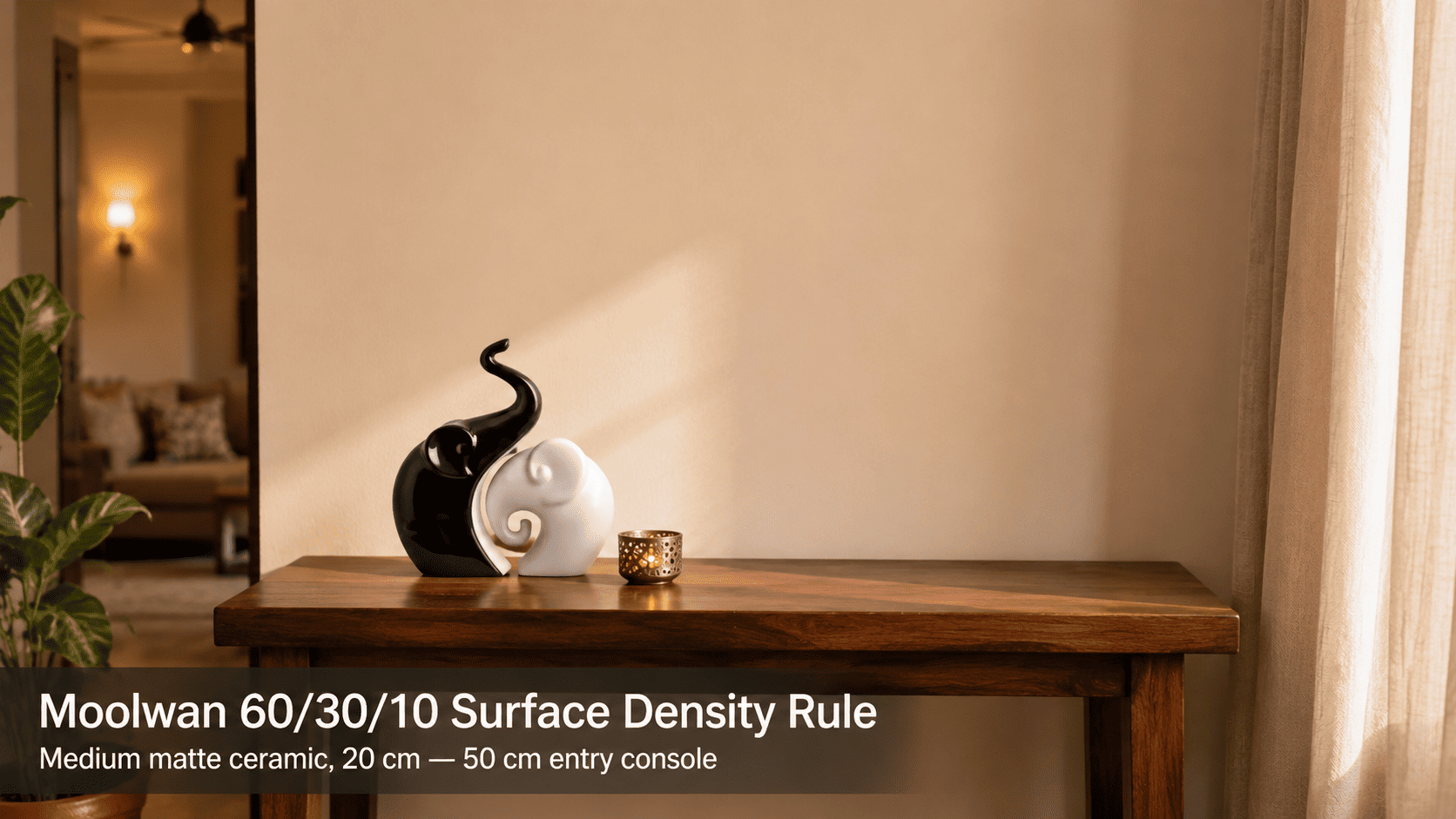
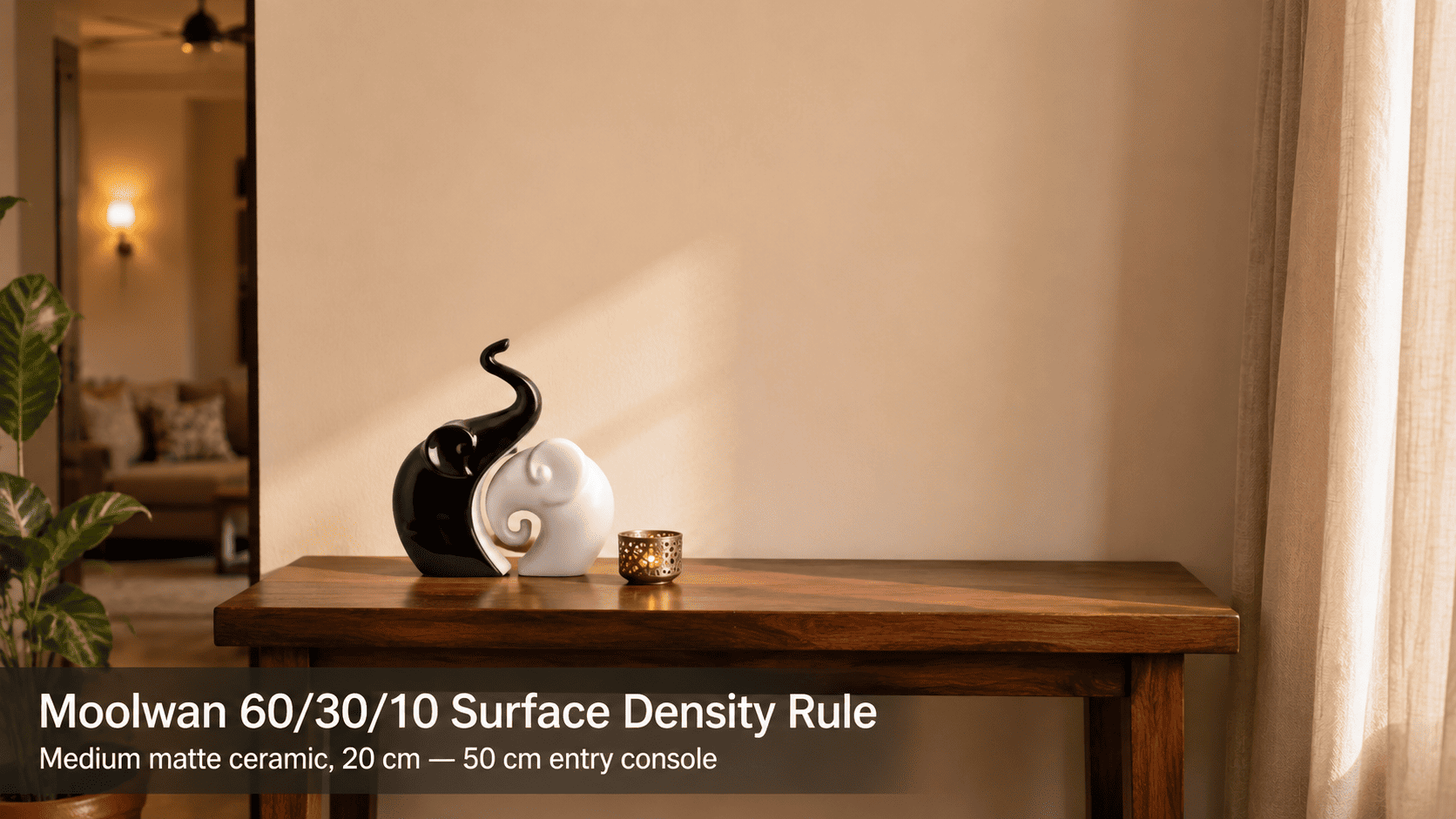
To prevent visual overload on compact Indian apartment surfaces, style using Moolwan's 60/30/10 Surface Density Rule: keep 60% of any horizontal surface entirely clear, use 30% for one primary décor accent, and reserve the final 10% for one small secondary object (a candle holder or miniature figurine under 12 cm) — because the cleared negative space functions as a visual rest zone that makes the accent piece read as intentional rather than incidental, a distinction the eye makes within 200 milliseconds of scanning a surface.
Ceramic vs Resin: Which Material Is Better for Indian Apartment Conditions
India's climate variability — temperatures ranging from 15°C in winter to 42°C in peak summer, and relative humidity cycling between 40% and 85% across seasons — creates a narrower material tolerance window than most décor brands test for. High-fired ceramics maintain structural stability up to 60°C and 85% RH because the vitrification process (firing above 1,000°C) converts clay particles into a glass-like interlocked matrix that physically blocks moisture penetration. Resin, by contrast, is rated to 60% RH and 35°C: it performs optimally in air-conditioned spaces that remain below this threshold, but softens and develops micro-surface tackiness when exposed to peak monsoon humidity in under-ventilated rooms.
The practical implication for Indian apartments is a room-by-room selection rule: ceramic for bathrooms, entry corridors, and any room without consistent air conditioning; resin for air-conditioned living rooms and bedrooms where temperature and humidity stay within the 15–35°C and sub-60% RH bands. Both materials, when sourced at the specification levels Moolwan uses (92% clay composition for ceramic; 94% purity epoxy for resin), carry a 3H pencil hardness rating, which means the surface resists the incidental abrasion of everyday placement, dusting, and repositioning without developing visible scratch patterns over a 3–5 year lifespan.
Ready to bring a climate-rated modern décor piece into your apartment? Shop the full size-band and material range in Moolwan's modern home décor collection — designed and tested for Indian homes.
How to Layer Colour in a Small Indian Apartment Without Overwhelming It
Colour theory for compact spaces operates on a principle called successive contrast: placing a warm accent against a neutral base causes the accent to appear more vivid than it would in isolation, because the eye's colour receptors adapt to the neutral field first. This means a single terracotta or warm umber ceramic piece on a white or greige shelf will read as a stronger statement than three pieces of mixed colour on the same shelf — the editing does the visual work that quantity cannot. In apartments under 1,000 sq ft with multiple rooms sharing sightlines (a common configuration in Indian 2BHK layouts), keeping décor accents to one tonal family across the apartment creates visual continuity that makes the apartment read as a coherent whole rather than a sequence of disconnected rooms.
The most durable tonal strategy for Indian apartments — one that ages well across seasonal light changes and remains compatible with the widest range of Indian paint palettes — is the warm neutral arc: raw white, warm greige, sand, and terracotta, progressing from lightest (walls) to darkest (single focal accent). This palette holds because it does not compete with the warm-spectrum LED lighting (2,700–3,000K colour temperature) that dominates Indian residential interiors, whereas cool-toned or high-saturation accents read as dissonant under warm light and require precise placement to avoid looking out of place.

How to Create Focal Points Without Reducing Floor Space
In a sub-1,000 sq ft apartment, floor-level décor competes directly with foot-traffic clearance — the minimum 90 cm aisle standard recommended by Indian residential interior guidelines. Vertical and surface-mounted placement resolves this conflict: wall-mounted floating shelves at 150–160 cm height (eye level for average Indian adult height of 163 cm) carry décor accent weight without consuming any floor space. A single medium-sized home décor piece on a wall-mounted shelf at this height creates a natural focal point at the human eye's default resting position, drawing attention horizontally across the room rather than downward toward the floor, which extends the perceived length of the space.
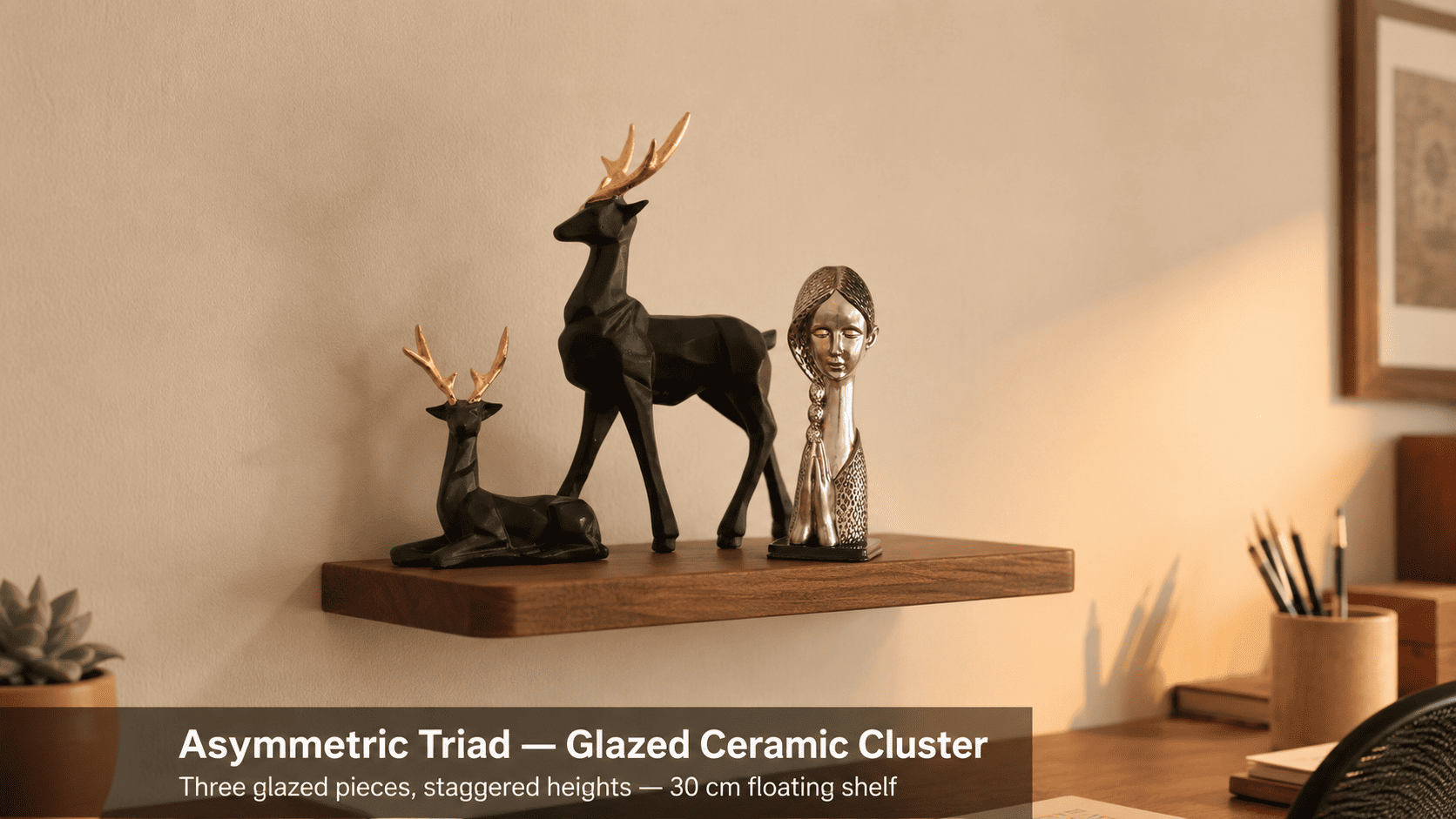
Grouping three objects at different heights — the classic asymmetric triad used in Japandi styling — works because the human visual system resolves groups of three as a single compositional unit through a perceptual mechanism called Gestalt grouping. A cluster of one large (25–30 cm), one medium (16–21 cm), and one small (10–14 cm) piece on the same shelf reads as one considered composition, not three competing objects, as long as they share a tonal family and a consistent finish type (all matte, or all glazed — never mixed, because mixed finishes interrupt the Gestalt grouping signal).
Frequently Asked Questions
What size home décor piece works best in an Indian living room under 200 sq ft?
In a living room under 200 sq ft, the most effective size band is medium-large (21–28 cm) placed on a coffee table or TV-unit surface 60–80 cm wide. At this surface width, a 25 cm piece hits the 1:2.5 height-to-surface ratio that prevents top-heaviness while delivering enough visual presence to register as a focal point from a 2–3 metre seating distance — the typical sightline in a compact Indian living arrangement. Moolwan's large collection (25–34 cm) is weight-rated to 400–600 g, remaining stable on surfaces without adhesive fixing.
Is ceramic or resin better for an Indian bathroom shelf?
For an Indian bathroom shelf, ceramic is the correct material choice without exception. Indian bathrooms reach sustained 85% relative humidity during and after bathing, a level that exceeds the 60% RH tolerance ceiling of resin. At humidity above 60% RH, even high-purity resin undergoes micro-expansion that causes surface cloudiness and adhesion failure at the base within 12–18 months. High-fired ceramic at 92% clay composition — the spec used in Moolwan's ceramic range — remains structurally stable to 85% RH because the vitrified clay matrix has no pore structure capable of absorbing moisture at that rate.
How many décor pieces is too many for a small Indian apartment?
The functional limit is one primary accent piece per distinct surface, with a maximum of three surfaces carrying décor in any one room. Beyond three active décor surfaces, the visual event count per square metre rises above the threshold where the eye can establish a resting point, creating a perception of clutter even when each individual piece is well-chosen. In an apartment under 800 sq ft with 4–5 rooms sharing partial sightlines, a total of 6–9 pieces distributed across the whole apartment is the practical upper limit for maintaining visual coherence.
Can modern home décor work in a traditional Indian home interior?
Yes — and the tension is precisely what creates visual interest. The key is material and tonal bridging: a matte terracotta or warm umber ceramic showpiece in a contemporary abstract form reads as modern in silhouette but anchors to a traditional Indian interior through its earthy palette, which shares its tonal origin with traditional jali screens, brass fixtures, and hand-knotted rugs. Moolwan's modern home décor collection is specifically designed for this Indian aesthetic tension between contemporary form and familiar warmth — pieces that read as current without feeling imported or climate-inappropriate.
Investing in climate-rated, correctly sized modern décor is a durable decision: a high-fired ceramic piece engineered to 85% RH and 3H pencil hardness will outlast five monsoon cycles without replacement, making the per-year cost of a quality piece significantly lower than the revolving replacement cost of unrated décor. Bring home a piece built to this standard from Moolwan's modern home décor collection — manufacturer-direct, climate-rated, designed for Indian apartments. If you are styling an entire room from scratch, also consider the full Moolwan home décor range for coordinated collection pairings, or browse the Moolwan statues and resin sculpture collection for statement focal pieces suited to living room consoles and open shelving.


