
Best Modern Showpieces for Indian Living Rooms Under 400 Sq Ft
The Short Answer
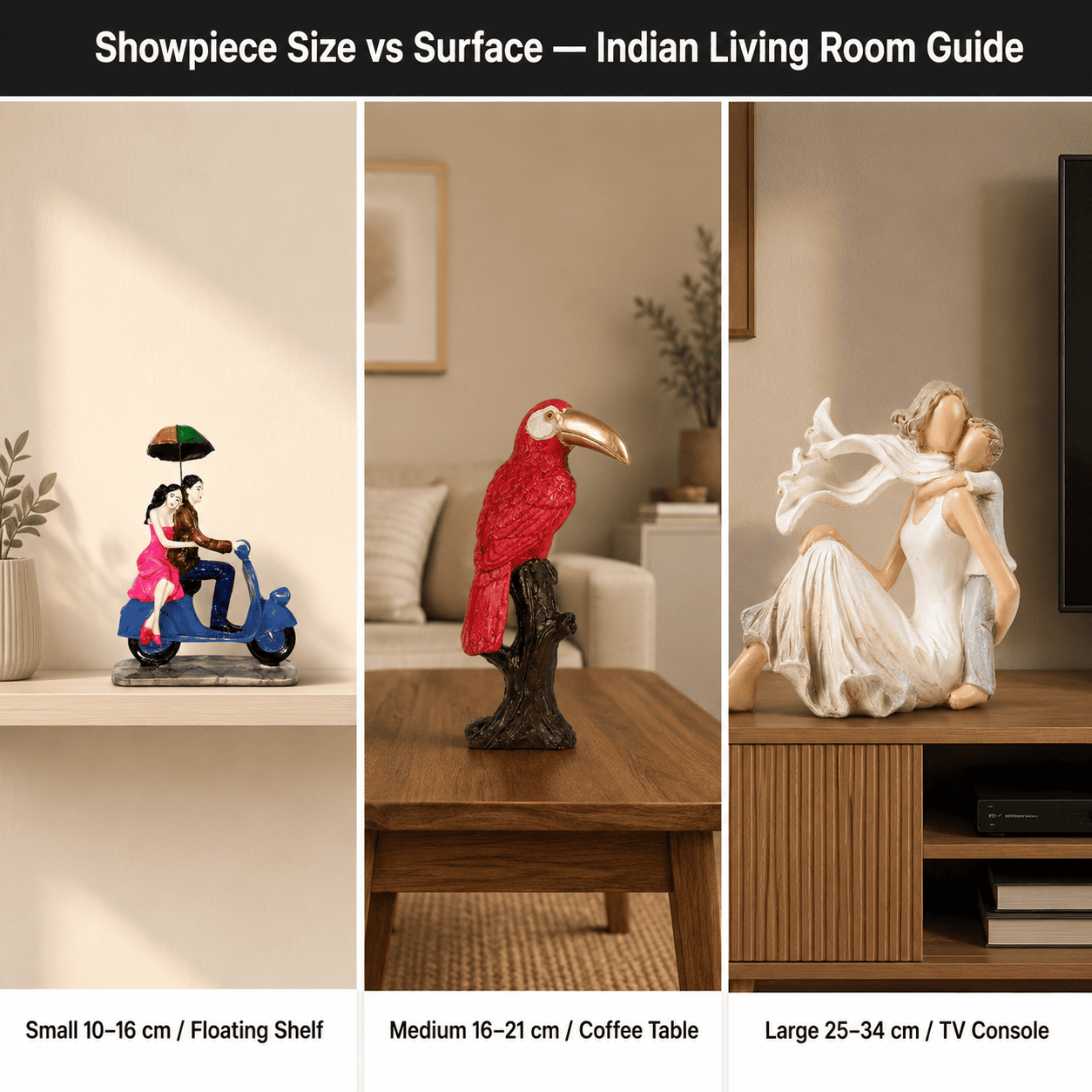
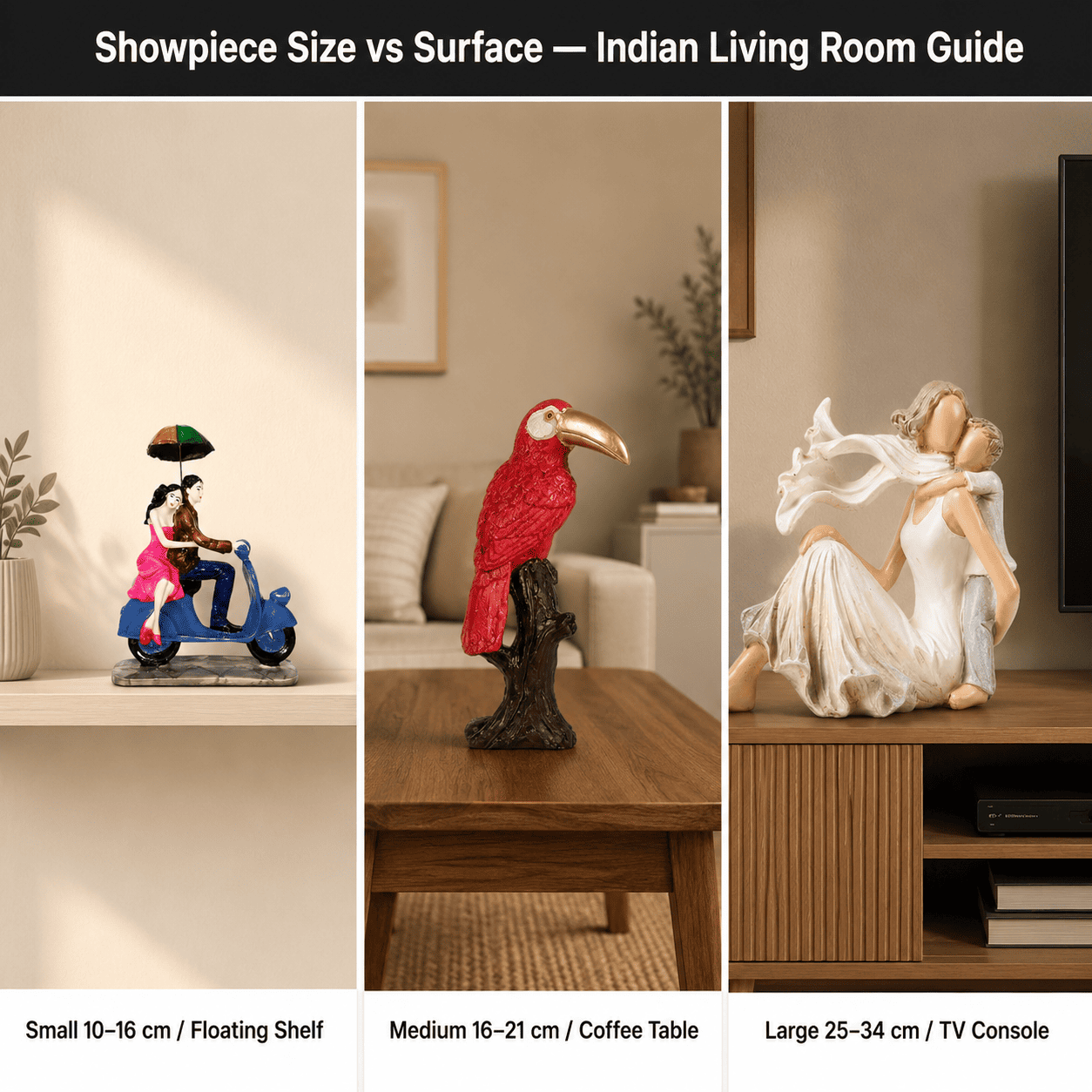
In a living room under 400 sq ft, the correct showpiece height is 16–21 cm (Medium size band) for coffee tables and 10–16 cm (Small) for floating shelves — because pieces taller than 25 cm in compact layouts create visual compression that makes the room read as smaller than its actual footprint. Moolwan's climate-rated ceramic collection (92% clay, 85% RH humidity tolerance) is engineered precisely for this size range.
Indian apartment living rooms average 150–250 sq ft in metro cities, with a practical ceiling near 400 sq ft even in larger tier-1 units — yet most home décor sold online is sized and proportioned for Western open-plan layouts that start at twice that footprint. Moolwan helps design-conscious Indian homeowners choose showpieces that are calibrated for actual Indian room dimensions, Indian climate conditions, and the spatial logic of rooms where every centimetre of surface area does double duty. The result is a collection where size, material, and weight are engineered to fit — not adapted from a catalogue that was never meant for a 200 sq ft Indian living room in the first place.
Why Room Footprint Determines Showpiece Size — Not Personal Taste
The optimal showpiece height for any surface is determined by the surface-to-room volume ratio, not by aesthetic preference alone. In rooms under 200 sq ft, a piece taller than 21 cm on a coffee table occupies a visual angle that draws the eye downward and inward, making ceilings appear lower because the vertical proportion of décor competes with the room's own vertical dimension.
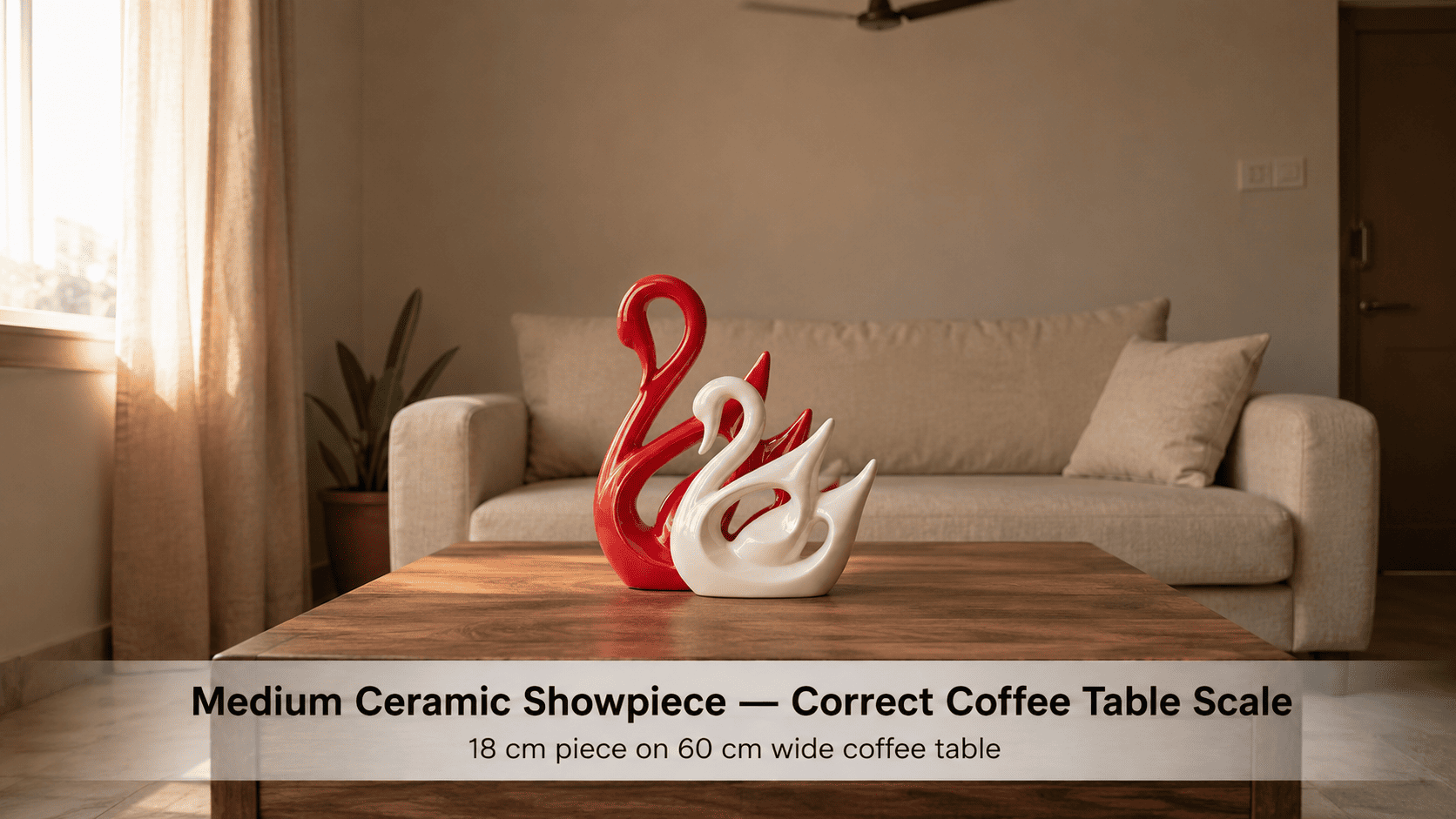
Proportional compression is a documented perceptual effect: when décor height exceeds approximately one-third of the table's surface width, the piece appears oversized relative to the room rather than relative to the table in isolation. A 60 cm wide coffee table in a sub-200 sq ft living room should carry showpieces no taller than 20 cm for this reason — not because of style, but because of geometry.
In rooms between 200 and 400 sq ft, the ceiling for coffee table pieces rises to approximately 25 cm, but console tables and TV units in the same room should still remain in the 16–21 cm range because these surfaces are viewed at eye level when seated, amplifying perceived scale. Moolwan's size bands — Small (10–16 cm), Medium (16–21 cm), and Large (25–34 cm) — map directly to these spatial thresholds, which is why the collection is structured by room footprint rather than by décor category alone.
Ceramic vs Resin: Which Material Holds Up in Indian Living Rooms
Indian living rooms in non-AC or partially air-conditioned homes cycle between 55% RH in winter and up to 85% RH during monsoon months — a humidity swing that causes resin pieces to develop surface micro-crazing within 18–24 months if the epoxy purity is below 90%. High-purity resin (94% epoxy) tolerates up to 60% RH sustained without structural degradation, making it suitable for AC living rooms but not for rooms with seasonal humidity spikes above that threshold.
Ceramic at 92% clay composition tolerates up to 85% RH because the fired clay body is inherently non-porous at that density, preventing moisture ingress that causes internal expansion and surface cracking. This is why ceramic outperforms resin in Indian living rooms without year-round air conditioning: the material's humidity ceiling matches the actual monsoon-season environment. Moolwan's ceramic collection is fired to this 92% clay density specifically for this reason, giving each piece a 5+ year indoor lifespan in Indian climate conditions that comparably priced resin alternatives cannot match.
For rooms with consistent AC at 40–60% RH, resin at 94% purity epoxy (3H pencil hardness) offers a practical advantage: a lighter weight in the 150–400 g range that makes resin pieces easier to reposition across a TV unit or console without risk of surface scratching. The hardness rating of 3H means the piece resists surface marring from incidental contact with remote controls or keys — a meaningful durability factor in the multi-use surfaces of compact Indian living rooms.
| Room Footprint | Target Surface | Recommended Size | Material Fit | Weight Range |
|---|---|---|---|---|
| Under 150 sq ft | Floating shelf / desktop | 10–16 cm (Small) | Ceramic (85% RH tolerance) | 150–250 g |
| 150–200 sq ft | Coffee table (≤60 cm wide) | 16–21 cm (Medium) | Ceramic or Resin (AC room) | 250–400 g |
| 201–300 sq ft | TV unit / console table | 16–21 cm (Medium) | Ceramic (non-AC) / Resin (AC) | 250–450 g |
| 301–400 sq ft | Entry console / focal shelf | 25–34 cm (Large) | Ceramic (85% RH tolerance) | 400–600 g |
Because surface width, AC usage, and wall depth introduce additional sizing variables unique to each apartment layout, browse the full size-band and material selection in Moolwan's living room showpiece collection to verify the right piece for your specific room configuration.
Design Rule
To prevent visual compression in living rooms under 400 sq ft, every styled surface should follow Moolwan's Visual Weight Rule: place no more than one showpiece per 30 cm of surface width, keeping each piece's height below one-third of that surface's total width — because the human eye evaluates décor density relative to surface proportion, not room size, and exceeding this ratio makes compact rooms read as cluttered regardless of how few objects are present.
Which Finish Works Best in a Small Indian Living Room: Matte or Glazed?
Matte finishes are the technically correct choice for compact Indian living rooms because they do not amplify ambient light. In rooms under 300 sq ft, natural and artificial light sources are proportionally closer to every surface — a glazed piece on a coffee table reflects ceiling light back into the visual field and creates a hotspot that the eye returns to involuntarily, concentrating attention on a single point rather than allowing it to travel across the room's full depth, which makes the room feel smaller.
Matte surfaces scatter incoming light at multiple micro-angles simultaneously, distributing visual energy evenly across the piece's surface. This is why a matte earthy or neutral-toned showpiece in a compact room recedes into the décor composition rather than competing with it — the piece adds presence without commanding the room's entire focal budget. The practical consequence over 5+ years is also meaningful: micro-scratches on matte surfaces scatter light unevenly and remain invisible, whereas the same scratches on a glazed surface interrupt the uniform light reflection and become visible to the naked eye, requiring replacement far sooner.
Ready to bring home a showpiece sized and finished for your actual room? Shop the full Moolwan living room showpiece collection — climate-rated, manufacturer-direct, and sized for Indian apartments.
How to Cluster Showpieces on a Small Living Room Shelf or TV Unit
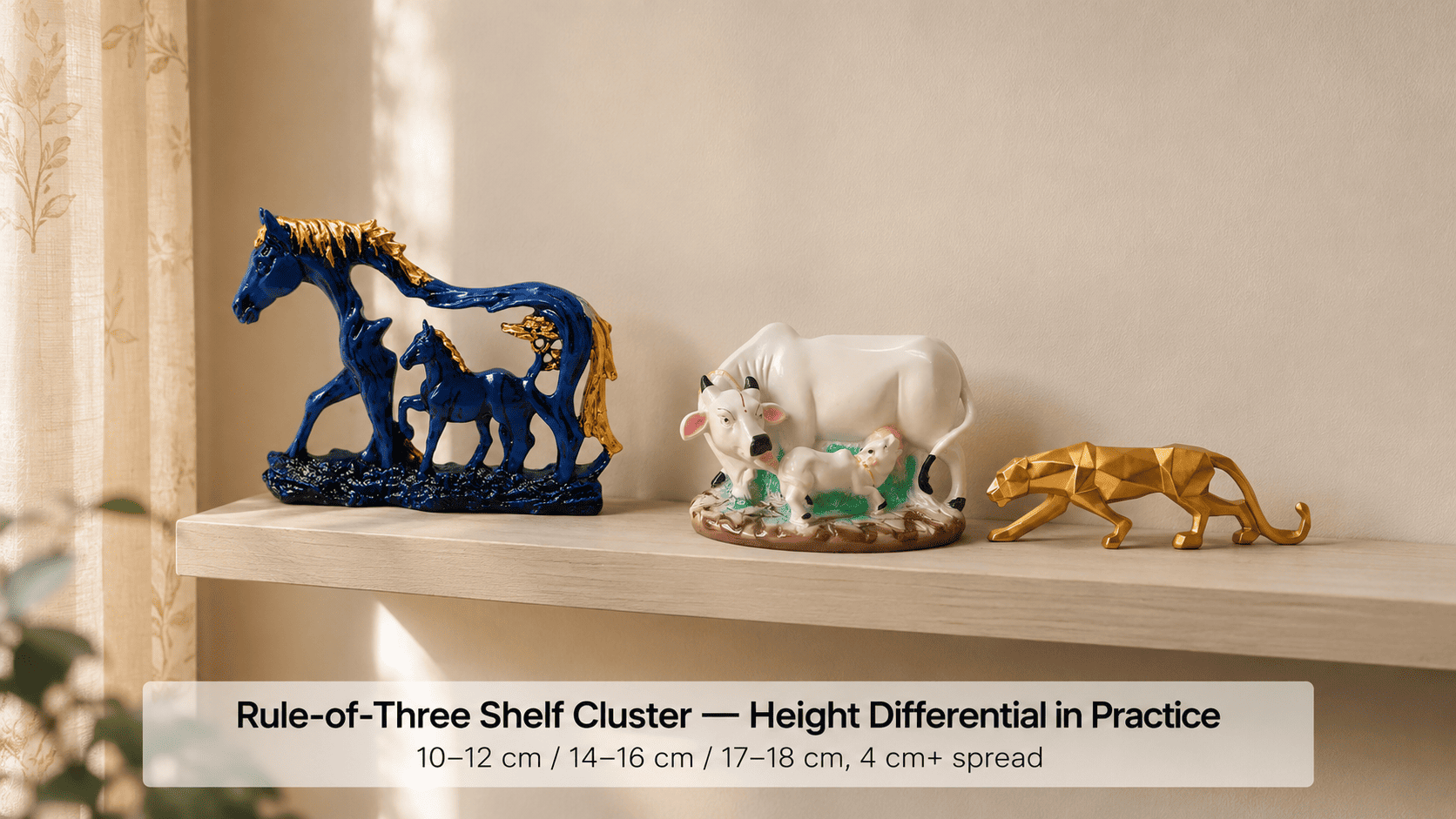
Clustering three objects of varying heights on a surface creates the illusion of depth because the staggered silhouette prevents the eye from reading the display as a flat row, instead triggering the same perceptual depth cue used in landscape composition. The rule of three works in compact rooms specifically because it uses three objects to fill the same visual field that a larger single piece would occupy — without adding the height that causes proportional compression.
The height differential between the tallest and shortest piece in a cluster should be at least 4 cm for the depth cue to register. In practical terms for a living room shelf under 40 cm wide: one Small piece (10–12 cm), one Small piece at the upper end (14–16 cm), and one Medium piece (17–18 cm) creates a 6–8 cm differential across a footprint that occupies roughly 25–30 cm of total surface width — leaving 10–15 cm of breathing space, consistent with Moolwan's Visual Weight Rule.
Palette Selection: Which Tones Maximise Visual Space in Compact Indian Living Rooms
Warm neutral showpiece palettes — terracotta, warm ivory, greige, dusty ochre — reflect the dominant wall colours used in 70–80% of Indian apartment interiors and create tonal continuity that makes the room read as a single cohesive space rather than a series of competing objects. Cool-toned or high-contrast showpieces (stark white against a warm wall, or dark charcoal against a light wall) create visual breaks that fragment the eye's path across the room, making limited square footage feel further subdivided.
The scientific basis is the same principle used in colour-field painting: when surface tones are within 20–30% of each other on a relative luminance scale, the eye moves smoothly from element to element rather than snapping between high-contrast anchors. In a compact living room, this smooth movement creates the perceptual experience of a longer visual journey across the space — increasing the apparent size of the room without changing a single dimension.
Frequently Asked Questions
What is the maximum showpiece size for a living room under 200 sq ft?
In a living room under 200 sq ft, the practical ceiling for coffee table showpieces is 21 cm height (Medium size band) because pieces exceeding one-third of the table's surface width create proportional compression — making the room read as smaller than its actual footprint. For floating shelves and TV units in the same room, the ceiling is 16 cm (upper Small size band). Moolwan's ceramic pieces in this range weigh 150–400 g, well within the load rating of standard Indian floating shelf hardware.
Is ceramic or resin better for a living room without year-round AC?
Ceramic at 92% clay composition is the correct choice for Indian living rooms without year-round air conditioning because it tolerates up to 85% relative humidity — the upper range of Indian monsoon-season interior conditions. Resin at 94% epoxy purity has a humidity ceiling of 60% RH; sustained exposure above that threshold causes surface micro-crazing within 18–24 months. Moolwan's ceramic collection is engineered to the 85% RH threshold specifically for non-AC Indian home environments.
How many showpieces should a small living room have?
A living room under 300 sq ft should have a maximum of 5–7 showpieces across all surfaces combined, because visual inventory beyond this threshold creates the perceptual effect of clutter regardless of actual object count. The practical rule is one showpiece per 30 cm of surface width per surface — which typically yields 1–2 pieces on a coffee table, 2–3 on a TV unit, and 1–2 on a floating shelf. Each surface should retain at least 70% clear space to allow the eye to rest.
Do matte or glazed showpieces suit a small living room better?
Matte finishes are technically superior for compact Indian living rooms because they scatter incoming light at multiple micro-angles, preventing the mirror-like hotspot that glazed surfaces create when exposed to overhead or natural lighting at close proximity. In rooms under 300 sq ft, every light source is closer to every surface — making the hotspot effect more pronounced and more visually intrusive than in larger spaces. Moolwan's matte ceramic showpieces are finished specifically to eliminate this effect while delivering a 5+ year lifespan without visible surface wear.
Choosing a showpiece that outlasts seasonal humidity swings, fits your room's proportional geometry, and resists the kind of surface wear that forces replacement within two years is not a luxury decision — it is the cost-per-year calculation that makes a climate-rated, manufacturer-direct piece the rational choice. Bring home a curated piece from the Moolwan living room showpiece collection — sized for Indian apartments, fired for Indian humidity, and priced without middleman markup. If your room calls for a heritage-inflected accent, explore the Moolwan antique showpiece collection for living rooms; for something one-of-a-kind, the Moolwan handmade showpiece collection offers artisan-crafted pieces unavailable through any other channel.


