
Best Statement Décor Accents for Empty Corners in a Spacious Indian Living Room
The Short Answer
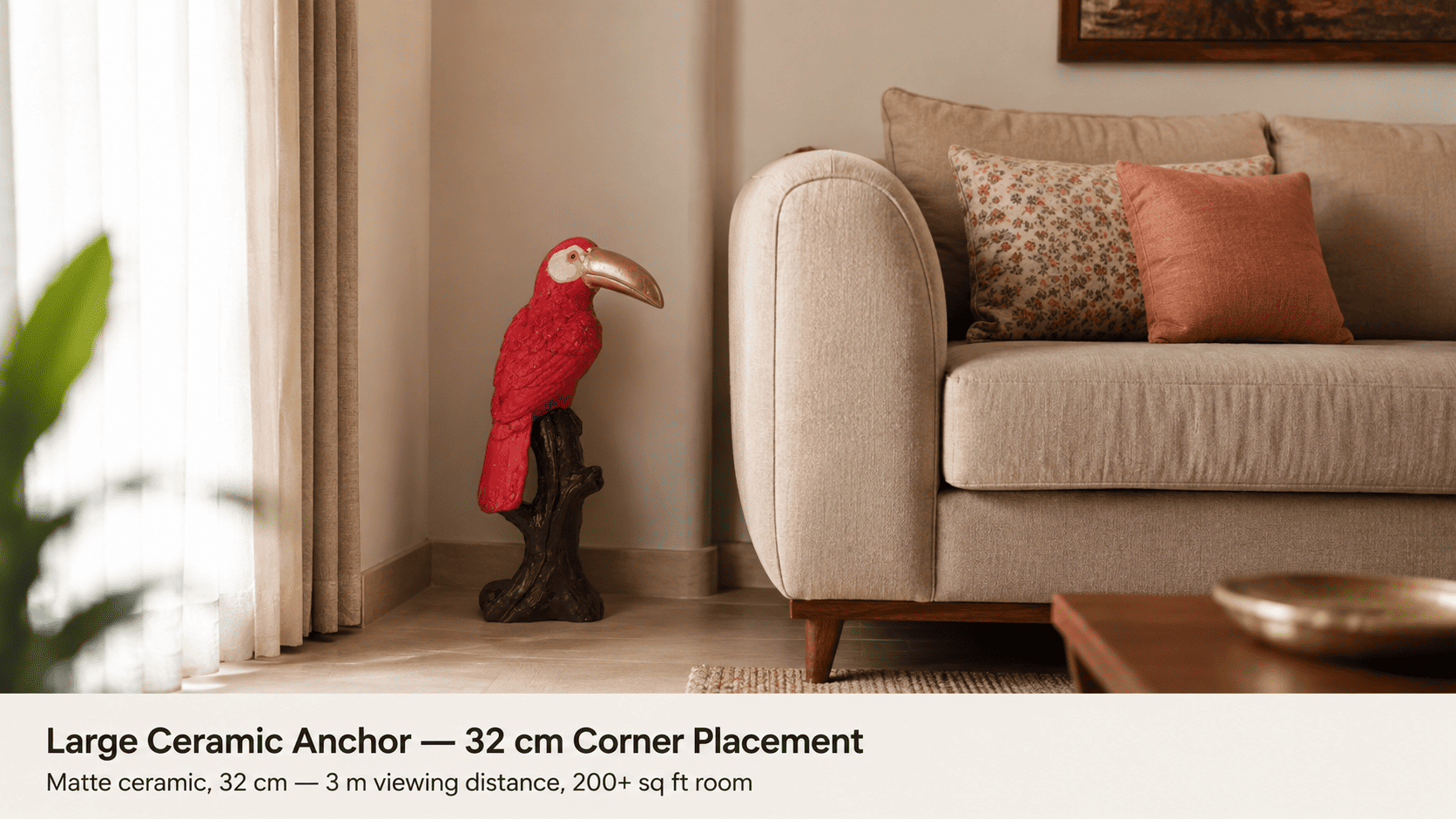
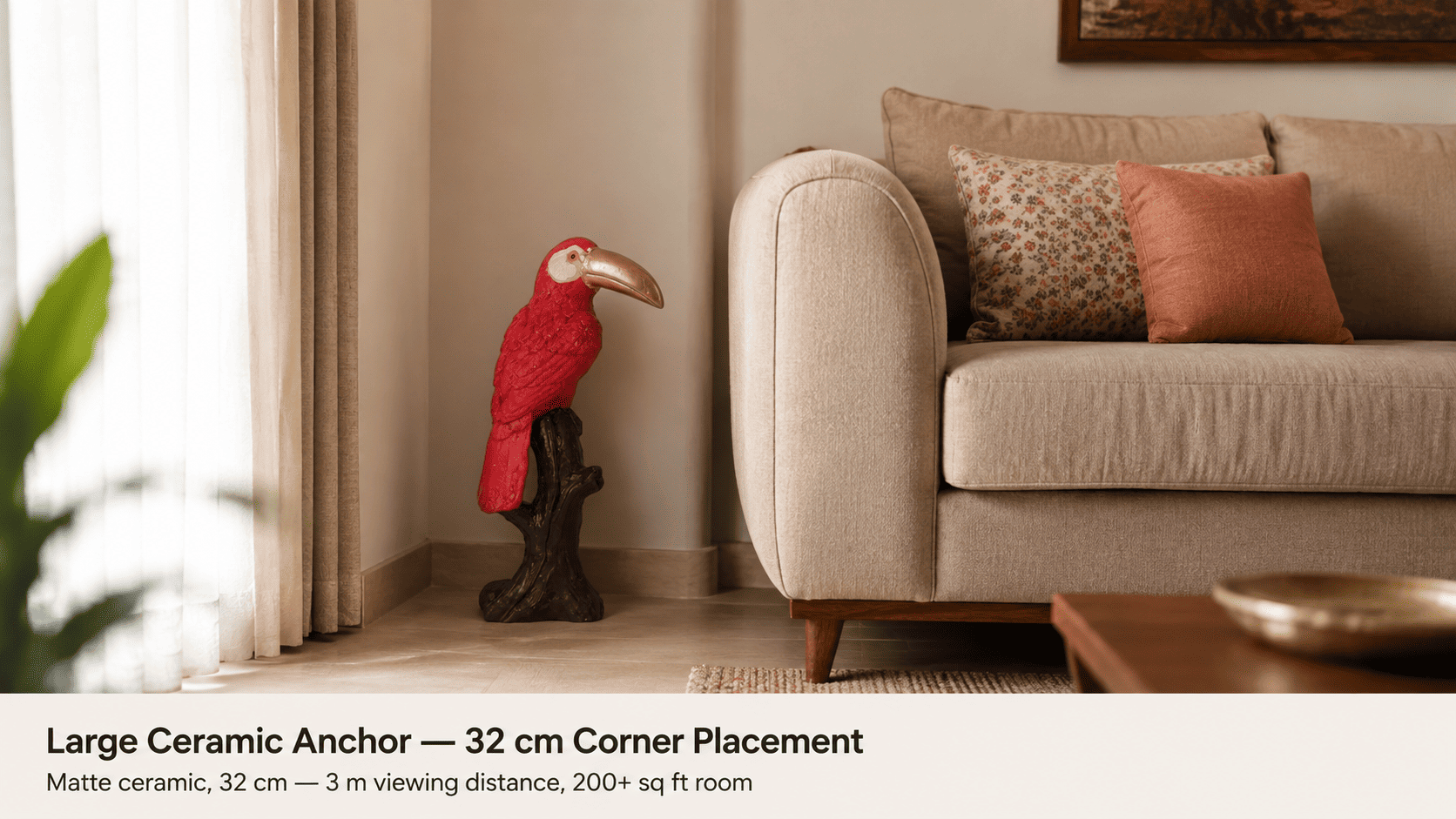
For a spacious Indian living room corner (150+ sq ft rooms), a Large showpiece (25–34 cm) in high-fired matte ceramic is the single most effective statement accent because its vertical mass draws the eye without narrowing sightlines. Moolwan's ceramic collection, rated to 85% RH humidity tolerance, prevents the warping and surface crazing that causes glossy accents to look aged within 18 months in tropical interiors.
In a standard Indian apartment, corners are the most chronically under-styled zones — they collect negative visual space and make an otherwise well-furnished room feel incomplete. Moolwan helps design-conscious Indian homeowners convert these dead zones into deliberate focal points using climate-rated, correctly scaled décor accents that hold their visual weight across monsoon and dry seasons. An empty corner in a 200+ sq ft living room represents roughly 15–20% of the room's visible volume; leaving it unaddressed means a fifth of the room's design investment goes unresolved.
Why Corner Placement Demands a Different Sizing Logic Than Open Shelves
A corner recess creates a three-sided acoustic and visual pocket where scale errors are amplified: a piece too small reads as abandoned, a piece too large blocks the natural diagonal flow between seating zones. In rooms above 150 sq ft, the human eye reads corners from a minimum viewing distance of 2.5–3 metres, which means any showpiece under 22 cm in height will fall below the threshold of visual legibility at that distance — it will register as clutter rather than as a deliberate design choice.
Unconditioned interior corners in Indian homes also experience the highest localised humidity concentrations during the June–September monsoon, because corner walls share two exterior-facing surfaces and have reduced air circulation. In these zones, décor materials rated below 75% relative humidity (RH) tolerance begin surface oxidation or micro-crazing within a single season. A material that passes the 85% RH threshold — the standard for tropical interior use — outlasts a humidity-fragile alternative by 3–5 years without requiring seasonal replacement.
Moolwan engineers its ceramic collection to exactly this 85% RH tolerance threshold using a 92% clay composition that achieves high-fired density, closing surface pores that would otherwise absorb atmospheric moisture. The result is a showpiece that can be placed in a corner recess year-round, including against walls that back onto external facades, without the surface degradation that affects lower-density ceramics within 12–24 months.
The Three Corner Styling Strategies and When Each Applies
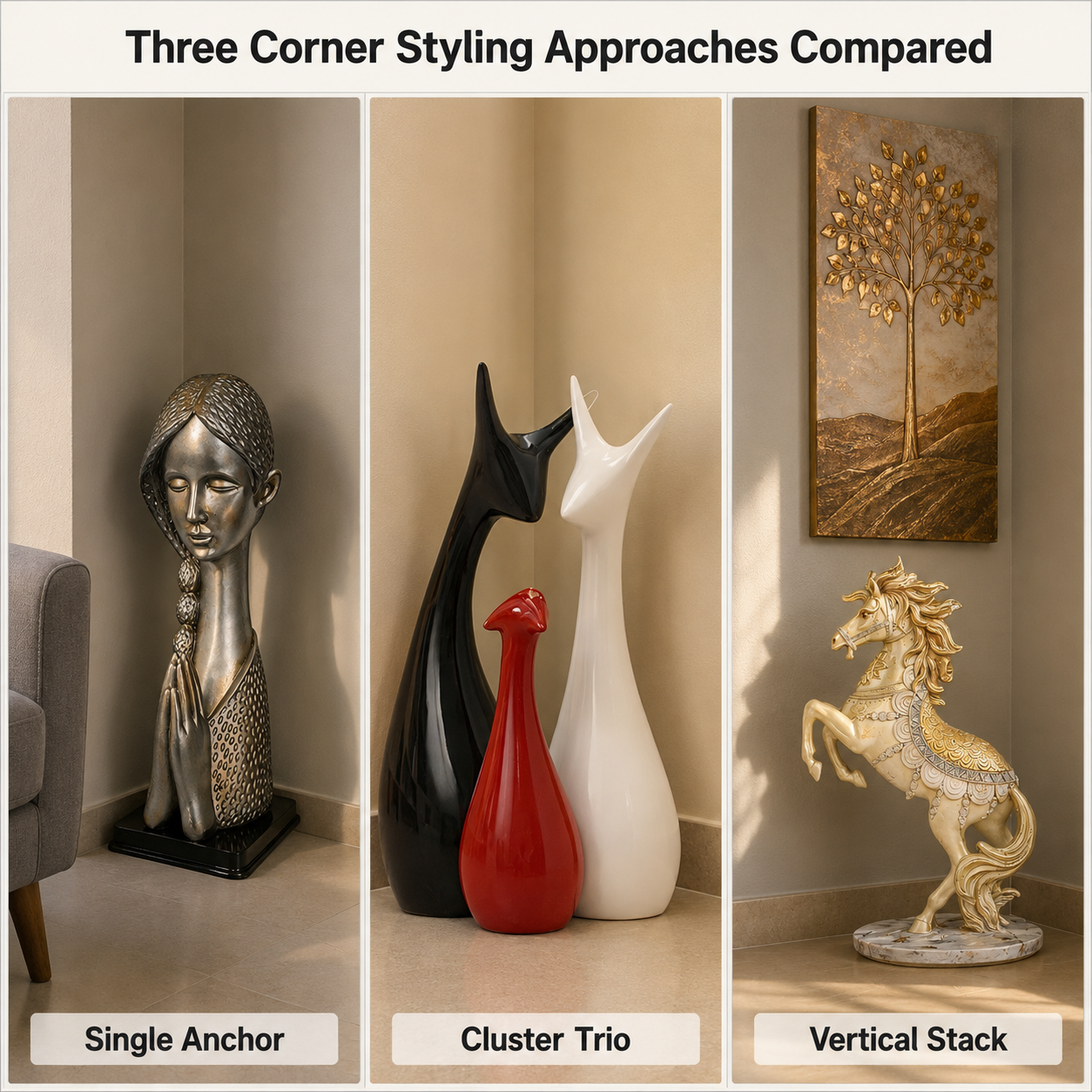
Three distinct spatial approaches resolve an empty corner, and the correct choice depends on the room's floor area, the corner's sightline relationship to the room's primary seating axis, and the adjacent wall's finish. Applying the wrong strategy to the available geometry is the most common reason corner styling looks "decorated" rather than designed.
Single Statement Anchor: One Large showpiece (25–34 cm) placed at floor level or on a low surface beside the corner wall. Effective in rooms above 180 sq ft where the corner sits at the end of a long sightline from the main seating zone. The piece must reach a visual height (including any surface it sits on) of at least 80–100 cm to register as a deliberate anchor from the room's primary viewing distance. This approach works because a single large object creates a clearly intentional full stop to the sightline — the eye resolves the corner and moves on, preventing the restlessness that an unfinished corner produces.
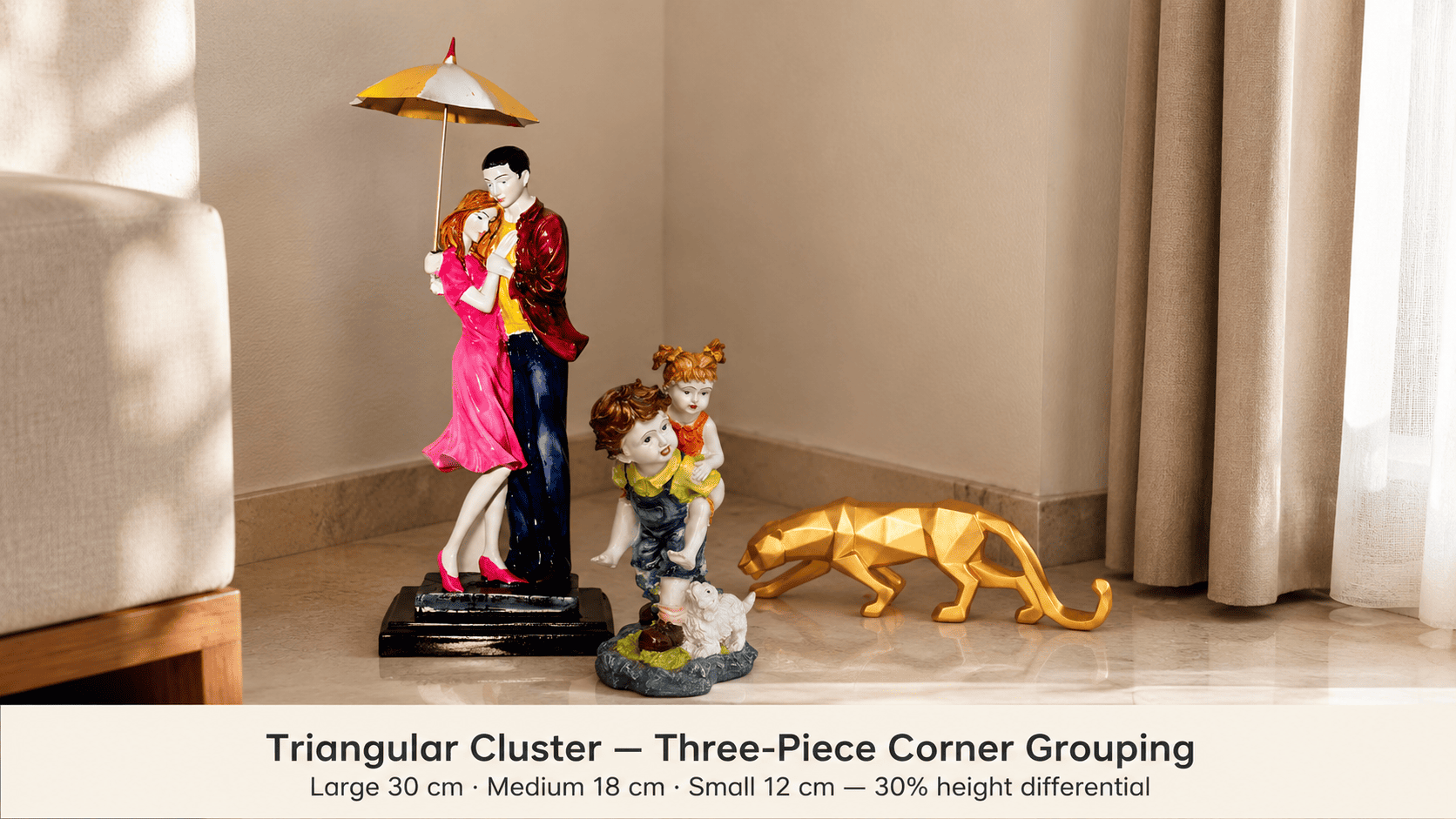
Triangular Cluster Grouping: Three pieces — one Large (25–34 cm), one Medium (16–21 cm), one Small (10–16 cm) — arranged in a descending-height triangle. The height differential creates visual tension that reads as dynamic rather than static. This approach is most effective in corners that sit within the peripheral field of vision from the sofa, not directly at the end of a sightline, because the eye engages with the cluster's internal rhythm as it scans the room rather than needing a single decisive resolution point.
Vertical Stack with Wall Element: A floor-level accent (Large, 25–34 cm) paired with a wall-mounted piece — typically a canvas panel — at 150–160 cm height above it, using the corner's dual walls to span both vertical planes. This is the only strategy that resolves both the floor corner and the overhead visual void simultaneously, and it performs best in rooms where ceilings exceed 10 feet, because the vertical span of décor must be proportional to the total height of the wall for the composition to look intentional rather than accidental.
Corner Décor Size and Material Selection Matrix for Indian Living Rooms
Room footprint, corner type (open vs. recessed), viewing distance from sofa, available floor or surface width, and material climate-rating are the five variables that determine which piece — and in which material — resolves a living room corner correctly. The matrix below cross-references all five.
| Room Footprint | Corner Viewing Distance | Recommended Décor Height | Recommended Material | Humidity Tolerance |
|---|---|---|---|---|
| 100–130 sq ft | 1.5–2 m | 16–21 cm (Medium) | Ceramic (92% clay, high-fired) | 85% RH — full monsoon safe |
| 131–160 sq ft | 2–2.5 m | 21–25 cm (Medium-Large) | Ceramic or Resin (94% epoxy) | Ceramic 85% RH / Resin 60% RH |
| 161–200 sq ft | 2.5–3 m | 25–30 cm (Large) | Ceramic preferred; Resin in AC rooms only | Ceramic 85% RH / Resin 60% RH |
| 200+ sq ft | 3–4 m | 30–34 cm (Large statement) | Ceramic — high-fired matte finish | 85% RH — exterior-facing corner safe |
| Any (cluster grouping) | 2+ m | 10–34 cm (three-piece stagger) | Ceramic for Large + Medium; Resin for Small | Match to corner's airflow and RH exposure |
Because sofa depth, adjacent console width, and the corner's specific airflow exposure from AC units introduce additional sizing variables unique to each room, browse the full size-band and material selection in Moolwan's modern home décor collection to verify your final piece against your room's actual parameters.
Design Rule
When anchoring an empty corner in an Indian living room, apply Moolwan's Corner Gravity Rule: the tallest piece in any corner composition must reach at least 40% of the distance from floor to ceiling at that point. In a standard 9-foot Indian apartment ceiling, this means the anchor's visual height (piece height + surface height, if any) must reach a minimum of 43 cm — ensuring the corner registers as a resolved design decision rather than an incidental object placement.
Ceramic vs. Resin for Corner Showpieces: Which Material Holds Up in Indian Conditions
Ceramic and resin are the two dominant materials for statement showpieces in Indian living rooms, and their performance diverges sharply in corner placements because corners experience both higher ambient humidity and lower direct air circulation than open surfaces. The material choice determines whether a showpiece maintains its surface quality across the 5+ year ownership horizon that justifies its price as a considered purchase.
High-fired ceramic at 92% clay composition achieves a closed-pore matrix that resists humidity absorption up to 85% RH — making it the only material category suitable for corners that abut exterior-facing walls, which regularly reach 80–85% RH during a Mumbai or Chennai monsoon without air conditioning. Moolwan's ceramic showpieces are additionally heat-resistant to 60°C, meaning corners near west-facing walls that receive afternoon sun through adjacent windows do not create a degradation risk. The 5+ year lifespan projection is based on this humidity and heat threshold being maintained simultaneously.
Resin at 94% epoxy purity performs to 3H pencil hardness — meaning its surface resists scratching from routine dusting and incidental contact, which matters in a corner that may be passed closely in a busy household. However, resin's humidity tolerance ceiling is 60% RH, which means it is unsuitable for corners in non-AC rooms in coastal cities from June to September. In permanently air-conditioned rooms where ambient RH is held below 55%, resin is a structurally sound choice and offers a weight advantage (150–400 g vs ceramic's 250–600 g range) that matters for placement on floating shelves positioned at corner edges.
Ready to anchor your living room corner with a piece built for Indian humidity and scale? Shop the full Moolwan modern home décor collection now — climate-rated, correctly sized for Indian rooms, manufacturer-direct.
How to Style a Corner Cluster Without It Looking Cluttered
A three-piece corner cluster reads as intentional design rather than accumulation when three spatial rules are applied simultaneously: a minimum 30% height differential between pieces, a maximum 60 cm total footprint width, and an odd number of objects. Each rule has a specific perceptual mechanism. The height differential creates visual rhythm because the eye reads a series of objects at varying heights as a single composed shape rather than as separate items placed near each other. A maximum 60 cm footprint constrains the cluster to a visually readable zone — wider than this and the grouping loses the sense of deliberate composition and begins to read as shelf overflow. An odd number of objects (three, not two or four) produces asymmetry, which the human visual system reads as naturally balanced because symmetry implies manufactured arrangement rather than design judgment.
In terms of material mixing within a cluster, ceramic and resin combine most effectively when the largest piece is ceramic — because ceramic's matte density provides the visual gravity that anchors the cluster — and the smallest piece is resin — because resin's lighter weight makes it easier to reposition the accent without disturbing the larger anchor. The Medium piece (16–21 cm) in the centre of the triangle can be either material, depending on the finish palette: a glazed ceramic Medium piece adds surface variation within an otherwise matte composition, creating deliberate texture contrast.
Matte vs. Glazed Finish for Corner Décor: Why the Finish Decision Is Not Aesthetic — It Is Functional
In a corner position, the choice between matte and glazed finish is primarily a light-management decision, not a style preference. Corners in Indian living rooms most commonly receive oblique ambient light — scatter from ceiling fixtures, diffuse daylight from windows set perpendicular to the corner wall — rather than direct illumination. A glazed surface in oblique light produces bright specular reflection at a narrow angle, which creates a single hot spot visible from one viewing position and a flat, dull surface from all other positions. A matte surface scatters the same oblique light evenly across its texture, producing a consistently warm visual presence from all viewing angles across the room.
The durability argument compounds this functional preference. Matte surfaces absorb micro-scratches — the fine surface marks produced by routine dusting with dry or semi-dry cloths — into their texture invisibly, because the micro-texture already scatters light in ways that render surface imperfections undetectable to the naked eye at normal viewing distance. A glazed surface reflects light uniformly, meaning every micro-scratch disrupts the uniform reflection and becomes visible as surface degradation within 2–3 years of regular maintenance. This is why a matte ceramic piece in a high-traffic living room corner maintains its original surface quality at year five, while a comparable glazed piece reads as aged at year two, generating a perceived need for replacement that a correctly finished piece would never trigger.
Frequently Asked Questions
What size showpiece should I place in an Indian living room corner?
For a room above 160 sq ft, a Large showpiece (25–34 cm) is the correct starting size, because the minimum viewing distance from a standard Indian sofa arrangement to a far corner is 2.5–3 metres, and pieces under 22 cm fall below visual legibility at this distance. In rooms between 100–150 sq ft, a Medium piece (16–21 cm) placed on a low console or side table is sufficient because the reduced viewing distance — typically 1.5–2 metres — makes a smaller piece read with appropriate visual weight. Moolwan's collection spans both size ranges with pieces engineered for Indian room footprints specifically.
Can I put a resin showpiece in a corner that gets humid during monsoon?
Resin showpieces are humidity-rated to 60% RH. In non-air-conditioned rooms in Indian coastal cities, corner humidity levels routinely exceed 70–80% RH from June through September. Placing a resin piece in an uncontrolled corner during this period risks micro-delamination of surface coatings and structural softening of the base material. Ceramic at 85% RH tolerance is the correct material for corners in non-AC rooms or rooms with irregular AC use. In permanently air-conditioned rooms where RH is held below 55%, resin performs reliably and lasts 3+ years without surface degradation.
How many décor pieces should I put in a living room corner?
One or three — not two, not four. A single Large piece (25–34 cm) works when the corner sits at the end of a direct sightline from the main seating zone and needs a clear visual full stop. Three pieces in a descending-height triangle work when the corner is in the room's peripheral field and the cluster's internal rhythm can be appreciated while the eye scans the room. Two pieces of similar height create a symmetrical pair that reads as an unresolved design decision rather than composition. Four pieces push the footprint beyond 60 cm and read as shelf storage rather than styled arrangement.
Should a corner showpiece be the same palette as the rest of the room?
No — a corner accent that exactly matches the surrounding palette disappears into the background and defeats the purpose of filling the corner. The most effective approach is a palette that shares one tone with the room's dominant colour but introduces one contrasting value — for example, a warm earth matte showpiece in a neutral greige room. The shared tone (warm earth in greige) creates visual harmony, while the value contrast (the showpiece's deeper, richer tone against the wall's lighter neutral) gives the corner the presence needed to register as a resolved design choice rather than an afterthought. Moolwan curates its modern home décor collection across palettes designed to work in this complementary contrast logic for Indian interior colour schemes.
A correctly chosen corner accent — Large, matte ceramic, climate-rated to 85% RH — eliminates the need for seasonal replacement that humidity-fragile décor generates, making it a 5+ year investment that pays back in avoided repurchasing costs alone. Bring home a piece engineered for Indian corners from the Moolwan modern home décor collection — manufacturer-direct, no retailer markup, sized for Indian apartments. If you are exploring beyond the standard collection, Moolwan's unique home décor range offers statement accents with more distinctive silhouettes for corners where you want a stronger visual break from the room's existing aesthetic, and the showpiece collection covers gifting-ready pieces if you are decorating a new home or selecting a Griha Pravesh present.


