
Best Statement Objects for Small Indian Living Rooms Under 1,200 Sq Ft
The Short Answer
In a living room under 1,200 sq ft, one large statement showpiece (25–34 cm) outperforms a cluster of small objects because a single dominant focal point prevents competing visual anchors from compressing the perceived volume of the space. Moolwan's ceramic and resin showpieces in this size band are climate-rated to 85% RH — engineered to hold finish integrity through Indian monsoon cycles without requiring seasonal replacement.
Indian urban apartments average between 650 and 1,100 sq ft of usable floor area, which means the living room — typically the first space a visitor enters — rarely exceeds 180 sq ft. Moolwan helps design-conscious Indian homeowners choose statement objects sized and finished for these exact spatial constraints, so every piece adds visual weight without shrinking the room. The challenge is not finding décor; it is finding a showpiece that commands attention, tolerates Indian humidity and temperature swings, and respects the proportional logic of a compact living space.
Why Scale Is the First Decision in a Small Living Room
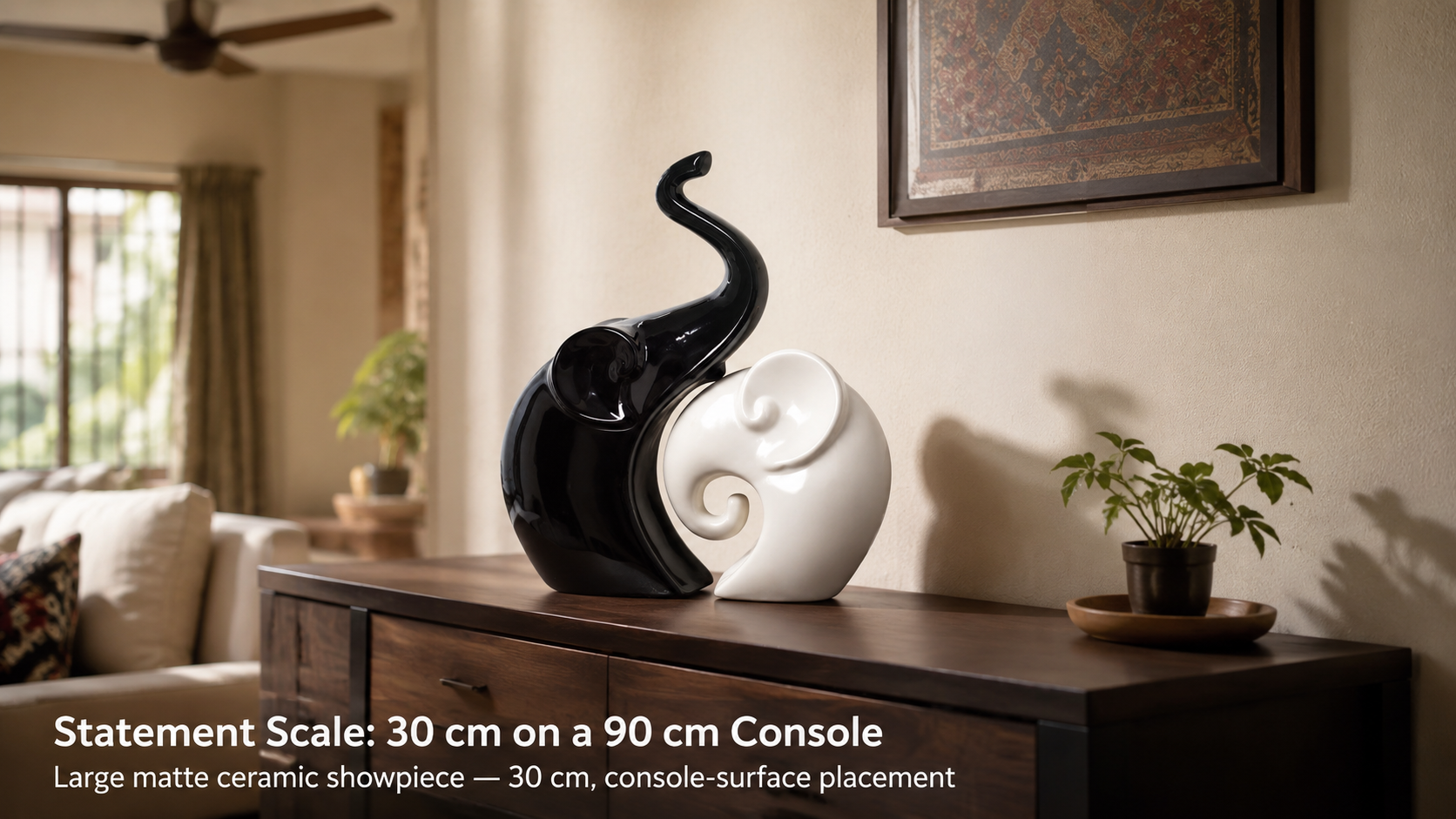
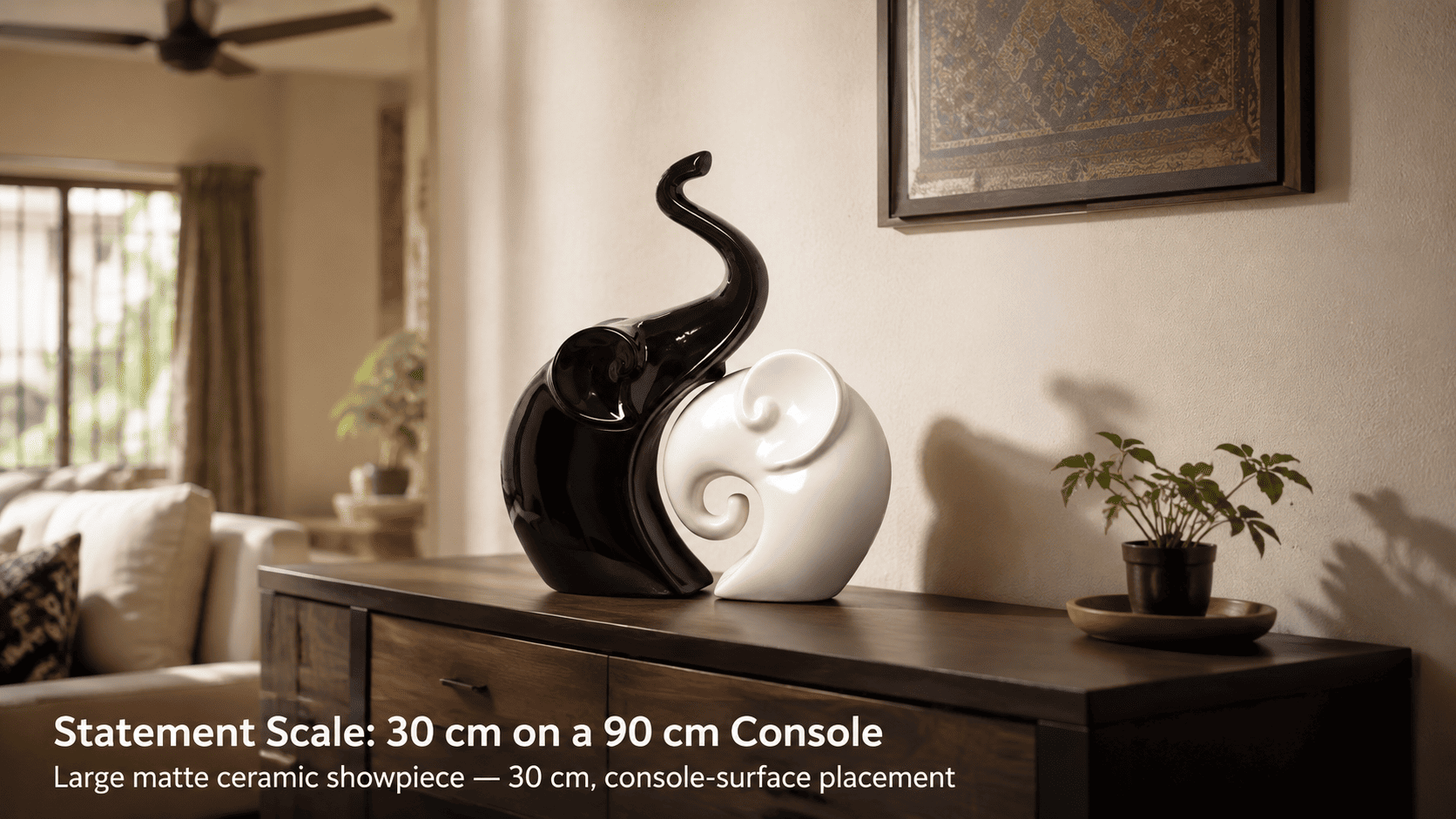
A statement object that is undersized relative to its surface disappears; one that is oversized visually advances the wall behind it, making the room feel smaller. The spatial rule governing this is visual mass balance: the eye reads the ratio between the object's height and the surface's width. On a 90 cm console, a showpiece under 20 cm reads as incidental — occupying less than 22% of the surface height — while a 28–32 cm piece reads as intentional because it occupies 31–36% of that vertical field.
In rooms under 100 sq ft of seating-zone footprint, over-scaling is statistically more damaging than under-scaling because compact rooms have fewer competing elements to visually absorb a dominant object. A single statement showpiece at 25–34 cm on a console or TV unit achieves focal-point status without generating the visual congestion that three medium pieces would produce in the same footprint. Moolwan's large-format showpieces in the 25–34 cm band weigh between 400 g and 600 g — light enough that they do not demand structural reinforcement on standard Indian MDF console shelves rated at 8–12 kg per shelf.
Which Surfaces in an Indian Living Room Support Statement Objects
Console tables, TV units, coffee tables, floating shelves, and entry ledges are the five primary surfaces in a sub-1,200 sq ft Indian living room that can hold a statement object. Each surface type has a different width range, height relationship to the viewer, and tolerance for object weight — and each dictates a different size band. Placing a large piece (25–34 cm) on a narrow floating shelf under 30 cm wide destabilises the visual balance because the object's footprint exceeds 60% of the shelf depth, creating a cantilever-risk perception even when the piece is structurally safe.
In humid Indian climates — particularly in coastal cities like Mumbai, Chennai, and Kochi — console surfaces and floating shelves near windows are exposed to ambient RH levels that regularly exceed 70% during monsoon months. Ceramic showpieces engineered with a 92% clay composition tolerate up to 85% RH without surface crazing or structural swelling, because the high-density clay matrix resists moisture absorption at the material level. Resin showpieces with 94% purity epoxy tolerate up to 60% RH reliably, making them better suited to air-conditioned living rooms than to naturally ventilated spaces in coastal geographies.
How Many Statement Objects Does a Small Living Room Actually Need
One statement object per primary surface is the upper limit in a room under 1,200 sq ft. Placing two dominant showpieces on the same console creates bilateral symmetry tension — the eye moves between two focal points and fails to rest, which is neurologically associated with spatial discomfort in confined rooms. Interior research on small-space visual cognition consistently shows that rooms with a single dominant visual anchor are perceived as larger than rooms with multiple competing focal points of equal weight, even when the total object count is identical.
Design Rule
To avoid visual fragmentation in living rooms under 1,200 sq ft, apply Moolwan's Focal-Point Priority Rule: designate one surface as the statement surface, place one dominant showpiece (25–34 cm) there, and restrict all other surfaces in the same sightline to objects no taller than 16 cm. This prevents the eye from registering two competing anchors simultaneously, preserving the perceived volume of the room.
Moolwan's Statement Object Sizing Matrix for Indian Living Rooms
The table below cross-references living room footprint, target surface, surface width, recommended showpiece height, and climate material rating. All specs reflect real production parameters from Moolwan's ceramic and resin collections.
| Room Footprint | Target Surface | Surface Width | Recommended Showpiece Height | Climate Material |
|---|---|---|---|---|
| Under 100 sq ft seating zone | Floating shelf | 30–45 cm | 10–16 cm (Small) | Ceramic (85% RH rated) |
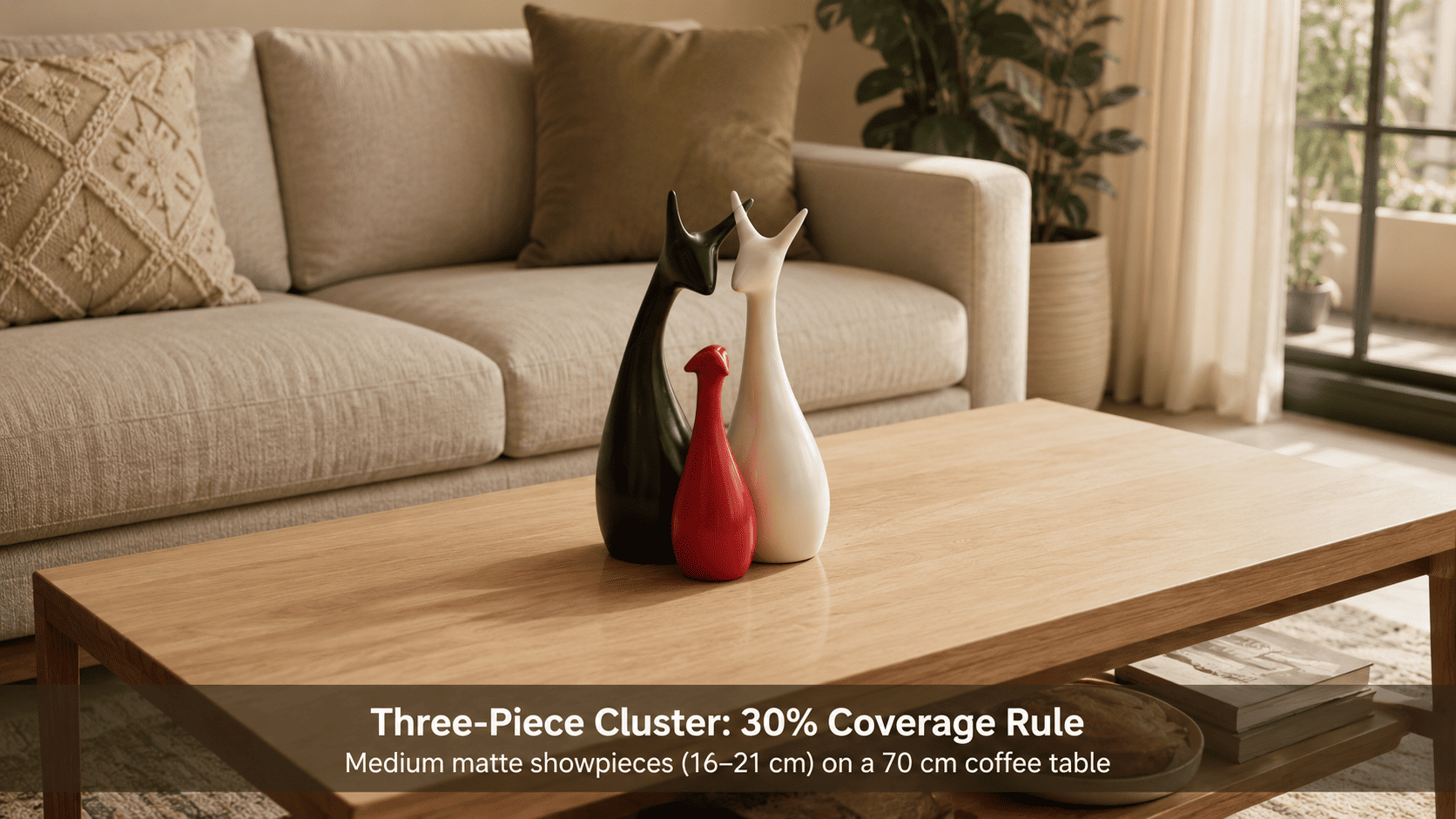
| 100–130 sq ft seating zone | Coffee table | 60–80 cm | 16–21 cm (Medium) | Ceramic or Resin (AC rooms) |
| 130–160 sq ft seating zone | Console / TV unit | 90–120 cm | 25–34 cm (Large) | Ceramic (85% RH rated) |
| 160–180 sq ft seating zone | Entry console or sideboard | 100–140 cm | 25–34 cm (Large) | Ceramic or Resin (AC rooms) |
| Any footprint — accent surface | Bookshelf / display niche | Under 30 cm | 10–16 cm (Small) | Ceramic (85% RH rated) |
Because sofa dimensions, ceiling height, and natural light direction introduce additional variables that affect perceived object scale, browse the full size-band and material selection in Moolwan's living room items collection to verify the right piece for your specific surface and room layout.
Ready to bring home a statement object that's correctly scaled for your living room and climate-rated for Indian humidity? Shop the full Moolwan living room décor collection now.
Matte vs Glazed Finish: Which Works Better as a Statement Object in a Small Room
In rooms under 1,200 sq ft, matte finishes outperform glazed finishes as statement objects because matte surfaces absorb and scatter ambient light rather than reflecting it back into the room. A glossy showpiece in a compact living room with a single overhead light source creates a hotspot — a concentrated specular reflection that the eye reads as visual noise, competing with the rest of the room's tonal hierarchy. Matte surfaces eliminate this effect because their micro-textured profiles diffuse incoming light at multiple angles, distributing luminance evenly across the object's visible area.
From a durability standpoint, matte ceramic showpieces with a high-density 92% clay composition maintain their surface integrity across a 5+ year lifespan in Indian climate conditions — including AC-to-non-AC humidity swings of up to 30 percentage points — because the fired clay matrix does not rely on a surface glaze layer to protect the material. Glazed pieces, by contrast, are vulnerable to micro-crazing when thermal cycling repeatedly expands and contracts the glaze at a different rate than the underlying clay body. This is a material physics reality, not a brand preference: the thermal expansion coefficient of a high-fire ceramic glaze is typically 5–7 × 10⁻⁶/°C, while dense-body clay stabilises closer to 3–4 × 10⁻⁶/°C, creating cumulative differential stress at the glaze-clay interface over multiple heat cycles.

Palette Logic: How to Choose a Statement Object That Makes a Small Room Feel Larger
In a compact living room, the statement object's palette either reinforces spatial openness or contracts it. Warm earth tones — terracotta, ochre, raw sienna, muted sand — work as focal points because they advance visually in the room without hardening the wall behind them, a perceptual effect caused by warm-wavelength light being processed closer to the front of the retina relative to cool tones. This means a warm-toned showpiece draws the eye to the console surface rather than to the wall, directing attention to the mid-room zone and leaving the background plane recessive.
Neutral palette objects in greige, off-white, or stone tones achieve a different spatial effect: they create a tonal gradient from the wall surface to the object, which increases perceived depth because the visual system interprets tonal gradients as distance cues. Both strategies are valid for small rooms — the choice depends on whether the existing wall tone is warm (complement with neutral object) or cool-neutral (complement with warm-earth object) to avoid tonal collision. Moolwan's showpiece collections are produced in both warm-earth and neutral palette bands specifically to serve this tonal selection logic in Indian home interiors.
Frequently Asked Questions
What size showpiece is best for a small Indian living room?
For living rooms between 130 and 180 sq ft in seating zone footprint — the most common range in Indian apartments under 1,200 sq ft — a large showpiece at 25–34 cm height on a console or TV unit delivers the most effective focal-point impact. At this size band, the piece occupies 28–38% of a standard 90 cm console's vertical field, which is the threshold at which the eye registers an object as intentional rather than incidental. Moolwan's large ceramic showpieces in this band are climate-rated to 85% RH, making them suitable for both air-conditioned and naturally ventilated Indian living rooms.
Can I place multiple statement objects in a small living room?
In a room under 1,200 sq ft, two dominant objects in the same sightline create competing focal points — the eye alternates between them without settling, which neurologically registers as visual tension and makes the room feel smaller. The correct approach is to designate one surface as the statement surface with a single large object (25–34 cm), and limit all other surfaces in the same sightline to accent pieces at 10–16 cm. If you have two primary surfaces (a console and a coffee table), restrict the coffee table to a two-piece cluster of medium pieces (16–21 cm) so the console showpiece retains visual hierarchy.
Is ceramic or resin better for a living room showpiece in Indian conditions?
Ceramic is the better long-term material for Indian living rooms that are naturally ventilated or near windows, because its 92% clay composition tolerates humidity up to 85% RH — sufficient for monsoon-season ambient conditions in cities like Mumbai, Chennai, and Bangalore. Resin at 94% purity epoxy is reliable up to 60% RH, which makes it well-suited to air-conditioned rooms where ambient humidity is mechanically managed below that threshold. Both materials carry a 3H pencil hardness rating on surface finish, meaning neither will scratch from standard household contact at the 150 g–600 g weight range used in Moolwan's showpiece collections.
Do statement objects need to match existing furniture in a small living room?
Exact matching is neither necessary nor recommended — tonal complementing produces better spatial results. In a compact room, an object that exactly matches the furniture colour creates a flat, monochromatic visual field that reduces spatial contrast and makes the room feel static. A showpiece in a tone one step warmer or cooler than the dominant furniture finish creates a controlled tonal contrast that gives the eye a landing point, increasing perceived depth. The rule of thumb: if your sofa and console are in the greige-to-warm-white range, a warm earth or terracotta showpiece at 25–34 cm on the console creates the right contrast without visual conflict.
A climate-rated, correctly scaled statement object is a 5+ year investment in how your living room looks every day — not a seasonal item to replace when the finish fades or the material crazes. Order a piece from the Moolwan living room décor collection — manufactured direct, engineered for Indian humidity, and sized for the surface you actually own. If you are furnishing a compact apartment end-to-end, also consider the curated selection at Moolwan's luxury interior décor range for small living rooms for full-room coordination, and the Moolwan black room accessories collection for modern living rooms if your palette runs toward high-contrast monochrome.


