
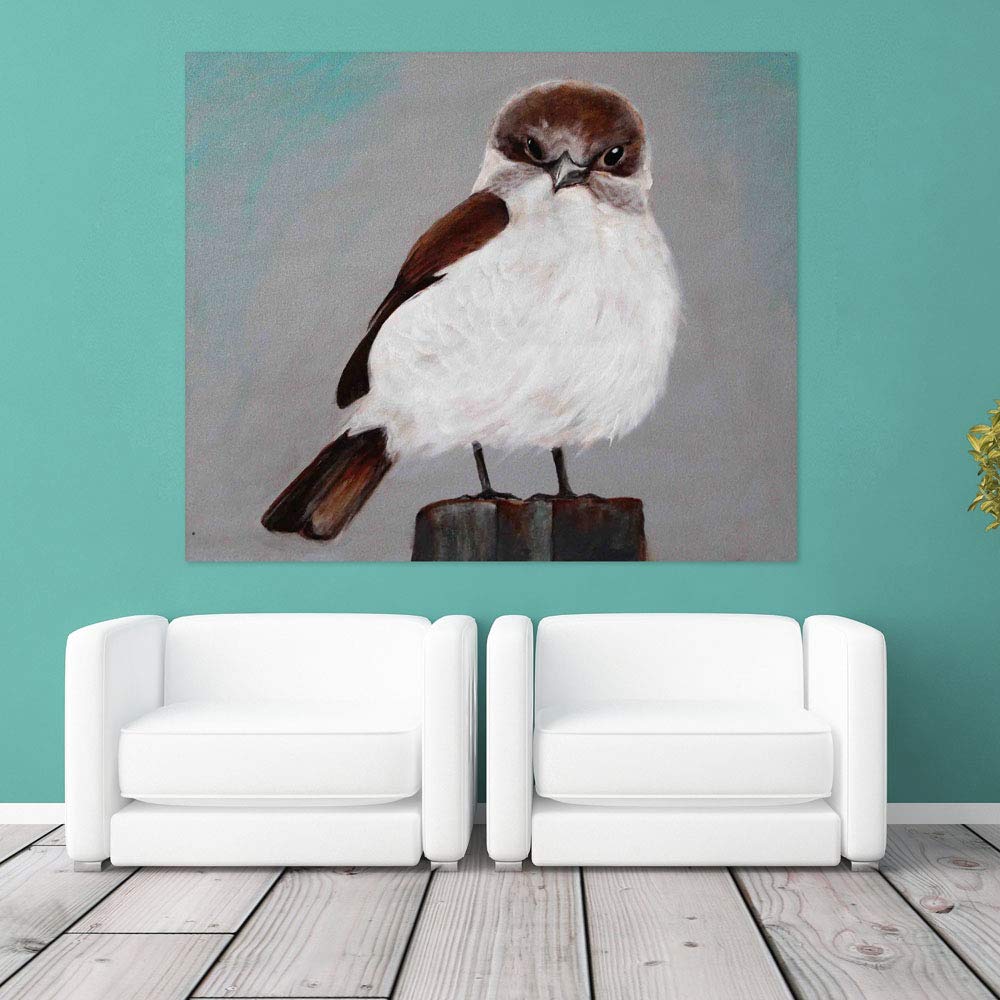

Bird-Brained Suspicion: framed Suspicious Bird Wall Art That'll Make Your Walls Start Chirping
You may also like


Moolwan Suspicious Bird Canvas Wall Art Painting (91x76cm) - Framed Humorous Bird Art
You might have browsed dozens of wall art pieces by now. Some were too small—those 40cm canvases that looked like afterthoughts on your 10-foot wall. Some were too large—overwhelming statement pieces that made your living room feel like an art gallery instead of a home. You probably kept coming back to something in the 80-100cm range—because intuitively, it feels right. But you want to be sure.
This 91x76cm suspicious bird canvas sits precisely in that comfortable middle ground. On a standard 10-foot (305cm) wall, it covers roughly 30% of the width—enough to anchor the space without dominating it. The grey-blue background works with the cream and off-white walls common in Indian apartments, while the brown and white bird creates a focal point that's distinctive without being jarring.
Why 91x76cm Works on 10-Foot Walls (and What Happens If You Go Smaller or Bigger)
Let's do the math your eyes are already trying to calculate.
A standard Indian living room wall runs about 10-12 feet (305-365cm). This 91cm canvas covers approximately 30% of a 10-foot wall, leaving 107cm of breathing space on each side. That's the golden ratio for single-panel art—enough presence to look intentional, enough margin to avoid the "crammed" look.
If you went smaller—say, a 60cm canvas—you'd cover only 20% of that same wall. It would look like you bought whatever was on sale rather than made a deliberate choice. Your sofa, probably 6-8 feet wide, would dwarf it.
If you went larger—120cm or more—you'd start eating into the 15-20% margin rule. The art would feel like it's competing with your furniture instead of complementing it.
At 76cm height, this canvas hangs comfortably at eye level (roughly 145-155cm from floor to center) with adequate clearance above a standard 3-foot console table or below an 8-9 foot ceiling.
The Color Science: How Grey-Blue and Brown Look Against Cream Walls
Here's what actually matters for your walls, not the styled mockup photos.
Your walls are probably cream, off-white, or builder's peach—the standard palette across Indian apartments. The grey-blue background of this canvas creates a cool-toned contrast that reads as sophisticated rather than stark. It won't clash with warm undertones in your wall paint the way pure white backgrounds sometimes do.
The brown cap and wings pick up the wood tones likely present in your furniture—whether it's a teak coffee table, wooden TV unit, or those floating shelves near the sofa. The fluffy white chest reflects ambient light, making the piece visible even from the dining area without being harsh.
In morning natural light, the grey-blue reads cooler and more subtle. Under evening LEDs (the warm white 3000K most Indian homes use), it shifts slightly warmer—but remains balanced. You won't wake up one day wondering why you bought something that now looks like a different painting.
Rental-Friendly Mounting: How to Hang Without Losing Your Deposit
At 400 grams, this is genuinely lightweight canvas art—not the 2-3kg framed pieces that require wall anchors and prayers.
Two small nails are enough. Standard 1.5-inch finishing nails, the kind available at any hardware store for ₹10, will hold this securely on cement or brick walls. The existing D-rings on the back are positioned for balanced hanging—you won't be adjusting and readjusting trying to get it level.
For those in rental apartments worried about the security deposit (₹50,000-2,00,000 in metros), here's the reality: two nail holes are easily filled with white toothpaste or wall putty during move-out. This isn't the kind of heavy art that requires drilling, rawl plugs, or explanations to your landlord.
Installation takes about 15 minutes including measuring, marking, and hanging. You'll spend more time unwrapping the packaging.
How This Compares to Smaller Sizes You've Been Considering
You've probably also looked at 60x40cm and 75x50cm options during your browsing.
The 60x40cm canvases work for gallery walls or small accent spaces—above a bedside table, in a hallway, as part of a cluster. As a standalone living room piece above a sofa, they consistently look undersized. The visual weight doesn't match modern furniture proportions.
The 75x50cm range is borderline. It works in 10x10 bedrooms or compact study rooms. In a 12x14 living room with a 7-foot sofa, it starts to feel like you're being cautious rather than decisive.
At 91x76cm, you're making a clear design choice. The single suspicious bird becomes a conversation piece rather than background decoration. Guests notice it—and the expression on that bird practically demands comments.
What This Will Look Like in Your Living Room (Not Just Online Photos)
Let's set realistic expectations.
The canvas has a subtle texture—340 GSM cotton, not glossy photo paper. This means it catches light softly rather than reflecting glare. If you're placing it opposite a window, you won't have that annoying bright spot that makes art invisible during certain hours.
The moisture-resistant coating matters for Indian conditions. During monsoon months (70-85% humidity), uncoated canvases can warp or develop that slightly wavy look. This one won't.
The suspicious expression on the bird is clearly visible from across a 14-foot room. The fluffy white chest and distinctive brown cap read well even from the dining table. It's not one of those pieces that only reveals itself when you're standing directly in front of it.
Quick Specifications
- Product: Moolwan Suspicious Bird Canvas Wall Art Painting
- Dimensions: 91cm (W) x 76cm (H) x 2cm (D)
- Weight: 400 grams
- Canvas: 340 GSM cotton with moisture-resistant coating
- Frame: 1.5" kiln-dried pinewood
- Inks: Eco-solvent UV-resistant
- Mounting: Framed with D-rings, ready to hang
- Delivery: 5-6 days (metro), 6-8 days (tier-2/3 cities)