
.jpeg)
.jpeg)

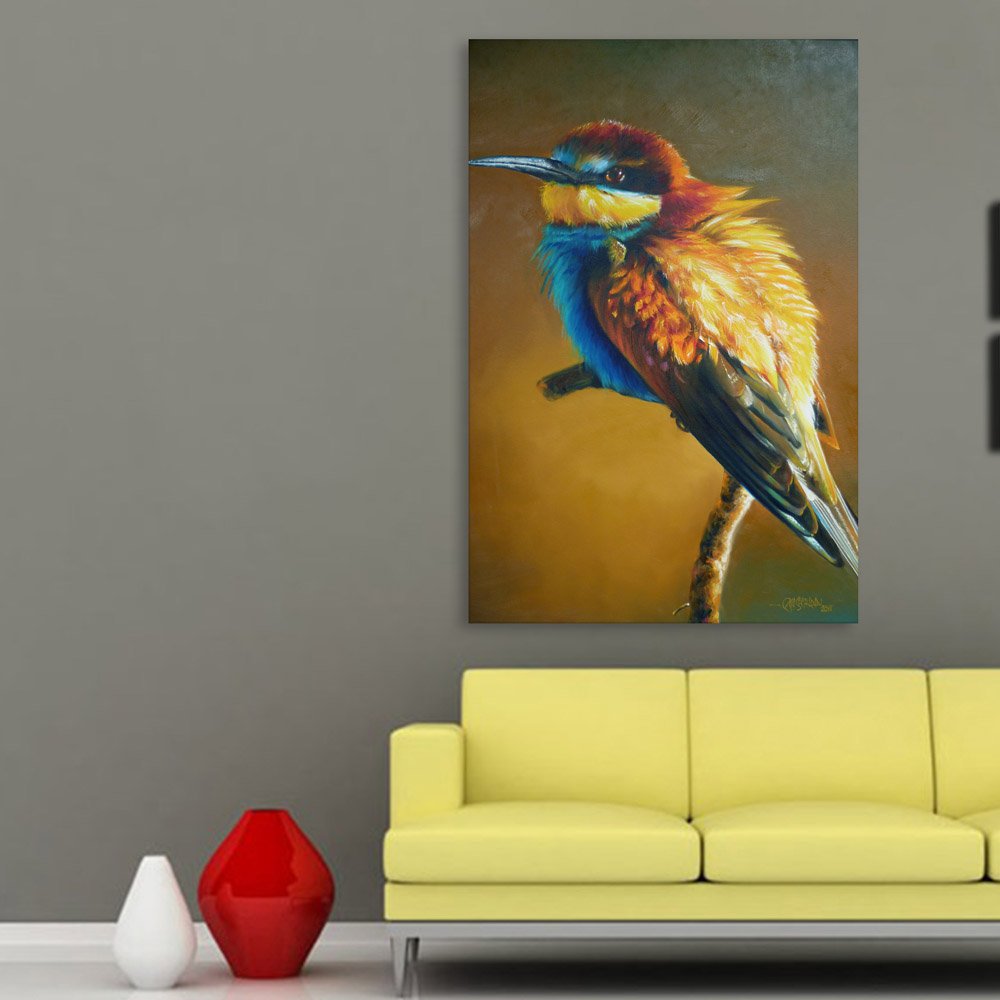
Bird-tastic framed Canvas That'll Make Your Walls Chirp - Beautiful Bird Art (61x91cm)
You may also like

Moolwan Bird Canvas Wall Art Painting (61x91cm) – Painterly Feather Detail with Turquoise-Rust Contrast
How This Bird Canvas Actually Looks on Your Wall
You've probably scrolled past a dozen bird prints this week—and they all looked fine in the product photos. The question isn't whether this one is pretty. The question is whether you can actually see it working on that specific wall you've been staring at for months.
This canvas helps you picture it: 61cm wide, 91cm tall, vertical orientation. That narrow wall beside your bookshelf, the strip between your bedroom door and wardrobe, the hallway that's too skinny for anything horizontal—this is sized for those spaces. The warm ochre background isn't fighting your cream or off-white walls; it's sitting alongside them. The bird's turquoise wing accents and rust-orange plumage create enough visual interest to stop someone mid-stride, but the muted background keeps it from screaming for attention.
The painterly texture in the feathers—visible brushstroke-style layering in the golden throat and russet chest—reads as intentional art, not a nature photograph stretched onto canvas.
Why 61cm Width Works on Narrow Walls (And What Changes If You Size Up)
A 61cm-wide canvas covers roughly 20% of a standard 10-foot (300cm) wall width. That sounds modest until you realize narrow wall sections—beside furniture, between doors, in hallways—are typically 80-120cm wide. At 61cm, this canvas fills 50-75% of that usable space without crowding it.
Vertical orientation matters here. Most wall art is horizontal because most sofas are horizontal. But vertical pieces solve the spaces horizontal art ignores: the 90cm gap beside your TV unit, the entryway wall that's 100cm wide, the hallway where a horizontal piece would look cramped.
If you sized up to 90x120cm, you'd need a wall section at least 150cm wide to maintain breathing room. This 61x91cm piece is for the walls you've been unable to fill because everything else was too wide.
Hang it with the center at 145-150cm from the floor (roughly eye level), or 20-25cm above a console table if you're placing it in an entryway.
What These Colors Look Like on Cream Walls (Morning vs LED)
The dominant ochre-amber background in this canvas is close to the warm side of cream—think masala chai rather than mustard. Against standard Indian builder-paint cream walls, it reads as complementary, not matching. There's enough color difference to define the canvas as a distinct object, but not so much contrast that it jolts.
In morning light (if your wall catches eastern sun), the turquoise wing feathers and blue tail come forward—they're the cool tones that balance the warmth. The rust-orange chest plumage and golden-yellow throat stay warm but don't flatten.
Under evening LED lighting (standard 3000K warm white), the whole canvas shifts warmer. The ochre background deepens toward caramel. The turquoise becomes teal. The golden throat glows. This is when the painterly texture becomes most visible—the layered brushwork in the feathers catches light differently across the surface.
Against grey walls (like the grey in the product photo): the warm tones pop harder. The canvas becomes a deliberate color statement rather than a tonal complement. Works if you want the bird to dominate; reconsider if you want something quieter.
Installation in Indian Walls (Concrete vs Drywall)
At 400 grams, this canvas is lighter than a hardcover cookbook. You don't need heavy-duty anchors—standard 6mm plastic wall plugs handle it easily.
For concrete walls (most older apartments, load-bearing walls in newer ones): 6mm masonry bit, drill 35mm deep, tap in the anchor, screw in the hook. The included D-ring hangers on the frame back slip onto the hook. Done in 10 minutes.
For drywall (common in modern apartments, especially partition walls): 6mm regular bit, 30mm deep, plastic anchor, hook. Same process, softer material.
Use the included hanging template—tape it to the wall at your target height, mark the drill points through the paper, remove template, drill. No measuring errors, no second holes.
For rentals: The 6mm holes are smaller than standard picture frame nail holes. When you move out, fill with wall putty (₹50 at any hardware store), sand smooth, touch up with matching paint. Your landlord won't notice.
Why Canvas Outlasts Macrame for Permanent Wall Décor
Macrame wall hangings have their appeal—handcrafted texture, boho aesthetic, no drilling required. But for a wall you walk past daily for years, canvas solves problems macrame creates.
Dust accumulation: Macrame's woven cotton fibers trap dust in every knot and loop. Within 6 months, you're either washing it (and watching it lose shape) or accepting the grey tinge. Canvas with a moisture-resistant coating wipes clean with a dry cloth—dust sits on the surface, doesn't embed.
Shape stability: Macrame sags. Gravity pulls the bottom edge down over time, especially in humid climates. The knots loosen slightly, the pattern distorts. Kiln-dried pinewood frames on canvas don't flex. A year from now, it hangs exactly as it did on day one.
Color retention: Macrame cotton absorbs ambient moisture, which accelerates dye fading. Eco-solvent inks on sealed canvas don't interact with humidity—your turquoise stays turquoise through multiple monsoons.
Visual presence: Macrame is textural and subtle. This bird canvas is a focal point. If you want the wall to have a clear subject—something guests notice and comment on—canvas delivers that statement.
What This Will Actually Feel Like in Your Room
From across the room (3-4 meters), the bird reads as a warm vertical shape with a pop of turquoise. The feather detail isn't visible—you see color and form.
From the doorway or mid-room (2 meters), the subject becomes clear: a bird perched on a branch, alert posture, looking left. The rust-orange and golden-yellow plumage registers as the main color story.
Up close (within arm's reach), the painterly texture emerges. The feather layering in the chest, the gradient in the throat, the visible handling of the ochre background—these details reward close viewing but don't demand it.
This canvas works as the sole piece on a narrow wall or hallway. It's sized and oriented for spaces that don't accommodate horizontal art or gallery walls. If you're placing it in a larger room, position it where the vertical format makes sense: beside a tall bookshelf, flanking a doorway, or above a narrow console table.
Moolwan Design Note
The turquoise-teal wing accents are positioned to catch peripheral vision—even when you're not looking directly at the canvas, that cool-toned flash registers. It's why this piece works in hallways and entryways where you pass without stopping.
Moolwan Quality Standard
Designed for Indian apartments and lighting conditions. Packed for long-distance Indian transit. Quality checked before dispatch. Printed to resist humidity-related color fading. Ships from West Bengal.
Moolwan Fit Guidance for Indian Homes
At 61cm wide, this vertical canvas fits wall sections 80-120cm wide—the narrow spaces beside furniture, between doors, or in hallways that horizontal art can't fill. Ideal for entryways and transitional spaces.
Quick Specifications
- Product: Moolwan Bird Canvas Wall Art Painting (61x91cm)
- Brand: Moolwan
- Category: Canvas Wall Art Painting
- Collection: Animal Wall Art Collection
- Dimensions: 61cm W x 91cm H x 2cm D
- Weight: 400 grams
- Material & Construction: 340 GSM pure cotton canvas, fade-resistant eco-solvent ink, 1.5-inch kiln-dried pinewood frame
- Colors: Warm ochre/amber background, rust-orange chest, golden-yellow throat, turquoise-teal wing accents, deep blue tail
- Best For: Narrow walls, hallways, entryways, beside furniture—vertical spaces 80-120cm wide
- Ships From: West Bengal
Frequently Asked Questions
Will 61cm width look too small above my sofa?
This canvas isn't designed for above-sofa placement—it's vertical, and sofas need horizontal pieces (60-75% of sofa width). Use this for narrow walls, hallways, or beside furniture where vertical orientation is the right fit.
How do the colours appear under warm LED lights versus daylight?
Under warm LED (3000K), the ochre background deepens and the turquoise shifts toward teal—the whole canvas feels richer. In daylight, the cool tones (turquoise, blue tail) come forward more, balancing the warmth.
Can I hang this without drilling in my rental apartment?
At 400 grams, Command strips rated for 2-3kg would technically hold it. However, for long-term stability, 6mm anchor holes are more reliable and easily patchable when you move out.
Will the colours fade near a window that gets afternoon sun?
The eco-solvent inks are UV-resistant—designed to hold color even with direct sun exposure. A west-facing wall with afternoon sun won't cause fading over normal use periods (3-5 years).
How do I clean dust off the canvas surface?
Dry microfiber cloth, gentle wipe. The moisture-resistant coating means dust sits on the surface rather than embedding in the canvas weave—it comes off easily without water or chemicals.
Product Snapshot
- Brand: Moolwan
- Product: Moolwan Bird Canvas Wall Art Painting (61x91cm)
- Category: Canvas Wall Art Painting
- Collection: Animal Wall Art Collection
- Theme/Type: Bird portrait, nature art
- Best For: Narrow walls 80-120cm wide, hallways, entryways, vertical spaces beside furniture
- Primary Differentiator: Painterly feather detail with turquoise-rust color contrast
- Secondary Differentiators: Warm ochre background matching Indian wall tones; vertical orientation for narrow wall sections
- Material & Construction: 340 GSM pure cotton canvas, eco-solvent fade-resistant ink, 1.5-inch kiln-dried pinewood frame with corner bracing
- Care Instructions: Dry dust with microfiber cloth every 2-3 weeks; avoid water and cleaning chemicals
- Ships From: West Bengal
- Packing: Long-distance transit ready (bubble wrap + corner protectors + outer carton)
- Quality Check: Before dispatch