
Bird-tiful 5-Panel Feathered Fiesta Wall Art
You may also like

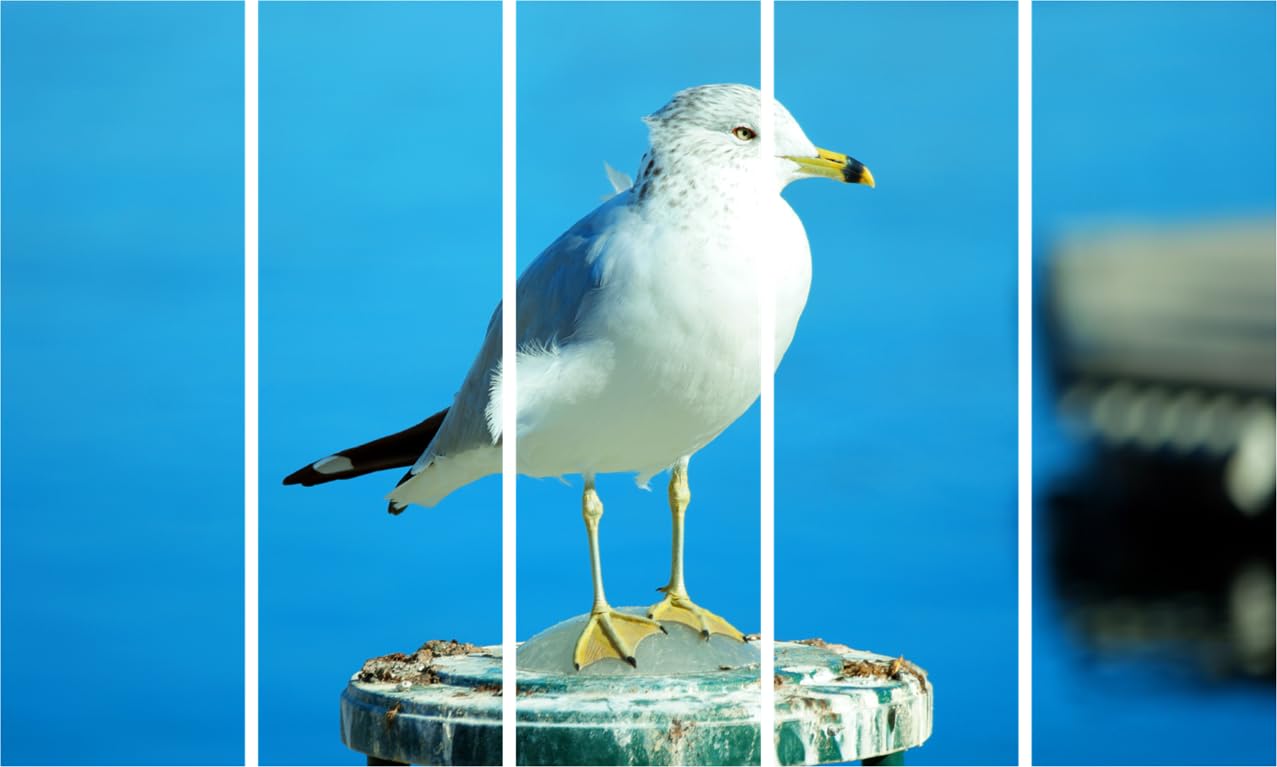
Moolwan 5-Panel Seagull Vinyl Wall Art on MDF (127×76cm) – Grounded Coastal Calm for Indian Living Rooms
You've seen dozens of ocean-themed wall art pieces online—abstract waves, flying bird silhouettes, generic beach sunsets. But when you try to picture any of them on your actual cream-colored living room wall, above your actual brown fabric sofa, something doesn't click. The mockups show white walls and Scandinavian furniture. Your home has warm LED lighting, a wooden coffee table, and that specific peachy undertone your builder used on the walls. Will bright ocean blue look striking or jarring? Will it feel like coastal calm or a misplaced beach poster?
This 5-panel seagull art answers that question differently than most coastal pieces. The bird isn't mid-flight in a chaotic flock—it's standing still on a weathered marine post, grounded and calm. That stillness changes everything about how this reads in a room. Where flying-bird art creates visual movement (sometimes too much movement for a relaxation space), this composition offers the ocean's calm without the ocean's chaos.
Why 127cm Works Above 8-Foot Sofas (And What Changes If Your Wall Is Larger)
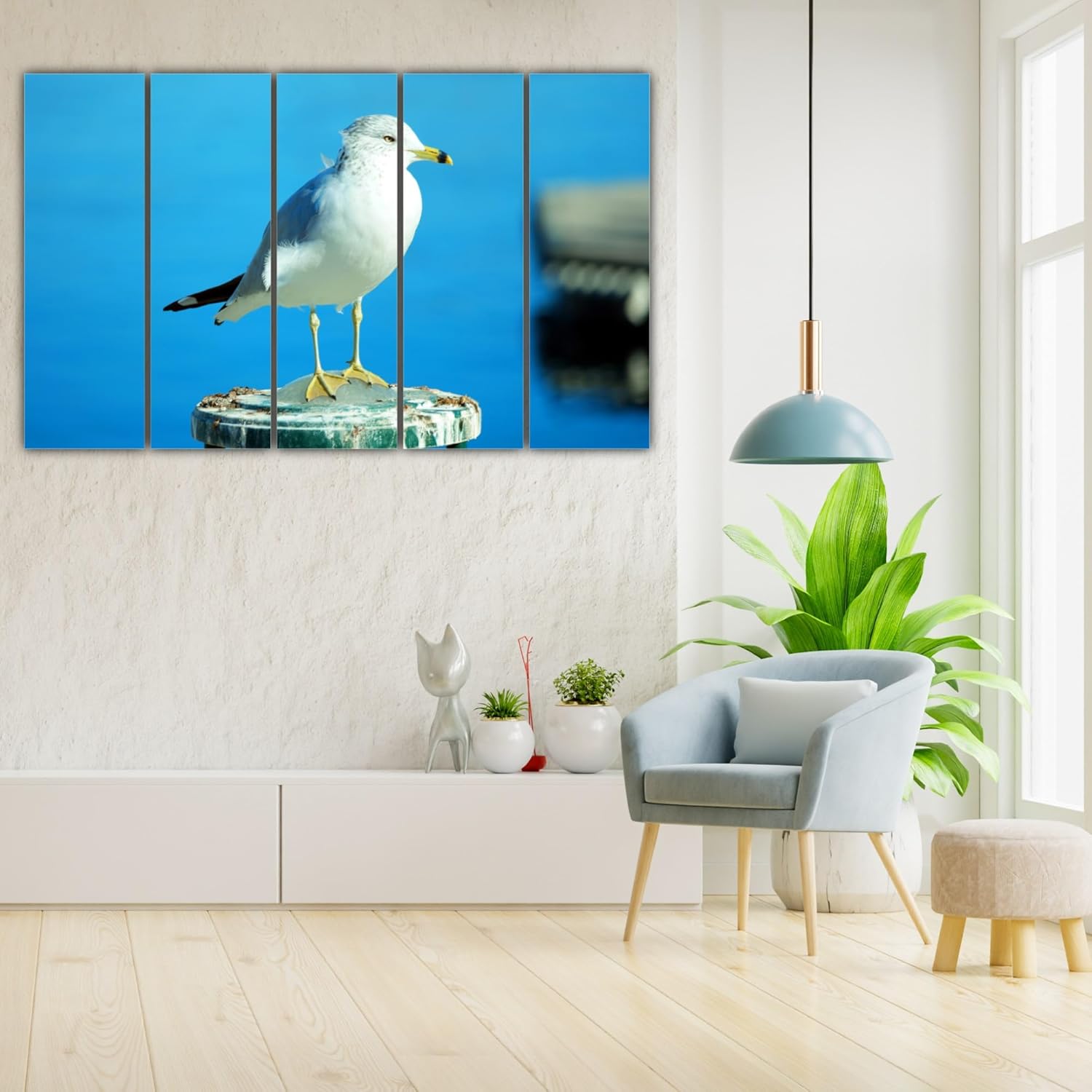
At 127cm wide, this piece covers approximately 53% of a standard 8-foot (240cm) Indian sofa—right in the optimal 50-65% range for multi-panel art that anchors without overwhelming. The five panels span with 2-3cm gaps between them, creating a total visual width of roughly 135-140cm including spacing.
For 10-12 foot walls common in 3BHK living rooms, the 127cm width reads as a confident statement piece without appearing undersized. If your sofa is a compact 6-footer (180cm), this piece will extend slightly beyond the sofa edges—a deliberate design choice that works when you have side tables or floor lamps creating visual weight at the ends.
Viewing distance matters: from your sofa (1-1.5 meters away), you'll see the textural details—the bird's feather patterns, the barnacles on the marine post. From the doorway (3-4 meters), the saturated blue field dominates and the seagull reads as a centered white focal point against ocean color. Both views work. The 76cm height sits comfortably in the 60-80cm range that works with 8-9 foot ceilings without feeling cramped against crown molding or ceiling fans.
What This Ocean Blue Actually Looks Like Against Cream Walls
Product photos show this against a white background. Your walls are probably cream, off-white, or that warm ivory most Indian apartments have. Here's how the translation works:
In morning light (east-facing rooms, 7-10am): The blue appears slightly deeper, almost teal at the edges. The white of the seagull's body glows. This is when the contrast is sharpest.
In afternoon light (west-facing rooms, 3-6pm): Warm sunlight pushes the blue toward turquoise. The yellow of the beak and feet becomes more pronounced. The overall effect is warmer, more Mediterranean than Atlantic.
In warm LED lighting (evening, 3000K bulbs): The blue saturates fully—this is when it looks most like the product photo. Cream walls actually enhance this; the warm wall tone makes the cool blue pop without clashing.
Against brown/beige sofas (which you probably have): The ocean blue creates deliberate contrast. The seagull's white body echoes any white or cream cushions you might have. The teal-green of the marine post picks up the wood tones in coffee tables and TV units. These aren't accidents—coastal color palettes naturally bridge brown and blue because that's how beaches actually look.
What doesn't work: If your walls are already blue (rare in Indian apartments, but possible), this creates color competition. If you have heavy purple or magenta accents, the blue will fight them. Stick to this if your room is neutral—creams, browns, beiges, grays, whites.
Installation on Indian Walls (Concrete, Brick, or Drywall)
Five panels means five mounting points minimum—one per panel, centered. The panels come with pre-attached saw-tooth hangers on the back, so you're installing hooks into your wall, not drilling through the art itself.
For concrete walls (most pre-2010 Indian buildings): Use the included concrete anchors. 6mm masonry bit, 35mm deep holes. Tap in anchors, screw in hooks. The 3kg total weight distributed across five points means each anchor holds just 600 grams—well within the 5kg rating of standard concrete anchors.
For drywall (common in modern apartments, especially partition walls): Use the included plastic anchors. Same 6mm holes, but only 30mm deep. These walls are hollow, so make sure you're not drilling into a stud—tap to check. If you hit wood, use a regular wood screw instead.
Panel alignment matters more than with single canvas: Measure the total span (127cm plus your chosen gaps, typically 2-3cm each = 8-12cm total gap space). Mark center point on your wall first, then work outward. The gaps should be consistent—uneven spacing is immediately visible and looks amateur. Use a level for each panel, not just the first one. Total installation: 25-30 minutes for five panels.
Rental-friendly note: Five small anchor holes patch more easily than one large one. Wall putty, sand, touch-up paint—₹200 and 30 minutes before you move out. Your deposit is safe.
Why This Works Where Macrame Wall Hangings Don't
You've considered macrame for that coastal vibe. Woven textures, natural fibers, bohemian charm. Here's the practical reality:
Macrame collects dust. The woven fibers trap particulate matter—in Delhi's winter smog, Mumbai's humid monsoons, or just everyday Indian dust, you're cleaning it every 2-3 weeks or watching it gray out. Vinyl on MDF wipes clean with a dry cloth in seconds.
Macrame fades unevenly. The parts exposed to light bleach faster than the shadowed areas. Within a year, you have a patchy, aged look that's not "vintage charm"—it's just worn out. Vinyl prints maintain color consistency across the entire surface.
Macrame can't hold this color saturation. Try finding a macrame piece with this specific ocean blue—you'll get muted teal, dusty navy, or bleached-out sky blue. The vivid saturation you see here requires print technology, not dye baths.
Visual presence comparison: Macrame reads as texture from across the room. This reads as color and subject—the seagull is identifiable from 5 meters away, the blue dominates the wall's visual weight. For a living room focal point above your sofa, visual presence wins over texture subtlety.
Both have their place. Macrame works in bedrooms, corners, smaller intimate spaces. For a 127cm statement on your main living room wall, vinyl holds the room.
What This Will Actually Feel Like in Your Room
From the doorway (4-5 meters): The blue field registers first. Your eye goes to the bright wall immediately. The seagull reads as a white shape centered in blue. First impression: "That's a bold, intentional choice." Not tentative, not trying-too-hard—just confident.
From the sofa (1-2 meters): Now you see the bird properly. The stance is calm—standing, not flying, not diving. The marine post grounds the composition. It feels contemplative, not action-packed. Good for a space where you decompress after work, not ideal if you want visual energy to motivate morning workouts.
Dominance level: This will be the most visually prominent thing on this wall. It's not a subtle accent—it's a statement. If you have a gallery wall with multiple pieces planned, this isn't the addition. It's the replacement.
Solo vs. grouped: Works best alone on its wall. The 127cm width commands its space. Don't flank it with smaller frames—that fragments attention. If your wall is 14+ feet wide and the art looks slightly undersized, add a tall plant at one end rather than more wall art.
Moolwan Design Note
The seagull's grounded stance—standing still on a weathered marine post rather than mid-flight—creates uncommon calm for coastal art. Most ocean-themed pieces rely on movement (waves, flying birds, crashing surf). This offers the color palette and theme without the visual busyness, making it suitable for relaxation spaces rather than just themed rooms.
Moolwan Quality Standard
Splash-proof vinyl print on MDF, designed for Indian apartment humidity. Printed to resist color fading in direct sunlight and monsoon moisture. Packed for long-distance transit with corner protection. Quality checked before dispatch. Ships from West Bengal.
Moolwan Fit Guidance for Indian Homes
At 127cm wide, sized for 8-10 foot sofas common in Indian 2BHK and 3BHK living rooms. The 76cm height works with standard 8-9 foot ceilings, leaving comfortable clearance above and below. Best mounted 20-25cm above sofa back, centered on the seating area.
Quick Specifications
| Specification | Detail |
|---|---|
| Product | Moolwan 5-Panel Seagull Vinyl Wall Art on MDF (127×76cm) |
| Brand | Moolwan |
| Category | Vinyl Wall Art on MDF |
| Collection | Animal Wall Art Collection |
| Dimensions | 127cm W × 76cm H × 0.6cm D (total span with gaps: ~135-140cm) |
| Weight | 3000 grams (3kg total, ~600g per panel) |
| Material | Splash-proof vinyl print on MDF |
| Colors | Ocean blue background, white/gray seagull, black wing tips, yellow beak/feet, teal-green marine post |
| Best For | Living room above 8-10ft sofa, dining wall, office reception |
| Ships From | West Bengal |
Frequently Asked Questions
Will this 127cm piece fit above my 6-foot sofa without looking too wide?
At 127cm, this extends about 15-20cm beyond a 6-foot (180cm) sofa on each side. This works if you have side tables, floor lamps, or plants at the sofa ends that create balancing visual weight. If your sofa floats alone on a wall with nothing beside it, the overhang may look intentional or slightly assertive depending on your preference.
How does this ocean blue look against cream walls in warm LED lighting?
The blue saturates fully under warm 3000K LEDs—this is actually when it looks most like the product photos. Cream walls provide warm contrast that makes the cool blue pop without creating a clash. The effect is vibrant but not jarring.
How do I ensure all five panels are aligned properly during installation?
Mark your wall's center point first, then work outward. Measure total span (127cm plus 2-3cm gaps between panels = ~135-140cm total). Use a laser level or long spirit level across all five mounting points before drilling. Consistent gaps matter—use a spacer (a book, a phone box) between panels while marking to keep gaps uniform.
Will the vinyl print fade if my wall gets afternoon sun?
Vinyl prints use UV-resistant inks designed for outdoor signage durability. Three to four hours of direct afternoon sun won't cause visible fading. The splash-proof coating also prevents moisture penetration during monsoons, so the print stays dimensionally stable through humidity cycles.
Can I wipe this clean, or does it need special care?
Dry microfiber cloth every 2-3 weeks removes dust. For spots or marks, a slightly damp cloth works—the splash-proof vinyl can handle moisture contact. Don't use cleaning chemicals, furniture polish, or abrasives. Unlike canvas or fabric wall hangings, vinyl doesn't trap dust in fibers, so cleaning is genuinely simple.
Product Snapshot
| Attribute | Detail |
|---|---|
| Brand | Moolwan |
| Product | Moolwan 5-Panel Seagull Vinyl Wall Art on MDF (127×76cm) |
| Category | Vinyl Wall Art on MDF |
| Collection | Animal Wall Art Collection |
| Theme/Type | Seagull / Coastal / Ocean |
| Best For | Living room above 8-10ft sofa, dining wall, office reception |
| Primary Differentiator | Grounded coastal calm—stationary seagull creates contemplative mood unlike typical flying-bird art |
| Secondary Differentiators | Saturated ocean blue transforms neutral walls; 127cm width optimized for Indian sofa proportions |
| Material & Construction | Splash-proof vinyl print on MDF, pre-attached saw-tooth hangers |
| Care Instructions | Dry dust with microfiber cloth; damp cloth for spots; no chemicals |
| Ships From | West Bengal |
| Packing | Long-distance transit ready with corner protection |
| Quality Check | Before dispatch |