
Bloom and Let Bloom: 5-Panel Nature Wall Art That'll Make Your Walls Jealous (150x76cm Framed)
You may also like


Moolwan 5-Panel Spring Garden Daffodils Vinyl Wall Art on MDF (127x76cm) – Continuous Daffodil Band Unifying Five Panels
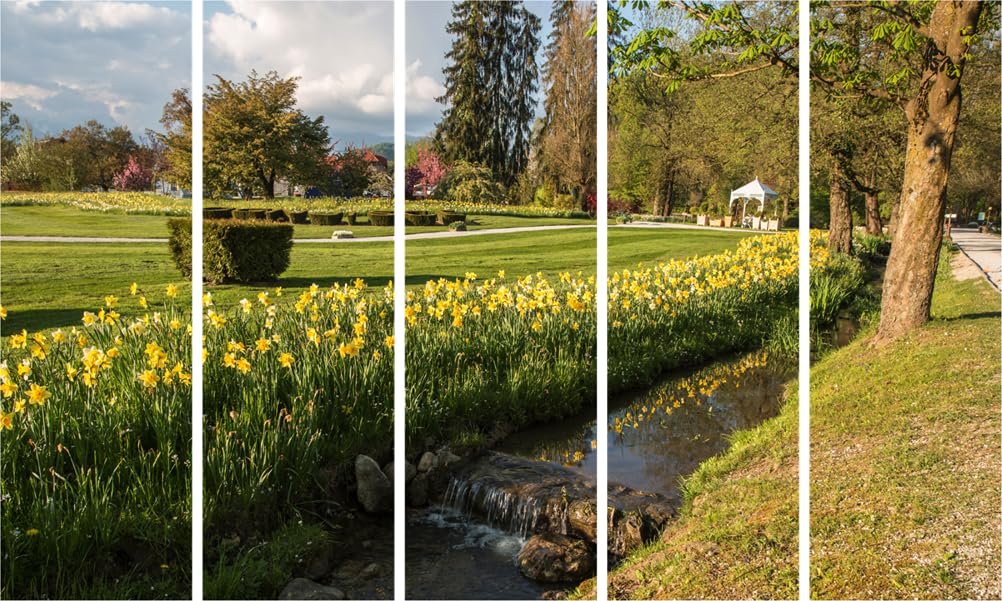
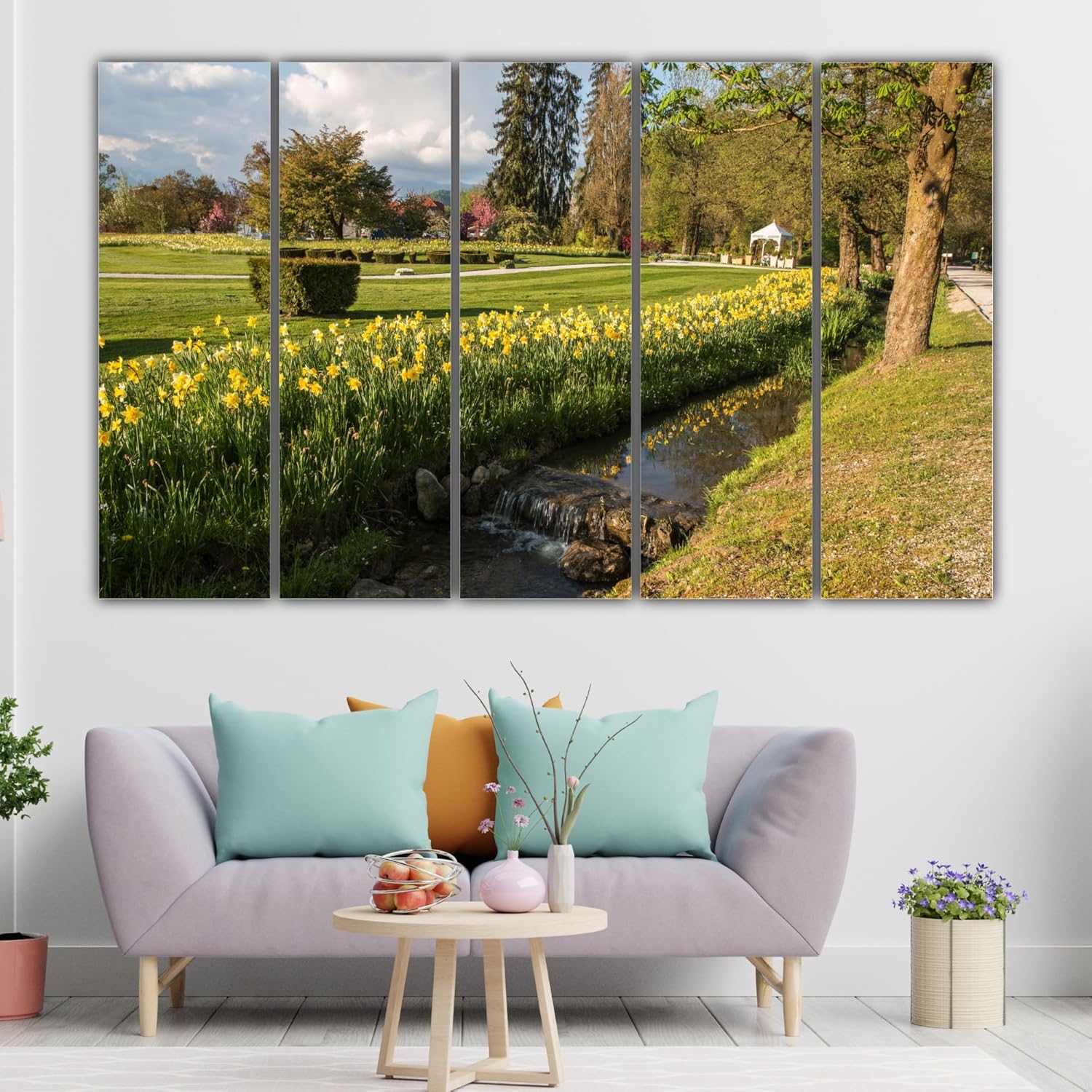
You've measured your wall. You've imagined something there. But every time you try to picture how a piece will actually look above your sofa, the mental image stays frustratingly vague—will it feel balanced or awkward? Will the colors work with your cushions and curtains, or clash in ways the product photo didn't prepare you for? This 5-panel garden scene answers that uncertainty with something concrete: a continuous band of yellow daffodils that runs unbroken across all five panels, creating immediate visual logic. Your eye follows the flower line from left to right, and the composition makes sense the moment you see it. That empty 10-foot wall behind your 7-foot sofa? This is what it's been waiting for.
Why 127cm Width Works on 10-12ft Walls (And What Changes If You Size Up)
At 127cm wide, this piece covers approximately 35-40% of a 10-foot wall (300cm) or 30-35% of a 12-foot wall (360cm). For the sofa-to-art ratio that actually looks intentional in Indian living rooms, you want canvas covering 60-75% of your sofa width. A standard Indian 3-seater runs 180-210cm, putting this 127cm piece right in the sweet spot—visible presence without overwhelming the furniture beneath it.
Viewing distance matters here. From across a typical 12-foot living room, the five panels read as one cohesive landscape. Up close (2-3 feet, when you're walking past), the panel gaps add visual rhythm without fragmenting the image. The central stream and waterfall naturally draw the eye to the middle panel, which means the composition stays anchored even as you move around the room.
Installation note: The 5-panel spread requires roughly 150cm of wall space including gaps (approximately 4-5cm between each panel). Measure your wall section between the sofa edge and any side table or floor lamp—you need clear space for all five panels to breathe.
What These Yellows and Greens Look Like on Cream Walls (Morning vs LED)
The dominant yellow of the daffodils is a warm, saturated tone—not the pale lemon of cheap prints, but the rich golden-yellow of actual spring flowers. Against cream or off-white walls (the default in most Indian apartments), this yellow pops without screaming. It reads as cheerful, not garish.
The greens are layered: bright lawn green in the foreground, deeper forest green in the background trees, soft sage in the manicured hedges. In morning daylight, these greens appear cooler and more varied. Under warm LED lighting (3000K, standard in Indian homes), the greens warm up and the yellows intensify—this is when the piece looks its richest.
The sky blues and soft pinks from the flowering trees in the background prevent the piece from feeling like a single-note "green and yellow" artwork. These secondary colors pick up well with blue or pink accent cushions if you have them, though the piece doesn't demand color-matching.
With brown or beige fabric sofas (most common in Indian living rooms), the earth tones in the tree trunks and rocks create natural cohesion. The artwork feels like it belongs with wooden furniture rather than fighting against it.
Installation in Indian Walls (Concrete vs Drywall)
Five panels means ten mounting points (two per panel for stability). This sounds more complicated than it is. The key is getting the first panel level—once that's anchored correctly, the remaining four follow the same horizontal line.
For concrete walls (most older Indian buildings): Use the included masonry anchors with a 6mm bit. Drill 35mm deep, tap in anchors, attach hooks. Total drill time: about 15 minutes for all ten points.
For drywall (newer apartments, especially in Bangalore and Gurgaon high-rises): Use plastic wall anchors. Same 6mm holes, 30mm depth. The 3kg total weight distributed across ten points means each anchor bears only 300 grams—well within drywall tolerance.
Panel alignment reality: Start from the center panel (the one with the stream/waterfall) and work outward. Maintain 4-5cm gaps between panels. Use a laser level or a long straight edge if you want precision, though honestly, eyeballing works if you step back and check from the doorway before drilling.
For rentals, these 6mm holes patch invisibly with standard wall putty. Ten small holes cost you ₹100 in putty and 30 minutes of repair time when you move out.
Why Vinyl on MDF Instead of Macrame Wall Hangings
If you've considered macrame as an alternative for this wall, here's the practical comparison.
Macrame creates texture but not imagery. It's decorative in an abstract, craft-forward way. It works in bohemian aesthetics but reads as "trying too hard" in the neutral, furniture-forward style of most Indian living rooms. It also collects dust in every knot and requires regular cleaning to avoid looking tired.
This vinyl-on-MDF piece delivers actual imagery—a scene you can look at and into, not just a textural pattern. The splash-proof vinyl surface wipes clean with a dry cloth. Dust doesn't embed in weave because there is no weave. In Mumbai's humid monsoons or Delhi's dusty summers, this surface stays fresh while macrame accumulates grime.
Visual weight is also different. Macrame hangs loose and creates shadows on the wall behind it. This MDF piece sits flush at 0.6cm depth, creating clean edges and consistent appearance throughout the day regardless of light angle.
What This Will Actually Feel Like in Your Room
From the doorway of a typical 12-foot living room, this piece reads as a single garden scene—the panels merge into one continuous landscape. The yellow daffodils create a strong horizontal band that anchors your eye and gives the wall a sense of purpose.
From the sofa (2-3 feet away), the panel separations become visible, adding a gallery-like quality. The central waterfall panel draws focus, which means your eye has somewhere to rest rather than scanning randomly across the artwork.
This piece complements rather than dominates. It brings outdoor freshness into the room—the feeling of a well-maintained garden—without demanding that all your other décor match or submit to it. It works alongside existing furniture rather than requiring a room redesign.
Alone or with adjacent décor? Best as a solo statement on this wall section. If you have floating shelves or other artwork nearby, leave at least 60cm of wall space between them and the edge panels. The five-panel spread already fills substantial visual real estate; crowding it diminishes impact.
Moolwan Design Note
The stream positioned in the center panel creates a natural focal anchor—your eye finds it first, then explores outward to the daffodils and trees. This isn't accidental; it's compositional logic that makes five separate panels feel like one unified scene.
Moolwan Quality Standard
Designed for Indian apartments and lighting conditions. Packed for long-distance Indian transit with protective layering for each panel. Quality checked before dispatch. Printed with fade-resistant inks for humidity tolerance. Ships from West Bengal.
Moolwan Fit Guidance for Indian Homes
At 127cm total width, this fits the 60-75% ratio for 7-8 foot sofas. Mount 20-25cm above sofa back, center the middle panel with your sofa's midpoint, and space remaining panels evenly outward.
Quick Specifications
- Product: Moolwan 5-Panel Spring Garden Daffodils Vinyl Wall Art on MDF (127x76cm)
- Brand: Moolwan
- Category: Vinyl Wall Art on MDF
- Collection: Nature Wall Art Collection
- Dimensions: 127cm W x 76cm H x 0.6cm D (total spread approximately 150cm with gaps)
- Weight: 3000 grams (3kg total across all panels)
- Material & Construction: Splash-proof vinyl print on MDF panels
- Colors: Golden yellow (daffodils), multiple greens (lawn, hedges, trees), sky blue, soft pink (flowering trees), earth brown (tree trunks, rocks)
- Best For: Living room above 7-8 foot sofa, dining room feature wall, hallway statement wall
- Ships From: West Bengal
Frequently Asked Questions
Will 127cm width look proportional above my 6-foot sofa?
Yes. A 6-foot sofa (180cm) pairs well with art that's 108-135cm wide. At 127cm, this piece falls within the ideal 60-75% width ratio, creating balanced visual presence without extending beyond your sofa's footprint.
How do the yellow tones appear under warm LED lights versus daylight?
Under warm LEDs (3000K, typical in Indian homes), the daffodil yellows intensify to rich golden tones. In natural daylight, they appear slightly cooler and more lemon-toned. Both readings work well against cream or off-white walls.
How do I align five panels evenly during installation?
Start with the center panel (featuring the stream). Level it carefully, then measure 4-5cm gaps outward for each adjacent panel. Use a long straight edge or laser level across the top edges to ensure all five sit on the same horizontal line.
Will the vinyl surface handle Mumbai monsoon humidity?
The splash-proof vinyl finish prevents moisture absorption. Unlike fabric or canvas, vinyl doesn't swell or warp with humidity changes. Surface condensation wipes away without penetrating the print layer.
Can I use Command strips instead of drilling for this piece?
Not recommended. At 3kg total weight distributed across five panels, you need proper wall anchors for long-term stability. Command strips rated for 3kg would need to hold each panel independently, and failure of any strip means panel damage. The included anchors and 6mm holes are the safer choice.
Product Snapshot
- Brand: Moolwan
- Product: Moolwan 5-Panel Spring Garden Daffodils Vinyl Wall Art on MDF (127x76cm)
- Category: Vinyl Wall Art on MDF
- Collection: Nature Wall Art Collection
- Theme/Type: Garden landscape with spring daffodils and stream
- Best For: Living room above sofa, dining wall, hallway feature wall
- Primary Differentiator: Continuous daffodil band creates visual unity across five separate panels
- Secondary Differentiators: Central stream provides natural focal anchor; layered depth from foreground flowers to background trees
- Material & Construction: Splash-proof vinyl print on MDF, 0.6cm depth
- Care Instructions: Wipe with dry microfiber cloth; avoid water or cleaning chemicals
- Ships From: West Bengal
- Packing: Long-distance transit ready with individual panel protection
- Quality Check: Before dispatch