
.jpeg)
.jpeg)

Bloom Boom: framed Floral Fiesta Canvas Art
You may also like

Moolwan Tropical Floral Bouquet Canvas Wall Art Painting (91x61cm) – Painterly Tropical Density with Visible Brushwork
This Is What Your Blank Wall Could Actually Look Like
You've walked past that empty wall for months now. You can picture something there—color, maybe flowers, something that makes the space feel finished—but every time you browse online, the mockups look staged and the actual product feels uncertain. Will it look like art or like a poster someone stretched over wood?
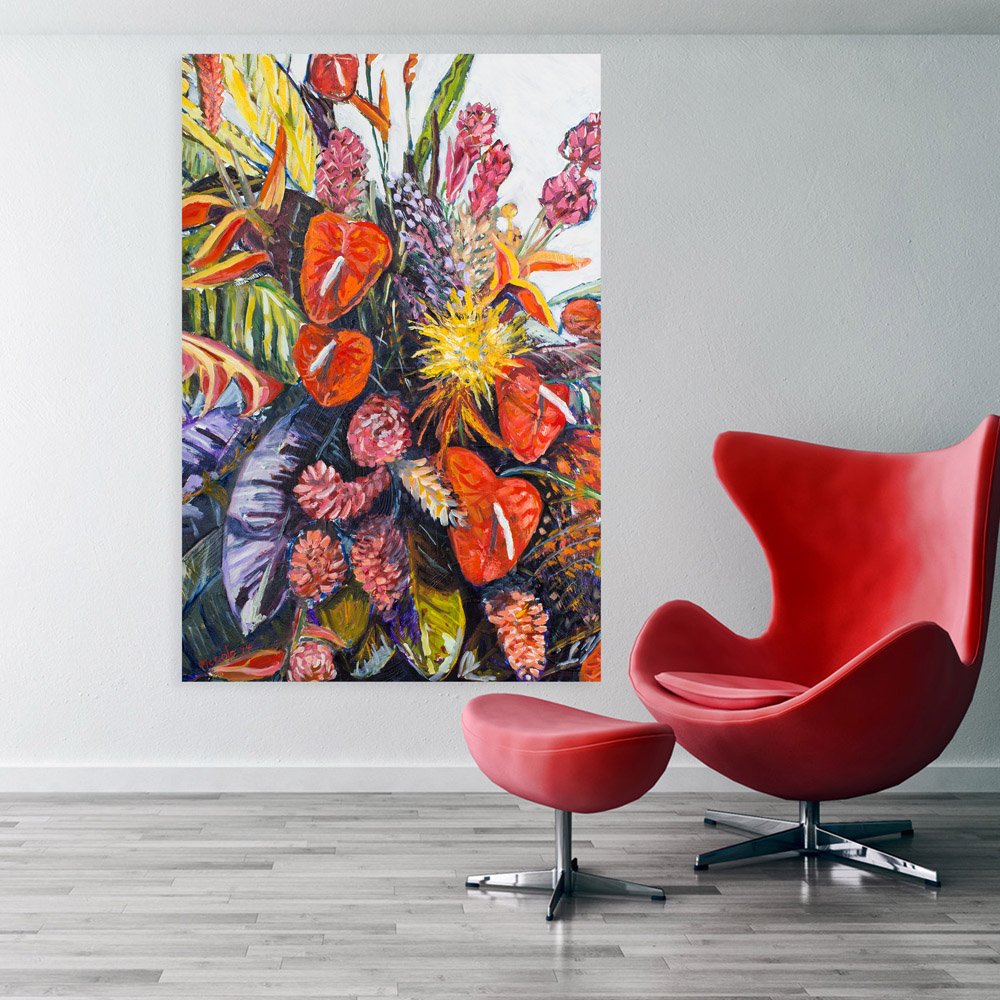
This tropical floral canvas answers that specific doubt. The visible brushwork texture—the way the coral anthuriums catch light differently than the purple-violet leaves behind them—reads as painted, not printed. At 91cm tall and 61cm wide, it's sized to fill a vertical wall space (hallway, bedroom accent wall, the narrow strip beside your wardrobe) without overwhelming adjacent furniture. The composition flows upward from a dense base of foliage, drawing the eye naturally from floor level toward ceiling height.
Why 91x61cm Works on Vertical Wall Spaces (And What Changes If You Size Differently)
A 91cm tall canvas covers roughly 35-40% of the visible wall height in standard 8-foot Indian apartments—substantial enough to anchor the space, restrained enough to leave breathing room above and below.
For hallway walls (typically 3-4 feet wide between doorframes), this 61cm width fills 50-65% of the horizontal space. That's the ratio where art feels intentional rather than cramped or floating. Hang it at eye level (center of canvas at 150-155cm from floor), and it becomes the natural focal point when you walk down the corridor.
For bedroom accent walls (beside the wardrobe, above a side table, on the wall facing the bed), the vertical orientation works with the room's existing vertical lines—door frames, curtain drops, standing furniture. A horizontal canvas in these spots often feels like it's fighting the room's geometry. This one cooperates with it.
If you're considering this for above a sofa: at 61cm wide, it would look undersized above a typical 6-foot Indian sofa (you'd want 90-120cm width for that placement). This canvas works better as a standalone statement in transitional spaces or smaller rooms.
What These Colors Look Like Against Indian Wall Paints (Not Just in Mockups)
The palette here runs warm-dominant: coral-orange anthuriums, magenta-pink ginger flowers, touches of yellow from the pincushion protea at center. These warm tones are grounded by deep purple-violet foliage and forest green leaves, with a white background that opens up the top third of the composition.
Against cream or off-white walls (the standard in most Indian apartments): the warm tones pop without clashing. The white background section blends into the wall, making the dense floral arrangement appear to emerge from the surface rather than sit on top of it.
Against light yellow or peach walls (common builder finishes): the coral and magenta tones complement rather than compete. The purple foliage provides enough cool contrast to prevent the overall effect from feeling too warm.
In morning light: colors appear slightly cooler, the purple-violet tones become more prominent, the overall mood reads as fresh and energizing.
In warm LED lighting (3000K, typical in Indian homes): the coral-orange tones intensify, the composition feels richer and more celebratory. This is when the painterly texture shows best—the brushwork creates subtle shadows that flat-printed canvas doesn't produce.
Installation in Indian Walls (Concrete vs Drywall)
For a canvas this size and weight (under 500 grams), installation is straightforward in both wall types common in Indian construction.
Concrete walls (older buildings, most tier-2 cities): Use the included concrete anchors. Drill two 6mm holes about 55cm apart (matching the D-ring spacing on the frame back), 35mm deep. Tap in anchors, screw in hooks, hang canvas on D-rings. Total time: 15 minutes including the part where you step back three times to check if it's level.
Drywall (newer apartments, gypsum partitions): Use the included drywall anchors. Same process, 30mm depth. The hollow-wall anchors spread behind the drywall surface to distribute weight.
Rental consideration: The 6mm holes are smaller than standard picture hook holes. When you move out, fill with wall putty (₹50 at any hardware store), sand smooth, touch up with matching paint if needed. Your landlord won't notice, and you won't lose deposit over them.
The included hanging template eliminates the "drilled in the wrong spot" problem. Tape the paper template to your wall at desired height, mark through the pre-printed holes, remove template, drill on marks. No measuring, no second-guessing.
Why Canvas Instead of Macrame Wall Hangings
Macrame has had its moment. And for certain spaces—bohemian-styled rooms, spaces that need textural softness—it works. But here's the practical reality:
Macrame collects dust in the woven fibers. In Indian cities with construction dust, pollution, and general particulate matter, you're looking at visible dust accumulation within 2-3 months. Cleaning requires careful hand-washing or professional care.
This canvas has a moisture-resistant polymer coating. Dust sits on the surface rather than embedding in fibers. A dry microfiber cloth every few weeks keeps it clean. No special care, no washing, no professional maintenance.
Macrame also fades and yellows over time, especially the natural cotton fiber varieties. The eco-solvent inks on this canvas are UV-tested to maintain color stability through direct sunlight exposure.
And visually: macrame reads as craft. Canvas with visible brushwork reads as art. Different aesthetic categories, different statements about the space.
What This Will Actually Feel Like in Your Room
From the doorway of a hallway: the tropical colors register first, pulling you down the corridor. The density of the composition gives the eye something to explore—you notice the coral anthuriums first, then the pink ginger flowers, then the purple foliage beneath.
Up close (within arm's reach): the brushwork texture becomes visible. The printed canvas reproduces the original painting's impasto strokes, giving the surface visual depth that flat printing doesn't achieve.
In a bedroom: the warm palette creates energy without aggression. This isn't calming nature art (soft greens, muted botanicals)—it's celebratory nature art. It suits bedrooms that feel like retreats rather than just sleeping spaces.
As a standalone piece: this canvas wants to be the only art on its wall. The density and color saturation mean it doesn't play well with adjacent artwork. Give it a wall to itself, and it rewards that space with visual completeness.
Moolwan Design Note
The upward-flowing composition—dense foliage at the base opening to white space at the top—makes vertical wall spaces feel taller. The coral anthuriums with white spadix provide a consistent visual anchor that prevents the density from feeling chaotic.
Moolwan Quality Standard
Designed for Indian apartments and lighting conditions. Printed to resist humidity-related color fading. Packed for long-distance Indian transit. Quality checked before dispatch. Ships from West Bengal.
Moolwan Fit Guidance for Indian Homes
At 91x61cm vertical, this fits hallway walls between doorframes (3-4ft width), bedroom accent walls beside wardrobes, and entryway spaces. Not recommended above sofas wider than 4 feet—the vertical orientation needs vertical wall contexts.
Quick Specifications
- Product: Moolwan Tropical Floral Bouquet Canvas Wall Art Painting (91x61cm)
- Brand: Moolwan
- Category: Canvas Wall Art Painting
- Collection: Nature Wall Art Collection
- Dimensions: 91cm H × 61cm W × 3.8cm D
- Weight: 400 grams
- Material & Construction: 340 GSM pure cotton canvas, eco-solvent UV-resistant inks, 1.5-inch kiln-dried pinewood frame
- Colors: Coral-orange, magenta-pink, purple-violet, forest green, yellow, white background
- Best For: Hallway walls, bedroom accent walls, entryway spaces in Indian apartments with 8-10ft ceilings
- Ships From: West Bengal
Frequently Asked Questions
Will 91x61cm look proportional on my hallway wall?
For hallways 3-4 feet wide (typical in Indian 2BHK/3BHK apartments), this vertical canvas fills 50-65% of horizontal space—the ratio where art feels intentional. Hang at eye level (center at 150-155cm from floor) for best visual balance.
How will the coral and pink tones look against my cream walls in evening light?
Under warm LED lighting (3000K, standard in Indian homes), the coral-orange tones intensify and the overall composition appears richer. The warm palette complements cream walls without clashing. The white background section blends into light walls, making the floral arrangement appear to emerge from the surface.
Can I install this in a rental without losing my deposit?
Yes. The installation requires two 6mm holes—smaller than standard picture hook holes. When moving out, fill with wall putty, sand smooth, touch up with paint if needed. Total repair: ₹200 and 20 minutes. Standard landlord inspections won't flag holes this small.
Will the colors fade during monsoon season or in humid conditions?
The eco-solvent inks are UV-tested and the canvas has a moisture-resistant polymer coating. This combination is designed for Indian climate conditions including 70-85% monsoon humidity. The coating prevents moisture absorption that causes color shift in untreated canvas.
Is this too colorful for a minimalist bedroom?
This is celebratory, saturated art—it makes a statement rather than receding into the background. For minimalist spaces, it works best as the single decorative element on its wall, with neutral bedding and furniture letting the canvas carry the room's color. If you prefer art that blends quietly, this isn't that.
Product Snapshot
- Brand: Moolwan
- Product: Moolwan Tropical Floral Bouquet Canvas Wall Art Painting (91x61cm)
- Category: Canvas Wall Art Painting
- Collection: Nature Wall Art Collection
- Theme/Type: Tropical floral bouquet, painterly botanical
- Best For: Hallway walls, bedroom accent walls, entryway spaces in Indian apartments
- Primary Differentiator: Painterly tropical density with visible brushwork texture
- Secondary Differentiators: Upward-flowing vertical composition; warm-cool color contrast (coral/orange against purple/green)
- Material & Construction: 340 GSM pure cotton canvas, eco-solvent UV-resistant inks, 1.5-inch kiln-dried pinewood frame with corner bracing
- Care Instructions: Dust with dry microfiber cloth every 2-3 weeks; no water, no chemicals
- Ships From: West Bengal
- Packing: Long-distance transit ready (bubble wrap + corner protectors + outer carton)
- Quality Check: Before dispatch