
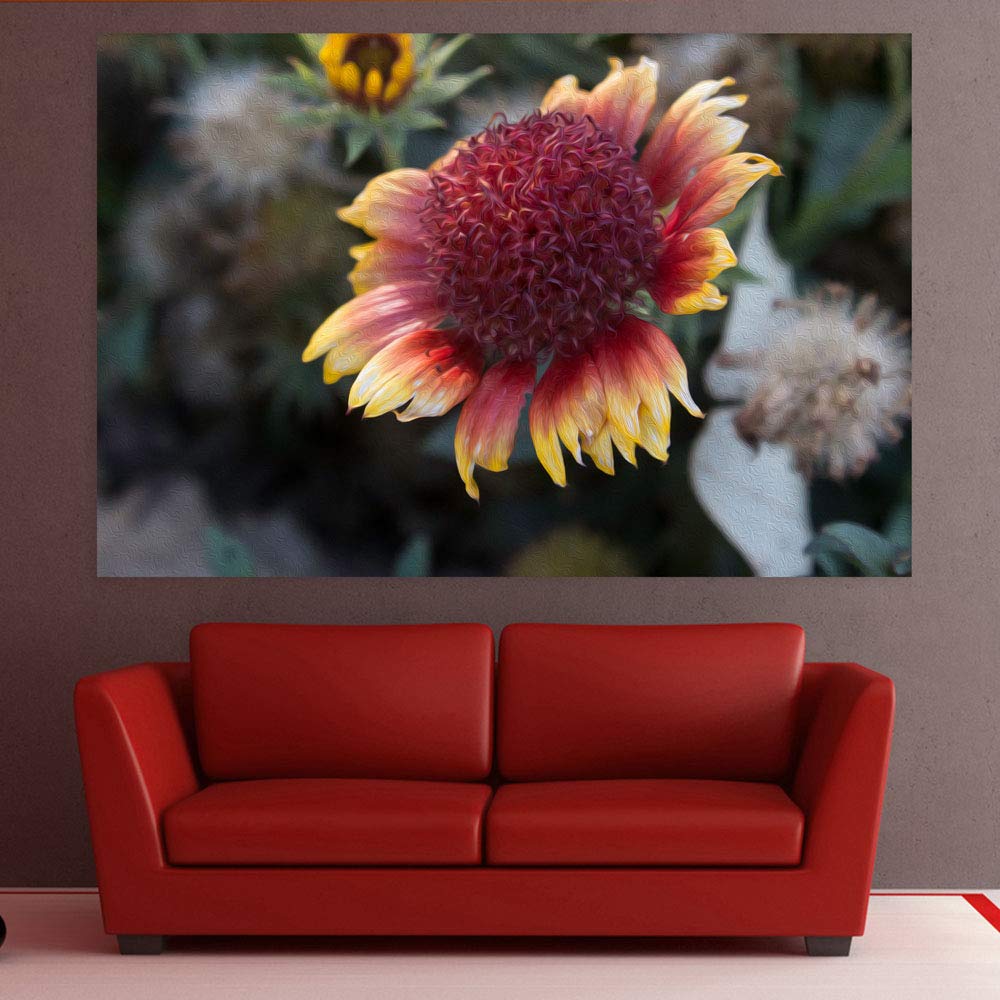

Bloom-tastic Floral Canvas That'll Petal Up Your Walls - framed Nature Art (91x61cm)
You may also like

Moolwan Blanket Flower Canvas Wall Art Painting (91x61cm) – Burgundy-Centered Bloom with Flame-Orange Gradient Petals
That Empty Wall Above Your Sofa Keeps Looking Different in Your Head Than in Reality
You've pictured something there dozens of times. You've held up your phone with saved images, squinted at the wall from across the room, tried to imagine how colors would land against your cream paint in actual afternoon light. But the mental image never quite holds—it shifts every time you look away, and you're left wondering whether what you're seeing online will translate to what you'll actually see when you walk into your living room at 7pm with the LEDs on.
This blanket flower canvas gives you something concrete to anchor that mental picture. The burgundy-maroon center sits dense and textured at the focal point, surrounded by flame-orange petals that gradient into golden-yellow at the tips. Behind it, a painterly soft-focus background in muted sage and cream creates depth without competing for attention. At 91x61cm, this is sized for walls behind 6-7 foot sofas—large enough to register as intentional from across the room, contained enough that it won't crowd the space above your sofa cushions.
Why 91cm Width Works Above a 6-Foot Sofa (And What Changes If Your Sofa Is Larger)
A 6-foot sofa (180cm) calls for canvas between 90-120cm wide. At 91cm, this painting hits the lower-middle of that range—roughly 50% of sofa width, which leaves comfortable visual breathing room on either side.
From your usual seated position, the burgundy center will sit at natural eye level when mounted 20-25cm above your sofa back. From the doorway (typical viewing distance of 3-4 meters in Indian living rooms), the warm orange-yellow petals will register first, drawing the eye toward the seating area without overwhelming it.
If your sofa is closer to 7 feet (210cm), this canvas still works—you'll have slightly more wall visible on either side, which actually helps if you have floor lamps or side tables flanking the sofa. If your sofa is 8 feet or longer, consider whether you want a deliberate asymmetric placement (canvas slightly off-center toward one end) or whether you'd prefer sizing up to 120cm width for centered placement.
Wall coverage math: On a 10-foot wall (300cm), this 91cm canvas covers about 30% of wall width. That's comfortable for a single statement piece—enough presence to anchor the sofa area, enough surrounding wall that the room doesn't feel crowded.
What These Colors Look Like on Cream Walls (Morning vs LED)
The dominant tones here are burgundy-maroon, flame-orange, golden-yellow, and soft sage-green in the background. Against cream or off-white walls (the default in most Indian apartments), these warm earth tones read as intentional and cohesive rather than jarring.
In morning light (if your living room faces east), the orange and yellow petals will appear slightly cooler, more muted. The burgundy center will look deep and rich. This is actually when the soft bokeh background shows its value—it catches ambient light and creates subtle depth without harsh shadows.
In evening LED light (warm white, 3000K—standard in most Indian homes), the entire canvas warms up. The flame-orange intensifies, the golden-yellow glows, and the burgundy center appears almost wine-colored. This is when guests see it, and this is when the warm-to-cool transition from the flower subject to the sage background becomes most visible.
Against light yellow or peach walls (common builder defaults): The warm tones will feel harmonious but may blend slightly. Consider whether you want the canvas to pop or integrate. Against sage or gray accent walls: The burgundy and orange will stand out more dramatically—this canvas can serve as a deliberate warm accent against cooler wall tones.
With brown leather or beige fabric sofas (most common in Indian living rooms): The earthy color palette feels like a natural extension of your furniture rather than a decorative afterthought.
Installation in Indian Walls (Concrete vs Drywall)
Most Indian apartment walls are either RCC concrete (older buildings) or brick with plaster (newer construction). Both require the same approach: 6mm masonry bit, 35mm deep holes, concrete anchors, screw-in hooks.
For this canvas at 400 grams, you need minimal hardware—two anchor points will hold it securely. The included hanging template eliminates guesswork: tape it to the wall at your chosen height (20-25cm above sofa back), mark the drill points through the template holes, remove the template, drill, anchor, hang.
Total installation time: 15-20 minutes including the part where you step back three times to confirm it's level.
If you're in a rental, the two 6mm holes this requires are smaller than standard picture frame nail holes. When you move out, fill with wall putty (₹50 from any hardware store), sand smooth, touch up with matching paint if you're feeling thorough. Your landlord won't notice, and it won't affect your deposit.
If your building has drywall (more common in modern high-rises and commercial-to-residential conversions), use the included plastic drywall anchors instead of concrete anchors. Same 6mm holes, same process, same 15-minute installation.
Why Canvas Instead of Fabric Tapestries for This Space
Fabric tapestries have their place—they're lightweight, often less expensive, and they add texture. But for a wall above your sofa that you'll see every single day, there are practical differences worth considering.
Tapestries move. Air conditioning, ceiling fans, someone walking past—the fabric shifts and sways. Over time, the edges curl. The hanging rod creates a visible bar across the top. In humid months, fabric absorbs moisture and can develop a slightly musty smell if your wall has any trapped dampness.
This canvas sits flush against the wall on a rigid pine frame. It doesn't move with airflow. The moisture-resistant coating means monsoon humidity beads on the surface rather than soaking into fibers. The frame maintains consistent tension on the canvas—no sagging corners, no curling edges, no gradual loosening over monsoon cycles.
The visual difference: tapestries read as soft, bohemian, slightly casual. Canvas reads as intentional, finished, gallery-adjacent. For a living room wall that guests see when they walk in, canvas signals that you've made a deliberate design choice rather than filled a blank space.
What This Will Actually Feel Like in Your Room
From the doorway, your eye will catch the warm orange-yellow first. It draws attention toward the sofa area without demanding it—the soft bokeh background prevents the canvas from feeling like it's shouting across the room.
Up close (standing near the sofa), the burgundy center reveals its texture—the dense, almost pompom-like structure of the blanket flower's disc florets. This is where the painterly quality of the canvas printing becomes visible: not photorealistic, but not abstracted either. It reads as an elevated nature photograph with artistic post-processing.
The soft-focus background means this canvas doesn't compete with other elements in your room. If you have patterned cushions, a textured rug, or other decorative objects on nearby shelves, the bokeh provides visual rest. The canvas becomes part of the room's warmth rather than a separate statement demanding attention.
If your current living room feels slightly cold or sterile (common in apartments with marble flooring and minimal soft furnishings), this canvas adds warmth without requiring you to change anything else. The burgundy-orange-yellow palette shifts the color temperature of the entire wall.
Moolwan Design Note
The blanket flower (Gaillardia) was captured at the moment when morning light catches the flame-colored petals while the burgundy center still holds shadow depth. The bokeh background isn't digitally added—it's the natural soft focus of a shallow depth-of-field shot, preserving the garden context without visual clutter.
Moolwan Quality Standard
Designed for Indian apartments and lighting conditions. Packed for long-distance Indian transit. Quality checked before dispatch. Printed to resist humidity-related color fading. Ships from West Bengal.
Moolwan Fit Guidance for Indian Homes
At 91x61cm, this canvas is proportioned for walls behind 6-7 foot sofas with 8-foot ceilings. Mount 20-25cm above sofa back for proper visual anchoring. The horizontal orientation suits standard Indian living room layouts where the sofa wall is wider than it is tall.
Quick Specifications
- Product: Moolwan Blanket Flower Canvas Wall Art Painting (91x61cm)
- Brand: Moolwan
- Category: Canvas Wall Art Painting
- Collection: Nature Wall Art Collection
- Dimensions: 91cm (W) x 61cm (H) x 2cm (D)
- Weight: 400 grams
- Material & Construction: Pure cotton canvas 380 GSM, fade-resistant eco-solvent inks, imported pine wood sturdy frame
- Colors: Burgundy-maroon center, flame-orange petals, golden-yellow petal tips, soft sage-green bokeh background
- Best For: Living room wall above 6-7ft sofa, bedroom accent wall, dining area
- Ships From: West Bengal
Frequently Asked Questions
Will 91cm look proportional above my 6-foot sofa, or should I size up?
For a 6-foot (180cm) sofa, 91cm width is well within the ideal 50-67% range. It will look proportional and intentional. If your sofa is 7-8 feet, this canvas still works but will appear slightly more compact—consider whether you want breathing room on the sides or prefer a larger visual anchor.
How will the burgundy and orange tones look against my cream walls in evening light?
Under warm white LED lighting (3000K, standard in most Indian homes), the burgundy deepens toward wine tones and the orange-yellow intensifies. Against cream walls, these warm tones create a cohesive, inviting atmosphere rather than clashing. The soft sage background provides enough cool contrast to prevent the canvas from feeling overwhelming.
Can I install this myself in a concrete wall without professional help?
Yes. You need a 6mm masonry drill bit and the included concrete anchors. Drill two 35mm deep holes using the hanging template as your guide, insert anchors, screw in hooks, hang canvas on the D-rings. Total time: 15-20 minutes. The canvas weighs only 400 grams, so minimal hardware is needed.
Will the colors fade if my living room wall gets afternoon sun?
The eco-solvent inks used in printing are UV-resistant and tested for direct sunlight exposure. If your wall receives 3-4 hours of afternoon sun daily, you won't see noticeable fading over years of use. The moisture-resistant canvas coating also prevents humidity-related color degradation during monsoon months.
The background looks soft and blurry—is that a printing defect or intentional?
That's intentional bokeh from the original photography—shallow depth-of-field that keeps the flower sharp while softening the garden background. It's not a defect; it's what prevents the canvas from feeling visually busy and allows the burgundy-orange bloom to remain the clear focal point.
Product Snapshot
- Brand: Moolwan
- Product: Moolwan Blanket Flower Canvas Wall Art Painting (91x61cm)
- Category: Canvas Wall Art Painting
- Collection: Nature Wall Art Collection
- Theme/Type: Floral / Blanket Flower Macro
- Best For: Living room above 6-7ft sofa, bedroom wall, dining accent
- Primary Differentiator: Burgundy-centered bloom with flame-orange gradient petals
- Secondary Differentiators: Painterly bokeh depth; warm-to-cool color transition from subject to background
- Material & Construction: Pure cotton canvas 380 GSM, fade-resistant eco-solvent inks, imported pine wood sturdy frame
- Care Instructions: Dry dust with microfiber cloth every 2-3 weeks; no water or cleaning chemicals
- Ships From: West Bengal
- Packing: Long-distance transit ready
- Quality Check: Before dispatch