
.jpeg)
.jpeg)
.jpeg)
.jpeg)

Bloomin' Marvelous: framed Floral Canvas That'll Petal to the Metal for Your Walls (91x61cm)
You may also like

Moolwan Poppy Field Canvas Wall Art Painting (91x61cm) – Impressionist Brushwork with Bold Red Focal Point
You've measured your wall three times. Maybe four. The tape measure says somewhere around 10-12 feet, but you're still not confident because the sizing guides online assume Western furniture proportions and 9-foot ceilings. Your sofa is probably 6-7 feet wide. Your wall behind it is probably that standard 10-12 feet in most Indian 2BHK or 3BHK living rooms. And you keep second-guessing: is 91cm actually right, or will it look lost on the wall?
Here's what 91cm does on your specific wall: it covers roughly 25-30% of a 10-12 foot wall. That leaves breathing room on either side—approximately 115-125cm of wall space on each flank if centered. The 61cm height sits comfortably above a 6-7 foot sofa with the recommended 20-25cm gap, keeping the bottom edge well above head height when seated. This isn't a statement piece that dominates; it's a focal point that anchors without overwhelming.
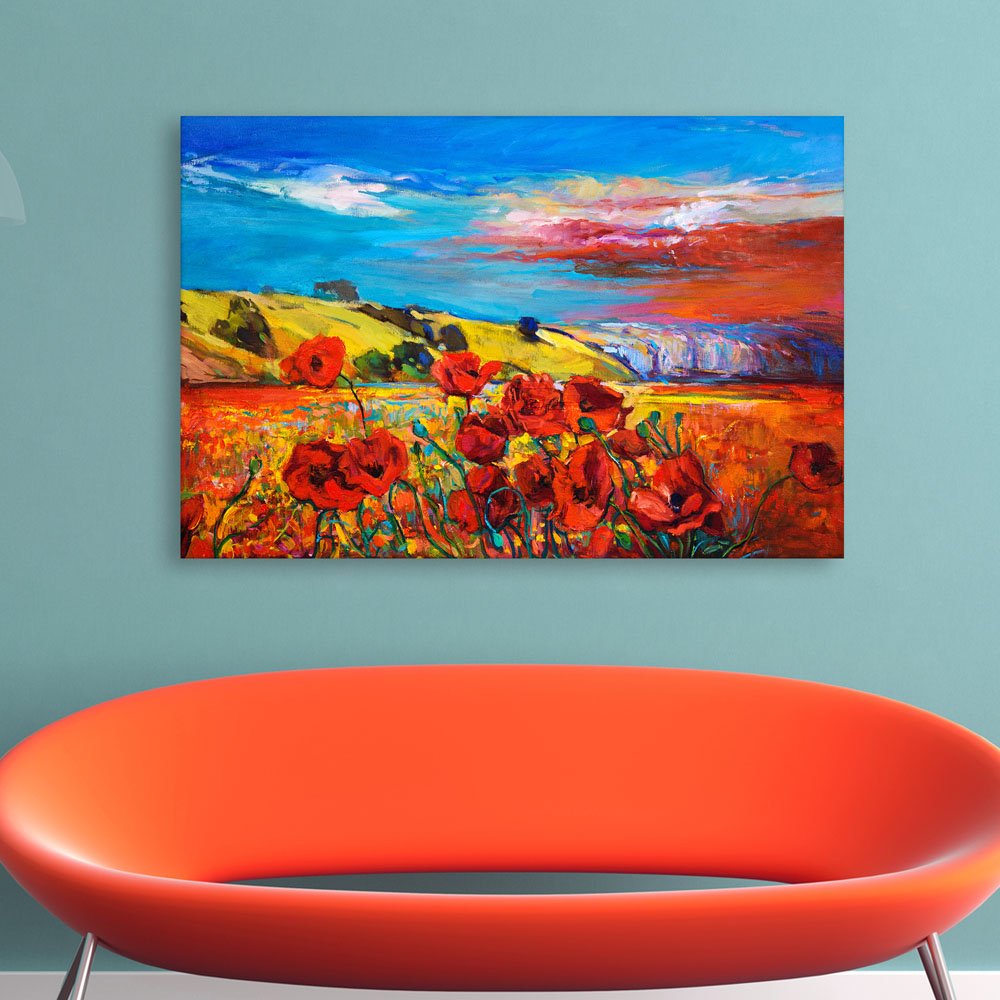
The painting itself—a poppy field rendered in visible, textured brushstrokes—draws the eye immediately to the cluster of deep crimson poppies in the lower third. The composition moves upward through golden wheat fields into rolling green hills, then releases into an expressive blue sky with pink-tinged clouds. The painterly quality means this reads as art, not décor. From across the room, you see color and energy. Up close, you see brushwork.
Why 91cm Works on 10-12 Foot Living Room Walls (and What Changes If You Size Up)
The math is straightforward: 91cm on a 300cm (10ft) wall gives you 30% coverage. On a 360cm (12ft) wall, that drops to 25%. Both work, but they work differently.
At 30% coverage, the canvas feels balanced above a 6-foot sofa. The proportions align with how your eye naturally groups furniture and art together. If you went smaller—say 75cm—you'd drop to 20-25% coverage, and the canvas would start looking tentative, like you weren't sure if you wanted art there or not.
If you went larger—120cm—you'd hit 33-40% coverage, which works only if your sofa is also larger (8 feet or more) or if you're placing this above a dining table where furniture doesn't visually compete. On a 6-foot sofa, 120cm often feels like the art is trying too hard.
The 61cm height keeps the canvas proportional at roughly a 3:2 aspect ratio. With standard 8-foot ceilings, hanging the bottom edge 20-25cm above your sofa top puts the center of the canvas at eye level for someone standing—which is exactly where guests will first notice it when they walk into the room.
What These Reds, Yellows, and Blues Look Like Against Cream Walls (Morning vs LED)
The color palette here is unusual for canvas wall art: saturated reds (the poppies), warm golds and ochres (the field), cool cerulean blue (the sky), and transitional pinks at the horizon. This isn't muted or neutral—it's vibrant but warm.
Against cream or off-white walls (the most common in Indian apartments), the warm tones in the painting—the reds, golds, oranges—amplify. Morning light through east-facing windows will bring out the blues and make the overall piece feel cooler, fresher. By afternoon, as natural light shifts warmer, the reds and golds dominate. Under evening LED (typically warm white, 2700K-3000K in Indian homes), the entire piece glows with earthy warmth.
If your walls are that specific builder's peach or light yellow, the blues in the sky will pop more, creating intentional contrast rather than clashing. If you have sage or mint walls (less common but gaining popularity), the reds become the obvious focal point, which works if you want drama.
With brown or beige fabric sofas, the golden yellows in the field visually connect the art to the furniture without matching exactly. The red poppies provide enough contrast to read as intentional, not accidental.
Installation in Indian Walls (Concrete vs Drywall): 15-Minute Setup
At 400 grams, this canvas is genuinely lightweight—lighter than most framed photos. This simplifies installation significantly.
For concrete walls (common in buildings older than 15 years): 6mm masonry bit, 35mm deep holes, plastic anchors, done. Two anchor points are sufficient at this weight.
For drywall (common in newer construction and false wall setups): Standard drywall anchors work fine. You don't need heavy-duty toggle bolts for 400 grams.
The holes you'll drill are smaller than what previous tenants left for curtain rods. When you move out, standard wall putty and a touch of paint renders them invisible. Your ₹50,000 deposit is safe.
Hanging hardware is included—D-ring hangers attached to the frame, plus a paper template showing exact drilling points. You're not eyeballing measurements or making a hardware store trip. Tape the template, mark the holes, drill, hang. Fifteen minutes including the time spent checking if it's level.
How This Compares to Macramé Wall Hangings You Might Be Considering
If you've been browsing alternatives, macramé wall hangings probably appeared in your search results. At similar dimensions, here's the trade-off:
Macramé adds texture but limited color. It works in bohemian-styled spaces but can look out of place in more traditional Indian living rooms with formal furniture. It collects dust in the weave, requiring periodic cleaning. And in high-humidity environments (Mumbai monsoons, Chennai year-round), natural fiber macramé can develop musty odors or visible mildew if your AC isn't running constantly.
This canvas is printed with eco-solvent inks on moisture-resistant coated cotton. Dust wipes off with a dry microfiber cloth. The colors don't shift with humidity changes. Three monsoon seasons from now, it still looks the same.
Macramé also creates visual "noise"—the texture competes for attention. This canvas has a clear focal point (the poppies) that anchors the eye, then releases it to explore the composition. It's intentional rather than decorative.
What This Will Actually Feel Like in Your Room
From the doorway: The red poppies register first, drawing your eye to that section of the wall. The overall impression is warmth and energy without being overwhelming. The horizontal format feels grounded, not precarious.
From the sofa: Sitting below the canvas, you're looking up at the sky portion—the blues and pinks. The poppies are above your sightline. This creates a different experience from seeing it across the room. Evening conversations happen with this as background color rather than direct focal point.
Up close: The brushwork becomes apparent. This isn't a flat photographic print—the visible texture gives it dimensionality. Guests who approach to look more closely see something worth examining, not just enlarged decoration.
Solo placement works. This canvas has enough visual interest to anchor a wall by itself. If you're creating a gallery wall, it functions as the centerpiece with smaller complementary pieces flanking it—but it doesn't need companions to justify its presence.
Moolwan Design Note:
The impressionist brushwork on this poppy field canvas creates visible texture even at arm's length—not the flat, photographic look of mass-printed canvas. The red poppy cluster in the lower third establishes an immediate focal point, while the layered composition (foreground flowers, midground field, background hills and sky) gives the eye movement without chaos.
Moolwan Quality Standard:
Designed for Indian apartments and lighting conditions. Packed for long-distance Indian transit. Quality checked before dispatch. Printed to resist humidity-related color fading. Ships from West Bengal.
Moolwan Fit Guidance for Indian Homes:
91x61cm works best above 6-7 foot sofas on 10-12 foot walls, maintaining 25-30% coverage. The vibrant warm palette complements cream walls and brown furniture commonly found in Indian living rooms. Ideal for living rooms or bedrooms that need energy without overwhelming the space.
Quick Specifications
- Product: Moolwan Poppy Field Canvas Wall Art Painting (91x61cm)
- Brand: Moolwan
- Category: Canvas Wall Art Painting
- Collection: Nature Wall Art Collection
- Dimensions: 91cm (W) x 61cm (H) x 1cm (D)
- Weight: 400 grams
- Material & Construction: Pure cotton canvas, fade-resistant eco-solvent inks, imported pine wood sturdy frame
- Colors: Crimson red, golden yellow, ochre, cerulean blue, soft pink, forest green
- Best For: Living room walls 10-12 feet wide, above 6-7 foot sofas; bedrooms seeking warm, energetic focal point
- Ships From: West Bengal
Frequently Asked Questions
Will 91cm look too small on my 12-foot living room wall?
At 25% coverage on a 12-foot wall, 91cm reads as intentional rather than undersized—especially above a 6-7 foot sofa where proportions align. If your sofa is 8 feet or larger, consider sizing up to 120cm for better visual balance.
How will these bright colors look in warm LED lighting?
The reds and golds intensify under warm white LEDs (2700K-3000K), creating a cozy, inviting glow. The blues recede slightly, making the overall piece feel warmer in evening light than in photos shot in daylight.
Can I hang this without losing my rental deposit?
At 400 grams, this canvas needs only two small anchor holes (6mm diameter). When you move, fill with standard wall putty, sand smooth, touch up with matching paint. Smaller holes than curtain rod brackets leave.
Will the colors fade during monsoon humidity?
The eco-solvent inks used are UV-resistant and printed on moisture-resistant coated cotton. The polymer coating prevents humidity from penetrating the canvas fibers. Two, three monsoon seasons—no visible fading or warping.
Does this need professional framing, or is it ready to hang?
Ready to hang. The canvas is pre-stretched on a sturdy pine wood frame with D-ring hangers attached. You receive a paper template for marking drill points. No framing required unless you want to add an additional decorative frame for style.
Product Snapshot
- Brand: Moolwan
- Product: Moolwan Poppy Field Canvas Wall Art Painting (91x61cm)
- Category: Canvas Wall Art Painting
- Collection: Nature Wall Art Collection
- Theme/Type: Floral Landscape / Impressionist Style
- Best For: Living rooms with 10-12ft walls, bedrooms seeking warm focal point, spaces needing color energy without overwhelming
- Primary Differentiator: Impressionist brushwork with bold red poppy focal point
- Secondary Differentiators: Warm-cool color contrast (reds/yellows against blue sky), layered depth composition
- Material & Construction: Pure cotton canvas, fade-resistant eco-solvent inks, imported pine wood sturdy frame
- Care Instructions: Dust with dry microfiber cloth every 2-3 weeks. No water or cleaning chemicals.
- Ships From: West Bengal
- Packing: Long-distance transit ready
- Quality Check: Before dispatch