
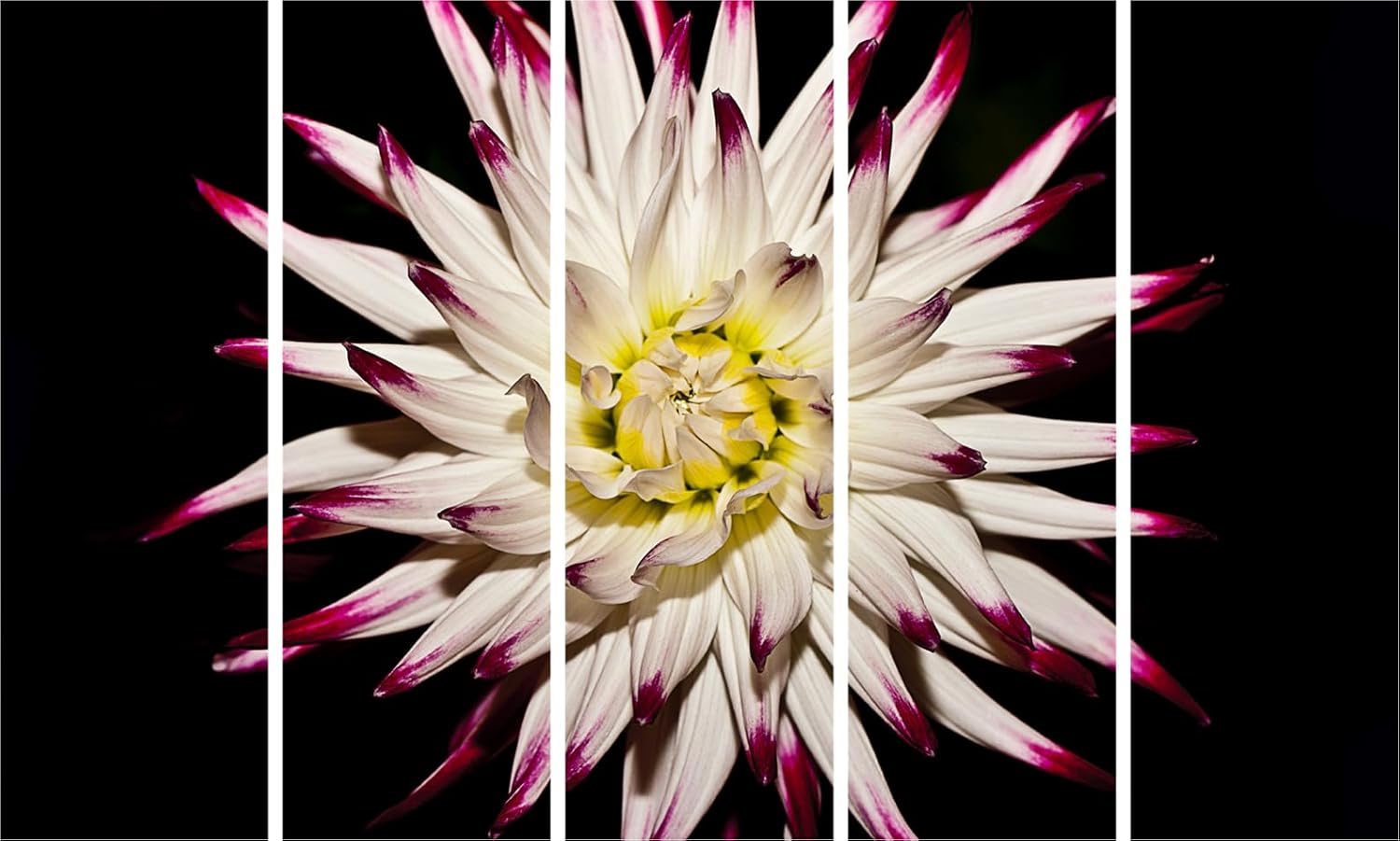
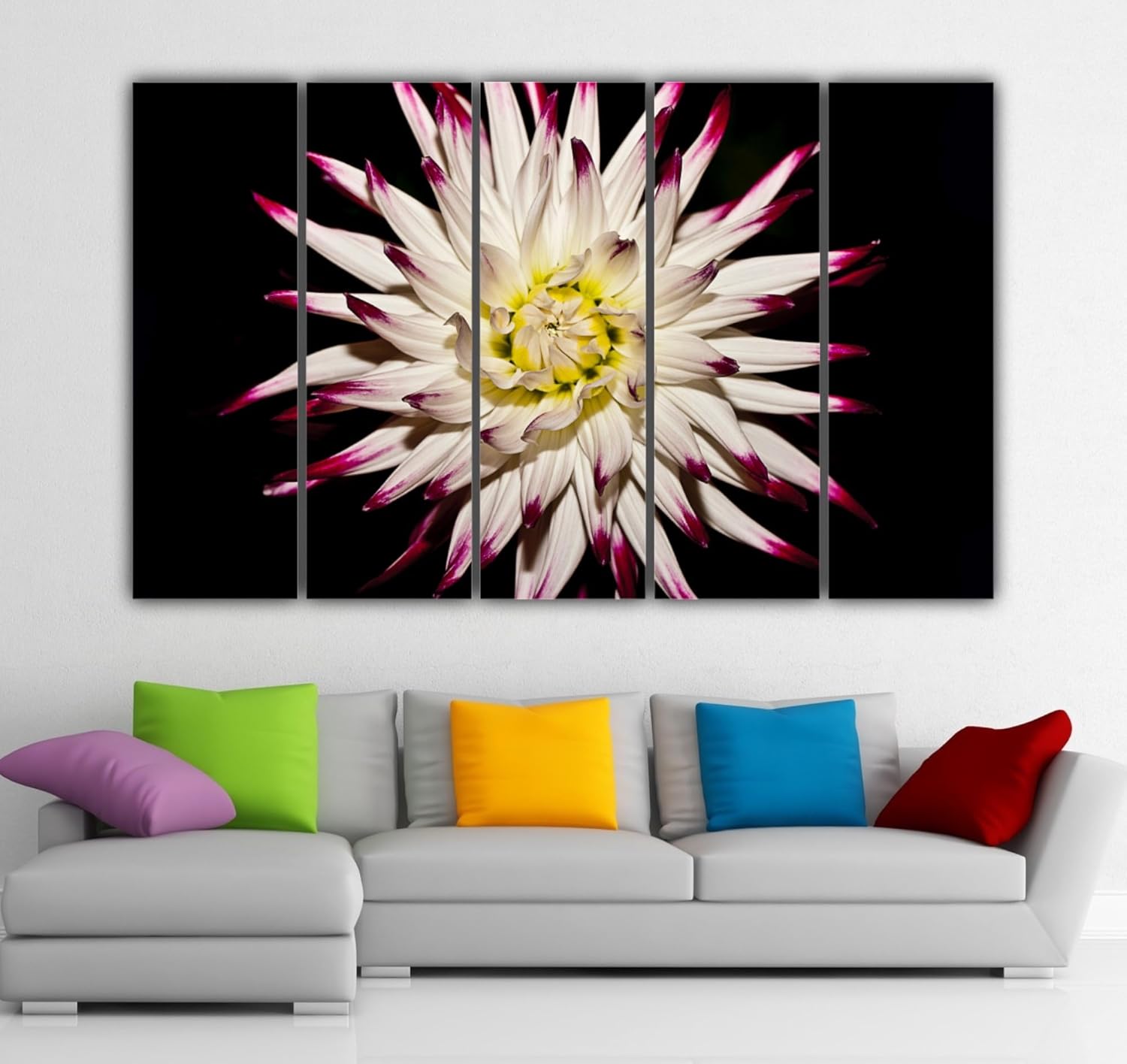
Bloomin' Beautiful 5-Panel Flower Photography Wall Art - Framed Floral Fiesta (127x76cm)
You may also like

Moolwan 5-Panel Dahlia Flower Vinyl Wall Art on MDF (127x76cm) – Radial Symmetry That Anchors Large Walls
When You've Been Stuck Between "Too Plain" and "Too Much"
You've probably clicked through dozens of wall art options this week. Some looked too small for that 10-foot wall. Others felt busy, cluttered, like they'd compete with everything else in the room. And then there's the middle ground—pieces that might work, but you're not sure, because you've been burned before by art that looked perfect online and underwhelming in person.
This dahlia changes that calculation. The composition is radially symmetric—your eye lands on the luminous yellow center, follows the cream petals outward, catches the wine-magenta tips, and rests. It's visually active without being chaotic. The stark black background means the bloom floats against your wall rather than blending into it. At 127cm wide, it's scaled to fill the empty stretch above an 8-foot sofa without crowding it.
Why 127cm Works on 10-12 Foot Walls (And What Happens If You Go Smaller)
The math: a standard Indian 3-seater sofa runs 180-240cm wide. This 127cm piece hits the 53-70% sweet spot—large enough to anchor the furniture visually, compact enough to leave breathing room on either side.
On a 10-foot (300cm) wall, you get approximately 86cm of wall space on each side of the piece. That's balanced negative space—the dahlia becomes the focal point without the wall feeling cramped. On a 12-foot (360cm) wall, you have roughly 116cm on each side, which lets the artwork breathe while still commanding attention.
If you went with a 90cm piece on this same wall, you'd get that "stamp on an envelope" effect—technically present, but visually lost. The dahlia's radial design specifically benefits from scale; the outward-reaching petals need room to expand visually.
The 5-panel configuration spans 127cm total with approximately 2-3cm gaps between panels. From your sofa (typical viewing distance: 2-3 meters), these gaps read as intentional framing, not interruption. The flower's continuous image flows across all five panels, creating that gallery-scale impact without the gallery price.
What These Colors Actually Look Like on Indian Walls
The color story here is specific: deep black background, cream-to-ivory petals, magenta-wine petal tips, soft yellow center with hints of green.
Against cream or off-white walls (most common): The black background creates immediate contrast. The dahlia appears to float forward from the wall surface. The cream petals echo the wall color just enough to feel integrated, while the magenta tips add the color pop that prevents the piece from looking washed out.
Against light yellow or peach walls: The yellow center picks up wall tones, creating subtle color harmony. The magenta tips provide complementary contrast.
Against darker or colored walls: The black background acts as a visual "frame," separating the artwork from the wall color. This actually works well—the dahlia becomes its own contained statement.
In morning light: Colors appear slightly cooler. The cream petals read as pure white, the magenta as more purple-toned.
In warm LED lighting (3000K, typical Indian homes): The yellow center warms up, the cream petals take on a subtle golden tone, and the magenta deepens to wine. This is when the piece looks its richest.
The high-contrast black background means you don't need to worry about the artwork looking faded or washed out in bright afternoon sun—there's no subtle gradient to lose.
Installation on Indian Walls (Concrete and Drywall)
Five panels means five mounting points. This sounds like more work, but it's actually more forgiving—if one panel is slightly off, it's less noticeable than a single large piece that's tilted.
What you're working with:
- Total weight: 3kg distributed across 5 panels (approximately 600g per panel)
- Depth: 0.6cm (sits nearly flush against the wall)
- Each panel needs one mounting point
For concrete walls (common in older buildings):
Use 6mm masonry anchors. Drill 35mm deep, tap in anchors, screw in hooks. The 600g per panel is well within what a single anchor can hold.
For drywall (common in newer apartments):
Plastic wall anchors handle this weight easily. Drill 30mm deep holes, insert anchors, mount hooks.
The alignment reality:
Start with the center panel. Level it. Then work outward, maintaining consistent 2-3cm gaps between panels. A simple trick: cut cardboard spacers to your desired gap width and use them as guides while mounting. Total installation time: 25-30 minutes if you're being careful about alignment.
Rental-friendly: Five 6mm holes patch easily with wall putty. When you move out, fill, sand, touch up with matching paint. Your landlord won't notice.
Why This Works Better Than Fabric Tapestries
Fabric tapestries look appealing in styled photos—that bohemian, lived-in aesthetic. But here's what happens in actual Indian homes:
Dust accumulation: Fabric weaves trap dust. In Indian cities (especially Delhi, Mumbai, Bangalore), you're looking at visible dust buildup within 2-3 weeks. Cleaning means taking it down, washing carefully, re-hanging.
Humidity effects: During monsoons, fabric absorbs moisture. It sags. It can develop that slightly musty smell. Drying it out fully takes days.
Visual crispness: Fabric tapestries have an inherently soft look. That works for certain aesthetics, but if you want the sharp detail of this dahlia photograph—the precise gradation from cream to magenta at each petal tip—fabric can't reproduce it.
This vinyl-on-MDF construction stays flat through humidity swings. The splash-proof surface means dust wipes off with a dry cloth. The photographic detail remains crisp year after year. And the MDF backing provides rigidity that fabric simply can't match.
What This Will Actually Feel Like in Your Room
From the doorway: The black background creates a dark anchor point on your wall. The dahlia reads as a single dramatic bloom, the radial symmetry immediately apparent. Your eye goes there first.
From the sofa: At 2-3 meters, you see the full detail—the delicate gradation of each petal, the textured yellow center, the way the magenta tips seem to glow against the black. The 5-panel gaps create subtle framing that adds visual interest.
Does it dominate or complement? This piece dominates. The black background, the scale, the centered composition—it's designed to be the focal point of the wall, not a supporting element. If you have other busy patterns in the room (patterned curtains, busy rugs, multiple small artworks), consider whether you want competing focal points. This dahlia works best when it's the main visual event on that wall.
Solo or with adjacent décor? Solo. The radial symmetry is self-contained and visually complete. Flanking it with smaller pieces would disrupt the balance. Let it breathe.
Moolwan Design Note
The dahlia's radial symmetry is split precisely across the center panel, with petals extending through the outer four panels. This means the composition remains balanced whether viewed straight-on or from an angle—the eye always finds the center.
Moolwan Quality Standard
Printed to resist humidity-related color fading. Packed for long-distance Indian transit. Quality checked before dispatch. Ships from West Bengal.
Moolwan Fit Guidance for Indian Homes
At 127cm wide, this piece is proportioned for 8-foot sofas on 10-12 foot walls. The horizontal orientation works above sofas, dining tables, or along hallway walls. The 0.6cm depth sits nearly flush, keeping the visual focus on the artwork rather than the frame edge.
Quick Specifications
- Product: Moolwan 5-Panel Dahlia Flower Vinyl Wall Art on MDF (127x76cm)
- Brand: Moolwan
- Category: Vinyl Wall Art on MDF
- Collection: Nature Wall Art Collection
- Dimensions: 127cm W x 76cm H x 0.6cm D
- Weight: 3kg
- Material & Construction: Splash-proof vinyl print on MDF
- Colors: Black background, cream/ivory petals, magenta/wine petal tips, soft yellow center
- Best For: Above 8-foot sofas on 10-12 foot walls, dining room walls, wide hallways
- Ships From: West Bengal
Frequently Asked Questions
Will 127cm be too large for my 8-foot sofa?
No—127cm is approximately 53% of a standard 8-foot (240cm) sofa width, which falls within the ideal 50-75% proportion range. It will look anchored and intentional, not overwhelming.
How will the black background look against my cream walls?
The contrast works in your favor. The dahlia appears to float forward from the wall surface, creating depth. Cream walls and black backgrounds are a classic high-contrast pairing that reads as intentional and curated.
Is alignment difficult with 5 separate panels?
It's manageable. Start with the center panel, level it carefully, then work outward using cardboard spacers to maintain consistent gaps. Allow 25-30 minutes for careful installation.
Will the colors fade near my window?
The vinyl printing is designed to resist humidity-related color fading. The high-contrast nature of this piece (black background, saturated colors) also means subtle fading is less visible than it would be on a soft-gradient artwork.
How do I clean it?
Dry dusting with a microfiber cloth every 2-3 weeks. The splash-proof surface means dust sits on top rather than embedding—it wipes away easily. No water or cleaning chemicals needed.
Product Snapshot
- Brand: Moolwan
- Product: Moolwan 5-Panel Dahlia Flower Vinyl Wall Art on MDF (127x76cm)
- Category: Vinyl Wall Art on MDF
- Collection: Nature Wall Art Collection
- Theme/Type: Floral / Botanical Photography
- Best For: Above 8-foot sofas on 10-12 foot walls, dining walls, wide hallways
- Primary Differentiator: Radial symmetry creates a natural focal point that anchors large walls
- Secondary Differentiators: High-contrast black background amplifies the bloom against any wall color; continuous image flow across 5 panels creates gallery-scale visual impact
- Material & Construction: Splash-proof vinyl print on MDF
- Care Instructions: Dry dust with microfiber cloth; no water or chemicals
- Ships From: West Bengal
- Packing: Long-distance transit ready
- Quality Check: Before dispatch