
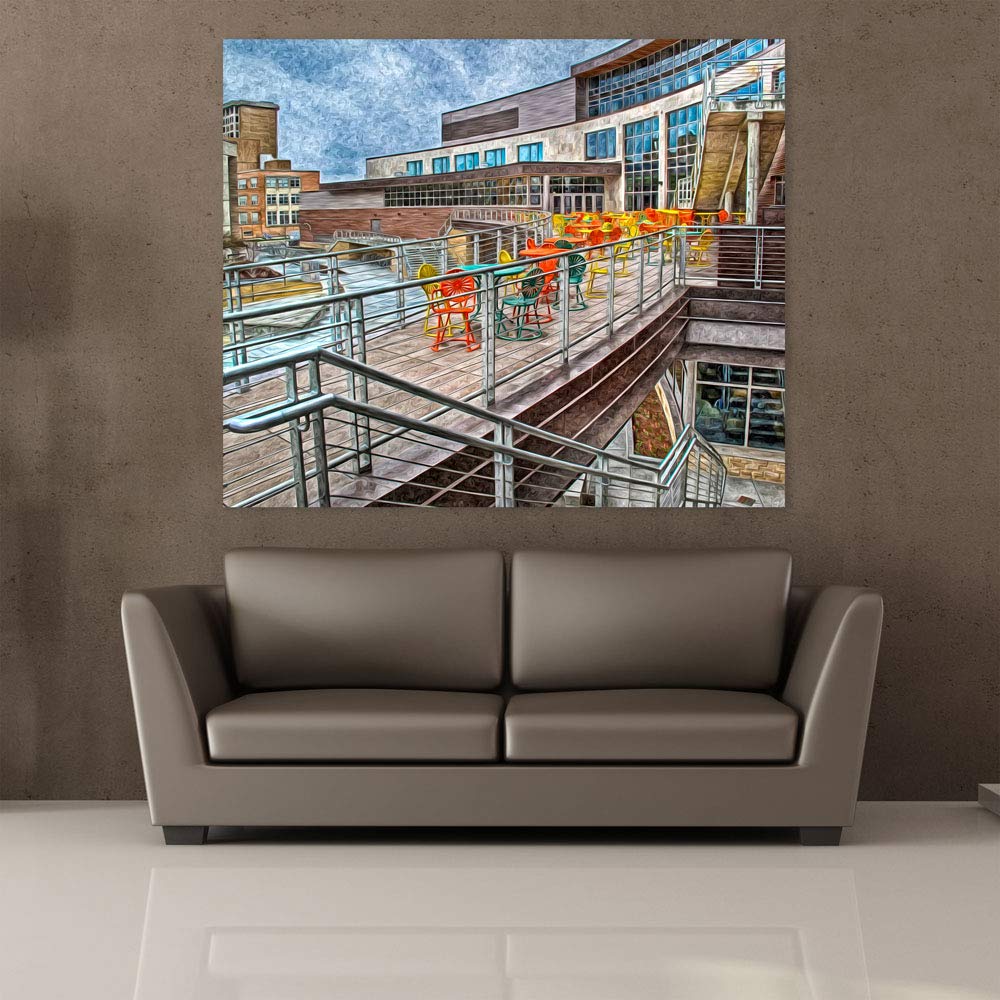

Bridge Bites Canvas That'll Make Your Walls Hungrier - framed Dinner on the Bridge Wall Art (91x76cm)
You may also like

Moolwan Urban Rooftop Café Canvas Wall Art Painting (91x76cm) – Diagonal Lines That Pull You Into the Scene
Finding Wall Art That Actually Looks Like Something
You've scrolled past hundreds of cityscapes. Skylines at night. Bridges at sunset. Streets in the rain. They all look the same from across the room — flat rectangles of buildings that register as "city art" without giving your eye anywhere to travel. You know what you want: something urban, something with energy, but something that doesn't disappear into visual noise the moment you step back to the doorway.
This rooftop terrace scene works differently. The diagonal staircase railing in the foreground creates an entry point — your eye follows the steel handrail upward, across the wooden decking, to the cluster of red, orange, yellow, and teal café chairs arranged along the terrace edge. The composition pulls you into the space rather than presenting a flat façade. At 91x76cm, it holds enough visual weight to anchor an 8-foot sofa wall without requiring you to imagine what it might look like — the geometry does the work.
Why 91x76cm Works on 10-12ft Walls (And What Changes If You Size Differently)
At 91cm wide, this canvas covers approximately 60-65% of a standard 6-foot Indian sofa — the ratio where art feels anchored to furniture rather than floating above it. On a 10-foot wall with an 8-foot sofa centered, you get roughly 30cm of visual breathing room on each side of the canvas, enough that the diagonal lines in the composition don't feel cramped against wall edges.
The near-square proportion (91x76cm) sits comfortably at 20-25cm above sofa height without crowding 8-foot ceilings. If your ceiling is 10 feet, you could position it slightly higher — 30cm above the sofa — and the vertical architectural elements (the staircase, the building façade) would use that extra wall height effectively.
Viewing distance matters here: from 8-10 feet (typical across-the-room distance in Indian living rooms), the diagonal lines resolve clearly, and the colorful chairs read as distinct accents rather than blurred dots. Closer than 6 feet, you'll notice the painterly brushstroke texture in the sky and building surfaces — intentional artistic treatment that distinguishes this from photographic prints.
What These Colors Look Like on Cream Walls (Morning vs LED)
The palette here splits into two registers: the cool architectural greys and blues (sky, steel railings, glass façades, concrete) and the warm saturated accents (red, orange, yellow chairs against wood decking).
On cream or off-white walls — the standard in most Indian apartments — the cool tones recede slightly while the warm accents push forward. In morning daylight from east-facing windows, the sky blue reads as open and airy, and the steel greys appear neutral. Under warm LED lighting (3000K, typical evening conditions), the entire scene warms up: the wood decking gains richness, the red and orange chairs intensify, and the overall effect feels more intimate than the daylight version.
Against grey walls (like the mockup image shows), the cool architectural elements blend more seamlessly, making the colorful chairs the dominant visual feature. Against peach or light yellow walls, the warm chair accents would harmonize while the cool blues provide necessary contrast.
The browns and wood tones in the decking complement standard Indian furniture — brown or beige fabric sofas, wooden coffee tables — without requiring you to match anything precisely. The urban subject reads as contemporary without clashing with traditional wooden furniture.
Installation in Indian Walls (Concrete vs Drywall)
A 91x76cm canvas on 1.5-inch pinewood frame weighs approximately 2-2.5kg — well within the range for standard wall anchors without needing heavy-duty hardware.
For concrete walls (common in older Indian buildings): 6mm masonry bit, drill 35mm deep, insert the included concrete anchors, screw in hooks. The D-ring hangers on the frame back distribute weight evenly across two mounting points.
For drywall (common in modern apartments and interior partition walls): 6mm drill bit, 30mm depth, plastic wall anchors, same hanging process. If you're uncertain which wall type you have, tap the wall — hollow sound means drywall method, solid thud means concrete method.
The included hanging template eliminates measurement anxiety. Tape it to the wall at your chosen height (20-25cm above sofa cushion top), mark the two drill points through the template, remove paper, drill. Two holes, 6mm each — smaller than standard picture hooks and easily patchable with wall putty when you move.
For rental situations: these anchor holes are the same size landlords expect from normal picture hanging. The repair cost at move-out is ₹50 in wall putty and 10 minutes of your time.
Why Canvas Holds a Wall Better Than Fabric Tapestries
Fabric tapestries occupy similar wall space at lower price points, which raises a reasonable question: why not just hang fabric?
The difference becomes obvious within months. Fabric tapestries absorb dust and humidity — in Mumbai's monsoons or Chennai's year-round humidity, the fibers hold moisture and develop musty odors. The edges fray. The hanging rod creates a visible horizontal line at the top that reads as "temporary decoration" rather than intentional art. The fabric sags over time, creating an uneven surface that catches shadows awkwardly.
Canvas stretched on a rigid pinewood frame maintains dimensional stability. The moisture-resistant coating on this 380 GSM cotton canvas means humidity beads on the surface rather than absorbing into fibers. The frame holds the canvas drum-tight — no sagging, no rippling, no visible mounting hardware. From across the room, it reads as a deliberate design choice, not a placeholder.
The eco-solvent inks resist fading in ways fabric dyes cannot. That cluster of red and orange chairs will still be saturated red and orange after two monsoon seasons and daily afternoon sun exposure. Fabric tapestry dyes fade to washed-out pastels within 6-8 months under the same conditions.
What This Will Actually Feel Like in Your Room
From the doorway: the diagonal lines register first, creating a sense of depth and movement that static grid-based cityscapes lack. The colorful chairs provide a focal point that draws the eye into the mid-ground of the composition.
From the sofa (directly below): you'll notice the painterly texture — the sky has visible brushwork, the buildings have softened edges that distinguish this from photographic prints. This artistic treatment gives the piece visual interest at close range without looking pixelated or low-resolution.
The near-square format means it doesn't demand horizontal wall space the way panoramic cityscapes do. It works as a standalone piece above a sofa or as part of a gallery arrangement in a hallway or stairwell landing.
With adjacent décor: the neutral grey and blue tones won't compete with colorful throw pillows or patterned rugs. The warm accents (red, orange, yellow chairs) can be echoed in small decorative objects — a terracotta vase, an orange cushion — if you want to create intentional color continuity, but the piece doesn't require matching.
In a dining area: the café subject matter creates thematic coherence. Colorful seating in the artwork reflects actual dining chairs without requiring literal matching.
Moolwan Design Note
The diagonal staircase railing wasn't incidental — it creates an entry point that pulls viewers into the terrace scene rather than presenting a flat urban façade. The colorful café chairs clustered in the mid-ground provide a focal anchor that gives your eye somewhere to rest.
Moolwan Quality Standard
- Designed for Indian apartments and lighting conditions
- Packed for long-distance Indian transit
- Quality checked before dispatch
- Printed to resist humidity-related color fading
- Ships from West Bengal
Moolwan Fit Guidance for Indian Homes
At 91x76cm, this canvas covers 60-65% of a 6-foot sofa width — the proportion where art feels anchored rather than floating. Position 20-25cm above sofa cushion height for optimal visual connection to furniture below.
Quick Specifications
- Product: Moolwan Urban Rooftop Café Canvas Wall Art Painting (91x76cm)
- Brand: Moolwan
- Category: Canvas Wall Art Painting
- Collection: City Wall Art Collection
- Dimensions: 91cm W x 76cm H x 3.8cm D (frame depth)
- Material & Construction: 380 GSM pure cotton canvas, fade-resistant eco-solvent inks, 1.5-inch imported pine wood frame with corner bracing
- Colors: Sky blue, steel grey, brick red, bright orange, yellow, teal, warm wood brown
- Best For: Living room above 6-8ft sofa, dining area wall, office reception
- Ships From: West Bengal
Frequently Asked Questions
Will 91x76cm look proportional above my 7-foot sofa?
Yes. At 91cm wide, the canvas covers approximately 55% of a 7-foot (210cm) sofa width — within the 50-75% range where wall art feels visually anchored to furniture. You'll have roughly 60cm of sofa extending beyond the canvas on each side, which reads as balanced rather than cramped.
How will the blue sky tones look under warm LED lighting?
Under 3000K warm white LEDs (standard in most Indian homes), the sky blue shifts slightly warmer and the overall scene gains intimacy. The red and orange chairs intensify noticeably. The effect is more evening-café atmosphere than midday-terrace brightness — many find this preferable for living room settings.
Can I install this on a rental apartment wall without losing my deposit?
The installation requires two 6mm anchor holes — smaller than standard picture frame nail holes. At move-out, fill with wall putty (₹50 at any hardware store), sand smooth, touch up with matching paint if needed. Total repair: 15 minutes and negligible cost. These holes fall well within normal wear expectations.
Will the colors fade if my wall gets afternoon sun?
The eco-solvent inks used in printing are UV-resistant — the same ink technology used for outdoor signage. Direct afternoon sun exposure won't cause visible fading over normal ownership periods. The colors you see at purchase will remain consistent through multiple monsoon seasons and sun cycles.
Is the painterly texture visible from across the room, or only up close?
From typical viewing distance (8-10 feet, across a living room), the diagonal composition and color accents dominate — the painterly texture reads as "artistic" without being consciously noticed. Within 4-6 feet, the brushstroke treatment in the sky and building surfaces becomes apparent, adding visual interest at close range without pixelation or blur.
Product Snapshot
- Brand: Moolwan
- Product: Moolwan Urban Rooftop Café Canvas Wall Art Painting (91x76cm)
- Category: Canvas Wall Art Painting
- Collection: City Wall Art Collection
- Theme/Type: Urban rooftop terrace café scene
- Best For: Living room above sofa (6-8ft), dining area, office reception
- Primary Differentiator: Diagonal architectural lines create depth and movement uncommon in static cityscape art
- Secondary Differentiators: Saturated primary-color chairs against neutral urban backdrop; painterly texture distinguishes from photographic prints
- Material & Construction: 380 GSM pure cotton canvas, eco-solvent UV-resistant inks, 1.5-inch kiln-dried pine wood frame with corner bracing
- Care Instructions: Dry dust with microfiber cloth every 2-3 weeks; avoid water or cleaning chemicals
- Ships From: West Bengal
- Packing: Long-distance transit ready (bubble wrap + corner protectors + outer carton)
- Quality Check: Before dispatch