
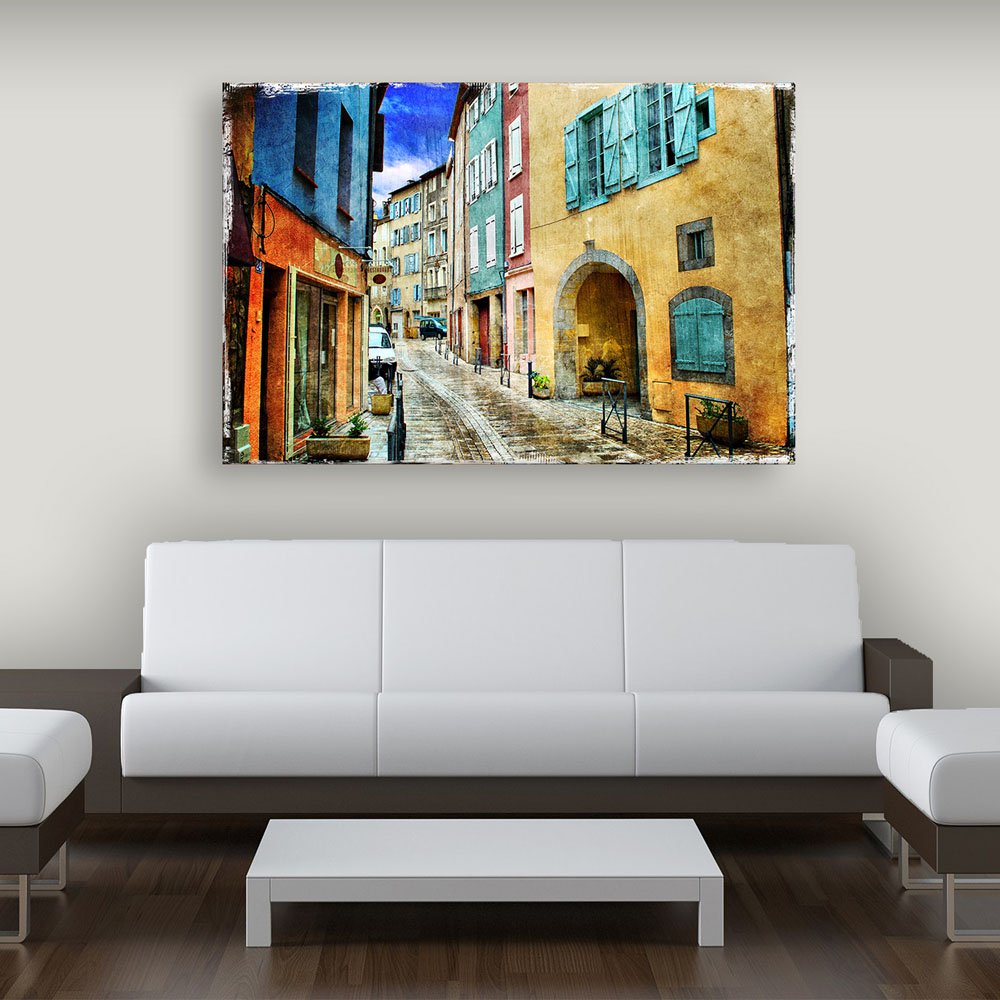

Bring Bella Italia Home: framed Italy Wall Art That Will Make Your Walls Sing ‘O Sole Mio!’
You may also like

Moolwan Italian Street Scene Canvas Wall Art Painting (91x61cm) – Vintage-Textured European Streetscape with Warm Ochre and Teal Harmony
When You Can't Picture How European Art Will Actually Look on Indian Walls
You've seen Italian street scenes online dozens of times. They look charming in the product photos — colorful buildings, cobblestone lanes, that distinctly European character. But every time you consider one, the same doubt stops you: will this actually work in your living room with its cream walls and brown sofa, or will it look like you randomly stuck a postcard on your wall?
This particular piece solves that visualization problem because its color palette already speaks the language of Indian interiors. The dominant warm ochre and golden yellow tones mirror the earthy warmth you likely already have in your wooden furniture. The teal shutters and turquoise accents provide contrast without coldness. The vintage texture — those deliberately aged, distressed edges — means this doesn't demand a pristine gallery wall to look intentional. It looks like art that's been loved, not art that's trying too hard.
The composition pulls your eye down a cobblestone street toward an arched doorway, creating a sense of depth that makes your wall feel less flat. That's the primary differentiator here: this isn't a static image sitting on your wall — it's a window into somewhere else.
Why 91cm Width Works on 8-10 Foot Walls (And What Changes If You Size Up)
At 91cm wide, this canvas covers approximately 30% of a standard 10-foot Indian living room wall. That's intentionally modest — this piece isn't trying to dominate your space. It's sized to work as a focal point above a 6-foot sofa (where it covers about 50% of sofa width) or as a complement to a larger 8-foot sofa (where it covers about 38%).
The 61cm height sits comfortably below the typical 8-foot ceiling with room to breathe. Install it 20-25cm above your sofa top, and the bottom edge lands at roughly eye level when seated — which is exactly where you want art that rewards closer inspection, like this streetscape with its architectural details.
From your doorway (3-4 meters away), the linear perspective creates an immediate sense of depth. Up close, you notice the texture of the cobblestones, the weathered plaster on the buildings, the small details in the shutters. This dual-distance appeal is what separates art that holds your attention from art you stop seeing after a week.
If your wall is 12 feet or wider, consider whether you want this as a solo statement or paired with smaller complementary pieces. At 91cm, it won't anchor a very large wall alone — but it will anchor a seating area beautifully.
What These Colors Look Like on Cream Walls (Morning vs LED)
The dominant palette here is warm: golden ochre, terracotta orange, sandy beige, with teal and cobalt blue as cooler accents. This warmth is deliberate and works specifically well in Indian apartments.
Against cream or off-white walls (the default in most Indian homes), the ochre tones recede naturally while the teal shutters pop forward. You get dimension without clash. The vintage texture softens everything — there are no harsh edges demanding attention.
In morning light, the blues intensify slightly. If your wall catches eastern sun, expect the sky portion to feel more vivid and the warm tones to balance it out. This is when the streetscape looks most "alive."
In warm LED lighting (3000K, standard in most Indian homes), the entire piece shifts warmer. The ochres deepen, the terracotta glows, and the teal becomes more muted. Evening viewing emphasizes the nostalgic, cozy quality of the scene.
Against brown or beige sofas, the color relationship is complementary — the canvas extends the warm palette upward rather than interrupting it. If you have teal or blue accent cushions, they'll find an echo in those distinctive shutters.
Installation in Indian Walls (Concrete vs Drywall)
Most Indian apartment walls are concrete with plaster — you'll need the masonry bit and concrete anchors included with this canvas. Drill 35mm deep, tap in the anchors, screw in the hooks. The D-rings on the back distribute the 400-gram weight evenly.
For newer constructions with drywall sections, use the plastic wall anchors instead. Test by tapping — a hollow sound means drywall, solid means concrete.
The 6mm holes you'll create are smaller than standard picture frame nail holes. When you move out, fill with wall putty, sand, touch up with paint. Your landlord won't notice, and your deposit stays intact.
Total installation time: 15-20 minutes. The included hanging template eliminates guesswork — tape it to your wall at the height you want, mark through the template, drill at the marks. No measuring, no second attempts.
Why This Works Better Than Fabric Tapestries for European Scenes
Fabric tapestries with similar European street scenes exist at similar price points. Here's why canvas works better for this specific aesthetic:
Tapestries drape. They move with air currents, they never sit perfectly flat, they collect dust in their weave. For a scene built on architectural precision — straight building lines, geometric shutters, linear perspective — that softness fights the subject matter. The image was designed around rigid geometry.
Canvas is taut. The 340 GSM cotton stretched over 1.5-inch pinewood frames creates a drum-tight surface that respects those architectural lines. The vintage texture in the print is intentional and controlled — not the accidental wrinkling of fabric that's been hanging for six months.
Tapestries also fade faster. The loose weave allows more UV penetration, and fabric dyes aren't as stable as the eco-solvent inks used on canvas. That teal shutter color? It'll still be teal after two monsoon seasons on canvas. On a tapestry, expect it to shift toward a washed-out seafoam.
And cleaning: you can dust canvas with a dry cloth in seconds. Tapestries need careful vacuuming or professional cleaning, and they're dust magnets in Indian conditions.
What This Will Actually Feel Like in Your Room
From your doorway, this reads as a warm, inviting scene that draws you in. The perspective pulls your eye toward the arched doorway, creating movement on an otherwise static wall.
Above a sofa, it provides a conversation anchor without demanding attention. Guests will notice it, comment on it, maybe ask where it's from — but it won't dominate every interaction in the room. The vintage aesthetic means it feels collected rather than decorated, like something you found rather than something you bought to fill space.
The distressed edges — that deliberate aged treatment around the border — mean this canvas doesn't need a frame to look finished. It looks intentionally unframed, artistic rather than incomplete. If your aesthetic leans modern-minimalist, this works. If you prefer a more traditional look, it still works because the subject matter is classic.
What it won't do: this won't make a small room feel bigger (the perspective creates depth, but the warm colors advance rather than recede). It won't work well in very dark rooms where the subtle details disappear. And if your furniture is all cool grays and whites, the warm palette may feel disconnected — though adding one or two warm accent pieces would bridge that gap easily.
Moolwan Design Note
The vintage texture treatment on this Italian streetscape isn't accidental aging — it's a deliberate artistic choice that lets the canvas stand confidently without a frame while adding character that generic European prints lack. The warm ochre and teal palette was selected specifically because these tones complement the cream walls and wooden furniture common in Indian living rooms.
Moolwan Quality Standard
Designed for Indian apartments and lighting conditions. Printed to resist humidity-related color fading. Packed for long-distance Indian transit. Quality checked before dispatch. Ships from West Bengal.
Moolwan Fit Guidance for Indian Homes
At 91x61cm, this canvas anchors a 6-foot sofa perfectly (50% width coverage) or complements an 8-foot sofa as part of a curated wall. Install 20-25cm above sofa top for optimal viewing from both seated position and doorway distance.
Quick Specifications
- Product: Moolwan Italian Street Scene Canvas Wall Art Painting (91x61cm)
- Brand: Moolwan
- Category: Canvas Wall Art Painting
- Collection: City Wall Art Collection
- Dimensions: 91cm W x 61cm H x 1cm D
- Weight: 400 grams
- Material & Construction: Pure cotton canvas 340 GSM, fade-resistant eco-solvent inks, imported pine wood sturdy frames (1.5-inch kiln-dried)
- Colors: Warm ochre, golden yellow, teal/turquoise, terracotta orange, muted pink, cobalt blue, weathered cream
- Best For: Living room above 6-8ft sofa, dining wall, hallway focal point
- Ships From: West Bengal
Frequently Asked Questions
Will 91x61cm look proportional above my 7-foot sofa?
Yes. At 91cm width, this canvas covers approximately 43% of a 7-foot (210cm) sofa — within the ideal 40-50% range for balanced visual weight. The horizontal orientation echoes the sofa's shape, creating cohesion rather than competition.
How will the warm ochre tones look against my light yellow walls?
The ochre and yellow are analogous colors, so they'll blend harmoniously rather than clash. The teal shutters will provide the contrast that prevents the canvas from disappearing into your wall. The overall effect will be warm and cohesive.
Can I hang this without drilling if I'm in a strict rental?
For a 400-gram canvas at 91cm width, heavy-duty Command strips (rated 5-7kg) will hold securely. However, proper wall anchors create a more stable mount with smaller holes that are easier to patch than the adhesive residue Command strips sometimes leave.
Will the vintage texture look dated or intentional?
The distressed edge treatment is a deliberate artistic technique, not simulated damage. It reads as curated vintage aesthetic — similar to the aged-poster look popular in European cafes and contemporary interior design. It won't look like a damaged print.
How do I clean the textured surface?
Dry microfiber cloth, light pressure, every 2-3 weeks. The moisture-resistant coating means dust sits on the surface rather than embedding in the canvas weave. No water, no cleaning chemicals needed.
Product Snapshot
- Brand: Moolwan
- Product: Moolwan Italian Street Scene Canvas Wall Art Painting (91x61cm)
- Category: Canvas Wall Art Painting
- Collection: City Wall Art Collection
- Theme/Type: European/Italian street scene, vintage cityscape
- Best For: Living room above sofa, dining wall, hallway focal point in homes with cream walls and warm wood furniture
- Primary Differentiator: Vintage-textured European streetscape with warm ochre and teal color harmony
- Secondary Differentiators: Linear perspective composition creating depth on flat walls; distressed edge treatment adding artistic character
- Material & Construction: Pure cotton canvas 340 GSM, fade-resistant eco-solvent inks, 1.5-inch kiln-dried imported pine wood frames
- Care Instructions: Dry dust with microfiber cloth every 2-3 weeks; avoid water and cleaning chemicals
- Ships From: West Bengal
- Packing: Long-distance transit ready
- Quality Check: Before dispatch