
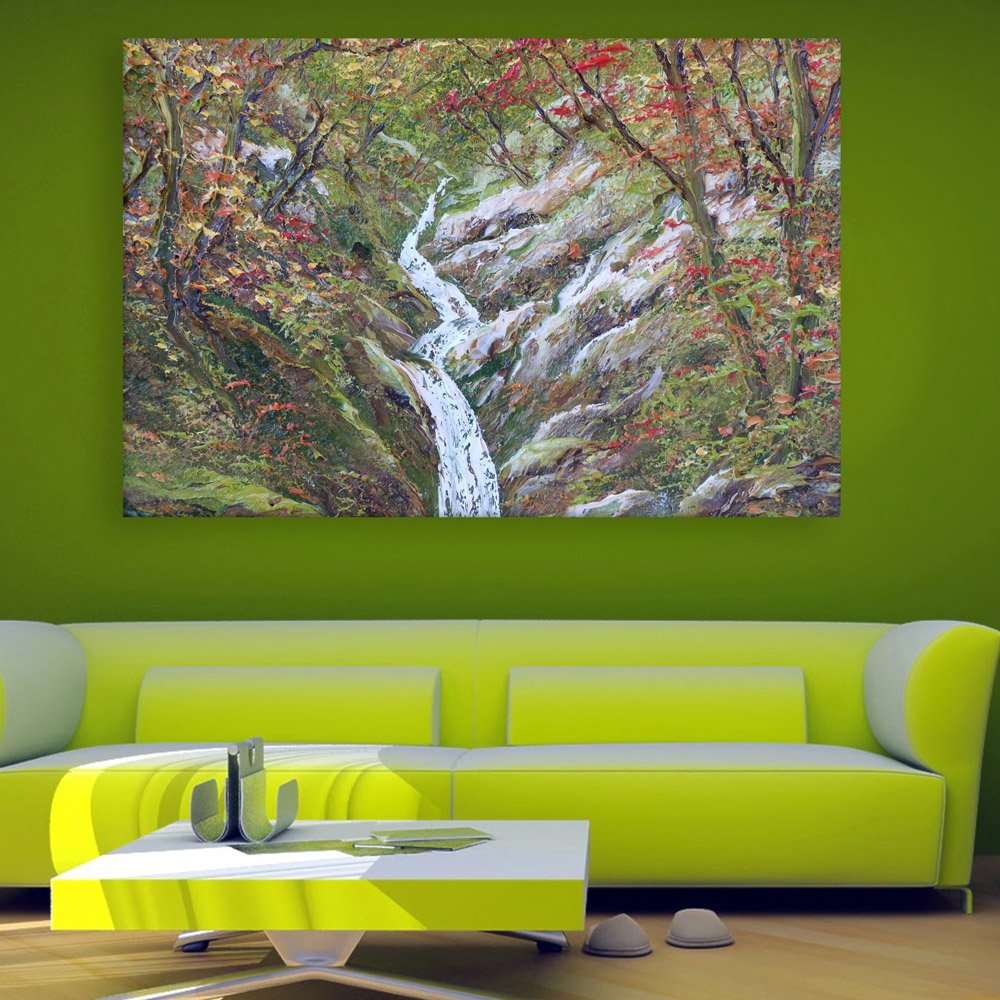

Bronze Nature Unframed Canvas That'll Make Your Walls Bloom
You may also like


Moolwan Autumn Waterfall Forest Canvas Wall Art Painting (91x61cm) – Central Cascade Creates Vertical Anchor in Horizontal Frames
You keep opening the product page, trying to mentally place this above your sofa. But it's impossible to know for sure, isn't it? 91x61cm looks perfect in mockups, but your wall has that AC vent on one side, the window on the other, and the switchboard that's never quite where you want it. You need to know this works in your specific space—not just in styled photos where everything aligns perfectly.
Here's what your eye actually does with this piece: it finds the white waterfall first. That vertical cascade running through the center creates an immediate focal point—something that pulls attention inward rather than letting it drift across the wall. The autumn foliage frames the water without competing with it. Bronze, rust, olive green, touches of red—these are colors that exist in most Indian living rooms already, in your wooden furniture, in the warm LED lighting you've installed, in the earth tones that feel familiar rather than imported.
At 91cm wide, this covers roughly 25% of a 12-foot wall. That leaves substantial breathing room on either side—about 137cm left, 137cm right—which matters if you have a floor lamp or side table flanking your sofa. The composition doesn't demand the entire wall. It occupies the central focal zone above your seating and lets the rest of your room exist around it.
Why 91cm Works on 10-12 Foot Walls (And What Changes If You Size Down)
The math for Indian living rooms: your sofa is probably 6-7 feet wide (180-210cm). A 91cm canvas is roughly 50% of that width—which sits in the sweet spot where the art feels anchored to the furniture below without appearing undersized.
On a 10-foot wall (300cm), 91cm creates 30% coverage. You'll have 104cm of wall space on each side. This works well when your sofa is centered and you have symmetric elements (matching side tables, floor lamps) that visually balance the composition.
On a 12-foot wall (360cm), coverage drops to 25%. This still works if your sofa is 7-8 feet and the canvas aligns with its center third. If your wall runs longer—say 14 feet—consider whether a single 91cm piece will read as intentional or as slightly lost.
Going smaller (75cm or 60cm) would push coverage below 20% on a 12-foot wall. At that ratio, the canvas stops anchoring the space and starts looking like placeholder decor you meant to replace.
The 61cm height works with standard 8-10 foot ceilings. Hung 20-25cm above your sofa top, the canvas bottom sits at roughly eye level when you're standing—which means the waterfall's central cascade catches your attention as you enter the room.
What These Colors Look Like on Cream Walls (Morning vs. Warm LED Evening)
The dominant palette here—bronze, rust, olive green, cream—is specifically what works against Indian wall colors without creating visual conflict.
Against cream or off-white walls (builder standard in most apartments): The bronze-rust tones warm the wall without overwhelming it. The olive greens provide enough contrast that the piece reads as distinct, not washed out. The white waterfall pops—it's the brightest element and draws the eye naturally.
Against light yellow walls: The bronze foliage harmonizes. Yellow and bronze share warm undertones, so the piece feels cohesive rather than competing. The greens add depth without clashing.
Against the builder's peach (common in older apartments): This is where the rust and copper tones genuinely shine. They pick up the wall's warmth and extend it, making the room feel intentionally coordinated rather than accidentally similar.
In morning light (east-facing windows): Colors appear slightly cooler. The greens become more prominent, the bronze feels more subdued. The waterfall's white reads as bright and crisp.
Under warm LED lighting (3000K, typical in Indian homes): Everything shifts warmer. The rust and bronze intensify, the greens recede into the background, and the overall impression is of autumn twilight—rich, enveloping, restful.
With wooden furniture: The bronze and rust in the foliage echo brown furniture tones naturally. This isn't coordination you have to force—it's built into the color palette.
Installation in Indian Walls: Concrete vs. Drywall Reality
Your wall is probably concrete with plaster and paint—standard construction in most Indian buildings. Here's exactly what installation involves:
For concrete walls: You'll need a 6mm masonry bit, the concrete anchors included with your canvas, and 15 minutes. Mark two points using the hanging template (included), drill 35mm deep, tap in anchors, screw in hooks. The D-rings on the canvas back slip onto these hooks. Done.
For drywall (newer construction, especially in gated communities): Use the plastic wall anchors instead. Same process, but drill into drywall rather than concrete.
At 400 grams, this canvas is genuinely lightweight. A single properly installed anchor can hold 5kg—you have two anchor points sharing 400 grams. The weight isn't the concern; level alignment is. Use a phone level app if you don't have a spirit level. Stand at the room entrance after hanging and check that neither side dips.
For rentals: The 6mm holes required are smaller than standard picture hook holes. When you move out, fill with wall putty (₹50 at any hardware store), sand smooth, touch up with matching paint. Your landlord won't notice, and your ₹50,000 deposit stays intact.
How This Compares to Wallpaper Decals (And Why Canvas Holds Up)
You've probably seen similar autumn forest imagery as peel-and-stick wallpaper decals—often priced ₹400-800 for a similar visual.
Here's the practical difference:
Wallpaper decals flatten to your wall. Every imperfection in your plaster—every slight bump, every hairline crack, every patch where the previous tenant's mounting hole was filled—shows through. The image wraps these imperfections instead of hiding them. Within 6 months in Indian humidity, edges start lifting. By monsoon two, you're dealing with peeling corners and air bubbles that weren't there when you installed.
Canvas on a 1.5-inch frame sits off the wall. The depth creates shadow lines that make the piece look intentional, mounted, substantial. The pinewood frame doesn't flex with humidity cycles the way vinyl decals expand and contract. The cotton canvas surface has texture—woven, tactile—instead of the glossy plastic smoothness that screams "temporary."
And critically: decals are single-use. Once you peel them off, they're garbage. Canvas comes down with two screws and rehangings elsewhere. When you move apartments—and most people in Indian metros move every 2-3 years—the canvas moves with you. The decal doesn't.
The price difference is ₹2,000-3,000 for something that lasts 2-3 years minimum versus ₹400-800 for something that looks tired within a year.
What This Will Actually Feel Like in Your Room
From the doorway: Your eye catches the white waterfall first. It's the brightest element in a warm palette, so it functions as a natural focal point. The autumn tones register as "warm, nature-themed"—a first impression that feels calming rather than demanding.
From the sofa (directly below): You're looking up at about a 15-degree angle. The waterfall flows toward you visually. The textural detail in the rocky terrain becomes visible—the grays and browns in the stone, the individual brushstroke-style rendering of water spray. This is the viewing distance where print quality becomes obvious. Cheap prints look flat and pixelated at 1-2 meters. Quality eco-solvent printing holds detail.
From across the room (3-4 meters): The composition reads as a unified autumn scene. Individual leaves blur into foliage masses; the waterfall becomes a bright vertical stripe. At this distance, color harmony matters more than detail—and the bronze-rust-green-cream palette coheres.
Alone on the wall: This piece can anchor a wall solo. The composition is complete—it doesn't need flanking pieces to feel finished. If your wall has nothing else, 91cm provides enough presence without overwhelming.
With adjacent decor: If you have wall clocks, small frames, or shelving nearby, keep them at least 30-40cm from the canvas edge. The autumn palette is accommodating—it won't clash with most neutrals—but visual breathing room prevents the wall from feeling cluttered.
Moolwan Design Note
The vertical waterfall through the horizontal frame creates deliberate tension—your eye moves downward while the canvas extends sideways. This keeps the composition dynamic without being restless, giving the piece energy that static landscape paintings lack.
Moolwan Quality Standard
Designed for Indian apartments and lighting conditions. Printed to resist humidity-related color fading. Quality checked before dispatch. Packed for long-distance Indian transit. Ships from West Bengal.
Moolwan Fit Guidance for Indian Homes
91cm width suits 6-7 foot sofas in living rooms with 10-12 foot walls. The bronze-rust palette works with cream, off-white, and peach walls common in Indian apartments. Position 20-25cm above sofa top for proper visual anchoring.
Quick Specifications
- Product: Moolwan Autumn Waterfall Forest Canvas Wall Art Painting (91x61cm)
- Brand: Moolwan
- Category: Canvas Wall Art Painting
- Collection: Nature Wall Art Collection
- Dimensions: 91cm W × 61cm H × 2cm D
- Weight: 400 grams
- Material: 380 GSM pure cotton canvas, fade-resistant eco-solvent inks, imported pine wood frame
- Colors: Bronze, rust, olive green, cream, gray-brown, white
- Best For: Living rooms with 10-12 ft walls, above 6-7 ft sofas, cream/off-white/peach wall colors
- Ships From: West Bengal
- Delivery: 5-6 days metro cities, 6-8 days tier-2/3 cities
Frequently Asked Questions
Will 91cm look proportional above my 7-foot sofa?
Yes. 91cm is roughly 43% of a 7-foot (210cm) sofa width, which falls within the ideal 40-60% range for balanced visual proportion. The canvas will appear anchored to the furniture without overwhelming it or looking undersized.
How will the bronze-rust colors look in warm LED lighting?
Warmer and richer. Under 3000K LED lighting (standard in most Indian homes), the bronze and rust tones intensify while the greens recede slightly. The overall effect is autumnal warmth—the piece looks its most inviting in evening lighting.
Can I hang this in a room with 70-80% humidity during monsoons?
Yes. The canvas has a moisture-resistant polymer coating that prevents water vapor from penetrating the fibers. The pinewood frame is kiln-dried to 12% moisture content before assembly, which means it won't absorb atmospheric moisture and warp. Through multiple monsoon cycles, the canvas stays taut and the frame stays dimensionally stable.
What tools do I need for installation on concrete walls?
A 6mm masonry drill bit and a power drill. The concrete anchors, hooks, and hanging template are included. Installation takes 15-20 minutes: mark two points using the template, drill 35mm deep holes, insert anchors, screw in hooks, hang the canvas on the D-rings.
Will the waterfall detail still be visible from across the room?
The white waterfall remains the dominant visual element at any viewing distance—it's the brightest part of the composition. Fine details like water spray and rocky texture are most visible from 1-2 meters. From 3-4 meters across the room, the waterfall reads as a bright vertical anchor within the autumn foliage.
Product Snapshot
- Brand: Moolwan
- Product: Moolwan Autumn Waterfall Forest Canvas Wall Art Painting (91x61cm)
- Category: Canvas Wall Art Painting
- Collection: Nature Wall Art Collection
- Theme/Type: Autumn forest with waterfall
- Best For: Living rooms with 10-12 ft walls, above 6-7 ft sofas
- Primary Differentiator: Central waterfall creates vertical visual anchor in horizontal frame
- Secondary Differentiators: Autumn bronze-rust palette; textural depth from rocky terrain
- Material & Construction: 380 GSM pure cotton canvas, eco-solvent UV-resistant inks, 1.5" kiln-dried pinewood frame, moisture-resistant coating
- Care Instructions: Dust with dry microfiber cloth every 2-3 weeks; avoid water and cleaning chemicals
- Ships From: West Bengal
- Packing: Long-distance transit ready (bubble wrap + corner protectors + outer carton)
- Quality Check: Before dispatch