
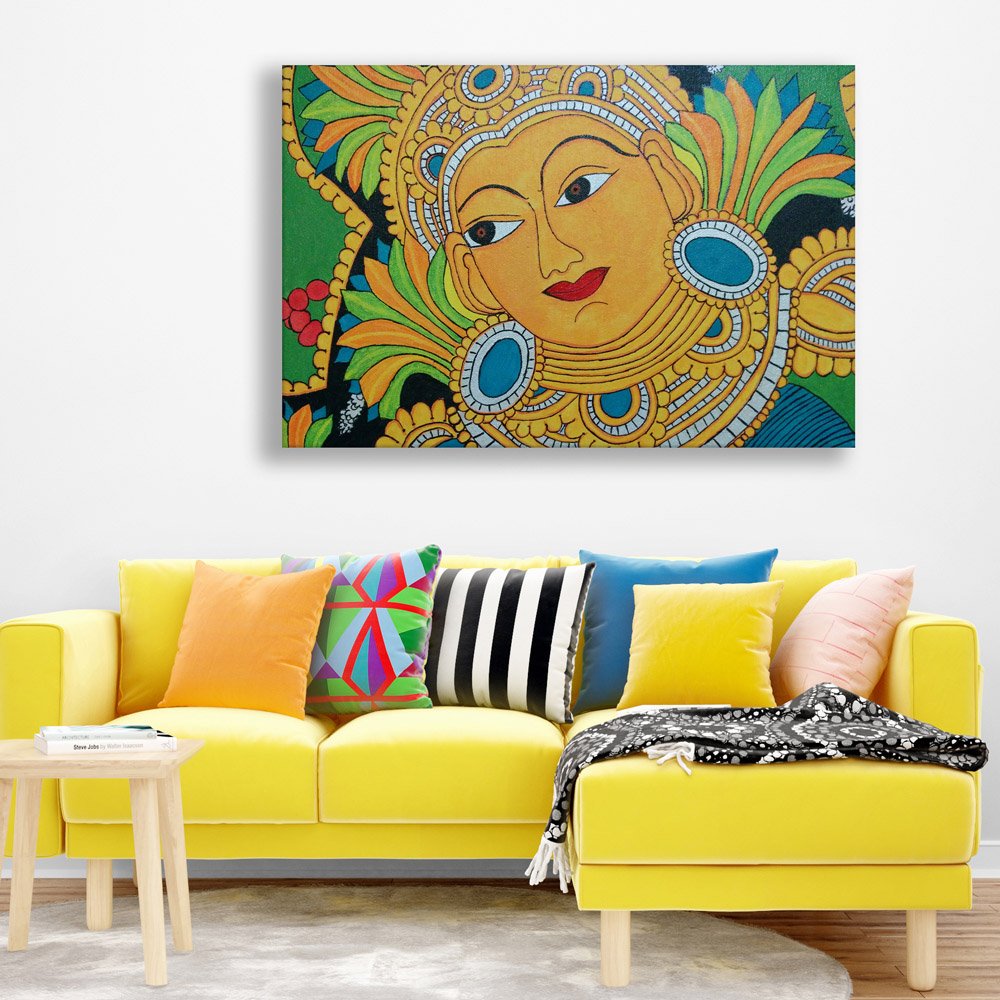

Bronze-tiful Kerala Canvas That'll Make Walls Pop – framed Abstract Vibe (91x61cm)
You may also like

Moolwan Kerala Mural Canvas Wall Art Painting (91x61cm) – Bronze-Gold Face with Traditional Headpiece
You've measured your wall three times. Maybe four. The tape measure says 300cm, but you're still not confident because every sizing guide seems written for Western homes with different furniture proportions. You keep second-guessing: is 91cm actually right, or will it look undersized above your 8-foot sofa?
Here's what the math actually shows: 91cm width on a 10-foot (300cm) wall means roughly 30% coverage. That leaves about 104cm on each side—enough breathing room that the canvas commands attention without crowding the wall. The Kerala mural's bold bronze face becomes a natural focal point, drawing the eye from across the room without overwhelming the space.
The bronze and gold tones in this piece aren't random. They're the warm end of the spectrum that reads well against cream and off-white walls common in Indian apartments. The deep forest greens and subtle blue accents in the decorative elements add depth without introducing colors that clash with typical wooden furniture.
Why 91cm Works on 10-12ft Walls (And What Changes If You Size Up)
On a standard 10-foot living room wall (300cm), 91cm width translates to 30% horizontal coverage. This is solidly in the "statement piece" range without dominating the wall. Hung 20-25cm above an 8-foot sofa, the canvas sits at eye level when you're standing across the room—which is where guests will first see it.
If your wall is closer to 12 feet (360cm), 91cm covers about 25% of the horizontal space. Still proportional, but leans slightly toward "curated" rather than "statement." If you want more presence on a 12-foot wall, the next size up (120cm) would push coverage to 33%.
For 8-foot walls (240cm), 91cm covers 38%—on the higher end of ideal. Works well if the wall is otherwise empty, but if you have a side table or floor lamp nearby, the visual weight might feel slightly heavy.
Viewing distance matters: from 3-4 meters (typical living room depth), the Kerala mural's intricate details remain visible. The ornate headpiece radiating outward, the traditional facial features, the layered circular earrings—these resolve clearly at normal viewing distance. From 5+ meters, the piece reads as a warm bronze-green composition with a centered face.
What These Colors Look Like on Cream Walls (Morning vs LED)
The dominant bronze-gold face occupies roughly 60% of the canvas. In morning daylight (cool white), the metallic quality of the gold linework appears more yellow-gold, and the greens look fresh and saturated. The blue accents in the earrings and border details pop against the warm tones.
Under warm LED lighting (3000K, what most Indian living rooms use in the evening), the bronze deepens toward amber. The greens shift slightly warmer, reading more olive than emerald. This isn't a negative shift—the evening version feels cohesive with wooden furniture and fabric sofas in brown and beige tones.
Against cream walls (the most common in Indian apartments), the canvas creates clear contrast without jarring against the background. The deep greens and blacks in the design provide enough edge definition that the artwork reads as intentional, not washed out.
Against light yellow or builder's peach walls, the bronze-gold palette harmonizes naturally—warm meeting warm. The blue accents prevent the overall effect from feeling too monochromatic.
Installation in Indian Walls (Concrete vs Drywall)
At 400 grams, this canvas is light enough for standard picture hooks in drywall or small concrete anchors in older buildings. You won't need heavy-duty hardware.
For concrete walls (common in buildings more than 10 years old): use the included 6mm plastic anchors. Drill 30-35mm deep, insert anchors, screw in hooks. The D-rings on the frame back sit flush against the wall when hung.
For drywall or gypsum partition walls (common in newer apartments): use the included drywall anchors. These grip the hollow wall material and hold the canvas weight easily.
The hanging template eliminates guesswork. Tape it to the wall at your target height (20-25cm above sofa back), mark the two drill points through the template, remove it, drill. Total installation time: 15-20 minutes including the part where you step back three times to check if it's level.
For rentals: the 6mm anchor holes are smaller than standard nail holes. When you move out, fill with wall putty, sand smooth, touch up with matching paint. Your landlord won't notice, and your deposit stays intact.
How This Compares to ₹800 Marketplace Canvas
The price difference between this canvas (₹2,796-4,596 range) and marketplace alternatives (₹800-1,200) comes down to three specific failure points in cheap canvas:
Canvas weight: Marketplace canvas typically uses 180-220 GSM material. It's thin enough that you can see the wooden stretcher bars through the fabric if light hits from behind. After one monsoon season of humidity cycling, the canvas starts sagging at the corners. The 340 GSM cotton in Moolwan canvas has enough body to stay drum-tight on the frame through multiple climate cycles.
Ink quality: Standard inkjet printing uses dye-based inks that fade visibly within 6-12 months if the wall gets morning sun. The bronze tones in this Kerala mural would shift toward muddy brown-gray. Eco-solvent inks (what this canvas uses) have UV inhibitors built in—the same technology used for outdoor signage.
Frame construction: Cheap frames use thin stretcher bars (0.75-1 inch) that warp in high humidity. In Mumbai's 85% monsoon humidity, in Chennai's coastal salt air, in Bangalore's temperature swings—undertreated wood bends. You'll see the canvas rippling at the edges within 3-6 months. The 1.5-inch kiln-dried pinewood frame here is dried to 12% moisture content before construction, which prevents moisture absorption and subsequent warping.
The ₹1,500-2,000 difference isn't paying extra for the same product. It's paying once instead of twice when the cheap version needs replacing.
What This Will Actually Feel Like in Your Room
From the doorway: the bronze-gold face pulls focus immediately. The radiating headpiece design creates outward visual movement that makes the piece feel larger than its 91cm width. The centered composition means the canvas works alone on a wall—it doesn't need flanking pieces or a gallery arrangement.
From the sofa: the intricate details resolve. The dotted patterns in the headpiece, the layered circular earrings, the fine linework defining the facial features. At 2-3 meters distance, you can appreciate the Kerala mural tradition this design references.
With adjacent décor: the strong cultural identity of this piece means it works best as a standalone focal point. Mixing with minimalist or Scandinavian-style décor might feel incongruous. Pairing with other traditional Indian elements (brass accents, carved wooden furniture, earthy textiles) creates coherence.
Guest perception: this is the kind of piece that prompts "where did you get this?" conversations. The Kerala mural style is recognizable to most Indian guests as culturally rooted art, not generic decoration. It reads as intentional rather than "something to fill the wall."
Moolwan Design Note
The asymmetric headpiece radiates upward and outward from the centered face, creating visual movement that draws the eye from across the room. The bronze-gold palette carries weight without darkening the wall—it adds warmth rather than shadows.
Moolwan Quality Standard
- Designed for Indian apartments and lighting conditions
- Printed to resist humidity-related color fading
- Packed for long-distance Indian transit
- Quality checked before dispatch
- Ships from West Bengal
Moolwan Fit Guidance for Indian Homes
At 91x61cm, this canvas covers approximately 30% of a 10-foot wall—substantial enough for a focal point above a 6-8ft sofa. The horizontal orientation and centered composition work best on walls without adjacent windows or doors competing for attention.
Quick Specifications
- Product: Moolwan Kerala Mural Canvas Wall Art Painting (91x61cm)
- Brand: Moolwan
- Category: Canvas Wall Art Painting
- Collection: Abstract Wall Art Collection
- Dimensions: 91cm (W) x 61cm (H) x 2cm (D)
- Weight: 400 grams
- Material: 340 GSM pure cotton canvas, eco-solvent UV-resistant inks, 1.5-inch kiln-dried pinewood frame
- Colors: Bronze-gold, deep green, blue accents, ochre, black
- Finish: Matte
- Best For: Living room walls 10-12ft wide, above 6-8ft sofas
- Ships From: West Bengal
Frequently Asked Questions
Will 91cm look proportional above my 8-foot sofa?
At 91cm width above an 8-foot (240cm) sofa, the canvas covers about 38% of the sofa width—within the 60-75% rule when accounting for visual weight. It works well if the sofa sits against a 10-12ft wall with no competing elements nearby.
How will the bronze-gold colors look under my warm LED lights?
Under warm LED lighting (3000K), the bronze deepens toward amber and the greens shift slightly warmer. The effect is cohesive with wooden furniture and brown/beige sofas—the warm palette becomes more unified rather than washed out.
Can I hang this in a rental without losing my deposit?
Yes. At 400 grams, the canvas requires only 2 small anchor holes (6mm diameter). When you move out, fill with standard wall putty, sand smooth, and touch up with matching paint. The holes are smaller than typical nail holes.
Will the colors fade if my wall gets morning sun?
The eco-solvent inks used in this canvas have built-in UV inhibitors—the same technology used for outdoor signage. Direct morning sun for 3-4 hours daily won't cause visible fading over years of normal use.
Does the Kerala mural style work in modern apartments?
The traditional subject matter in this canvas is balanced by bold, contemporary color blocking. It reads as cultural art rather than religious imagery, making it suitable for living rooms, entryways, and offices in both traditional and modern Indian interiors.
Product Snapshot
- Brand: Moolwan
- Product: Moolwan Kerala Mural Canvas Wall Art Painting (91x61cm)
- Category: Canvas Wall Art Painting
- Collection: Abstract Wall Art Collection
- Theme/Type: Kerala mural traditional face art
- Best For: Living room walls 10-12ft wide, above 6-8ft sofas, cream/off-white wall backgrounds
- Primary Differentiator: Bronze-gold face with radiating traditional headpiece
- Secondary Differentiators: Kerala mural cultural heritage, warm palette compatible with wooden furniture
- Material & Construction: 340 GSM pure cotton canvas, eco-solvent UV-resistant inks, 1.5-inch kiln-dried pinewood frame with moisture-resistant coating
- Care Instructions: Dry dust with microfiber cloth every 2-3 weeks; avoid water and cleaning chemicals
- Ships From: West Bengal
- Packing: Long-distance transit ready
- Quality Check: Before dispatch