
Brooklyn Bridge-tastic Multi-Frame Wall Art That'll Span Your Style - Framed Bridge Decor (127x76cm)
You may also like

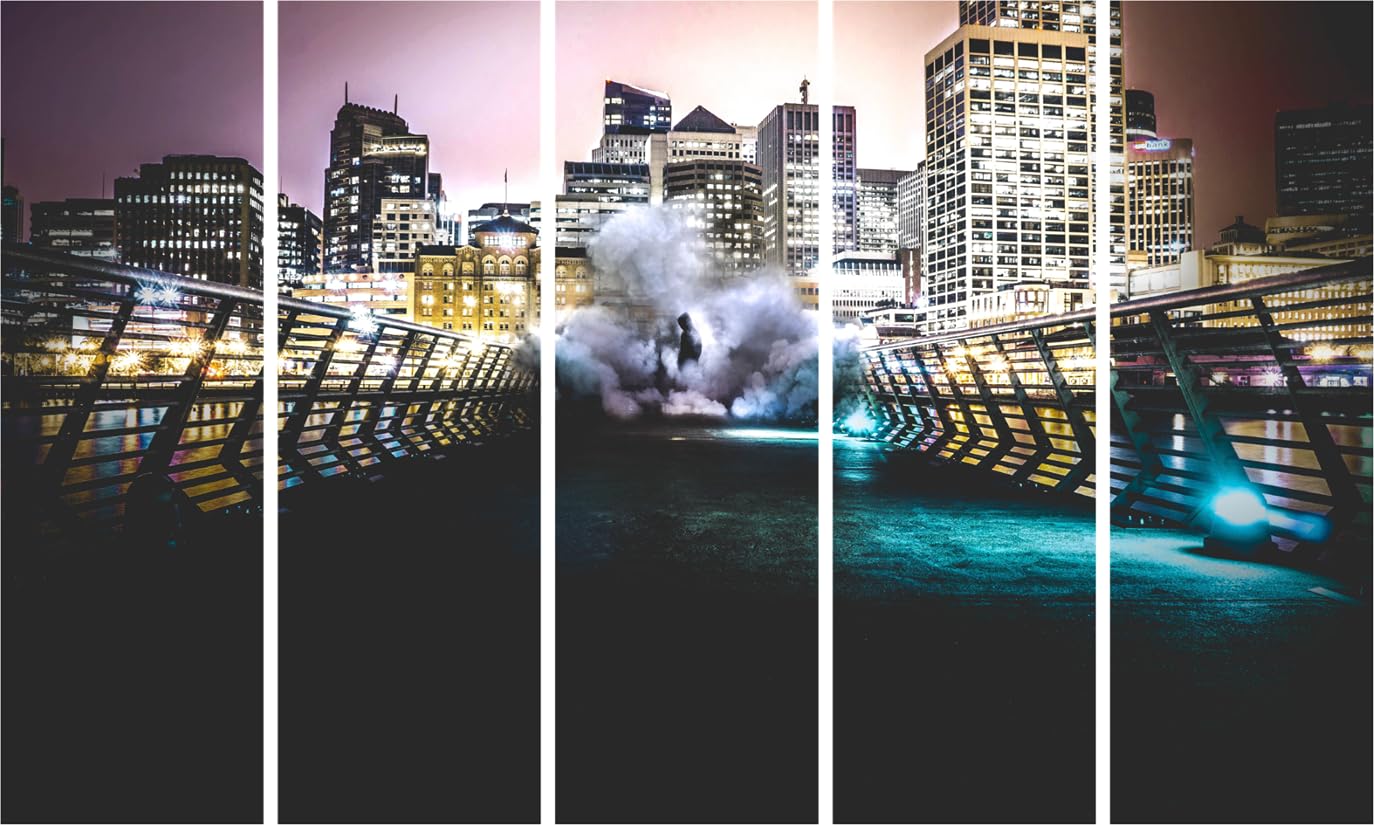
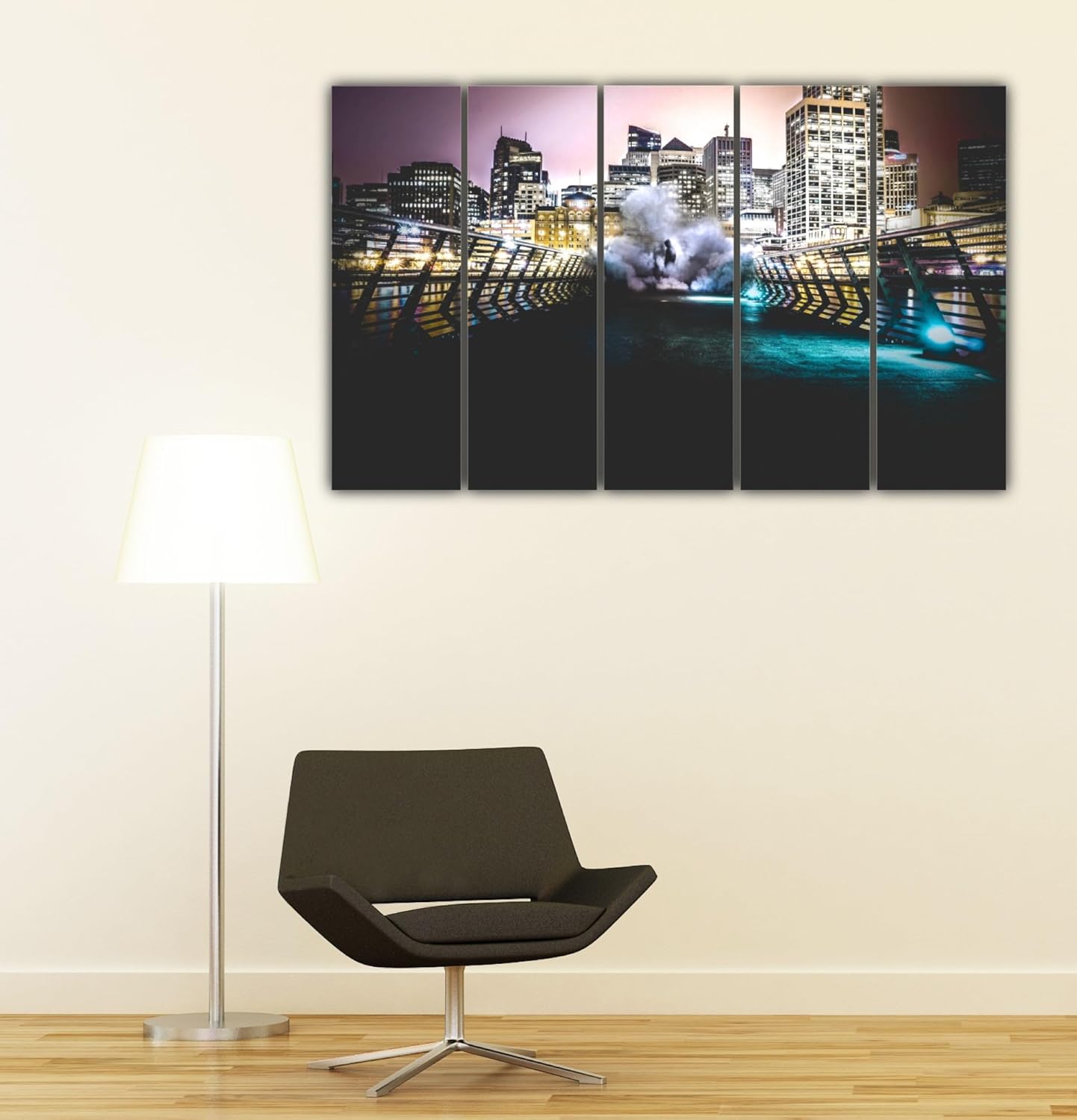
Moolwan 5-Panel City Skyline Night Bridge Vinyl Wall Art on MDF (127x76cm) – Cinematic Diagonal Perspective with Teal-Gold Urban Glow
When You Can't Picture How a City Print Will Actually Read on Your Wall
You've seen city skyline art before — flat shots of buildings, generic nightscapes that could be anywhere, prints where the "drama" is just saturated colors cranked up in editing. And every time you've considered one, the same question stops you: will this look like intentional urban art on my wall, or will it look like a stock image I stretched too large?
This piece solves that specific problem through perspective, not just subject matter. The bridge railings create diagonal lines that physically pull your eye from the outer panels toward the illuminated cityscape in the center. The smoke element in the middle panel breaks what would otherwise be predictable geometry. From your doorway, across a 12-foot living room, those converging lines create actual depth — the kind that makes guests pause and look closer, not glance and move on.
At 127cm wide and 76cm tall, this covers approximately 65-70% of a standard 8-foot Indian sofa's width. That's the proportion where wall art looks anchored to your furniture rather than floating randomly above it.
Why 127cm Works on 10-12ft Walls (And What Happens If You Size Down)
A 10-foot wall (300cm) with an 8-foot sofa (240cm) centered on it leaves roughly 30cm of visible wall on each side of the sofa. At 127cm, this piece spans just over half your sofa width — large enough to command attention, small enough to leave breathing room.
If you went with a 90cm piece instead: it would cover only 37% of your sofa width. From your doorway, it would read as "small art above a big sofa" rather than as a deliberate focal point.
The 5-panel format adds another dimension. Each panel is approximately 24-25cm wide with 1-2cm gaps between them. When mounted, those gaps create subtle shadow lines that add visual depth. From 3 meters away (typical viewing distance from an opposite wall or dining area), the gaps disappear and the image reads as continuous. Up close, the panel separation becomes part of the aesthetic.
For placement: this works above an 8-foot sofa, on a dining room wall opposite your table, or as an entryway statement in a wide hallway. The horizontal orientation and perspective depth work best on walls you approach head-on rather than walls you pass parallel to.
What These Colors Look Like on Cream Walls (Morning vs LED)
The color palette here is unusual for city art — most urban prints lean either fully cool (blues, grays, silvers) or fully warm (orange sunsets, golden hour). This one layers both.
The dominant tones: deep black (lower third of each panel), teal/cyan (ground-level lighting, reflections), warm gold-yellow (building windows, city lights), mauve-pink-purple (sky gradient), white-gray (central smoke element).
On a cream or off-white wall with morning light: the teal and mauve tones come forward. The piece will read as slightly cooler, more atmospheric. The black lower sections absorb light and create a grounding effect.
On the same wall with warm LED lighting (3000K, standard in most Indian homes): the gold tones in the building windows intensify. The teal shifts slightly greener. The overall piece reads warmer, more inviting. The mauve sky becomes almost rose-tinted.
Against brown or beige furniture: the gold tones echo your sofa color. The teal provides contrast without clashing. This isn't a piece that demands you redecorate around it — it slots into existing warm-neutral Indian living rooms without fighting for dominance.
What doesn't work: pure white walls make the blacks appear harsher. Very warm wall colors (peach, yellow) will clash with the cool teal-mauve tones.
Installation in Indian Walls (Concrete vs Drywall)
Five panels means ten mounting points — two D-ring hangers per panel. This sounds complicated but it's actually more forgiving than single-panel installation.
Why: with a single large piece, if your two mounting hooks aren't perfectly level, the entire canvas tilts. With five panels, you mount the center panel first (using a level), then position each adjacent panel relative to it. Small variations are hidden by the gaps between panels.
For concrete walls (most older Indian buildings): 6mm masonry bit, drill 35mm deep, tap in concrete anchors, screw in hooks. Each panel weighs approximately 600 grams — well within the capacity of standard plastic anchors.
For drywall (modern apartments): 6mm standard bit, plastic wall anchors, same process. The total weight (3kg distributed across 10 points) means each anchor holds only 300 grams. Standard drywall anchors handle this easily.
For rental apartments: the 6mm holes are smaller than standard curtain rod mounting holes. Ten holes sounds like a lot, but they're grouped in a 127cm span. When you move out, a single tube of wall putty and ten minutes of patching makes them invisible.
Alignment tip: use painter's tape to mark your horizontal line first. Mount center panel on that line. Then use a straightedge to position each adjacent panel at consistent spacing (1.5-2cm gaps look intentional; uneven gaps look like mistakes).
Why Vinyl on MDF Instead of Fabric Tapestries
Fabric tapestries have a specific problem: they move. Air conditioning, ceiling fans, someone walking past quickly — the fabric shifts, ripples, catches light unevenly. What looks bohemian and relaxed in photos often looks sloppy in real Indian homes with ceiling fans running eight months a year.
Vinyl on MDF stays flat. The MDF backing provides rigidity. The vinyl surface provides the actual print, and it's splash-proof — accidental contact with wet hands, humid monsoon air, kitchen steam if this is near your dining area, none of it affects the surface.
The trade-off: you lose the "soft" look of fabric. This is a deliberate, architectural piece. It reads as intentional, modern, slightly industrial. If you want something that softens your space, this isn't it. If you want something that sharpens your space, defines it as contemporary, gives your living room an edge — that's what this format delivers.
Longevity comparison: fabric tapestries in Indian humidity absorb moisture, stretch unevenly, develop musty odors if not aired regularly. Vinyl on MDF wipes clean, maintains dimensions, doesn't absorb anything.
What This Will Actually Feel Like in Your Room
From your doorway: you'll see the perspective lines first — the diagonal bridge railings drawing your eye toward the lit cityscape. The piece reads as cinematic, like a frame from an urban film.
From your sofa (if mounted above): you'll see the panel edges, the texture of the vinyl surface, the detail in the building windows. The smoke element in the center panel adds visual interest at close range — it's not just "buildings at night," there's something happening.
Walking toward it: the diagonal lines create parallax movement. As your viewing angle changes, different panels come into prominence. This is an effect you don't get from single-panel art.
Does it dominate the room? Yes. This is a 127cm statement piece with high contrast and strong perspective. It will be the thing guests notice and comment on. If you want art that fades into the background, choose something with softer tones and less geometric energy.
Does it work alone? Yes — the 5-panel format is already visually complex. Adding adjacent small frames or decorative objects will compete for attention and make the wall look cluttered. Let this piece breathe. Empty wall space on either side isn't a problem; it's framing.
Moolwan Design Note
The diagonal bridge railing perspective creates actual depth perception rather than the flat "photo-on-wall" effect of typical city prints. The smoke element in the center panel prevents the composition from being purely geometric — it adds organic unpredictability that holds visual interest over time.
Moolwan Quality Standard
Designed for Indian apartments and lighting conditions. Packed for long-distance Indian transit. Quality checked before dispatch. Printed to resist humidity-related color fading. Ships from West Bengal.
Moolwan Fit Guidance for Indian Homes
At 127cm wide, this fits above 7-8 foot sofas or on dedicated art walls in 10-12ft rooms. The teal-gold palette works with cream walls and brown furniture without requiring color coordination elsewhere.
Quick Specifications
| Specification | Detail |
|---|---|
| Product | Moolwan 5-Panel City Skyline Night Bridge Vinyl Wall Art on MDF (127x76cm) |
| Brand | Moolwan |
| Category | Vinyl Wall Art on MDF |
| Collection | City Wall Art Collection |
| Dimensions | 127cm (W) x 76cm (H) x 0.6cm (D) |
| Weight | Approximately 3000 grams |
| Material & Construction | Splash-proof vinyl print on MDF panels with black edge finish |
| Colors | Deep black, teal/cyan, warm gold-yellow, mauve-pink sky, white-gray smoke |
| Panel Configuration | 5 panels |
| Best For | Living room above 7-8ft sofa, dining wall, wide hallway/entryway |
| Ships From | West Bengal |
Frequently Asked Questions
Will 127cm be too large above my 6-foot sofa?
At 127cm, this piece is 70% of a 6-foot (180cm) sofa's width — at the upper end of the recommended 60-75% range. It will work, but will appear more dominant than above an 8-foot sofa. If your sofa has side tables or lamps adjacent, the overall furniture grouping visually widens, making 127cm more proportional.
How will the teal tones look with my beige sofa?
Teal and beige are complementary — the cool teal provides contrast against warm beige without clashing. The gold tones in the city lights echo beige furniture tones. This color combination is more balanced than it might appear from photos alone.
Do the panel gaps show dust accumulation?
The gaps between panels are vertical, so dust doesn't settle in them. The MDF edges are finished, so there's no raw surface to collect debris. A microfiber cloth across the vinyl surface every 2-3 weeks is sufficient maintenance.
Will this warp in Mumbai monsoon humidity?
MDF is more dimensionally stable than solid wood in humidity fluctuations. The vinyl surface is splash-proof and doesn't absorb moisture. Two monsoon seasons won't affect panel flatness or vinyl adhesion.
How do I align five panels evenly?
Mount the center panel first using a level. Then use painter's tape to mark consistent gap spacing (1.5-2cm) on each side. Mount the adjacent panels relative to the center, working outward. Total installation time: 30-40 minutes including measuring.
Product Snapshot
| Attribute | Detail |
|---|---|
| Brand | Moolwan |
| Product | Moolwan 5-Panel City Skyline Night Bridge Vinyl Wall Art on MDF (127x76cm) |
| Category | Vinyl Wall Art on MDF |
| Collection | City Wall Art Collection |
| Theme/Type | Urban cityscape, night scene, bridge perspective |
| Best For | Living room above sofa, dining wall, hallway statement piece in homes with cream/neutral walls |
| Primary Differentiator | Cinematic diagonal perspective with bridge lines creating visual depth toward illuminated cityscape |
| Secondary Differentiators | Teal-gold-mauve gradient adapts to daylight vs LED; atmospheric smoke element breaks geometric rigidity |
| Material & Construction | Splash-proof vinyl print on MDF with black finished edges |
| Care Instructions | Dry dust with microfiber cloth every 2-3 weeks; avoid water and cleaning chemicals on surface |
| Ships From | West Bengal |
| Packing | Long-distance transit ready |
| Quality Check | Before dispatch |