
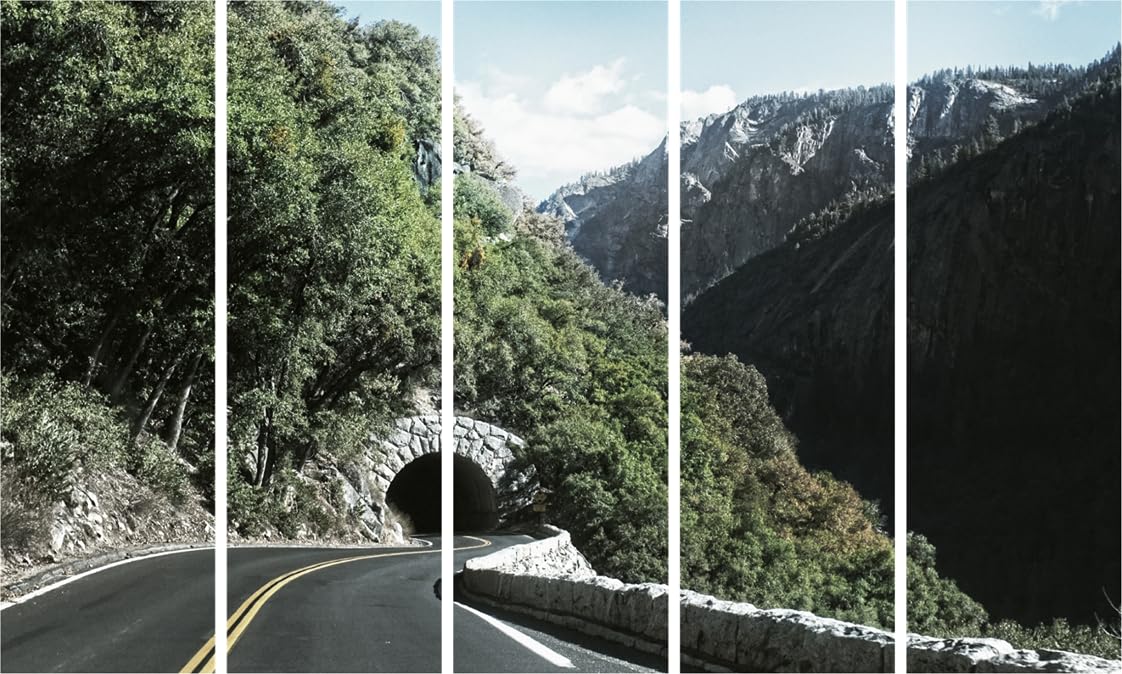
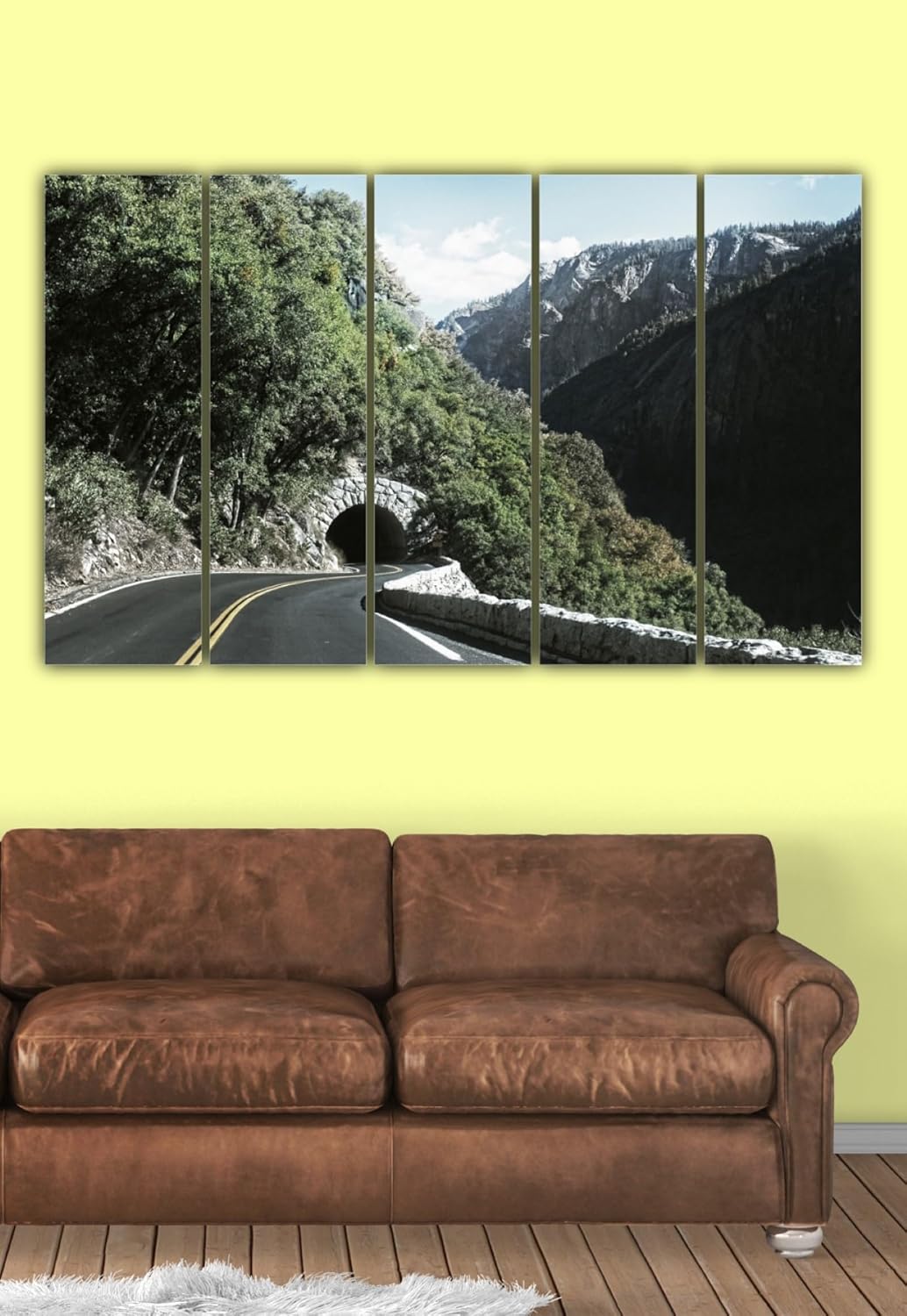
Buckle Up, Tunnel Trippers! 5-Frame Mountain Photography Wall Art - Framed Scenic Voyage (150x76cm)
You may also like

Moolwan 5-Panel Mountain Road Vinyl Wall Art on MDF (150x76cm) – Journey Composition with Stone Tunnel Focal Point
You keep opening the product page, trying to mentally place this on your living room wall. But it's impossible to know for sure, isn't it? 150cm looks substantial in mockups, but your wall has that AC vent on one side, the switch board, and your sofa isn't perfectly centered. You need to know this works in your specific space—not just in styled photos where everything aligns perfectly.
This 5-panel mountain road scene works differently than single-frame landscapes. The stone tunnel in the left-center panels creates an anchor point, while the winding road draws your eye rightward toward the distant valley and peaks. On a 10-12ft wall above an 8ft sofa, the composition reads as a complete journey—not five disconnected images awkwardly spanning your wall.
The color palette—forest greens, slate mountain grays, muted sky blues—sits in the neutral-cool range that complements cream and off-white walls without competing with existing furniture tones. The yellow road markings provide just enough warmth to prevent the piece from feeling cold in evening LED lighting.
Why 150cm Works on 10-12ft Walls (and What Changes If You Size Down)
Your wall is probably between 10 and 12 feet (300-360cm). At 150cm wide, this piece covers 42-50% of that span—substantial presence without overwhelming the space.
The math: On a 360cm (12ft) wall, 150cm leaves 105cm on each side. That's enough breathing room for the piece to feel intentional, not cramped. Above an 8ft (240cm) sofa, 150cm represents 62.5% of sofa width—within the 60-75% ratio that reads as proportional rather than undersized or dominant.
What happens if you go smaller? A 120cm piece on the same wall drops to 33-40% coverage. From across a 12x14ft living room, that registers as a mid-sized accent rather than a statement. The 5-panel flow loses impact when compressed—the road journey feels truncated, the mountain valley gets cropped into insignificance.
Panel spacing matters here. Each of the five MDF panels hangs with 2-3cm gaps between them. The total visual span extends to roughly 158-162cm including gaps. When aligning above furniture, measure from the outer edge of panel 1 to the outer edge of panel 5, not just the artwork dimensions.
What These Greens and Grays Look Like on Cream Walls (Morning vs LED)
The dominant colors—forest greens from the tree canopy, slate grays from the mountain face, stone grays from the tunnel—exist in the cool-neutral spectrum. Against cream or off-white walls (the default in most Indian apartments), this creates depth without clash.
In morning natural light, the greens read slightly brighter, the sky blues more apparent. The stone tunnel appears more dimensional. This is when the layered depth of the composition shows best—foreground road, mid-ground tunnel, background peaks each occupying distinct visual planes.
In evening warm LED (3000K, standard in Indian homes), the greens shift slightly warmer, the grays soften. The overall mood becomes more subdued, contemplative. The yellow road markings gain prominence, providing visual warmth that balances the cooler mountain tones.
Against cream walls with brown/beige fabric sofas and wooden coffee tables (the typical Indian living room configuration), this palette integrates rather than demands attention. The greens echo any indoor plants you have. The browns in the rocky mountainside complement wooden furniture tones.
Installation in Indian Walls: 5 Panels, One Clean Line
Five panels require more precision than single-frame mounting. Each panel needs to sit level, with consistent spacing, creating one continuous image across the wall.
For concrete walls (common in older Indian buildings): Use the included wall anchors. Mark all five hanging points using the template before drilling. Start from the center panel and work outward to ensure symmetry.
For drywall (modern apartments): Drywall anchors distribute weight better for MDF panels. The total 3kg weight divides across five mounting points—roughly 600g per panel, well within anchor capacity.
Rental-friendly approach: The mounting holes for 5 panels are small (6mm each) and easily patchable when you move. The key is accurate first-time placement—measure twice, mark with removable tape, step back from the doorway to confirm alignment before drilling.
Installation time: 25-30 minutes for all five panels. The challenge isn't weight or complexity—it's ensuring the horizontal line stays true across 150cm span.
How This Compares to Fabric Tapestries You Might Be Considering
Fabric tapestries offer a softer, bohemian aesthetic. But they come with functional trade-offs worth understanding.
Tapestries hang loose. In ceiling fan airflow (standard in Indian homes), fabric moves. The constant subtle flutter can be calming or distracting depending on your tolerance. MDF panels stay fixed—the image doesn't shift or ripple.
Tapestries absorb dust and humidity. In monsoon conditions (70-85% humidity), fabric absorbs moisture, potentially developing musty odors. The splash-proof vinyl surface on MDF wipes clean and doesn't absorb atmospheric moisture.
Tapestries lack structural depth. The print quality on fabric is inherently softer—fine details blur. The vinyl print on MDF maintains photographic sharpness. The stone texture of the tunnel, the individual tree canopy variations, the road surface grain—these remain crisp rather than diffused.
Longevity differs significantly. Fabric tapestries fade faster in direct light and degrade with humidity cycling. Vinyl on MDF maintains color stability across monsoon seasons.
What This Will Actually Feel Like When You Walk Into Your Room
From the doorway (the first viewing angle for guests), the 5-panel mountain road reads as a journey scene. The eye enters at the road in the left panels, follows the curve through the tunnel, and exits toward the mountain valley on the right. This left-to-right flow aligns with natural reading direction—the composition guides rather than overwhelms.
From the sofa (your daily view), you're 2-3 meters away. At this distance, the five panels merge into a continuous panorama. The gaps between panels become graphical elements rather than interruptions. The stone tunnel becomes the resting point for your eye during casual viewing.
Does it dominate or complement? At 150x76cm on a 10-12ft wall, this piece anchors the wall without overwhelming adjacent elements. If you have a floor lamp nearby or artwork on adjacent walls, this maintains presence without demanding that everything else disappear.
Moolwan Design Note
The stone tunnel positioned across panels 2-3 creates an architectural anchor that prevents the panoramic sweep from feeling aimless. The road's yellow centerline provides warm contrast against otherwise cool mountain tones—deliberate color balance for LED-lit Indian living rooms.
Moolwan Quality Standard
Designed for Indian apartments and lighting conditions. Splash-proof vinyl on MDF resists humidity-related warping through monsoon seasons. Packed for long-distance Indian transit with corner protection. Quality checked before dispatch. Ships from West Bengal.
Moolwan Fit Guidance for Indian Homes
150cm width fits 10-12ft walls with proportional breathing room. 76cm height sits comfortably between 8ft sofa tops and standard 8-10ft ceilings when mounted 20-25cm above furniture.
Quick Specifications
- Product: Moolwan 5-Panel Mountain Road Vinyl Wall Art on MDF (150x76cm)
- Brand: Moolwan
- Category: Vinyl Wall Art on MDF
- Collection: Landscape Wall Art Collection
- Dimensions: 150cm W × 76cm H × 0.6cm D (combined)
- Weight: 3000g (3kg)
- Material & Construction: Splash-proof vinyl print on MDF panels
- Colors: Forest green, slate gray, muted blue, stone gray, asphalt with yellow accents
- Best For: 10-12ft living room walls, above 8ft sofas, hallway feature walls
- Ships From: West Bengal
Frequently Asked Questions
Will 150cm look proportional above my 8-foot sofa?
Yes. 150cm represents approximately 62% of an 8ft (240cm) sofa width—within the optimal 60-75% range for visual proportion. The piece anchors to the furniture without appearing cramped or floating.
How do the greens look in warm LED lighting versus morning sunlight?
In morning natural light, the forest greens appear brighter with more variation visible in the tree canopy. In warm LED (evening viewing), greens shift slightly warmer and the overall mood becomes more subdued. Both conditions work with cream/off-white walls and brown furniture.
How difficult is installing five separate panels in a straight line?
The provided template marks all five hanging points before drilling. Start from the center panel, work outward, and use a level for each panel. Total installation takes 25-30 minutes. The alignment process is methodical but not complex.
Will the MDF panels warp during monsoon season?
The splash-proof vinyl surface prevents moisture absorption. MDF is dimensionally stable under humidity variations that would affect fabric or untreated materials. Panels remain flat through multiple monsoon cycles.
How much gap should I leave between each panel?
2-3cm between panels creates visual separation while maintaining image continuity. The total span including gaps extends to approximately 158-162cm—factor this into your wall measurement rather than just the 150cm artwork width.
Product Snapshot
- Brand: Moolwan
- Product: Moolwan 5-Panel Mountain Road Vinyl Wall Art on MDF (150x76cm)
- Category: Vinyl Wall Art on MDF
- Collection: Landscape Wall Art Collection
- Theme/Type: Mountain landscape with road journey
- Best For: 10-12ft living room walls, hallway feature walls, above 8ft sofas
- Primary Differentiator: Journey composition with road and stone tunnel creating directional visual flow
- Secondary Differentiators: Architectural tunnel focal point; layered depth from foreground to distant peaks
- Material & Construction: Splash-proof vinyl print on MDF panels
- Care Instructions: Wipe with dry microfiber cloth; no water or cleaning solutions
- Ships From: West Bengal
- Packing: Long-distance transit ready with corner protection
- Quality Check: Inspected before dispatch