
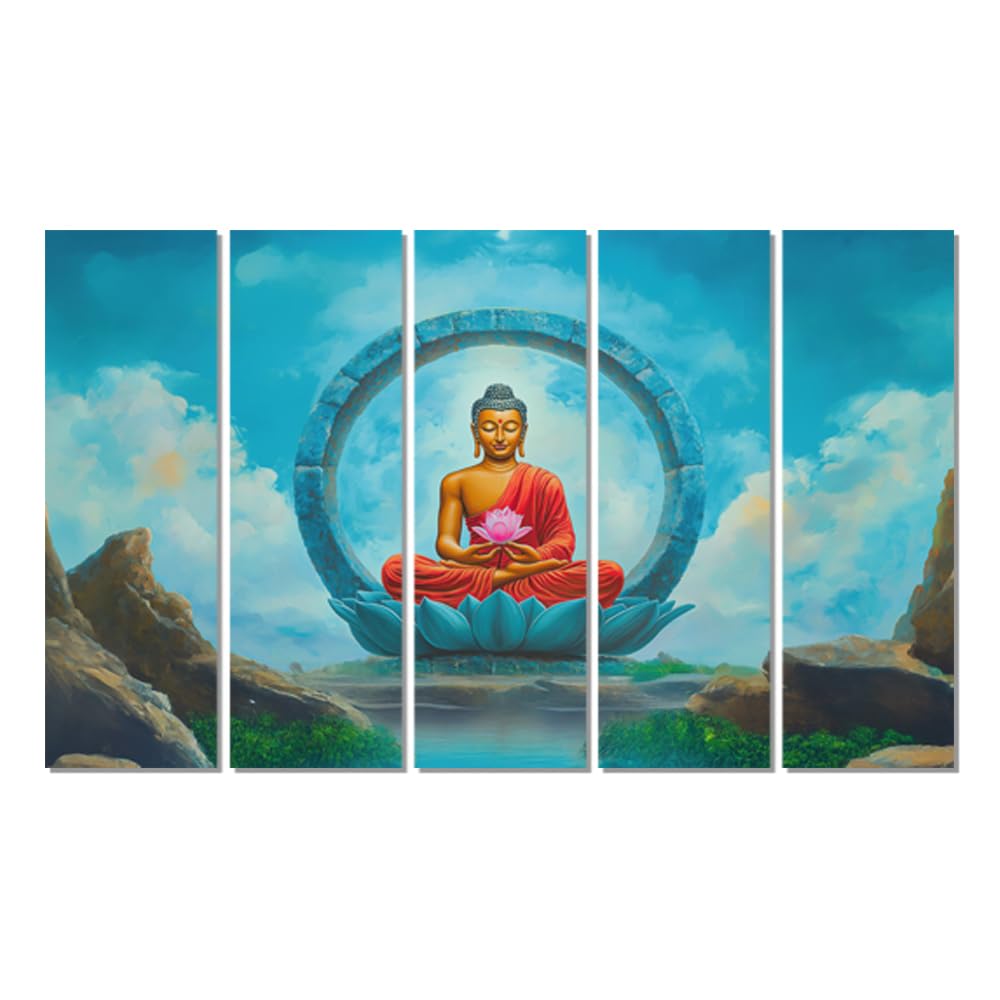
Buddha Bliss 5-Panel Framed Wall Art That'll Zen-Out Your Space (50x30in)
You may also like

Moolwan 5-Panel Buddha with Lotus Vinyl Wall Art on MDF (127x76cm) – Centered Stone-Ring Composition for Anchored Stillness
Where This Actually Goes on Your Wall
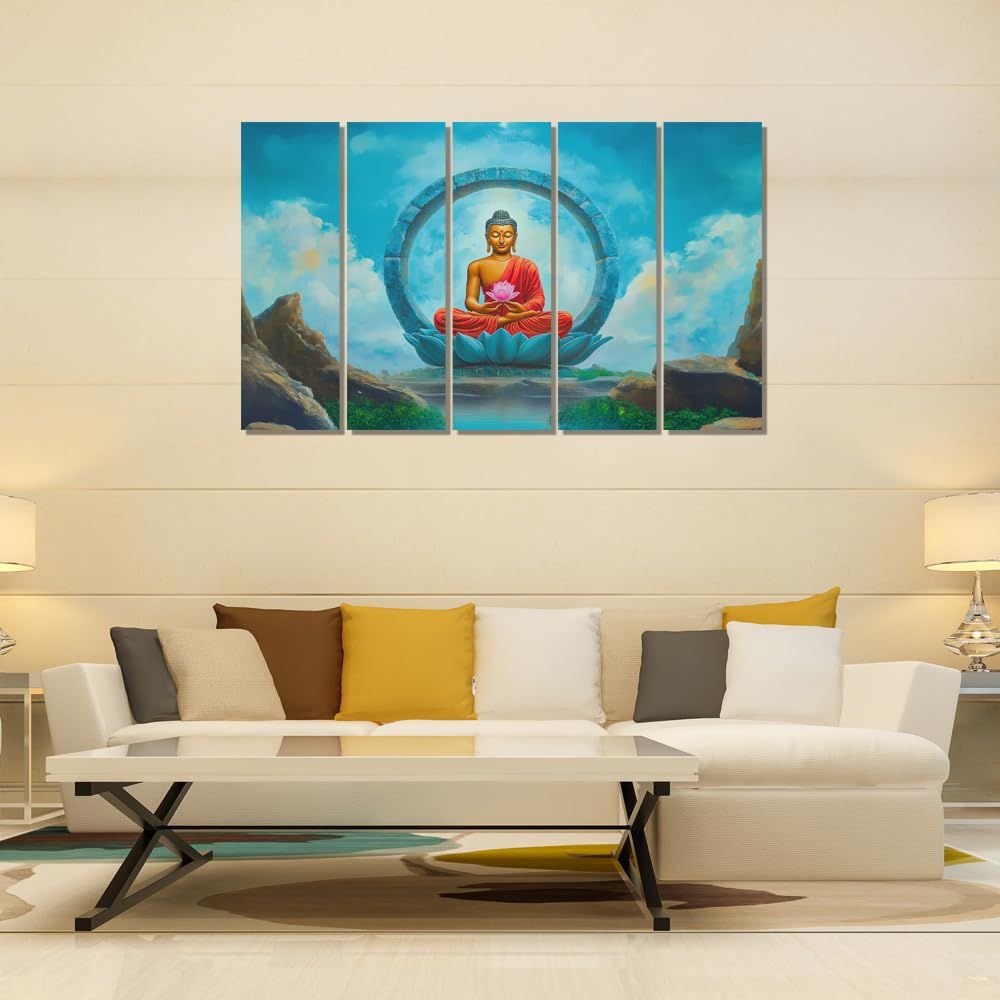
That blank stretch above your sofa has been bothering you for months. You've scrolled past dozens of Buddha artworks online, but none of them helped you picture what they'd actually look like in your living room — how they'd sit against your cream wall, whether the colors would clash with your brown sofa, whether 127cm would look proportional or awkward from the doorway.
This 5-panel Buddha artwork solves the visualization problem through its composition structure: the stone ring frames the Buddha figure in the exact center, which means when you install it above your sofa, your eye knows immediately where to rest. The five panels span 127cm total — roughly 53% of an 8-foot (240cm) sofa's width, placing it comfortably within the 50-60% proportion that looks intentional rather than cramped or overwhelming.
The centered stone-ring creates anchored stillness that reads as deliberate placement, not random wall-filling.
Why 127cm Works on 10-12 Foot Walls (And What Changes If You Go Smaller)
For a standard Indian living room wall of 10-12 feet (300-360cm), this 127cm width provides roughly 35-42% horizontal coverage. That's intentional: Buddha artwork isn't meant to dominate a room the way a panoramic landscape might. It creates a focal zone — a visual anchor that draws attention without demanding it.
Above an 8-foot sofa, the 127cm span sits comfortably with 55-60cm of visual breathing room on each side. This matters because your sofa likely has side tables or floor lamps nearby, and this width accounts for that peripheral furniture without competing with it.
The 76cm height works for standard 8-10 foot ceilings. Installed 20-25cm above your sofa back, the top edge sits at roughly 150-160cm from the floor — eye level when standing, slightly above eye level when seated. This positioning means guests notice it when entering, and you see it comfortably while sitting.
If you went smaller (say, 90x60cm), the five-panel format would compress each panel to under 18cm width — the stone ring would feel fragmented rather than continuous. The 127cm width lets each panel breathe while maintaining the composition's flow.
What These Colors Look Like on Cream Walls (Morning vs LED)
The dominant color here is a teal-turquoise sky that spans all five panels. Against cream or off-white walls (which most Indian apartments have), this teal reads as calming rather than cold. In morning light, the teal appears slightly muted, almost seafoam. Under warm LED lighting (3000K, the standard in most Indian homes), it deepens to a richer cyan.
The saffron-orange of Buddha's robes provides warmth that prevents the composition from feeling sterile. This orange sits in the same color family as terracotta, rust, and the brown tones common in Indian wooden furniture — your coffee table, TV unit, and sofa frame will echo these warm undertones rather than clash with them.
The pink lotus Buddha holds is a deliberate softening detail. Without it, the composition would be entirely teal-and-orange — striking but potentially harsh. The pink introduces gentleness, which matters for a meditation-adjacent artwork.
The brown-ochre rocks on the outer panels serve a practical function: they ground the ethereal sky and create a visual bridge to wooden furniture below. If your sofa is brown or beige fabric with wooden arms (as most Indian sofas are), these rock tones will feel like an intentional extension of your existing color scheme.
Installation in Indian Walls (Concrete vs Drywall)
Five panels means ten hanging points — two per panel. This sounds more complicated than it is.
For concrete walls (common in older Indian buildings): Use the included masonry anchors. Drill 6mm holes, 35mm deep. The panels are MDF-backed, which means they're lighter than stretched canvas — each panel weighs roughly 600 grams. Standard concrete anchors handle this easily.
For drywall (common in newer apartments): Use the included plastic anchors. Same 6mm holes, 30mm deep. MDF panels don't flex the way stretched canvas does, so there's no risk of the panel warping or bowing after installation.
The five-panel format requires leveling attention. Use a spirit level across the top edges of all five panels before drilling. The continuous composition — where the stone ring and Buddha figure span multiple panels — means even a 1cm height difference between panels becomes visible. Take the extra five minutes to mark all ten points with painter's tape and verify level before you drill.
Panel spacing: 2-3cm between each panel creates the standard gallery look. Closer than 2cm and the panels start to feel like they should be touching; wider than 3cm and the composition fragments.
Total installation time: 25-35 minutes for five panels, including leveling and spacing verification.
Why This Works Better Than Macrame Wall Hangings
You've probably considered macrame as an alternative — it's trending, it's textured, it fills wall space. Here's what macrame doesn't do:
Macrame hangs loose. It moves when air currents shift, when someone walks past, when the ceiling fan runs. This creates visual instability — your eye never quite settles because the hanging is always subtly in motion. The MDF-backed vinyl panels here sit flush against the wall, completely static. The stone-ring composition creates a fixed focal point your eye returns to.
Macrame collects dust in every fiber twist. In Indian conditions — ceiling fan dust, cooking particles, monsoon humidity — macrame needs monthly washing or it starts looking dingy within six months. Vinyl on MDF wipes clean with a dry cloth.
Macrame offers texture but not imagery. If you want spiritual presence in your room — an actual Buddha figure rather than a generic woven pattern — macrame can't provide that. The centered Buddha, lotus, and stone ring here carry specific meditative symbolism that textile hangings simply can't replicate.
Macrame also sags over time. The cotton fibers stretch under their own weight. After a year, what started as a tight weave becomes a loose droop. MDF doesn't sag.
What This Will Actually Feel Like in Your Room
From the doorway — the first impression when guests enter — this reads as a cohesive blue-and-gold focal point. The five-panel format creates horizontal presence without overwhelming the wall. The centered Buddha draws attention without demanding it.
Up close (standing 1-2 feet away), the detail becomes apparent: the texture of Buddha's robes, the individual stones in the ring, the lotus petals, the rock formations. This rewards closer inspection without requiring it — the composition works at distance and proximity.
The teal sky might initially feel like a risk if you're used to warm-toned decor, but its pairing with saffron and ochre creates balance. This isn't a cold, clinical blue; it's a warm-adjacent teal that complements rather than fights your existing color scheme.
Solo or with adjacent decor: This works best as a standalone focal piece. The five-panel spread already commands significant visual attention. Adding side pieces (small paintings, wall clocks, shelving) would compete rather than complement. Keep the adjacent wall space clean.
Moolwan Design Note
The stone ring in this composition isn't decorative — it's structural. By framing Buddha in a circular element, the eye has a natural boundary that prevents it from drifting to the panel edges. This creates the anchored stillness that makes five-panel spiritual artwork feel meditative rather than fragmented.
Moolwan Quality Standard
Splash-proof vinyl print on MDF panels. Designed for Indian apartments and lighting conditions. Packed for long-distance Indian transit with individual panel protection. Quality checked before dispatch. Ships from West Bengal.
Moolwan Fit Guidance for Indian Homes
At 127cm width, this fits above 7-9 foot sofas with proportional breathing room on both sides. The 76cm height works for 8-10 foot ceilings when installed 20-25cm above sofa back. Best suited for living rooms, meditation corners, or entryways where the Buddha figure greets visitors.
Quick Specifications
- Product: Moolwan 5-Panel Buddha with Lotus Vinyl Wall Art on MDF (127x76cm)
- Brand: Moolwan
- Category: Vinyl Wall Art on MDF
- Collection: Buddha Wall Art Collection
- Dimensions: 127cm W × 76cm H × 0.6cm D (total across all panels)
- Weight: 3kg (total)
- Material & Construction: Splash-proof vinyl print on MDF panels
- Colors: Turquoise/teal sky, saffron-orange robes, golden Buddha figure, pink lotus, brown-ochre rocks, green foliage
- Best For: Above 7-9ft sofas, meditation corners, entryways, living rooms with cream/off-white walls
- Ships From: West Bengal
Frequently Asked Questions
Will 127cm look proportional above my 8-foot sofa?
Yes. An 8-foot (240cm) sofa pairs well with artwork that spans 50-65% of its width. At 127cm, this falls at 53% — comfortably within the proportional range, leaving roughly 55-60cm of visual space on each side.
How will the teal color look against my cream walls under LED lighting?
Under warm LED (3000K, standard in Indian homes), the teal deepens to a rich cyan while the saffron-orange robes appear warmer. The combination reads as balanced rather than cold — the warm tones in the composition prevent the teal from feeling clinical.
How do I ensure all five panels are level during installation?
Use painter's tape to mark all ten hanging points before drilling. Run a spirit level across the marks to verify alignment. The continuous stone-ring composition makes even small height differences visible, so this step is worth the extra five minutes.
Will the vinyl print fade in humidity or direct sunlight?
The vinyl is splash-proof and designed for Indian climate conditions. UV-resistant printing prevents color shift from indirect sunlight. Avoid direct afternoon sun exposure for extended periods, but normal living room conditions with morning light or ambient daylight won't cause fading.
What spacing should I leave between the five panels?
2-3cm between each panel creates the standard gallery appearance. Closer spacing makes the panels feel cramped; wider spacing fragments the continuous composition where the stone ring and Buddha figure span multiple panels.
Product Snapshot
- Brand: Moolwan
- Product: Moolwan 5-Panel Buddha with Lotus Vinyl Wall Art on MDF (127x76cm)
- Category: Vinyl Wall Art on MDF
- Collection: Buddha Wall Art Collection
- Theme/Type: Meditating Buddha with lotus, stone ring halo, natural landscape
- Best For: Living rooms above 7-9ft sofas, meditation corners, entryways with cream or neutral walls
- Primary Differentiator: Centered stone-ring composition creates anchored stillness across all five panels
- Secondary Differentiators: Teal-to-ochre gradient bridges cool walls and warm furniture; pink lotus adds softness to spiritual composition
- Material & Construction: Splash-proof vinyl print on MDF panels
- Care Instructions: Wipe with dry microfiber cloth; avoid water and cleaning chemicals
- Ships From: West Bengal
- Packing: Long-distance transit ready with individual panel protection
- Quality Check: Before dispatch