
Buddha Bliss 5-Panel Framed Wall Art to Zenify Your Zone
You may also like

Moolwan 5-Panel Buddha Face Vinyl Wall Art on MDF (127×76cm) – Asymmetrical Composition with Meditative Negative Space
When You've Seen Fifty Buddha Prints and They All Look the Same
You've scrolled past dozens of Buddha wall art pieces this week. Golden Buddhas, meditating Buddhas, Buddhas surrounded by lotus flowers, Buddhas with inspirational text overlaid. And something stops you every time — not because they're wrong, exactly, but because they all feel... generic. Mass-produced. Like spiritual clip art stretched across a frame.
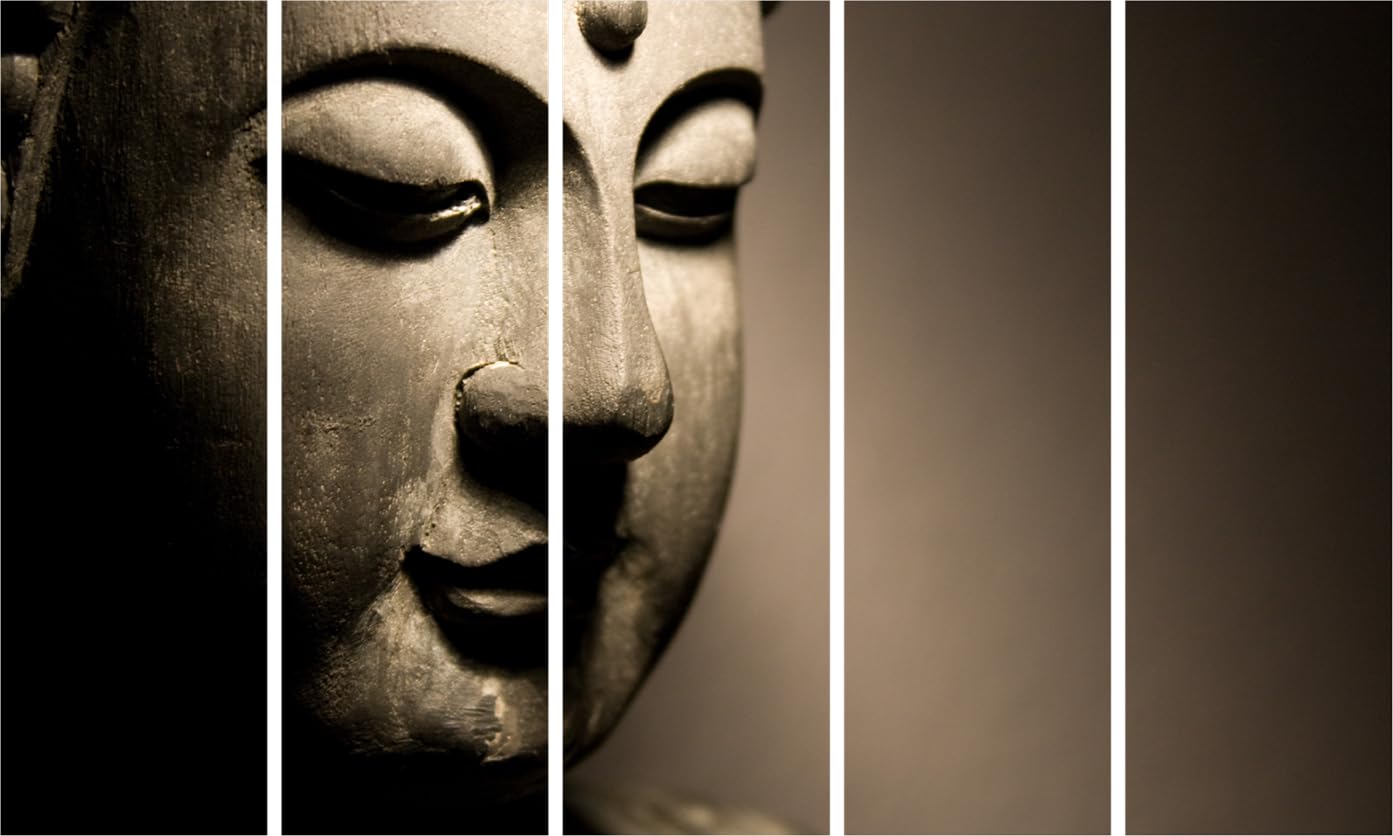
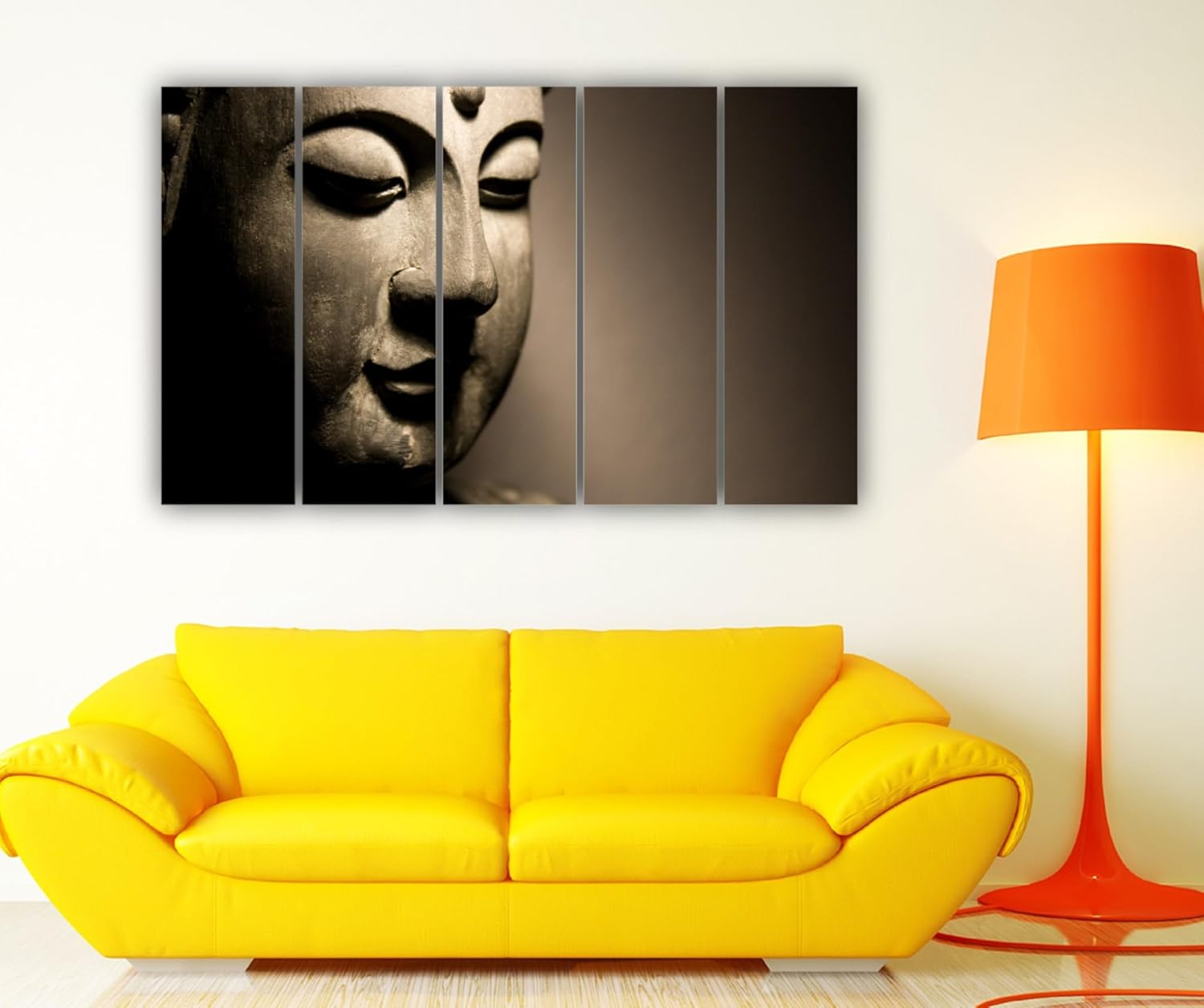
This piece works differently. The Buddha face occupies only the left three panels in close-up profile — stone texture, closed eyes, the slight curve of lips in repose. Panels four and five fade into soft taupe gradient, empty space that isn't actually empty. That negative space is the composition's actual purpose. It creates the visual equivalent of a held breath, the pause between thoughts that meditation aims for.
At 127cm wide, this covers roughly 53% of a standard 8-foot sofa's width. The asymmetry means it doesn't demand center-placement — it can sit slightly left of center above your sofa and the composition still resolves correctly, which gives you flexibility if your wall has an AC vent or electrical panel on one side.
Why 127cm Works on 10–12 Foot Walls (And What Changes If You Size Up or Down)
A 127cm piece on a 10-foot wall (305cm) covers approximately 42% of the wall width. On a 12-foot wall (365cm), that drops to 35%. Both proportions work because the five-panel spread creates horizontal visual weight that reads larger than a single-panel piece of the same dimensions.
For above-sofa placement: if your sofa is 7 feet (213cm), this covers 60% of sofa width — slightly generous but appropriate for a statement piece. For an 8-foot sofa (244cm), coverage is 52%, which sits comfortably in the 50-60% range where wall art feels anchored to the furniture below rather than floating independently.
Viewing distance matters with this particular composition. From across a 12-foot room (typical living room depth), the Buddha face reads as a cohesive serene presence. From 6 feet away (seated on the sofa, looking up), the stone texture and sculptural detail become visible — the weathering on the surface, the definition around the eyelids, the patina that suggests age and permanence.
The five panels should be mounted with 2-3cm gaps between them. These gaps are part of the composition — they create rhythm and prevent the panoramic image from reading as a single rectangle that happens to be divided. The consistent gap spacing matters more than perfect millimeter precision; visual consistency reads as intentional, slight variations read as mistakes.
What These Sepia Tones Look Like on Cream Walls (Morning vs Evening)
The palette here is deliberately narrow: sepia, stone gray, charcoal shadows, warm taupe in the gradient panels. No competing colors, no unexpected accents that might clash with your existing room.
Against cream or off-white walls (which covers roughly 80% of Indian apartment wall colors), this reads as sophisticated neutral rather than decorative statement. The warm sepia tones pull toward the yellow undertones in cream walls, creating cohesion rather than contrast.
In morning natural light: the stone texture becomes more visible, the sculptural quality more pronounced. The shadows in the Buddha's features deepen slightly.
Under warm LED lighting (3000K, standard in most Indian homes): the sepia warms further, the overall mood becomes more intimate. The gradient panels pick up a subtle golden quality that complements wooden furniture.
If you have brown or beige sofas (common in Indian living rooms), the taupe gradient panels echo those tones without matching them exactly. If you have gray furniture (increasingly common in modern apartments), the charcoal shadows in the Buddha's features create a subtle connection.
The monochromatic approach means this piece doesn't introduce new colors into your room — it works with what's already there rather than demanding you coordinate around it.
Installation in Indian Walls (Concrete vs Drywall)
Five panels means ten mounting points total — two per panel. This sounds more complicated than it is.
For concrete walls (most older Indian buildings): use the included masonry anchors with a 6mm masonry bit. Drill approximately 35mm deep, insert anchor, screw in hook. The combined weight of all five panels is 3kg, well within the capacity of standard anchors.
For drywall (common in newer constructions and false ceiling areas): use drywall anchors instead. Same process, slightly shallower holes.
The critical step is leveling. With five panels, even a 2-degree tilt becomes visibly apparent across the 127cm span. Use a spirit level across the top edge of each panel after hanging. Adjust before the anchors set fully. The included hanging template helps — tape it to the wall, mark all ten points at once, remove template, drill. This prevents the cumulative error that happens when you measure each panel position independently.
For rentals: ten small anchor holes sounds concerning, but each is only 6mm diameter. When you move out, fill with wall putty (₹50 from any hardware store), sand smooth, touch up with matching paint. Total time: 30 minutes. These holes are smaller than the damage from a single heavy-duty curtain rod bracket.
How This Compares to Fabric Tapestries (A Common Alternative)
Fabric tapestries with Buddha imagery are readily available for ₹800-1,500. They're lightweight, require only two mounting points, and come in similar sizes. So why vinyl on MDF instead?
Fabric tapestries drape. They move with air currents from fans and AC. The edges curl over time. In humid conditions (monsoon season in coastal cities), they absorb moisture and can develop a musty smell or even mildew in poorly ventilated rooms. The printed image on fabric has a softness that some prefer, but it also means reduced detail — the stone texture and sculptural quality visible in this piece would blur into vague shapes on fabric.
Vinyl on MDF is rigid. The panels stay flat against the wall, maintain consistent gaps, and don't shift position. The splash-proof surface means condensation from monsoon humidity beads up and evaporates rather than absorbing into the material. The print resolution stays sharp — that weathered stone texture remains visible five years from now.
The trade-off: MDF panels require proper anchoring (you can't hang them from a single nail), and they're heavier (3kg total vs under 1kg for fabric). If you're looking for temporary, easily-removed wall covering, fabric tapestries make sense. If you're looking for wall art that behaves like wall art — stays in position, maintains appearance, becomes part of the room rather than something draped on the wall — vinyl on MDF is the appropriate material.
What This Will Actually Feel Like in Your Room
From your doorway, walking into the living room: the Buddha face registers as a calm presence on the wall. The asymmetrical composition draws the eye left, then releases it into the gradient space. It doesn't dominate the room — the muted palette and leftward weight prevent it from demanding constant attention.
From the sofa, looking up: the sculptural detail becomes the focus. The closed eyelids, the texture of aged stone, the suggestion of a slight smile. This is when the piece works as meditation anchor rather than just wall decoration.
For adjacent décor: the negative space in panels 4-5 means you can place a floor lamp or tall plant to the right of this piece without creating visual competition. The composition already accounts for empty space on that side. To the left, keep it clean — the Buddha face needs room to breathe on that edge.
This piece works as a solo statement. It doesn't need companion pieces, gallery wall arrangements, or coordinating elements. The five-panel format already creates visual complexity; adding more elements around it risks making the wall feel cluttered rather than curated.
Moolwan Design Note
The asymmetrical panel distribution — three panels of detail, two panels of gradient — is the composition's defining choice. Most multi-panel Buddha art centers the face and distributes visual weight evenly. Here, the intentional imbalance creates the meditative quality: presence on one side, space on the other, like a breath half-held.
Moolwan Quality Standard
Designed for Indian apartments and lighting conditions. Packed for long-distance Indian transit. Quality checked before dispatch. Printed to resist humidity-related surface damage. Ships from West Bengal.
Moolwan Fit Guidance for Indian Homes
At 127cm width, this fits above sofas between 6.5 and 8.5 feet wide. Mount 20-25cm above sofa back, maintain 2-3cm gaps between panels. Works in living rooms, meditation corners, entryways. Avoid bedrooms where horizontal format may exceed typical bed-wall proportions.
Quick Specifications
Product: Moolwan 5-Panel Buddha Face Vinyl Wall Art on MDF (127×76cm)
Brand: Moolwan
Category: Vinyl Wall Art on MDF
Collection: Buddha Wall Art Collection
Dimensions: 127cm W × 76cm H (total span)
Weight: 3kg (all panels combined)
Material & Construction: Splash-proof vinyl print on MDF panels
Colors: Sepia, stone gray, charcoal, warm taupe
Best For: Living room above 7-8ft sofa, meditation corner, entryway
Ships From: West Bengal
Frequently Asked Questions
Will 127cm be too wide for my wall?
For walls between 10-12 feet (305-365cm), 127cm provides 35-42% coverage — proportional for a statement piece. For walls under 9 feet, this may feel oversized. Measure your wall width and divide by 3; if the result is less than 127cm, consider a smaller format.
How do the sepia tones look under tube lights vs LED?
Under cool white tube lights (common in older Indian homes), the sepia appears slightly more gray, less warm. Under warm LED (3000K, standard in modern fixtures), the sepia warms and the stone texture becomes more pronounced. If you have tube lights, the piece still works — it just reads as more neutral than warm.
Can I install this on a rental wall without losing my deposit?
Yes. The ten anchor holes required are 6mm diameter each — smaller than standard picture frame nail holes. Fill with wall putty when moving out, sand smooth, touch up with paint. Total repair time: 30 minutes. Landlords typically don't notice properly patched small holes.
How does vinyl on MDF handle Mumbai/Chennai humidity?
The splash-proof vinyl surface prevents moisture absorption. During monsoons, humidity condenses on the surface and evaporates rather than penetrating the material. MDF is more humidity-stable than solid wood, which can warp. Store in dry conditions during any period the panels are unmounted.
What gap should I leave between panels?
2-3cm between each panel creates the intended visual rhythm. Wider gaps (4-5cm) make the panels read as five separate pieces rather than one composition. Narrower gaps (under 1.5cm) compress the image and reduce the panoramic effect. Consistency matters more than exact measurement — use a spacer (a book spine works) to maintain uniform gaps during installation.
Product Snapshot
Brand: Moolwan
Product: Moolwan 5-Panel Buddha Face Vinyl Wall Art on MDF (127×76cm)
Category: Vinyl Wall Art on MDF
Collection: Buddha Wall Art Collection
Theme/Type: Buddha face close-up, sculptural stone texture
Best For: Living room above 7-8ft sofa, meditation corner, entryway on 10-12ft walls
Primary Differentiator: Asymmetrical composition with weighted left focus and meditative negative space
Secondary Differentiators: Sculptural stone texture with visible patina; monochromatic sepia-taupe palette
Material & Construction: Splash-proof vinyl print on MDF panels
Care Instructions: Dust with dry microfiber cloth; wipe surface moisture immediately; avoid chemical cleaners
Ships From: West Bengal
Packing: Long-distance transit ready
Quality Check: Before dispatch