
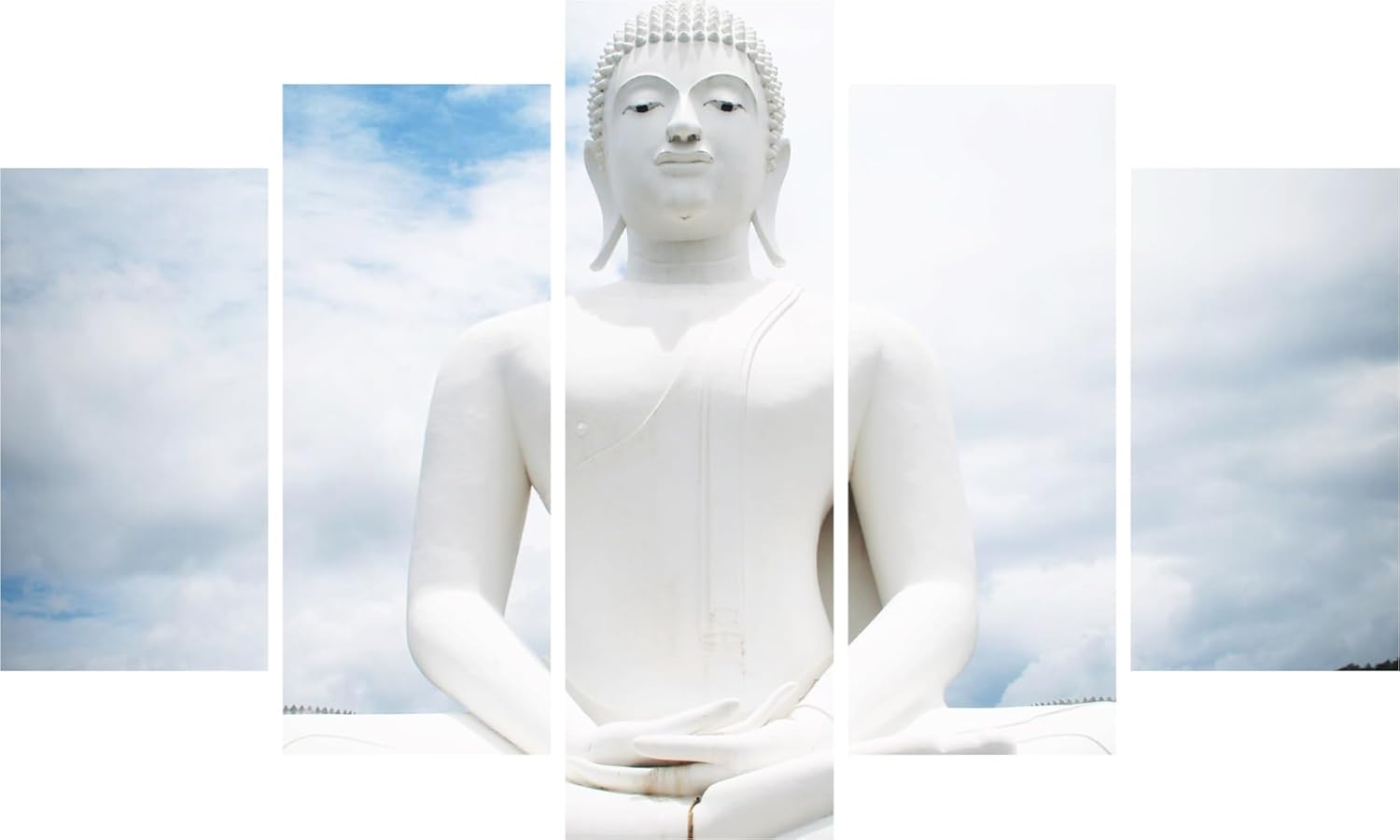
Buddha Bliss 5-Panel Wall Art That Kicks Chaos to the Curb - Framed Zen Vibes (150x76cm)
You may also like

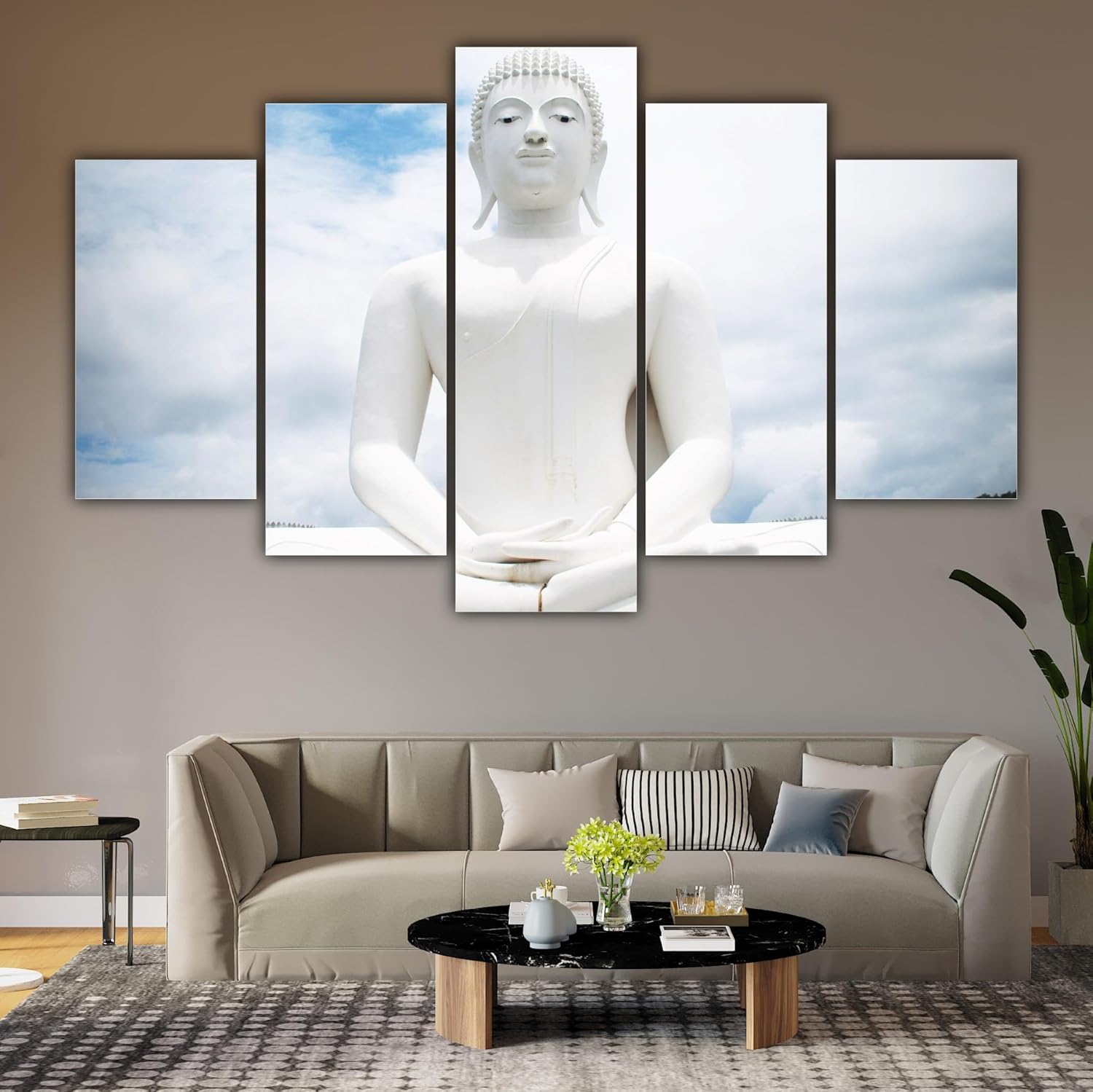
Moolwan 5-Panel White Buddha Vinyl Wall Art on MDF (150x76cm) – Sky-Merge Floating Figure Composition
You keep opening this product page. Closing it. Opening it again. You can picture a large Buddha piece on that wall—you've nearly convinced yourself it'll work—but then the specifics stop you. Not the subject (Buddha feels right for your living room). Not the size on paper (150cm sounds substantial). What stops you is the actual mental image of five separate panels going up on a real wall in a real room. How much sky will show on the outer panels? Will the Buddha figure look fragmented or cohesive? Will the white figure blend into your cream walls and effectively disappear? You need to see it in your space—not against the white photography backdrop in the product image.
Here's what resolves the uncertainty: the composition was designed to be read as a single scene across all five panels, not as five separate images placed side by side. Your eye enters the soft blue sky on the outer left panel, travels through the cloudscape, finds the white Buddha seated in dhyana mudra across the three central panels—still, centered, facing forward—and exits through the matching open sky on the right. The figure doesn't feel cut apart. The 150cm horizontal span makes the sky expansive and the figure monumental without adding visual heaviness. And on cream walls? The soft sky-blue behind the figure creates just enough contrast to hold the Buddha's outline while the white form gains a sculptural quality—it appears to emerge from your wall rather than hang against it.
The Visual Math: How 150cm Covers a 12-Foot Wall in Indian Living Rooms
A 12-foot (360cm) wall with a 150cm canvas leaves 105cm of clear wall on each side—roughly a full meter on both edges. Coverage ratio: 42%. That's the range where a piece reads as an intentional focal point rather than something placed there to occupy space. Substantial enough to anchor the room. Restrained enough that adjacent elements—a bookshelf three feet away, a window to one side—don't feel crowded.
The five-panel format means that 150cm includes the 2–3cm gaps between panels as part of the visual width. From your sofa at 8–10 feet, those gaps disappear into the composition entirely. You read one continuous scene.
If your wall is narrower—10 feet (300cm)—150cm gives 51% coverage. This works well, but that wall should be clear of competing elements. Nothing flanking the canvas edges within reach.
If your wall is wider—14 feet (420cm)—150cm gives only 36% coverage. The painting remains a correct focal point, but you'll likely notice the room wants something flanking it. Not because the canvas is wrong—because 420cm of wall with 36% coverage reads as undercomposed. A floor plant or lamp at one side resolves it.
The 76cm height sits comfortably under 8-foot ceilings with at least 30cm of wall above. Mount it 20–25cm above your sofa's top cushion edge. At that height, seated across the room, the Buddha figure sits at natural eye level—the folded hands in meditation mudra fall in the centre of your visual field. This is not coincidence. It's the viewing geometry that makes spiritual art feel genuinely peaceful rather than merely decorative.
What Sky-Blue and Cloud-White Actually Look Like in Indian Homes (Morning vs. Evening LED)
Most Buddha wall art available online uses saturated gold, deep ochre, or rich burgundy. Those colours photograph well. But months of daily exposure in a typical Indian living room—cream walls, warm LED lighting, wooden furniture—can make heavily saturated spiritual art feel demanding over time. This composition makes a different choice.
Against cream or off-white walls (the most common in Indian 2BHK and 3BHK apartments): the soft sky-blue panels hold their own without conflicting with the wall colour. The white Buddha figure does something specific here—it partially softens at its outer edges against a cream wall, so the figure appears to emerge from the room rather than be mounted onto it. The effect is sculptural presence. Your eye registers a figure, not a frame.
With brown or warm wooden furniture—coffee table, TV unit, side tables: the cool sky-blue provides quiet contrast against warm wood tones. Complementary, not competing. You won't feel pressure to change anything else in the room to accommodate it.
In morning light from east-facing windows: the blues become luminous. The cloud-whites take on a very soft warmth. The composition reads as serene rather than cold. If you meditate in the morning, this is the version of the painting you'll know best, and it earns that context.
In afternoon direct light: eco-solvent inks on vinyl don't shift colour under UV exposure. Standard dye-based decal prints typically show a yellowish or flat drift within 6–12 months under the same conditions. The sky-blue here remains consistent year after year.
In warm evening LED at 3000K—standard in Indian homes: the blues recede slightly and the white figure becomes more prominent against the now-warmer surroundings. This is when guests see your living room. This is when the peaceful effect registers most clearly without feeling like you're trying to make a statement about spirituality.
Long-term consideration: saturated spiritual art can feel heavy after a year of daily exposure. Sky-blue and cloud-white stay gentle. Two or three years from now, the room will still feel calm rather than cluttered.
From Box to Wall in Under 25 Minutes (Rental-Friendly)
Five panels and 3kg sounds like significant wall work. In practice: the entire installation leaves three anchor points across the 150cm span. Each hole is 6mm diameter, 35mm deep—smaller than the brackets for your curtain rod, smaller than the towel bar in your bathroom.
When you vacate: three 6mm holes filled with wall putty (₹50 at any hardware store), sanded flush, touched up with paint. Twenty minutes. ₹200. Your landlord will not find them unless specifically looking with a flashlight at a grazing angle.
What comes in the box: concrete anchors for older solid-wall buildings, drywall anchors for newer hollow-core construction, D-ring hangers pre-attached to each panel's back frame, and a paper positioning template. The template removes all guesswork—tape it at your desired height, mark three pencil points, remove it, drill, insert anchors, hang. No measuring twice and drilling once wrong.
Panel alignment: start with the centre panel, check it's level (your phone's bubble level app works fine), then position adjacent panels with consistent 2–3cm gaps using a ruler or finger width. The symmetrical composition means even a 0.5cm variance in gap width is imperceptible from sofa distance. Total time, including the three passes you'll make stepping back to check: 25 minutes.
For older concrete buildings: 6mm masonry bit, 35mm depth, included masonry anchors.
For newer drywall construction: same hole size, included plastic drywall anchors.
The panels travel with you when you move. The wall behind them is undamaged—unlike what's left after removing adhesive decals.
What This Has Over Large-Format Buddha Wall Decals and Sticker Sets
The direct comparison most buyers make is this: a 5-panel vinyl wall art set at ₹2,496 versus a large-format Buddha wall decal or sticker set that covers similar wall area for ₹400–₹700. Both show Buddha imagery. Both go on the same wall. So what's the actual difference?
Wall decals are printed on thin adhesive vinyl film applied directly to your wall surface. In Indian home conditions, three things happen within 12–18 months: the adhesive picks up dust and loses grip at its edges, particularly through monsoon humidity cycles; the thin film cannot maintain colour depth, so the design progressively looks flatter and more obviously "stuck-on"; and eventual removal—which is inevitable—typically lifts paint from the wall surface, which is a significantly larger repair than three 6mm holes.
Vinyl print on MDF panels has physical dimension. You can see the panel edges from the side. There's something actually hanging there, not a surface treatment applied to your wall. The colour depth five years from now matches day one. When you leave the apartment, you take the panels with you—and leave the wall untouched.
One specific difference that doesn't show up in product photos: Buddha decals almost always assume a flat, freshly painted wall surface for adhesion. Textured paint finishes, older plaster with minor relief, previous paint layers—all create air pockets and edge lift. Panels anchored to the wall are completely indifferent to surface texture.
Morning Light vs. Sofa Distance: Setting Honest Expectations for Your Room
From your sofa at 8–10 feet: you register the complete meditation scene—white Buddha centred against open sky, five panels creating genuine horizontal breadth. The composition feels larger than a single-frame 150cm painting would from the same distance. Your eye moves across it. The room settles.
From your doorway at 12–15 feet: the canvas anchors the wall. It reads as deliberate, not decorative. The soft palette integrates without demanding a response from your other furniture and flooring. You won't feel that it's fighting anything in the room.
Up close at 3–4 feet: vinyl on MDF holds sharper fine detail than cotton canvas weave—the folds of the robe, the subtle tonal gradations in the clouds, the careful modulation of white against blue are clearly visible. The surface texture is smooth rather than organic. Some buyers prefer the painterly quality of canvas weave; others prefer this crispness. What vinyl on MDF does best: photographic detail held consistently across all five panels, exactly matched at the seams.
On visual dominance: this composition is high-key—bright, airy, very low in visual weight for its size. The room won't feel heavy after it's hung. If you have a pooja shelf elsewhere in the room, a bookshelf on the same wall at reasonable distance, or family photos on an adjacent wall, the soft blue-white palette won't compete. If your sofa or furniture is dark and heavy, this canvas provides genuine visual relief. It earns its wall space without demanding everything around it reorganise.
Whether it works alone: completely. No flanking plants, no smaller companion frames needed to balance it. The five-panel span provides its own visual rhythm and the composition is resolved at its current dimensions.
Moolwan Design Note
The Buddha figure here was photographed from a low vantage point, looking upward—which gives the figure natural vertical presence and a sense of scale that front-facing compositions don't produce. Across the five panels, the sky extends far enough on the outer panels that the composition feels complete rather than arbitrarily cropped. What makes this specific arrangement work: the outer two panels carry meaningful sky and cloud detail, so the scene reads as genuinely expansive rather than an image with blank border panels added to increase width.
Moolwan Quality Standard
Designed for Indian apartments and lighting conditions. Printed to resist humidity-related color fading. Quality checked before dispatch. Packed for long-distance Indian transit. Ships from West Bengal.
Moolwan Fit Guidance for Indian Homes
At 150cm across five panels, this covers 42% of a 12-foot wall—the coverage range that reads as deliberate focal point without dominating in standard Indian 2BHK and 3BHK living rooms. The 76cm height sits correctly under 8-foot ceilings when mounted 20–25cm above sofa level, placing the meditation figure at seated eye-level from across the room.
Quick Specifications
- Product: Moolwan 5-Panel White Buddha Vinyl Wall Art on MDF (150x76cm)
- Brand: Moolwan
- Category: Vinyl Wall Art on MDF
- Collection: Buddha Wall Art Collection
- Dimensions: 150cm (W) × 76cm (H) per assembled span
- Weight: 3kg total
- Panel Configuration: 5 panels, each approximately 28cm wide; 2–3cm gaps between panels
- Color Palette: Soft sky-blue, cloud-white, pure white (Buddha figure)
- Material & Construction: Splash-proof vinyl print on MDF
- Best For: 12-foot living room walls, bedroom focal walls, meditation corners
- Hanging Height: 20–25cm above sofa top cushion edge; approximately 140–150cm from floor
- Climate Rating: Humidity-resistant; suitable for Indian monsoon conditions
- Installation: Concrete anchors, drywall anchors, D-ring hangers, paper positioning template included
- Ships From: West Bengal
- Delivery: 5–6 days to metro cities, 6–8 days to tier-2/3 cities
- COD: Available across India
- Price: ₹2,496
Frequently Asked Questions
Will 150cm look proportional on my 12-foot living room wall?
150cm covers 42% of a 12-foot (360cm) wall, leaving approximately 105cm of clear wall on each side. That coverage ratio reads as a deliberate focal point without overwhelming adjacent elements — a bookshelf a few feet away, a window to one side, a floor lamp nearby. For walls under 10 feet, 120cm works better. For walls over 14 feet with nothing else competing on that wall, 180cm creates stronger impact.
Will the white Buddha figure disappear against my cream walls?
The soft sky-blue background behind the figure creates enough contrast to hold the Buddha's form clearly against cream or off-white walls. The figure's outer edges do soften slightly at the boundary — which reads as the figure emerging from the room rather than being mounted onto it. The composition does not disappear against a standard cream builder's wall.
Will the sky-blue colour hold up if my wall gets afternoon sun?
Vinyl prints with eco-solvent inks resist UV exposure. The sky-blue panels maintain colour depth even with 3–4 hours of direct daily sunlight. Standard dye-based prints on paper-backed decals typically show visible colour shift within 6–12 months under the same conditions.
How do I align five panels evenly on the wall?
The included paper template marks all three anchor points precisely. Hang the centre panel first at your intended height, verify it's level. Position the two adjacent panels with consistent 2–3cm gaps using a ruler or measured spacer, then the outer two panels at matching gaps. Total time including alignment: 25 minutes. The symmetrical composition means small gap variations are invisible from sofa distance.
Will installation affect my rental deposit?
Installation needs three 6mm anchor holes — smaller than curtain rod brackets. When you leave, fill with wall putty, sand flush, touch up with paint: approximately 20 minutes and ₹200 in materials. The panels travel with you intact; the wall behind them is undamaged, unlike adhesive decals which typically lift paint on removal.
Product Snapshot
- Brand: Moolwan
- Product: Moolwan 5-Panel White Buddha Vinyl Wall Art on MDF (150x76cm)
- Category: Vinyl Wall Art on MDF
- Collection: Buddha Wall Art Collection
- Theme/Type: White Buddhist meditation figure against open sky
- Best For: 12–14ft living room walls, meditation corners, bedroom focal walls
- Primary Differentiator: Low-vantage sky-merge composition — Buddha photographed from below looking upward, figure merging into clouds across the central three panels, creating sculptural floating presence from sofa distance rather than a portrait-on-background effect
- Secondary Differentiators: Sky extends meaningfully on both outer panels (composition reads as genuinely expansive, not artificially widened); high-key bright palette creates focal point without visual weight in Indian living rooms with dark wooden furniture
- Material & Construction: Splash-proof vinyl print on MDF
- Care Instructions: Wipe with dry microfiber cloth; no water or chemical cleaners
- Ships From: West Bengal
- Packing: Long-distance transit ready
- Quality Check: Before dispatch
- Price: ₹2,496