
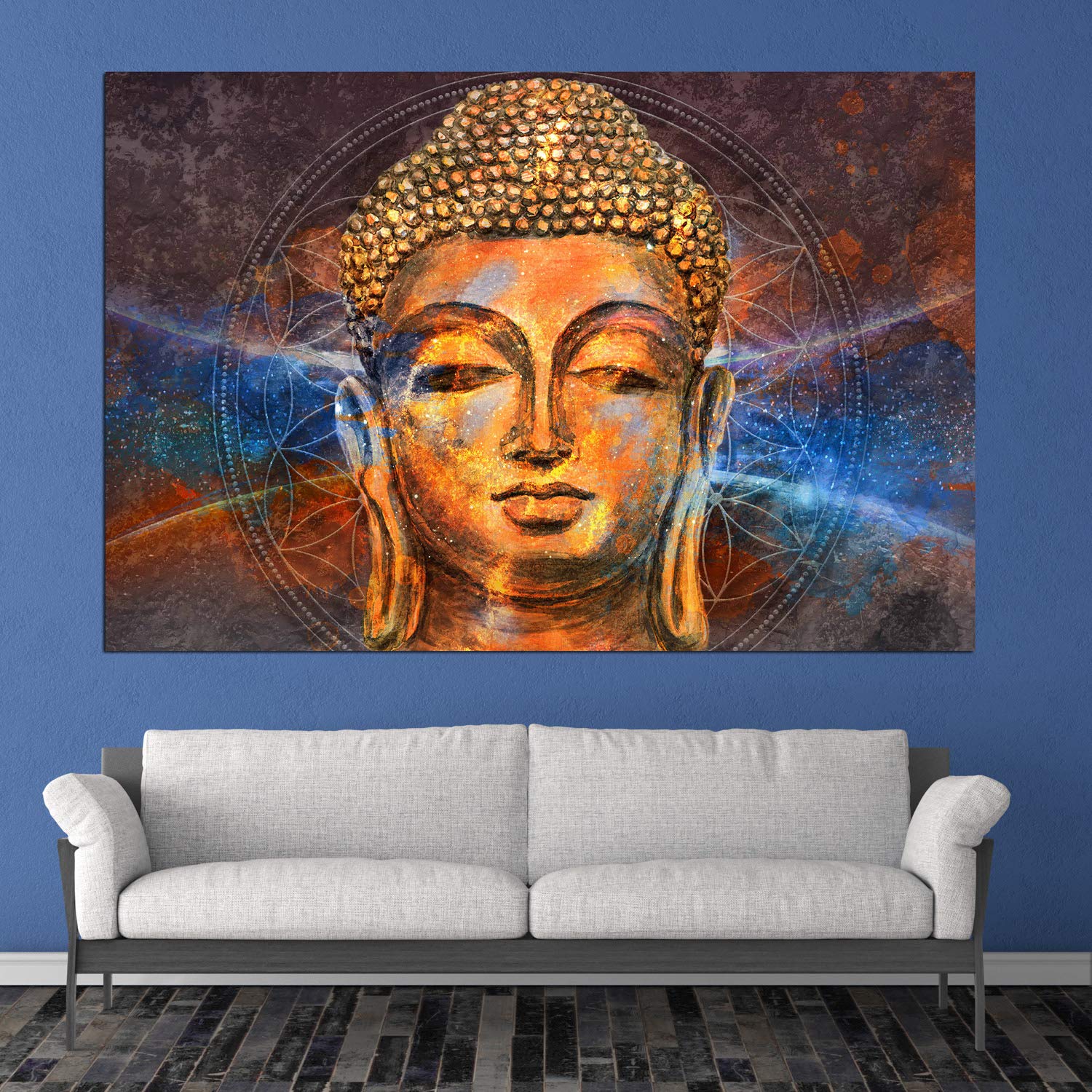

Buddha Bliss framed Canvas Wall Art That Speaks Zen
You may also like

Moolwan Buddha Canvas Wall Art Painting (91×61cm) – Golden Portrait with Cosmic Sacred Geometry Background
Finding the Right Buddha Art When Every Option Looks the Same Online
You've scrolled through dozens of Buddha paintings. Golden ones, white ones, minimalist silhouettes, ornate temple murals. They all look peaceful in the product photos—soft lighting, perfectly styled rooms, walls that definitely aren't the cream color yours actually is. But here's the question that keeps stopping you: will this specific piece actually create that sense of calm you're looking for, or will it just... hang there?
This particular Buddha canvas solves that visualization problem because its color story is unusual enough to describe precisely. The Buddha's face glows in warm amber and copper tones—not the flat gold of cheap prints, but layered brushwork that catches light differently across the face, nose, and elongated earlobes. Behind the head, deep cobalt and teal swirl outward with the Flower of Life sacred geometry pattern barely visible, like looking at the night sky through incense smoke. The edges fade into textured rust and burgundy, grounding the cosmic background in something earthly.
Against a cream wall, that golden face becomes the warmest point in the room. Against an off-white or light yellow wall, the blue background creates just enough contrast without clashing. This isn't a piece you'll wonder about—the warm center and cool surround create a visual anchor that reads clearly from across the room.
Why 91×61cm Works on 10-12ft Walls (And What Changes If You Size Up or Down)
At 91cm wide, this canvas covers roughly 25-30% of a standard 10-foot Indian living room wall when hung above a 6-foot sofa. That's intentional—Buddha paintings work better as contemplative focal points than dominant statement pieces. You want guests to notice it, pause, feel something. You don't want it overwhelming the room like a temple installation.
The math: if your sofa is 180cm (6 feet), this 91cm canvas hits the lower end of the 50-75% width ratio. It won't look undersized, but it also leaves breathing room on either side. If you have floor lamps or side tables flanking your sofa, this sizing accounts for that visual weight.
For 8-foot ceilings (standard in most Indian apartments), hang the bottom edge 20-25cm above your sofa cushions. The 61cm height means the top of the canvas lands around 80-85cm above the sofa—well below ceiling height, keeping the room proportioned.
If your wall is 12 feet or your sofa is 8 feet, you could size up to 120×80cm for more presence. But if your room has other visual elements competing—a decorated TV unit, a bookshelf, a pooja corner visible from the living room—this 91×61cm lets the Buddha coexist rather than dominate.
What These Colors Look Like on Cream Walls (Morning vs LED Evening)
The product photo shows this canvas against a blue wall—which is beautiful but probably not your wall. Here's how the colors actually behave in typical Indian home conditions:
On cream or off-white walls (most common): The golden Buddha face becomes the warmest element in the room. Cream walls are neutral-warm, and this painting's amber tones complement rather than clash. The blue background creates contrast without looking jarring—it reads as intentional, like you chose it to add depth.
On light yellow or peach walls (builder standard in many apartments): The rust and burgundy edges tie into warm wall tones. The blue creates a cooling balance. This is one of the few Buddha paintings that works on warmer wall colors without looking disconnected.
In morning daylight: The golden tones appear lighter, almost honey-colored. The sacred geometry pattern behind the Buddha's head becomes more visible—you'll notice details you miss under artificial light.
Under warm LED lighting (3000K, typical Indian households): The amber and copper tones deepen. The face appears more bronze than gold. The blue shifts slightly toward teal. This is when the painting looks most dramatic—evening guests will see it at its richest.
Under cool white LED (4000K+): The golden face maintains warmth, but the blue background appears more saturated. If you have cool lighting, consider whether your furniture tones (brown wood, beige fabric) balance this cooler reading.
The textured, weathered edges where blue meets rust add dimension that photographs can't fully capture—in person, the canvas has visual depth that flat prints lack.
Installation in Indian Walls (Concrete vs Drywall)
At 400 grams, this canvas is lighter than most hardcover books. Installation is straightforward:
For concrete walls (common in older buildings and most tier-2/3 city construction):
- Use the included concrete anchors
- 6mm masonry drill bit
- Two holes, 35mm deep
- Tap in anchors, screw in hooks
- Total time: 15 minutes
For drywall (common in newer apartments and gated communities):
- Use the included drywall anchors
- 6mm standard drill bit
- Two holes, 30mm deep
- Insert anchors, screw in hooks
- Total time: 12 minutes
For rentals: The 6mm anchor holes are smaller than picture frame nail holes. When you move out, fill with wall putty (₹50 at any hardware store), sand smooth, touch up with leftover wall paint. Your landlord won't notice.
The hanging template included with your canvas eliminates the "did I measure right?" anxiety. Tape it to the wall at your chosen height, mark the drill points through the paper, remove template, drill. No second-guessing, no cluster of failed holes from miscalculation.
Unframed advantage: Without an outer frame, the canvas sits flush against the wall—no shadow gaps, no dust-collecting edges. The stretched canvas wraps around the wooden stretcher bars, creating clean edges that work with minimalist décor without needing a frame to "finish" the look.
Why Canvas Instead of Macrame Wall Hangings for Meditation Spaces
Macrame wall hangings have a moment right now—the boho aesthetic, the handcrafted feel, the Instagram-ready texture. But for a Buddha-themed meditation corner or contemplative living room space, canvas offers practical advantages macrame doesn't:
Visual clarity: Buddha's facial details—the closed eyes, the subtle smile, the elongated earlobes symbolizing renunciation of material wealth—require print resolution that textiles can't achieve. Macrame Buddha silhouettes lose this nuance.
Dust and maintenance: Macrame cotton traps dust in every knot and fiber. In Indian conditions with ceiling fans running daily, macrame needs regular shaking out or vacuuming. Canvas with moisture-resistant coating? Wipe with a dry microfiber cloth every few weeks. That's it.
Humidity behavior: Cotton macrame absorbs monsoon moisture, stretches, and changes shape over time. Some people like the evolving look—but if you want your Buddha meditation piece to look the same in December as it did in August, canvas maintains dimensional stability that woven textiles can't match.
Longevity of visual impact: Macrame fades and yellows over years, especially near windows. Eco-solvent inks on treated canvas resist UV degradation—this Buddha will look the same three years from now.
The textured, painterly edges of this particular canvas give you artistic depth without sacrificing the practical advantages of stretched canvas construction.
What This Will Actually Feel Like in Your Room
From the doorway, the golden Buddha face draws attention without demanding it. The warm tones register as a focal point against cooler room elements—your gray or beige sofa, your wooden coffee table, the neutral walls. Your eye goes there naturally, rests, moves on.
From the sofa looking up at an angle, the sacred geometry pattern behind Buddha's head becomes more visible. The layered blues and the Flower of Life circles add complexity you don't see from across the room—a detail that rewards closer viewing during quiet moments.
Solo or with adjacent décor? This piece works best alone. The centered composition and strong color contrast make it self-sufficient—you don't need flanking sconces, side paintings, or floating shelves to "complete" the wall. If you already have a gallery wall aesthetic going, this Buddha would compete with rather than complement multiple smaller pieces.
Room feel: The closed eyes and serene expression create a contemplative mood without religious intensity. This reads as "art with spiritual undertones" rather than "altar piece"—appropriate for living rooms where guests of various backgrounds visit, or bedrooms where you want calm without temple aesthetics.
What guests will notice: The warm-cool color contrast. The unusual cosmic background that's different from typical solid-gold-background Buddha art. The sense that this was chosen deliberately, not grabbed from a marketplace listing.
Moolwan Design Note
The Flower of Life sacred geometry behind Buddha's head isn't decorative filler—it's deliberately subtle, appearing through the cosmic blue like an underlying structure. This prevents the "floating head" effect common in Buddha portraits with solid backgrounds, grounding the face in something dimensional without cluttering the contemplative simplicity.
Moolwan Quality Standard
- Designed for Indian apartments and lighting conditions
- Printed to resist humidity-related color fading
- Quality checked before dispatch
- Packed for long-distance Indian transit
- Ships from West Bengal
Moolwan Fit Guidance for Indian Homes
At 91×61cm, this canvas fits above 6-7 foot sofas in standard 10ft living rooms without overwhelming the space. The horizontal orientation and centered composition work equally well as the sole wall element or as the primary piece in rooms with existing décor. Avoid placement above bed headboards wider than 150cm—the proportions feel better above sofas or on dedicated meditation corner walls.
Quick Specifications
| Attribute | Detail |
|---|---|
| Product | Moolwan Buddha Canvas Wall Art Painting (91×61cm) |
| Brand | Moolwan |
| Category | Canvas Wall Art Painting |
| Collection | Buddha Wall Art Collection |
| Dimensions | 91cm (W) × 61cm (H) × 1cm (D) |
| Weight | 400 grams |
| Material & Construction | 340 GSM cotton canvas, eco-solvent UV-resistant inks, kiln-dried pinewood stretcher bars, moisture-resistant polymer coating |
| Colors | Golden amber Buddha face, cobalt blue and teal cosmic background, rust and burgundy textured edges |
| Best For | Living room above 6-7ft sofa, meditation corner, entryway |
| Ships From | West Bengal |
Frequently Asked Questions
Will 91×61cm look too small above my 8-foot sofa?
At 91cm wide above a 240cm sofa, the canvas covers about 38% of sofa width—on the smaller side of ideal proportions. It won't look lost, but if your wall is otherwise empty and your room is spacious, the 120×80cm size would create more presence. For rooms with additional décor elements or meditation corners, 91×61cm is appropriately contemplative rather than dominant.
How will the golden tones look against my cream walls under warm LED lights?
Under warm LED (3000K), the golden Buddha face deepens toward bronze while the blue background shifts slightly teal. Against cream walls, this creates a warm focal point with enough cool contrast to feel balanced. The effect is richer and more dramatic than daylight viewing—evening is when this painting looks its best.
Can I hang this on concrete walls without professional help?
Yes. At 400 grams, this canvas requires only two 6mm anchor holes—smaller than standard picture frame hardware. The included concrete anchors and hanging template make this a 15-minute installation. If you can drill two holes and turn two screws, you can hang this yourself.
Will the colors fade near my east-facing window that gets morning sun?
Eco-solvent inks include UV inhibitors that resist color shift from direct sunlight exposure. Morning sun through an east-facing window won't cause noticeable fading over typical product lifespan. Coastal salt air and extreme humidity (85%+) are harder on canvas than sunlight—and the moisture-resistant coating addresses those conditions.
Is this appropriate for a living room where guests of different religious backgrounds visit?
Yes. The contemplative Buddha portrait with cosmic/sacred geometry background reads as artistic and spiritual rather than specifically religious. The closed eyes and serene expression create mood without requiring devotional context—similar to how landscape art creates calm without being nature worship.
Product Snapshot
| Attribute | Detail |
|---|---|
| Brand | Moolwan |
| Product | Moolwan Buddha Canvas Wall Art Painting (91×61cm) |
| Category | Canvas Wall Art Painting |
| Collection | Buddha Wall Art Collection |
| Theme/Type | Buddha portrait with sacred geometry |
| Best For | Living room above sofa, meditation corner, entryway wall |
| Primary Differentiator | Golden-toned Buddha portrait with cosmic blue sacred geometry background |
| Secondary Differentiators | Flower of Life pattern creating depth; textured weathered edges adding artistic dimension |
| Material & Construction | 340 GSM cotton canvas, eco-solvent UV-resistant inks, kiln-dried pinewood stretcher bars, moisture-resistant polymer coating |
| Care Instructions | Dust with dry microfiber cloth every 2-3 weeks; avoid water and cleaning chemicals |
| Ships From | West Bengal |
| Packing | Long-distance transit ready |
| Quality Check | Before dispatch |