
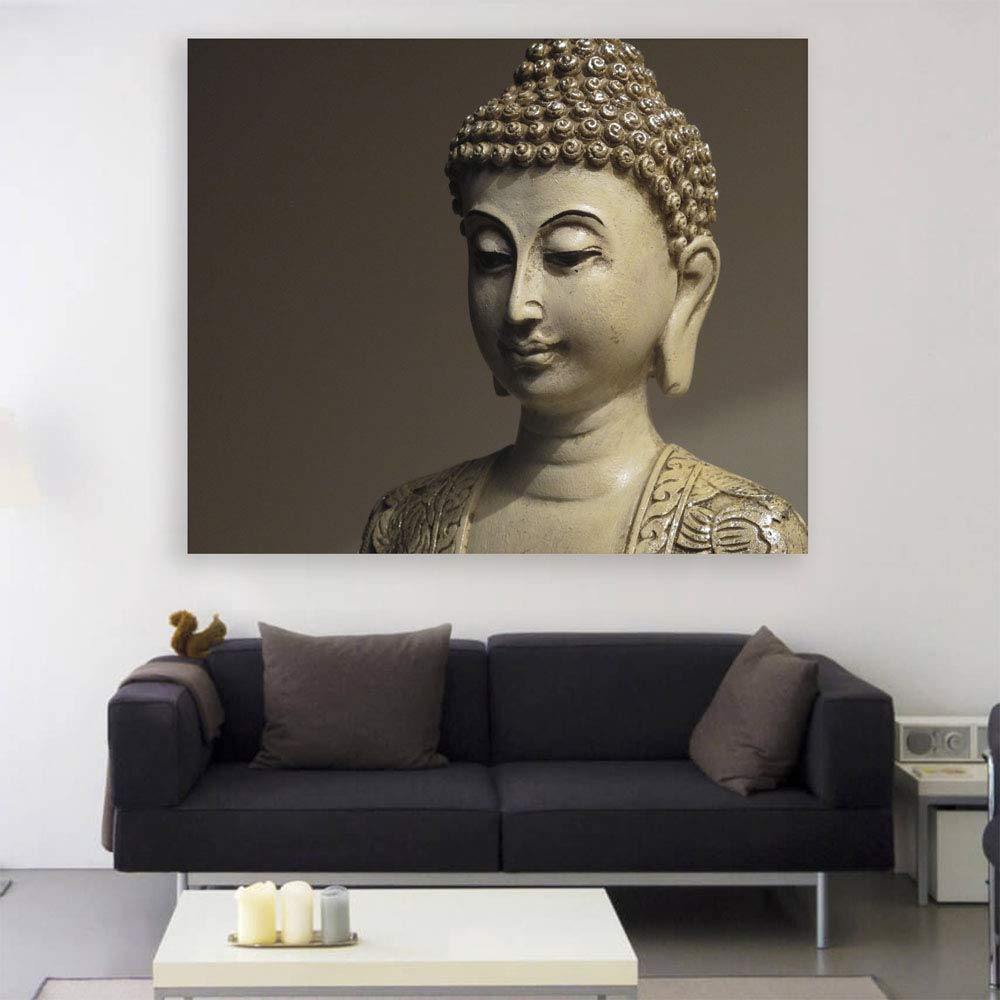

Buddha Bliss framed Wall Art
You may also like

Moolwan Buddha Portrait Canvas Wall Art Painting (91x76cm) – Contemplative Three-Quarter Gaze
When That Wall Has Been Empty Too Long
You've walked past it for months — that stretch of wall above the sofa that still doesn't have anything on it. You've scrolled through hundreds of options. The frontal Buddha poses all look the same. The colors look fine on screen but you're not sure how they'll actually work with your cream walls and wooden furniture. At 91x76cm, this Buddha portrait fills that specific gap: large enough to anchor the space, proportioned to work above a standard 6-foot Indian sofa. The three-quarter angle — face turned slightly left, eyes cast downward — creates a contemplative presence that frontal Buddha prints don't achieve. The figure doesn't stare at you; it rests in stillness.
Why 91cm Width Works on 150-180cm Walls
At 91cm wide, this canvas covers approximately 50-60% of a typical 6-foot (180cm) sofa's visual span. This ratio creates anchored presence without overwhelming the furniture below. If your sofa is 8 feet (240cm), this piece reads as intentional restraint — a focused statement rather than an attempt to fill maximum space.
Viewing distance matters here. From the doorway (typically 3-4 meters in Indian living rooms), the Buddha's face remains the clear focal point. The dark background recedes, making the figure appear almost sculptural against your wall. Up close, the textured detailing on the ushnisha and robe becomes visible.
Hang 20-25cm above your sofa's top cushion. This height keeps the artwork visually connected to the furniture rather than floating in isolation.
How Stone-Cream and Gold-Bronze Tones Behave on Indian Walls
The Buddha figure sits in stone-cream and warm sand tones — colors that don't fight cream or off-white walls. Instead, they create subtle tonal harmony. The gold-bronze highlights on the crown and robe detailing add warmth without looking gaudy under Indian warm-white LEDs.
In morning light, the taupe background appears slightly cooler, more gray-olive. The Buddha's face looks carved from pale stone. In evening LED lighting (3000K warm white, standard in most Indian homes), the entire palette warms up — the background deepens to a rich olive-brown, and the gold accents on the robe become more pronounced.
Against brown wooden furniture — the coffee tables and TV units common in Indian living rooms — the gold-bronze tones create natural visual echo. The palette doesn't clash with beige or gray sofas either; the neutral figure reads as timeless rather than matchy.
Installation in Indian Walls
For concrete walls (common in older buildings): Use the included concrete anchors with a 6mm masonry bit. Drill 35mm deep. The canvas weighs approximately 1.5-2kg at this size — well within safe limits for standard anchors.
For drywall (modern apartments): Plastic wall anchors work fine. Same 6mm holes, 30mm depth.
The included hanging template eliminates measurement anxiety. Tape it to your wall at eye level, mark the drill points, remove, drill. Total time: 15-20 minutes including the part where you step back three times to confirm it's level.
For rentals: These 6mm holes patch invisibly with standard wall putty. Your deposit isn't at risk.
What Fabric Tapestries Can't Do
Buddha tapestries cost less. They also drape, wrinkle, collect dust in the weave, and look increasingly shabby after one monsoon season. The fabric absorbs humidity, creating that slightly musty smell in homes without constant AC.
Canvas on a proper frame stays taut. The moisture-resistant coating means the surface stays flat through humidity cycles. You dust it once a month with a dry cloth — that's the entire maintenance requirement. Three years from now, this canvas looks the same as the day it arrived. Tapestries don't age that way.
What This Actually Feels Like in Your Room
From the doorway, you'll notice the Buddha first — the off-center composition draws the eye naturally. The dark background creates a frame-within-frame effect, making the figure appear to occupy its own contained space rather than just sitting on canvas.
This piece anchors a wall. It doesn't need adjacent décor to feel complete. In fact, adding flanking elements would dilute the contemplative mood. Let it exist as a solo statement.
The gaze direction matters: the Buddha looks toward the lower left. If you hang this above a sofa, that downward angle creates a subtle sense of the figure watching over the room — present but not confrontational.
Moolwan Design Note
The three-quarter portrait angle avoids the static quality of frontal Buddha prints. The turned face and downward gaze create contemplative depth — this piece invites pause rather than decoration.
Moolwan Quality Standard
Printed to resist humidity-related color fading. Packed for long-distance Indian transit. Quality checked before dispatch. Ships from West Bengal.
Moolwan Fit Guidance for Indian Homes
91cm width anchors 6-foot sofas without overwhelming them. The stone-cream and taupe palette complements cream walls and wooden furniture common in Indian apartments.
Quick Specifications
- Product: Moolwan Buddha Portrait Canvas Wall Art Painting (91x76cm)
- Brand: Moolwan
- Category: Canvas Wall Art Painting
- Collection: Buddha Wall Art Collection
- Dimensions: 91cm W × 76cm H × 2cm D
- Material & Construction: Pure cotton canvas 380 GSM, fade-resistant ink, imported pine wood sturdy frames
- Colors: Dark taupe/olive-gray background, stone-cream Buddha figure, gold-bronze crown and robe accents
- Best For: Living room above 6-foot sofa, meditation space, entryway
- Ships From: West Bengal
Frequently Asked Questions
Will 91x76cm look too small above my 8-foot sofa?
At 91cm, this canvas covers about 38% of an 8-foot (240cm) sofa's width. It reads as a focused statement piece rather than full-wall coverage. If you want more visual weight for an 8-foot sofa, consider the 120x80cm size option for 50% coverage.
How will the dark background look on my cream walls?
The taupe/olive-gray background creates gentle contrast against cream or off-white walls — visible separation without harshness. Under warm LED lighting, the background deepens slightly and feels integrated rather than stark.
Can I hang this in a room that gets afternoon sun?
Yes. The fade-resistant inks are tested for UV exposure. Direct afternoon sunlight won't shift the colors over normal use periods. The taupe background and muted gold tones are inherently forgiving of light variation.
How does this hold up during monsoon season?
The canvas has a moisture-resistant polymer coating. Humidity causes condensation to bead on the surface rather than soaking into fibers. The kiln-dried pinewood frame (12% moisture content) resists warping through humidity cycles.
Is this suitable for a meditation room or pooja space?
The contemplative pose and muted palette suit meditation spaces well. For placement near a pooja area, ensure proportional balance — this 91cm piece works as a complementary spiritual presence rather than competing with existing religious displays.
Product Snapshot
- Brand: Moolwan
- Product: Moolwan Buddha Portrait Canvas Wall Art Painting (91x76cm)
- Category: Canvas Wall Art Painting
- Collection: Buddha Wall Art Collection
- Theme/Type: Buddha portrait, three-quarter contemplative pose
- Best For: Living room above 6-foot sofa, meditation corner, entryway statement
- Primary Differentiator: Three-quarter portrait angle with contemplative downward gaze
- Secondary Differentiators: Dark taupe background creates gallery-like isolation; stone-cream and gold-bronze palette suits Indian interiors
- Material & Construction: Pure cotton canvas 380 GSM, fade-resistant ink, imported pine wood sturdy frames
- Care Instructions: Dust with dry microfiber cloth every 2-3 weeks; no water or chemicals
- Ships From: West Bengal
- Packing: Long-distance transit ready
- Quality Check: Before dispatch