
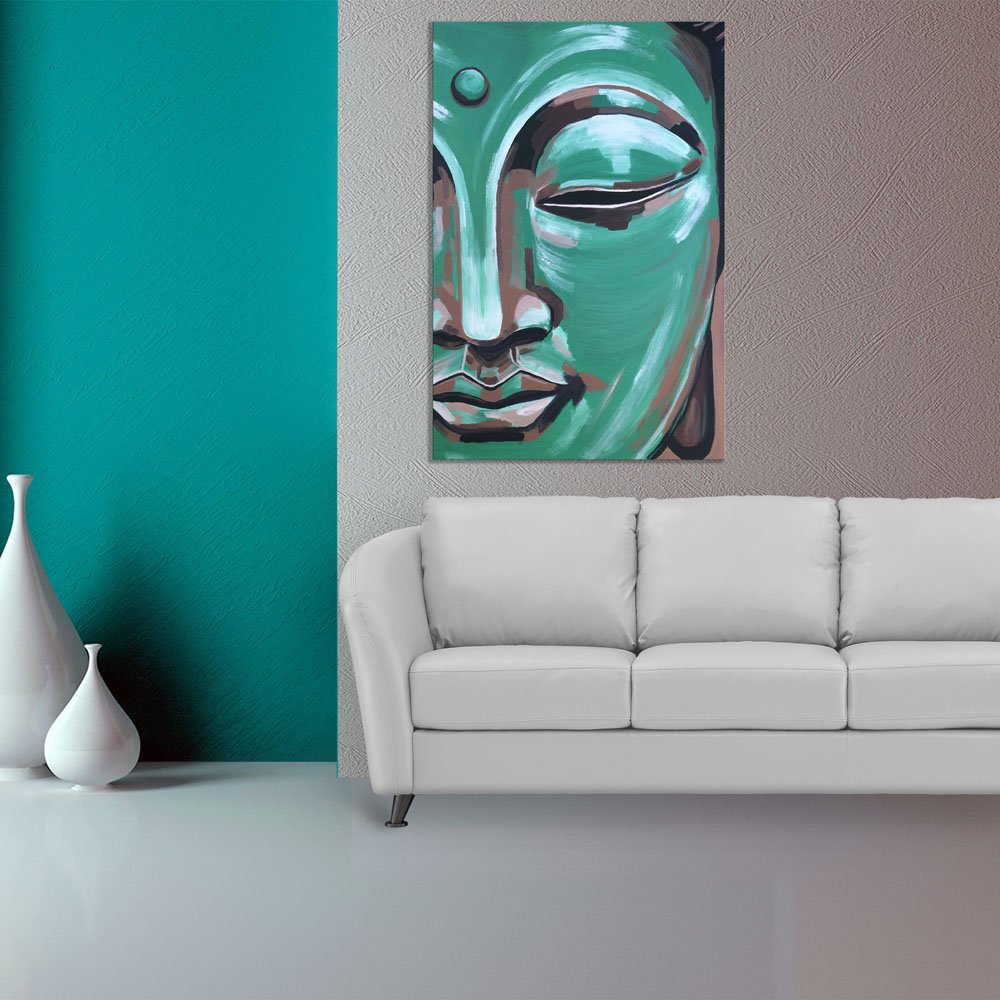

Buddha Bliss framed Wall Art That Sparks Inner Peace
You may also like

Moolwan Meditating Buddha Canvas Wall Art Painting (91x61cm) – Intimate Close-Crop Composition for Meditative Focus
You've measured that wall above your sofa three times. You've imagined something there—something calming, something that makes the room feel intentional instead of unfinished. But every Buddha painting you've seen online sits in a professionally styled room with perfect lighting and white walls, and you can't picture how it'll actually look against your cream wall, next to your brown sofa, under your warm LED bulbs. This 91cm x 61cm vertical canvas solves that specific problem. The composition crops tightly into the Buddha's face—closed eyes, serene expression, asymmetrical framing that fills the canvas without centering the subject. The result is a piece that feels intimate rather than decorative, like a meditation focal point rather than religious artwork hung for appearance. The sage-green palette with terracotta shadow work means it reads as warm under evening LED lighting while staying fresh in morning daylight—the exact lighting conditions your living room cycles through daily.
Why 91cm Height Works on 8-10ft Walls (And What Changes If You Go Smaller)
A 91cm tall canvas on a standard 8-foot (244cm) ceiling wall leaves roughly 75cm between the top of your sofa and the bottom of the frame (at the recommended 20-25cm gap), then 91cm of canvas, then approximately 78cm to the ceiling. This ratio—roughly 1:1:1—creates visual balance where the artwork anchors to the furniture below without crowding the ceiling above.
Go smaller (60cm height), and the canvas floats awkwardly in too much negative space. Your eye doesn't know where to rest. The wall still feels empty because the artwork doesn't command enough visual weight relative to the sofa beneath it.
The 61cm width works above sofas in the 180-200cm range (6-foot to 6.5-foot sofas, common in Indian 2BHKs). If your sofa is wider—say, 240cm—this piece works better as a solo vertical statement slightly off-center, balanced by a floor lamp or plant on the opposite side.
Viewing distance matters here. From across a typical Indian living room (3-4 meters), the Buddha's face reads clearly as a meditative figure. From the sofa itself, you see the brushstroke texture and color gradations—the piece rewards both distances.
What These Greens Actually Look Like on Cream Walls (Morning vs LED)
The product image shows sage green as the dominant tone, but there's nuance the photo can't fully communicate. The green shifts depending on your lighting:
In morning daylight (east-facing windows, 7-10am): The sage reads cooler, almost mint. The pink and mauve accents in the shadow work become more visible. The overall effect is fresh and slightly contemporary.
In afternoon light (11am-4pm, indirect): The green neutralizes. The terracotta brown shadows warm up. The piece looks balanced—neither cool nor warm, just calm.
In evening under warm LED (3000K, the standard in most Indian homes): The sage green takes on a slightly golden undertone. The terracotta shadows deepen. The pink accents nearly disappear into warmth. This is when the piece looks most traditional, most grounded.
Against cream or off-white walls (the default in 80% of Indian apartments), this palette works because it doesn't fight the wall color. Cool blues or stark whites would create visual tension against cream. This sage-terracotta combination sits harmoniously—present but not demanding.
If you have brown or beige fabric sofas, the terracotta shadows in the Buddha's face echo that warmth. The piece looks like it belongs rather than like you're trying to introduce a new color scheme.
Installation in Indian Walls (Concrete vs Drywall)
Most Indian apartment walls are either solid concrete (older buildings, load-bearing walls) or brick with plaster. True drywall (gypsum board over metal studs) exists mainly in modern commercial-style apartments and accent walls.
For concrete or plastered brick: You need a 6mm masonry bit and concrete anchors. Drill 35mm deep at the marked points from your hanging template. The anchors expand inside the hole when you drive the screw, creating holding power that exceeds what this 400-gram canvas requires by a factor of ten.
For drywall sections: Plastic drywall anchors work. Same 6mm hole, 30mm depth. The anchor's wings spread behind the gypsum board.
How to tell which you have: Tap the wall. Solid thud = concrete or brick. Hollow sound = drywall. If you're unsure, start with the concrete method—a masonry bit through drywall just creates a clean hole, no damage.
At 400 grams, this canvas is light enough that even a single properly installed anchor holds it securely. The D-ring hanging system distributes weight across two points, keeping the frame level without constant adjustment.
Rental consideration: Two 6mm holes, 35mm deep, positioned behind where the frame hangs. When you move out, fill with wall putty (₹50 at any hardware store), let dry, sand flush, touch up with matching paint if needed. Total repair time: 15 minutes. Your landlord won't notice unless they're specifically looking for patched holes.
Why Canvas Instead of Macrame or Fabric Hangings for This Wall
Macrame wall hangings have had a moment. They're textural, they move slightly in air currents, they feel handcrafted. But for a meditation-focused space or a living room where you want calm, they create problems canvas doesn't.
Visual noise: Macrame patterns are inherently busy. The knotwork, the fringe, the varying cord thicknesses—your eye has no single place to rest. A close-crop Buddha face gives your eye exactly one focal point: the serene expression.
Dust accumulation: Cotton macrame rope collects dust in every twist and knot. In Indian conditions—ceiling fans running daily, windows open during non-monsoon months—macrame needs washing every 2-3 months to not look dingy. Canvas with a moisture-resistant coating dust-wipes clean in thirty seconds.
Color consistency: Macrame comes in natural cotton (off-white that yellows over time), dyed cotton (fades unevenly), or synthetic (looks plastic). None of these hold specific colors like sage green with terracotta accents. Canvas printing locks in exact color relationships that don't shift.
Longevity: A quality macrame hanging might last 2-3 years before the fiber breaks down visibly—sagging, stretching, fraying edges. Properly constructed canvas on kiln-dried frames maintains tension and color for 5+ years in Indian climate conditions.
The tradeoff is texture. Macrame has dimensional depth that flat canvas doesn't. But for a meditative focal point where you want visual stillness rather than tactile interest, the flat plane of canvas serves the purpose better.
What This Will Actually Feel Like in Your Room
From the doorway: The vertical format draws the eye upward, then the sage green registers as "calm" before you consciously process the Buddha subject. The close-crop composition means it reads as "art" first, "spiritual" second—important if you want meditative energy without overt religious display.
From the sofa: You see texture. The brushstroke-style rendering becomes apparent. The small circular element (moon or orb) in the upper left corner provides a secondary detail that rewards longer looking. The asymmetry keeps it interesting without being restless.
For guests: This piece prompts "I like that" more than "Oh, you're Buddhist?" The contemporary color palette and artistic rendering style make it feel like a design choice rather than a devotional one. If that distinction matters in your household or social circle, this canvas threads the needle.
Solo vs paired: This piece wants to be alone on its wall section. The close-crop composition already fills the frame edge-to-edge—adding adjacent pieces creates competition. If you have a large wall (3+ meters), position this canvas with empty space on both sides, not crowded between other frames.
The 91x61cm size reads as substantial without overwhelming. It anchors the wall without making the room feel like a gallery or shrine. In a 12x14 foot living room (typical Indian 2BHK), it hits the right scale.
Moolwan Design Note
The close-crop asymmetry—face filling the frame, eyes positioned off-center—creates intimacy that traditional centered Buddha compositions don't achieve. Your eye rests on the closed eyelid and follows the serene expression rather than scanning a full figure.
Moolwan Quality Standard
Designed for Indian apartments and lighting conditions. Printed to resist humidity-related color fading. Packed for long-distance Indian transit. Quality checked before dispatch. Ships from West Bengal.
Moolwan Fit Guidance for Indian Homes
The 91cm height works above 6-foot sofas in rooms with 8-foot ceilings. Position bottom edge 20-25cm above sofa back for anchored visual connection.
Quick Specifications
| Attribute | Detail |
|---|---|
| Product | Moolwan Meditating Buddha Canvas Wall Art Painting (91x61cm) |
| Brand | Moolwan |
| Category | Canvas Wall Art Painting |
| Collection | Buddha Wall Art Collection |
| Dimensions | 91cm (H) x 61cm (W) x 1cm (D) |
| Weight | 400 grams |
| Material & Construction | 380 GSM pure cotton canvas, fade-resistant eco-solvent ink, imported pine wood sturdy frame |
| Colors | Sage green, mint, terracotta brown, mauve-pink accents |
| Best For | Living room above 6ft sofa, meditation corner, bedroom feature wall |
| Ships From | West Bengal |
Frequently Asked Questions
Will 91x61cm look proportional above my 6-foot sofa, or will it seem too narrow?
At 61cm wide, this canvas covers roughly one-third the width of a 180cm sofa—slightly narrower than the 60-75% ratio recommended for horizontal pieces. However, vertical canvases follow different visual logic. The height (91cm) creates presence, and the asymmetrical close-crop composition fills the frame so completely that the piece reads as substantial. If you want more horizontal coverage, consider flanking with small plants or a floor lamp rather than adding additional frames.
The green looks different on my phone versus my laptop. What color will I actually receive?
The sage green has warm undertones that appear cooler on blue-light-heavy phone screens and warmer on laptops with night-mode enabled. The actual canvas matches natural-daylight photography conditions. Under your home's warm LED lighting (3000K), expect the green to read slightly warmer than it appears on most screens—more sage-olive than sage-mint.
Can I hang this on a rental apartment wall without losing my deposit?
Yes. Installation requires two 6mm holes, each 35mm deep—smaller than holes left by standard picture hooks. When moving out, fill with wall putty, sand smooth, touch up with matching paint if your walls aren't stark white. Total cost: under ₹100. Total time: 15 minutes. Holes positioned behind the frame location are typically invisible during move-out inspection.
How will this hold up during Mumbai/Chennai monsoons with 80%+ humidity?
The canvas has a moisture-resistant polymer coating that prevents vapor absorption. The pine wood frame is kiln-dried to 12% moisture content before construction, below the equilibrium point for coastal humidity. Previous monsoon seasons won't cause rippling, warping, or color shift. The eco-solvent inks are UV-stable, so humidity plus indirect sunlight won't accelerate fading.
Does the Buddha subject work in a living room, or is it better suited for a dedicated meditation space?
The contemporary color palette (sage green rather than traditional gold or earth tones) and artistic brushstroke rendering make this piece read as "art with meditative qualities" rather than "religious iconography." It works in living rooms where you want calm energy without overt spiritual display. Guests typically respond to it as a design choice rather than a devotional statement.
Product Snapshot
| Attribute | Detail |
|---|---|
| Brand | Moolwan |
| Product | Moolwan Meditating Buddha Canvas Wall Art Painting (91x61cm) |
| Category | Canvas Wall Art Painting |
| Collection | Buddha Wall Art Collection |
| Theme/Type | Meditating Buddha, close-crop portrait |
| Best For | Living room above 6ft sofa, meditation corner, bedroom wall |
| Primary Differentiator | Intimate close-crop asymmetrical composition with face filling frame |
| Secondary Differentiators | Sage-green palette with terracotta shadows; painterly brushstroke texture |
| Material & Construction | 380 GSM pure cotton canvas, fade-resistant eco-solvent ink, imported pine wood sturdy frame |
| Care Instructions | Dust with dry microfiber cloth every 2-3 weeks; no water or chemicals |
| Ships From | West Bengal |
| Packing | Long-distance transit ready |
| Quality Check | Before dispatch |