
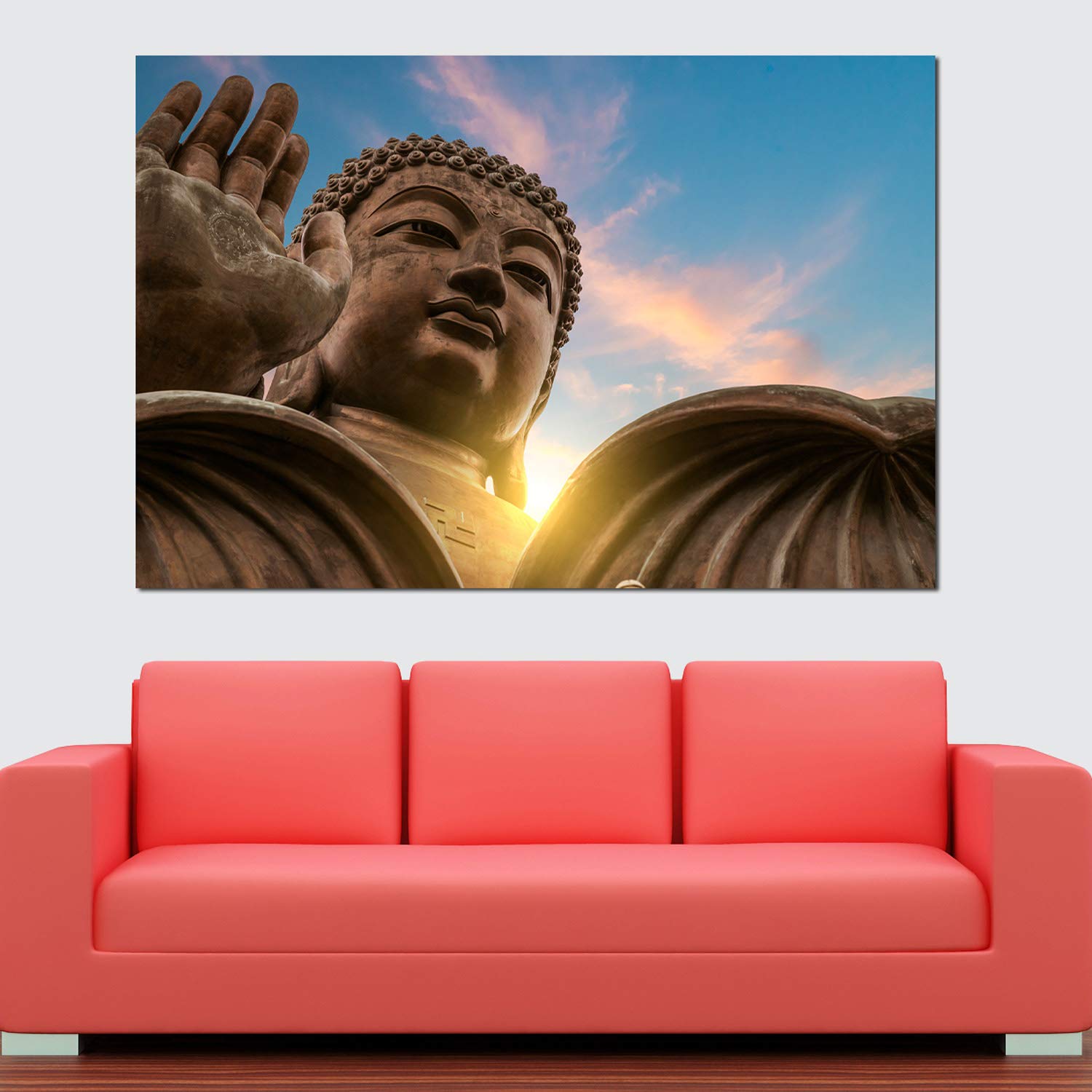

Buddha Bliss Unframed Wall Art: Chill Vibes Only
You may also like

Moolwan Buddha Abhaya Mudra Sunrise Canvas Wall Art Painting (91x61cm) – Low-Angle Sunrise Composition with Grounded Monumentality
That wall above your sofa has been empty for months now. You've scrolled through hundreds of Buddha paintings online, but every single one looks the same in photos—serene face, closed eyes, maybe some lotus flowers. You can't tell which one will actually feel substantial on your wall versus which one will arrive looking like a poster someone stretched over cheap wood. The mockup images show these pieces in pristine white rooms with perfect lighting, but your living room has cream walls, a brown fabric sofa, and that specific warm LED light you installed last year.
This particular composition solves that visualization problem through its low-angle perspective. The Buddha figure is photographed from below, looking upward—which means on your wall, it creates the same sense of grounded presence that you'd feel standing beneath an actual monument. The sunrise positioned at chest level draws your eye to a natural focal point, not scattered across the canvas. At 91cm wide, this covers approximately 50-55% of a standard 6-foot Indian sofa, which places it in the proportional sweet spot where it commands attention without overwhelming the seating below.
Why 91cm Width Works on 10-12 Foot Living Room Walls
The 91x61cm dimensions create specific visual behavior on Indian apartment walls. On a 10-foot wall (300cm), this canvas occupies roughly 30% of the horizontal space—enough presence to anchor the wall without making the room feel smaller. On a 12-foot wall (360cm), coverage drops to 25%, which works when you have side tables or floor lamps flanking your sofa that need visual breathing room.
From your doorway—where guests first see the room—the 91cm width reads as intentional. Not so large that it dominates every sightline, not so small that it looks like an afterthought. The 61cm height fits comfortably in the space between a standard sofa top (85-90cm from floor) and an 8-foot ceiling, leaving the recommended 20-25cm gap above furniture. For 10-foot ceilings, you gain additional wall space above, but the canvas proportions remain balanced because the horizontal orientation anchors to the sofa width, not the ceiling height.
Viewing distance matters: from 2.5-3 meters (typical Indian living room depth), the low-angle Buddha face remains clearly visible, and the sunrise glow creates a warm focal point that pulls the eye naturally.
What These Bronze and Blue Tones Look Like on Cream Walls Under Indian Lighting
The color transition in this canvas moves from warm bronze (the Buddha figure) through golden yellow (the sunrise) to soft blue with pink-tinged clouds. This specific palette behaves differently depending on your lighting:
Under morning daylight through east-facing windows, the blue sky portion appears more vivid, and the bronze Buddha takes on cooler undertones. The overall effect feels fresh and expansive.
Under evening warm LED lighting (the 3000K bulbs most Indian homes use), the bronze and golden tones intensify while the blue recedes slightly. The canvas appears warmer, more intimate—which is when most people actually spend time in their living rooms and when guests typically visit.
Against cream or off-white walls (the default in most Indian apartments), the warm bronze provides enough contrast to define the canvas edges without creating harsh visual boundaries. The golden sunrise center naturally draws the eye, which means your wall doesn't need additional accent lighting to make this piece work.
With brown or beige sofas and wooden furniture—the dominant combination in Indian homes—the bronze tones in the Buddha figure echo the wood grain and furniture colors. This creates cohesion rather than the "floating art on a wall" effect that happens when canvas colors have no relationship to room furnishings.
Installation in Indian Walls (Concrete vs Drywall)
Most Indian apartment walls are concrete with plaster finish, not drywall. For this 400-gram canvas, you need two anchor points, each requiring a 6mm hole drilled 35mm deep. The included concrete anchors expand inside the hole when you insert the screw, creating secure holds that won't pull out.
If your building is newer construction with some drywall sections (common around electrical panels or AC ducts), tap the wall first—hollow sound means drywall, solid sound means concrete. Drywall needs the plastic expansion anchors instead, drilled only 30mm deep.
The hanging template included with this canvas eliminates measurement anxiety. Tape it to the wall at your chosen height (measure 20-25cm above your sofa cushion top), mark the two drill points through the template holes, remove the paper, drill, and mount. Total time: 15-20 minutes including the part where you step back three times to verify it's level.
For rentals: these 6mm holes patch invisibly with standard wall putty (₹50 at any hardware store). When you move out, fill, sand smooth, touch up with paint. Your landlord won't notice, and you won't lose deposit money over properly mounted wall art.
Why Canvas Instead of Macrame Wall Hangings
Macrame wall hangings occupy a similar price range and serve the same "fill the empty wall" function, but the practical differences matter for Indian conditions:
Macrame accumulates dust in every knot and fiber. In Indian cities with construction dust, traffic pollution, and monsoon humidity, those fibers become dust traps within weeks. Cleaning requires removing the entire piece, washing carefully, drying completely (which takes days during monsoon), and rehanging. Canvas with moisture-resistant coating wipes clean with a dry microfiber cloth in 30 seconds.
Macrame fibers absorb humidity. During monsoon months (70-85% humidity in coastal cities), the cotton or jute develops that specific musty smell. The fibers can grow mildew if your wall has any trapped moisture. Canvas with polymer coating resists moisture absorption entirely—vapor beads on the surface instead of soaking into the material.
Visual presence differs significantly. Macrame creates texture and movement but lacks color impact from across the room. At 91x61cm, this Buddha canvas creates a defined focal point visible from your doorway. The bronze and golden tones read clearly from 3-4 meters away. Macrame at the same size appears as texture without specific visual content.
What This Will Actually Feel Like in Your Room
From your doorway walking in: the sunrise golden glow registers first, drawing your eye to the wall above the sofa. The Buddha figure fills your peripheral vision with warm bronze tones. The overall impression is calm presence, not loud statement.
Sitting on your sofa: looking up at the canvas, the low-angle composition creates the same upward perspective the photographer captured—monumentality without intimidation. The Abhaya mudra (raised palm blessing gesture) faces outward into the room.
From the dining area (if visible from living room): at this distance, color and form dominate over detail. The warm bronze reads as a cohesive shape against your cream wall, anchoring that section of the room.
This canvas works best as a standalone focal point. The composition is complete within its frame—the Buddha figure fills the canvas from robe to raised hand. Adding adjacent décor (smaller frames, wall shelves) creates visual competition rather than enhancement. If your wall is wider than 12 feet and feels unbalanced with one piece, consider a single plant stand below rather than additional wall items beside.
Moolwan Design Note
The low-angle sunrise composition places the light source at chest level rather than behind the head—a deliberate choice that creates warmth without the backlit halo effect common in Buddha imagery. The Abhaya mudra hand enters the frame from the left, creating directional movement that resolves at the serene face.
Moolwan Quality Standard
Designed for Indian apartments and lighting conditions. Printed to resist humidity-related color fading. Packed for long-distance Indian transit. Quality checked before dispatch. Ships from West Bengal.
Moolwan Fit Guidance for Indian Homes
At 91x61cm, this canvas covers 50-55% of a standard 6-foot sofa width—the proportional range where wall art commands attention without overwhelming seating furniture. Mount 20-25cm above sofa cushion top for anchored visual connection.
Quick Specifications
- Product: Moolwan Buddha Abhaya Mudra Sunrise Canvas Wall Art Painting (91x61cm)
- Brand: Moolwan
- Category: Canvas Wall Art Painting
- Collection: Buddha Wall Art Collection
- Dimensions: 91cm W × 61cm H × 2cm D
- Weight: 400 grams
- Material & Construction: 340 GSM pure cotton canvas, eco-solvent UV-resistant inks, 1.5-inch kiln-dried pinewood frame with moisture-resistant coating
- Colors: Bronze/warm brown Buddha figure, golden sunrise center, soft blue sky with pink-tinged clouds
- Best For: Living room walls above 6-foot sofas, meditation corners, entryway focal points in homes with cream walls and wooden furniture
- Ships From: West Bengal
Frequently Asked Questions
Will 91cm look proportional above my 6-foot sofa, or should I size up?
At 91cm width above a 6-foot (180cm) sofa, you're at approximately 50% coverage—the lower end of the ideal 50-75% range. This works well if you have side tables or floor lamps beside your sofa that occupy visual space. If your sofa sits alone against the wall with empty space on both sides, the 120cm option provides stronger presence.
How will the bronze and blue colors look under my warm LED lights?
Under warm LED lighting (3000K, the standard in most Indian homes), the bronze Buddha figure and golden sunrise intensify while the blue sky recedes. The canvas reads warmer overall in evening lighting than in the product photo, which was shot in natural daylight. Against cream walls, this creates a cohesive warm presence rather than the cooler effect you see in the image.
Can I install this in a rental without losing my deposit?
Yes. This canvas requires two 6mm anchor holes, which are smaller than standard picture frame nail holes. When you move out, fill with wall putty, sand smooth, touch up with matching paint. Total repair takes 20 minutes and costs under ₹200 in materials. The included hanging template ensures you drill in the correct spots the first time—no cluster of failed attempts.
Will the colors fade in my Mumbai apartment during monsoon?
The eco-solvent inks used in this canvas are UV-resistant and tested for humidity conditions up to 85%. The moisture-resistant coating on the canvas surface prevents humidity absorption that causes color shift. After two monsoon seasons, you should see no visible fading—the bronze and golden tones will remain consistent.
Is this canvas too heavy for adhesive strips, or do I need to drill?
At 400 grams, this canvas is technically within the weight limit for heavy-duty adhesive strips. However, for a 91cm-wide piece, proper wall anchors provide more reliable long-term hold—adhesive can fail gradually in humid conditions, and a falling canvas risks frame damage. The 15-minute anchor installation is worth the permanence, and the holes are easily patchable when you move.
Product Snapshot
- Brand: Moolwan
- Product: Moolwan Buddha Abhaya Mudra Sunrise Canvas Wall Art Painting (91x61cm)
- Category: Canvas Wall Art Painting
- Collection: Buddha Wall Art Collection
- Theme/Type: Buddha with Abhaya Mudra at Sunrise
- Best For: Living room walls above 6-foot sofas in Indian homes with cream walls and wooden furniture
- Primary Differentiator: Low-angle sunrise composition creating grounded monumentality
- Secondary Differentiators: Abhaya mudra blessing gesture visible; warm bronze-to-blue color transition
- Material & Construction: 340 GSM pure cotton canvas, eco-solvent UV-resistant inks, 1.5-inch kiln-dried pinewood frame, moisture-resistant polymer coating
- Care Instructions: Dust with dry microfiber cloth every 2-3 weeks; avoid water and cleaning chemicals
- Ships From: West Bengal
- Packing: Long-distance transit ready (bubble wrap + corner protectors + outer carton)
- Quality Check: Before dispatch