
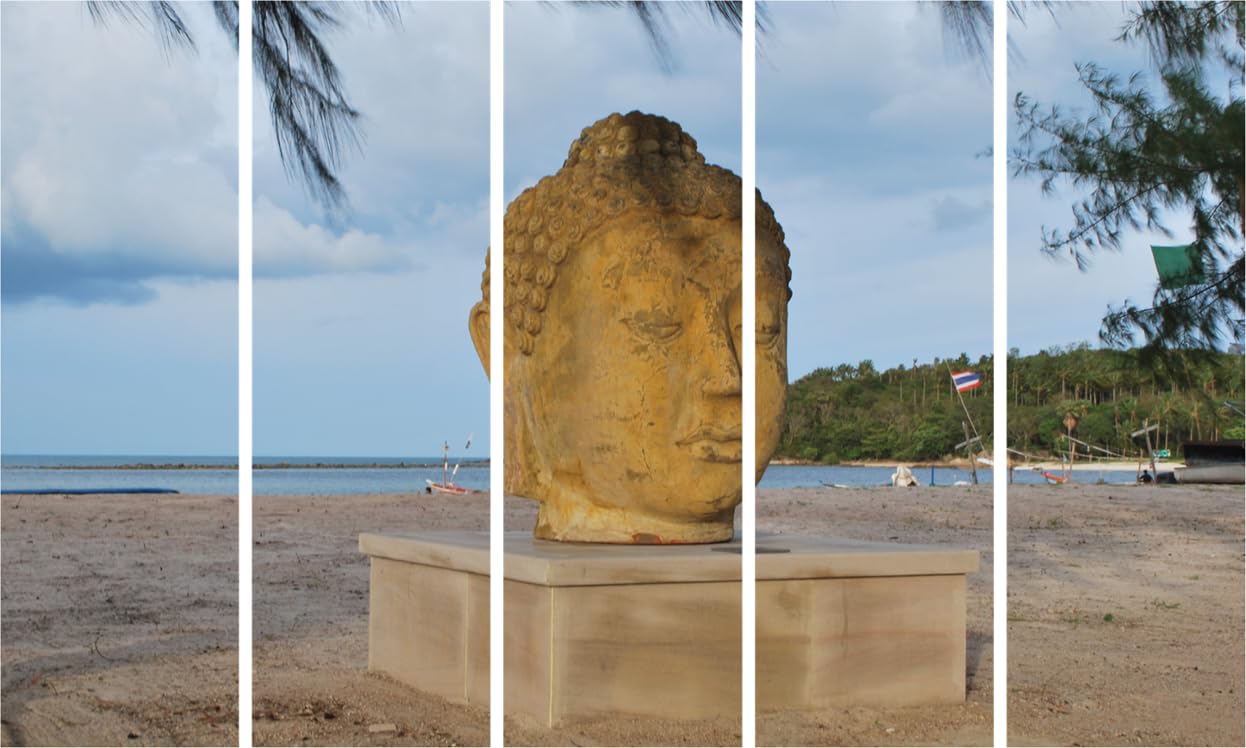
Buddha Bliss: Framed 5-Panel Wall Art That'll Have Stress Saying Goodbye
You may also like

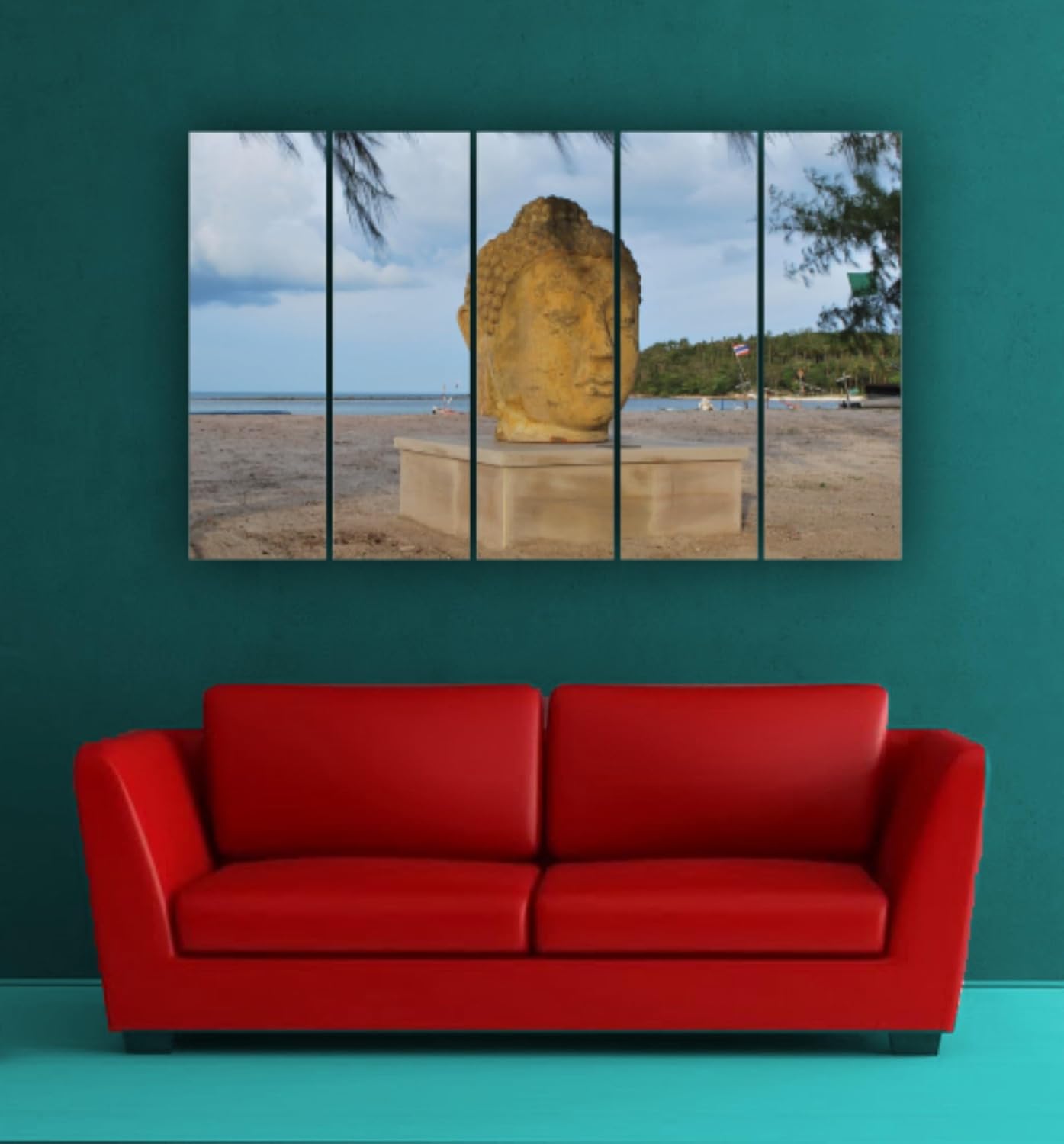
Moolwan 5-Panel Coastal Buddha Vinyl Wall Art on MDF (127x76cm) – Meditative Calm Meets Coastal Openness
Three weekends of browsing. Maybe more. Dozens of Buddha wall art pieces saved, several tabs still open, and you're still here because every time you get close to buying, the same question stops you: will this actually bring the calm I'm looking for, or will it just hang there like another decoration? You're not indecisive—you're careful. Because once this is on your living room wall, you'll see it every single day. It needs to feel right.
This 5-panel coastal Buddha composition does something most Buddha wall art doesn't. Instead of placing Buddha against dark backgrounds or abstract patterns, it positions a weathered golden Buddha head against an actual beach—ocean horizon, sandy shore, palm fronds, open sky. The result is a visual that breathes. The golden ochre of the Buddha sculpture anchors your eye to the center panel, while the surrounding four panels extend the coastal scene outward, creating depth without crowding. At 127cm wide and 76cm tall, this covers substantial wall space while maintaining the horizontal calm that Buddha imagery requires.
The palette matters here. Golden ochre dominates the Buddha, shifting to sandy beige at the base, with soft sky blues and muted greens in the background. These aren't the saturated colors that clash with Indian interiors—they're toned, earthy, the kind that settle into cream walls and complement brown wooden furniture without demanding attention. Morning light will cool the blues slightly; evening LED will warm the golden tones. Both work.
Why 127cm Works on 10-12 Foot Walls (And What Changes If You Size Up or Down)
Your living room wall is probably 10-12 feet wide—standard in most 2BHK and 3BHK apartments. At 127cm (roughly 4.2 feet), this 5-panel set covers approximately 35% of a 12-foot wall and 42% of a 10-foot wall. That leaves balanced breathing room on either side: about 116cm (3.8 feet) on each side of a 12-foot wall, or 86cm (2.8 feet) on each side of a 10-foot wall.
This is deliberate. Buddha wall art that dominates a wall creates visual tension—the opposite of what you want from meditative imagery. The 35-42% coverage ratio creates presence without overwhelm. The 5-panel format extends the scene horizontally, making the composition feel expansive rather than compressed.
If you went smaller—say, 90cm—you'd be at roughly 25% wall coverage. The coastal scene would feel like a window rather than an environment. The Buddha would read as a small accent rather than a focal point. If you went larger—150cm—you'd approach 50% coverage, which works on 14-foot walls but risks feeling cramped in standard Indian living rooms, especially if you have a side table or floor lamp near the sofa.
Above an 8-foot sofa, 127cm sits comfortably within the sofa's visual width. Above a 6-foot sofa, it extends slightly beyond—which works for Buddha compositions because the extended sky and beach panels frame the furniture rather than fight it.
How Golden Ochre and Coastal Blues Look in Indian Living Rooms
You've seen Buddha art online that looks serene in photos and garish in person. Usually, that's because the colors were designed for white-walled Western interiors, not the cream, off-white, and builder's peach that covers most Indian apartment walls.
This coastal Buddha works differently. The dominant golden ochre of the Buddha head is a warm neutral—it complements cream walls rather than contrasting them. The sandy beige base and beach foreground echo the warm undertones already present in most Indian wall paints. The sky blues are muted, not saturated—they add visual relief without creating a temperature clash against warm wall colors.
In morning daylight from east-facing windows, the sky portions will appear slightly brighter, the golden Buddha slightly cooler. The overall effect: fresh, airy, open. In evening LED lighting (the warm white 3000K that most Indian homes use), the golden ochre intensifies, the blues recede, and the Buddha head becomes the dominant visual element. Both conditions work—the composition was designed for this tonal range.
Against brown sofas and wooden furniture (coffee tables, TV units), the golden and sandy tones create continuity. The coastal setting doesn't clash with traditional Indian furniture the way abstract or minimalist Buddha art sometimes does. Your mother-in-law won't pause and wonder why there's a beach in your living room—the Buddha is clearly the subject, the beach is clearly the backdrop.
Installation in Indian Walls (Concrete and Drywall)
Five panels means five mounting points—but that's simpler than it sounds. Each panel hangs independently using included hardware: concrete anchors for older buildings, drywall anchors for modern apartments, and D-ring hangers on each panel back.
The practical reality: start with the center Buddha panel. Mark 20-25cm above your sofa cushion top. Level it, drill, hang. Then work outward, using the included spacing guide to maintain consistent 2-3cm gaps between panels. The gaps matter—they're what creates the multi-panel effect. Too close and it looks like a botched single canvas; too wide and the scene fragments.
Total installation time: 25-30 minutes for all five panels, including the part where you step back repeatedly to check alignment. The holes you'll drill are 6mm diameter—smaller than standard picture frame anchors. When you move out of your rental, fill with wall putty, sand smooth, touch up with paint. Your ₹50,000 deposit stays intact.
For concrete walls (most older buildings), tap the anchor in, screw the hook, hang. For drywall (modern apartments), the plastic anchor expands behind the wall when you insert the screw. Both hold the 3kg total weight comfortably—each individual panel weighs about 600 grams.
How This Compares to Macrame Wall Hangings You've Considered
You've probably seen macrame Buddha pieces in the same search results—woven wall hangings with Buddha motifs, often priced similarly or slightly cheaper. The appeal makes sense: no drilling, just a single nail and a cord loop.
Here's the trade-off. Macrame is texture-forward—it adds dimension through woven patterns, but the imagery is always simplified, abstracted. You get the idea of Buddha, not the detail. The weathered texture of this stone Buddha head, the actual coastal landscape behind it, the way the golden ochre catches light differently across the sculpture's curves—macrame can't reproduce this.
More practically: macrame collects dust in its weave. In Indian homes, especially in cities with high particulate matter (Delhi, Mumbai, Chennai), you'll be cleaning it monthly or watching it gray over time. Vinyl print on MDF wipes clean with a dry cloth. Dust sits on the surface, doesn't embed.
And the visual weight differs. Macrame hangs—it has physical sag, movement, a craft aesthetic. This 5-panel set sits flush against the wall, creating a window effect into another space. For living rooms where you want deliberate, finished presence rather than bohemian softness, the flat panels read as more intentional.
What This Will Actually Look Like From Your Doorway
Walk into your living room from the main entrance. Your eye will find the golden Buddha head first—it's the warm focal point against cooler surroundings. The 5-panel format means the scene extends into peripheral vision before you consciously register the coastal details. The effect: calm presence that you notice without it demanding attention.
From across the room—3-4 meters away, typical viewing distance from a doorway or dining area—the composition reads as unified. The panel gaps disappear visually; you see a continuous coastal Buddha scene. This is the sweet spot for this size.
From the sofa directly below—1-2 meters away, looking up at an angle—you'll notice the panel edges, the vinyl texture, the individual frames. This isn't a flaw; it's how multi-panel art works. The closer you get, the more you see construction. The further you get, the more you see composition.
In terms of room dominance: this doesn't take over. The muted palette and horizontal format create presence without visual loudness. If you have a TV on an adjacent wall, colorful cushions, a busy bookshelf—this won't compete. It anchors its wall section and lets everything else coexist.
Moolwan Design Note
The coastal setting isn't decorative backdrop—it's compositional strategy. Beach horizons are the most universally calming visual pattern (sky-water-sand, three horizontal bands). Placing Buddha's meditative stillness against this pattern doubles the calming effect without doubling the visual complexity. The weathered golden stone texture prevents the Buddha from looking like a digital render; it reads as an actual sculpture photographed in an actual place.
Moolwan Quality Standard
Designed for Indian apartments and lighting conditions. Printed to resist humidity-related color fading. Packed for long-distance Indian transit with corner protection and bubble wrap. Quality checked before dispatch. Ships from West Bengal.
Moolwan Fit Guidance for Indian Homes
127cm width fits 10-12 foot walls with balanced coverage (35-42%). Position center panel 20-25cm above sofa top. Works above 6-8 foot sofas without extending awkwardly beyond furniture width. Golden ochre palette complements cream walls and brown wooden furniture common in Indian living rooms.
Quick Specifications
- Product: Moolwan 5-Panel Coastal Buddha Vinyl Wall Art on MDF (127x76cm)
- Brand: Moolwan
- Category: Vinyl Wall Art on MDF
- Collection: Buddha Wall Art Collection
- Dimensions: 127cm W × 76cm H × 0.6cm D (total mounted)
- Weight: 3,000 grams (3 kg total, ~600g per panel)
- Material & Construction: Splash-proof vinyl print on MDF panels
- Colors: Golden ochre, sandy beige, sky blue, muted green, cloud white
- Panel Count: 5 panels
- Best For: Living room walls 10-12 feet wide, above 6-8 foot sofas, meditation corners, entryways
- Ships From: West Bengal
- Delivery: 5-6 days metro cities, 6-8 days tier-2/3
- Price: ₹2,796
Frequently Asked Questions
Will 127cm look proportional above my 7-foot sofa, or should I go smaller?
127cm (about 4.2 feet) extends slightly beyond a 7-foot sofa's visual width, but for Buddha art, this works well. The extended sky and beach panels frame the sofa rather than sitting contained within it. If you prefer art that stays within sofa width, 90cm would be the alternative—but you'd lose the expansive coastal effect.
How will the golden ochre Buddha look against my light yellow walls?
Golden ochre and light yellow are adjacent warm tones—they harmonize rather than contrast. The Buddha will blend smoothly into your wall color, creating a cohesive warm palette. The sky blues in the background provide the visual contrast that defines the composition.
Can I hang this without drilling if I'm in a strict no-drill rental?
For 3kg total weight across 5 panels, adhesive strips aren't recommended—they may hold initially but risk failing over time, especially in humid conditions. However, the 6mm drill holes required are smaller than standard picture hooks and easily patchable with wall putty when you move out. Most landlords don't notice or penalize properly patched small holes.
Will the colors fade if my wall gets afternoon sun?
The vinyl print uses fade-resistant inks designed for Indian climate conditions. Direct afternoon sun won't cause visible fading within the product's expected lifespan. The moisture-resistant surface also prevents humidity-related color shift during monsoon months.
How do I align all 5 panels evenly without professional help?
Start with the center Buddha panel—hang it first at your desired height (20-25cm above sofa). Use a level to ensure it's straight. Then hang the adjacent panels using the spacing guide included, maintaining 2-3cm gaps. Work outward from center to edges. The process takes 25-30 minutes total.
Product Snapshot
- Brand: Moolwan
- Product: Moolwan 5-Panel Coastal Buddha Vinyl Wall Art on MDF (127x76cm)
- Category: Vinyl Wall Art on MDF
- Collection: Buddha Wall Art Collection
- Theme/Type: Coastal Buddha, spiritual with nature backdrop
- Best For: Living room walls 10-12 ft wide, above sofas, meditation spaces, entryways
- Primary Differentiator: Coastal Buddha composition—meditative subject against natural beach backdrop creates rare blend of spiritual calm with nature's openness
- Secondary Differentiators: Golden-ochre tonal warmth against muted sky blues; centered focal point with expansive horizontal breathing room
- Material & Construction: Splash-proof vinyl print on MDF, 5 independent panels
- Care Instructions: Dust with dry microfiber cloth; avoid water or cleaning chemicals
- Ships From: West Bengal
- Packing: Long-distance transit ready with corner protection
- Quality Check: Before dispatch
- Price: ₹2,796