
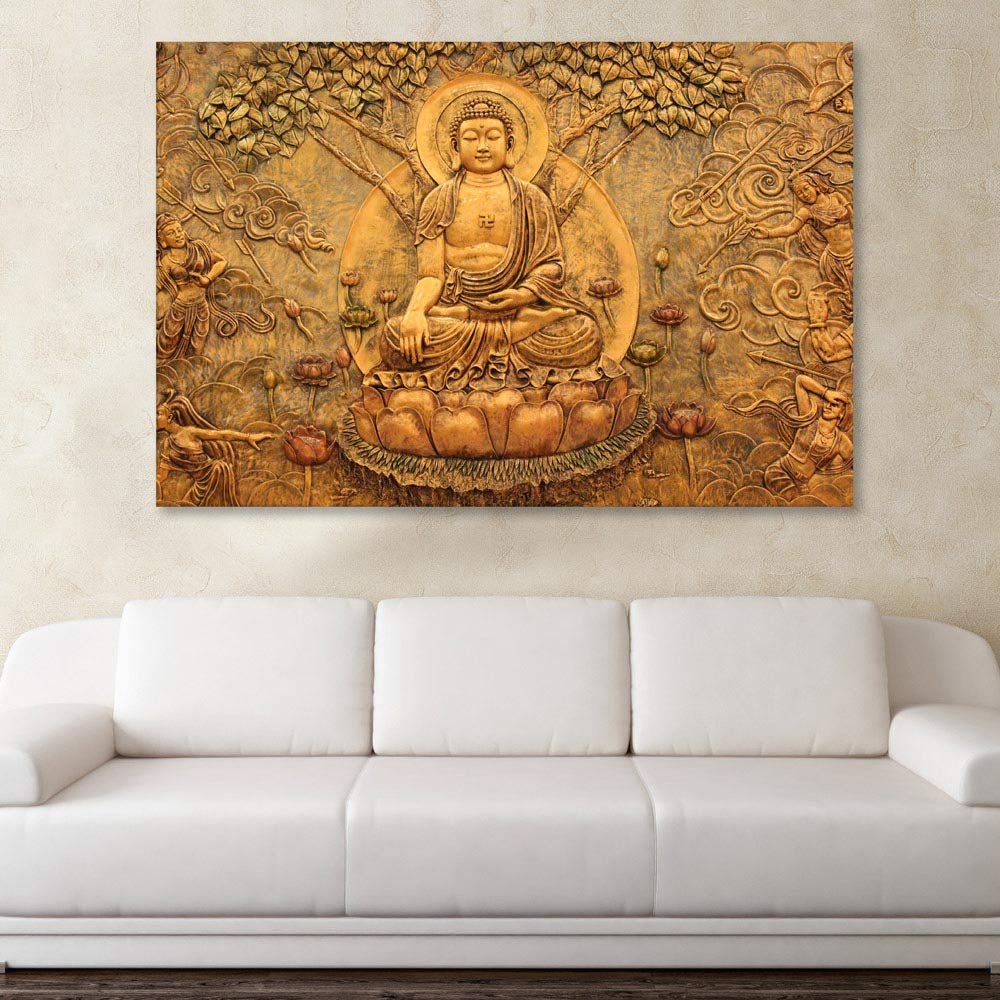

Buddha Bliss: framed Canvas Wall Art (91x61cm)
You may also like

Moolwan Buddha Canvas Wall Art Painting (91x61cm) – Faux Relief Sculptural Depth on Flat Canvas
You've measured your wall three times. Maybe four. The tape measure says 300cm, but you're still not confident because every sizing guide contradicts the next—some say go 60% of sofa width, others say 50% of wall width, and none of them seem to account for the fact that Indian sofas sit differently than the ones in Western mockups. You keep second-guessing: is 91cm actually right for your wall, or will it look undersized once it's up there?
Here's what 91cm does on a 10-12 foot wall: it occupies roughly 25-30% of the horizontal space, leaving 100-120cm on either side. That's deliberate. A centered Buddha composition doesn't need edge-to-edge coverage—it needs breathing room. The empty wall space around it becomes part of the visual statement, not an awkward gap. This particular piece carries a faux relief effect that mimics carved temple sculpture, creating perceived depth that makes the canvas feel substantial despite its modest physical footprint.
The golden-bronze palette reads as warm without competing with your existing furniture tones. Against cream or off-white walls—the standard in most Indian apartments—these amber and ochre hues create gentle contrast that draws attention without demanding it.
Why 91cm Works on 10-12 Foot Walls (and What Changes If You Size Up)
Your wall is probably between 10 and 12 feet wide. That's 300-360cm of horizontal space. At 91cm, this canvas covers 25-30% of that width—leaving roughly 105-135cm of wall on either side.
For a spiritual subject like Buddha in meditation posture, this coverage ratio works in your favor. Unlike panoramic landscapes or multi-panel abstracts that benefit from stretching across 50-60% of wall width, centered devotional art gains visual authority from the surrounding negative space. The composition is symmetrical—Buddha seated on lotus, Bodhi tree canopy above, celestial figures flanking—and symmetry needs room to breathe.
If your wall is exactly 10 feet (300cm): 91cm = 30% coverage. The canvas becomes a clear focal point without overwhelming the wall.
If your wall is 12 feet (360cm): 91cm = 25% coverage. Still proportional, though if you prefer more presence, a 120cm piece would push you to 33% coverage.
Viewing distance matters here. From your sofa—typically 8-10 feet from the wall—91cm reads comfortably. The relief-style detailing (lotus petals, tree leaves, cloud formations) remains visible without requiring you to walk up close. If your room depth exceeds 15 feet, consider whether a larger size might serve better.
Installation height: center the canvas at eye level when standing, which typically means the bottom edge sits 20-25cm above your sofa back. For a 61cm tall canvas, that places the center point at roughly 150cm from floor level.
What These Golden-Bronze Tones Look Like on Cream Walls (Morning vs LED)
The entire palette here operates within a single color family: golden, amber, bronze, antique ochre. There's no competing blue or green to clash with your furniture. This monochromatic approach means the canvas harmonizes with brown leather sofas, beige fabric sofas, wooden coffee tables, and the teak-toned TV units common in Indian living rooms.
Against cream walls in morning light, the golden tones appear slightly lighter, almost honey-colored. The relief details—the carved-look texture of Buddha's robes, the lotus petals, the swirling cloud motifs—catch natural light and create subtle shadow patterns that enhance the sculptural illusion.
Under warm LED lighting (the 3000K bulbs most Indian homes use), the bronze undertones deepen. The canvas gains richness without becoming muddy. Evening viewing, when most guests actually see your living room, brings out the antique quality of the palette.
If your walls lean toward builder's peach or light yellow rather than pure cream, the golden palette still works—it pulls from the same warm spectrum rather than fighting against it.
One thing to note: the relief effect is printed, not physically carved. In certain angles under direct light, you'll see the flat canvas surface. From normal viewing distance on your sofa, the dimensional illusion holds convincingly.
Installation in Indian Walls (Concrete vs Drywall)
Most Indian apartment walls are either solid concrete (older buildings, load-bearing walls) or brick with plaster. True drywall—the hollow sheet-based construction common in Western homes—is relatively rare except in modern office interiors or partition walls.
For concrete or brick walls, you'll need a masonry drill bit (6mm) and concrete anchors. The canvas weighs 400 grams, which is genuinely light—a single anchor can handle it, though two anchors (one per D-ring on the frame back) provide level stability.
Drilling depth: 30-35mm into concrete. Mark your drill bit with tape at the right depth so you don't go deeper than necessary.
For plaster over brick, use the same concrete method. Tap the wall first—if it sounds solid throughout, treat it as concrete. If you hear hollow sections, you may have partition walls that need drywall anchors instead.
Rental considerations: the holes you're making are 6mm diameter and 30-35mm deep. These are substantially smaller than the holes left by TV mounting brackets or heavy shelving. When you move out, fill them with standard wall putty (₹50 from any hardware store), sand smooth once dry, and touch up with matching paint if your landlord is particular. Total repair: ₹200 and 20 minutes.
Installation time for this piece: 15-20 minutes including the part where you step back three times to check if it's level.
How This Compares to Macrame Wall Hangings You Might Be Considering
If you've been browsing wall decor, you've probably seen macrame Buddha-themed pieces—woven cotton hangings with Buddha silhouettes or lotus motifs worked into the knotted design. They photograph well in boho-styled rooms.
Here's the practical difference:
Dust accumulation: Macrame's textured cotton cords trap dust between fibers. In Indian conditions—where dust is a constant—you're looking at visible grime within 4-6 months and no easy way to clean it without taking the whole piece down and hand-washing. Canvas has a moisture-resistant coating; dust sits on the surface and wipes away with a dry microfiber cloth.
Humidity behavior: Macrame absorbs moisture. During monsoon months (70-85% humidity), the cotton fibers swell and stretch. Your wall hanging droops. When the air dries, it contracts unevenly. Over two monsoon cycles, the original shape distorts noticeably. Canvas on a kiln-dried wooden frame maintains dimensional stability because the frame is pre-dried to 12% moisture content—below the ambient humidity of most Indian climates.
Visual weight: Macrame reads as craft; canvas with relief-style printing reads as art. Neither is inherently better, but if you want the space to feel curated rather than decorated, the canvas option carries more visual authority.
Color retention: Cotton macrame fades. The natural dyes used in most macrame products aren't UV-stable. A year of indirect sunlight shifts cream to yellowed, and any colored accents wash out. Eco-solvent inks on canvas are formulated for UV resistance—the golden tones stay golden.
What This Will Actually Feel Like in Your Living Room
When you walk into the room from the doorway, 91cm reads as a deliberate focal point, not an overwhelming statement. The Buddha figure—seated in meditation, one hand touching the earth in Bhumisparsha mudra—draws the eye to the center of the wall. The symmetrical composition and muted palette don't compete with other elements in the room.
From your sofa position, 8-10 feet away, the relief details are visible: the individual Bodhi leaves overhead, the lotus petals beneath the seated figure, the celestial attendants on clouds flanking the central image. The sculptural illusion is most convincing at this distance—close enough to appreciate detail, far enough that the printed nature of the relief doesn't break the effect.
This piece works best as a standalone statement rather than part of a gallery wall arrangement. The centered symmetry and spiritual subject matter don't pair well with adjacent frames—they create competing focal points. If you have a large wall with multiple hanging options, give this canvas its own section rather than clustering it with other art.
For placement beyond living rooms: this size and subject suit meditation corners, home office walls where you face away from the art (so it greets you when you enter), or bedroom walls opposite the bed (not above the headboard, where you'd see it only when walking in).
Moolwan Design Note
The faux relief effect on this Buddha canvas replicates the dimensional quality of carved temple sculpture—lotus petal layering, robe folds, cloud formations—through precision printing on flat cotton canvas. The monochromatic golden palette is calibrated for warm LED lighting conditions common in Indian homes.
Moolwan Quality Standard
Designed for Indian apartments and lighting conditions. Printed to resist humidity-related color fading. Quality checked before dispatch. Packed for long-distance Indian transit. Ships from West Bengal.
Moolwan Fit Guidance for Indian Homes
At 91x61cm, this Buddha canvas fits 10-12 foot walls in living rooms, meditation spaces, or entryways where centered spiritual art serves as a standalone focal point. Best paired with cream or off-white walls and wooden furniture tones.
Quick Specifications
- Product: Moolwan Buddha Canvas Wall Art Painting (91x61cm)
- Brand: Moolwan
- Category: Canvas Wall Art Painting
- Collection: Buddha Wall Art Collection
- Dimensions: 91cm W × 61cm H × 1cm D
- Weight: 400 grams
- Material: 380 GSM pure cotton canvas, fade-resistant ink, imported pine wood frame
- Colors: Golden, bronze, amber, ochre, antique gold
- Best For: 10-12 ft living room walls, meditation corners, entryways
- Ships From: West Bengal
Frequently Asked Questions
Will 91cm look too small on my 12-foot living room wall?
At 91cm on a 360cm wall, you're covering about 25% of the width. For a centered Buddha composition with symmetrical design, this ratio works—the negative space around the canvas becomes part of the visual statement. If you prefer more wall coverage, a 120cm option would give you 33% coverage.
How do the golden tones look under warm LED lighting?
Warmer and richer than in daylight. The 3000K LED bulbs common in Indian homes bring out the bronze undertones in the palette. Morning natural light makes the tones appear lighter and more honey-colored; evening LED light deepens them toward antique gold.
Can I hang this in my rental apartment without losing my deposit?
Yes. The canvas weighs 400 grams—among the lightest in this size category. You need two 6mm anchor holes, 30-35mm deep. When you move out, fill with wall putty, sand smooth, and touch up with paint. Total repair cost under ₹200.
Will the relief effect look obviously printed up close?
From normal viewing distance (8-10 feet, your sofa position), the sculptural illusion holds convincingly. If you walk up and examine from 2-3 feet away under direct light, you'll see the flat canvas surface. The effect is designed for how you'll actually view it in daily use, not for close inspection.
How does this hold up during monsoon humidity?
The canvas has a moisture-resistant polymer coating, and the pine wood frame is kiln-dried to 12% moisture content—below ambient humidity levels during monsoons. This prevents the canvas from sagging and the frame from warping through multiple monsoon cycles.
Product Snapshot
- Brand: Moolwan
- Product: Moolwan Buddha Canvas Wall Art Painting (91x61cm)
- Category: Canvas Wall Art Painting
- Collection: Buddha Wall Art Collection
- Theme/Type: Buddha in Meditation, Bhumisparsha Mudra
- Best For: 10-12 ft living room walls, meditation spaces, entryways with neutral tones
- Primary Differentiator: Faux relief sculptural depth effect creating dimensionality on flat canvas
- Secondary Differentiators: Monochromatic golden palette warming neutral walls; centered symmetrical composition for visual anchoring
- Material & Construction: 380 GSM pure cotton canvas, fade-resistant eco-solvent ink, imported pine wood frame (1.5" kiln-dried)
- Care Instructions: Dry dust with microfiber cloth every 2-3 weeks; avoid water and cleaning chemicals
- Ships From: West Bengal
- Packing: Long-distance transit ready (bubble wrap + corner protectors + outer carton)
- Quality Check: Before dispatch