
Buddha-la-Zen Multi-Frame Framed Wall Art That'll 'Om' Your Walls (150x76cm)
You may also like

Moolwan 5-Panel Golden Buddha Vinyl Wall Art on MDF (127×76cm) – Monumental Abhaya Mudra Against Clear Blue Sky
You keep opening this page, trying to mentally place this golden Buddha on your living room wall. But it's impossible to know for sure, isn't it? 127cm looks substantial in photos, but your wall has that AC vent on one side, the window on the other, and the sofa taking up visual weight below. You need to know this works in your specific space—not just a styled mockup where everything aligns perfectly. The question isn't whether you like it. You do. The question is whether it will look proportional, grounded, and intentional once it's actually up there.
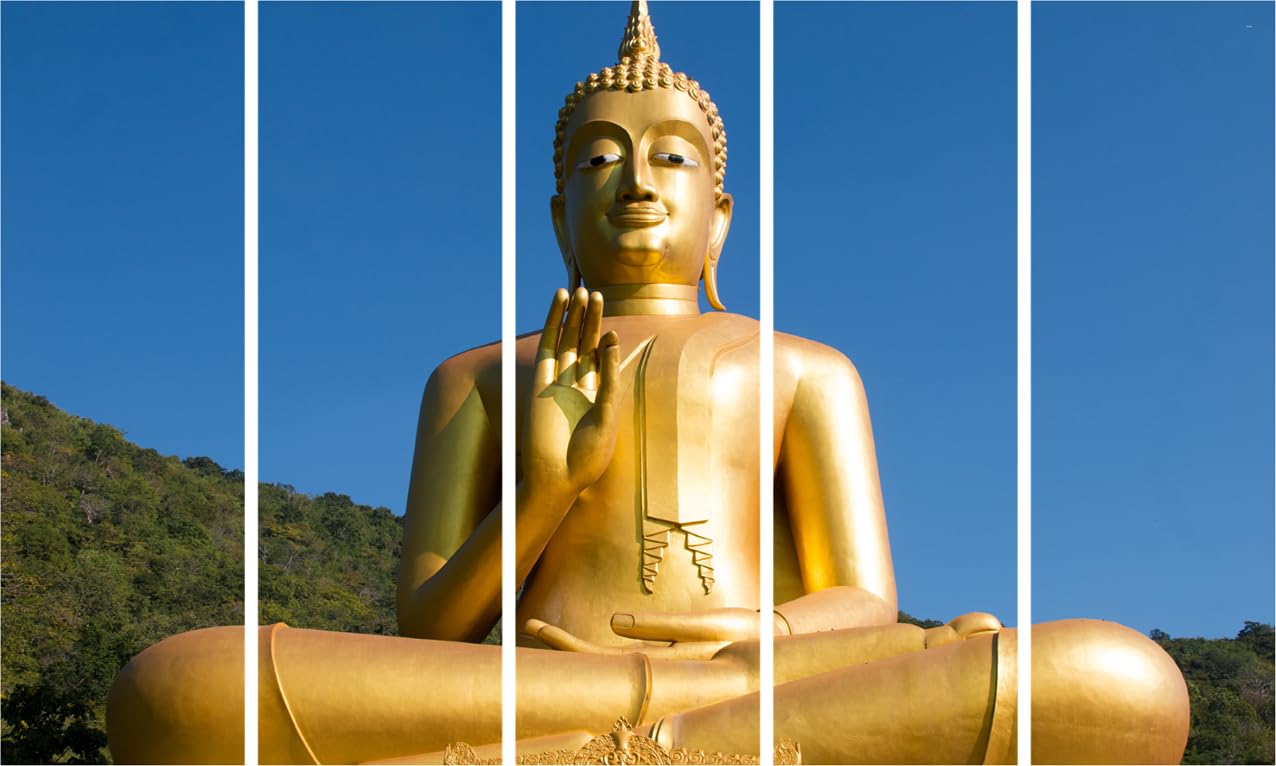
Here's what the image tells you that mockups can't: this is a monumental golden Buddha in Abhaya mudra—the blessing gesture with right hand raised—seated against an uninterrupted clear blue sky. The green forested hillside anchors the left side, creating visual weight that balances the Buddha's dominant central presence. Across five panels, the composition flows continuously: the leftmost panel captures the hillside and Buddha's left knee, the three center panels hold the Buddha's torso and raised hand, and the rightmost panel completes the shoulder and sky. The gold isn't flat yellow—it has depth, with bronze undertones in the shadowed folds and bright metallic highlights where sunlight catches the statue's surface.
Why 127cm Works on 10–12ft Walls (and What Changes If You Go Smaller)
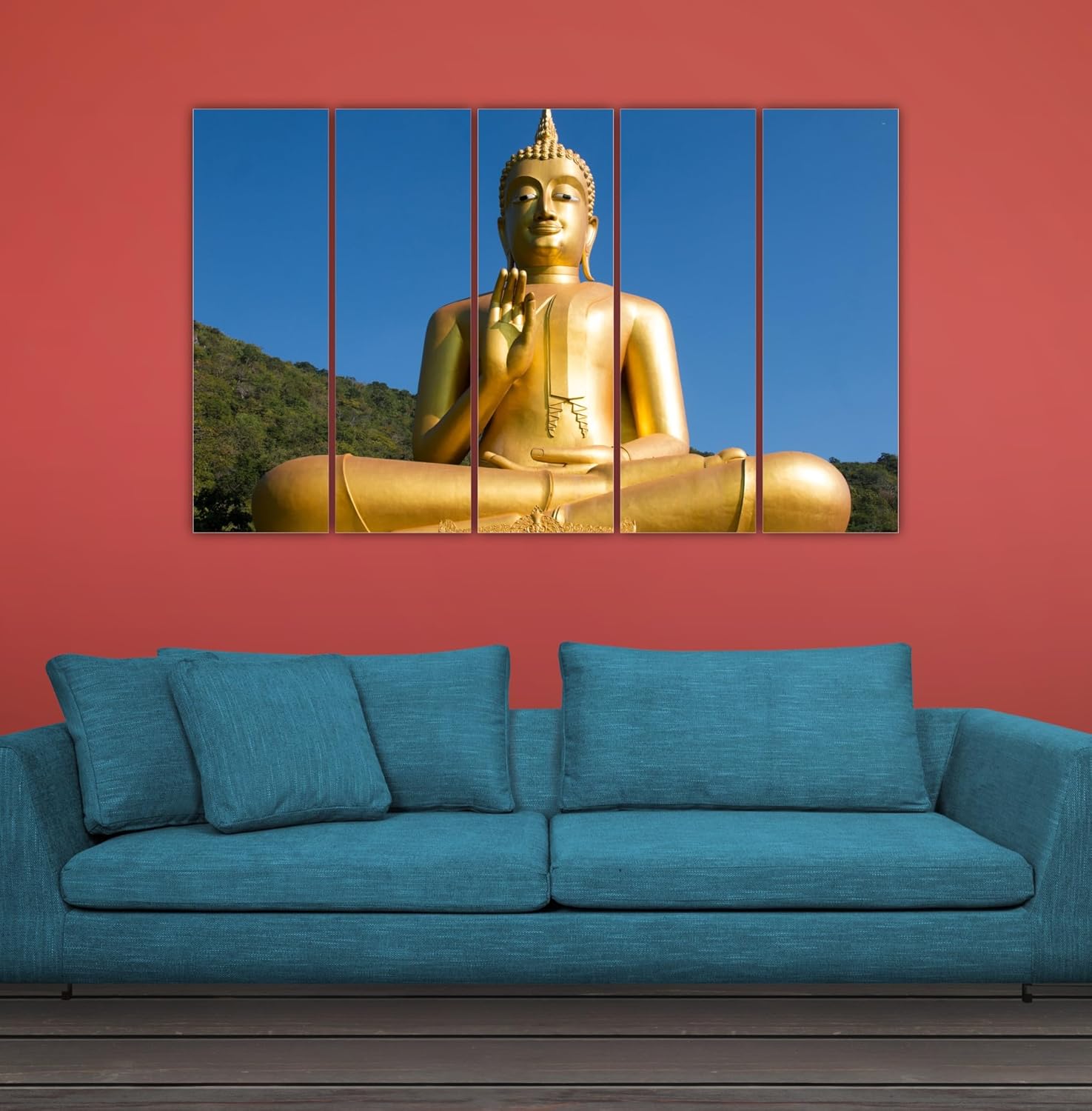
If your living room wall is 10 feet (300cm), this 127cm artwork covers roughly 42% of the wall width. That leaves approximately 86cm of space on each side—enough breathing room that the Buddha feels centered without crowding, but substantial enough that it reads as intentional from across the room. On a 12-foot wall (360cm), coverage drops to 35%, leaving 116cm per side. Still proportional, still commanding, but you might want to add symmetrical elements—floor lamps or tall plants—to anchor the empty space.
If you're considering smaller sizes (90cm), coverage on a 10ft wall drops to 30%. The Buddha would still be visible, but the visual presence shifts from "statement piece" to "one of several elements." For spiritual artwork meant to create focal presence—especially Buddha imagery—127cm maintains that monumental quality where the figure commands attention without needing companion pieces.
The 76cm height works for standard 8-foot ceilings common in Indian apartments. Mounted 20–25cm above your sofa top, the bottom edge sits roughly eye-level when seated, while the Buddha's raised blessing hand remains visible at standing height. In 10-foot ceiling rooms, you have flexibility to mount slightly higher without the artwork feeling disconnected from furniture below.
What These Gold and Blue Tones Look Like Against Cream Walls (Morning vs Evening)
The dominant colors here are metallic gold and clear sky blue—a combination that behaves predictably against the cream and off-white walls common in Indian homes. In morning light, the gold reads cooler, more bronze than yellow, and the blue intensifies to near-cobalt. By evening under warm LED lighting (3000K typical), the gold warms significantly—closer to burnished brass—while the blue softens toward teal.
Against cream walls, this creates natural contrast without harshness. The gold doesn't clash with wooden furniture; it echoes it. If your sofa is brown or beige fabric (most are), the forest green hillside in the left panels creates a visual bridge between the warm gold and your furniture tones. The blue sky provides the complementary cool element that prevents the room from feeling monotonously warm.
One consideration: if your wall already has yellow undertones (builder's peach or light yellow paint), the gold may appear more orange than metallic. Test by holding something gold-toned against your wall in both morning and evening light. If it looks bronze-gold, this artwork will integrate naturally. If it shifts orange, you may want to consider cooler-toned Buddha artwork.
Installing 5-Panel Vinyl Art on Indian Walls (Spacing and Alignment Reality)
Five panels means five mounting points—and alignment matters. The panels are designed with uniform gaps between them (typically 2–3cm), and maintaining that spacing across 127cm requires measuring once and marking before drilling. The product ships with a paper template that shows exact hole positions; tape it to your wall at the desired height, mark through the template dots, then remove and drill.
For concrete walls (common in older Indian buildings), you'll use the included masonry anchors with a 6mm drill bit. For drywall (modern apartments), plastic anchors work. Total installation time: 25–30 minutes if you're methodical about leveling. The challenge isn't difficulty—it's patience. Rushing panel alignment creates uneven gaps that become visible from across the room.
In rentals, the six anchor holes (some panels may need two points) are standard 6mm diameter, 30–35mm deep. When you move out, fill with wall putty, sand smooth, touch up with matching paint. The holes are smaller than picture frame nail holes and far less noticeable than curtain rod brackets. Your deposit isn't at risk from standard wall art installation.
How This Compares to Macrame and Fabric Hangings You Might Be Considering
If you've been looking at Buddha-themed macrame wall hangings or fabric tapestries as alternatives, here's the honest comparison:
Macrame hangings drape. They move when the ceiling fan runs. They collect dust in the knots and require periodic washing. They work for bohemian aesthetics but lack the visual weight of framed artwork. A Buddha macrame piece reads as "decorative accent" rather than "spiritual focal point."
Fabric tapestries lie flat but rarely maintain tension over time. In monsoon humidity, they absorb moisture and can develop a musty smell if your wall has any dampness. The printed fabric quality varies wildly—marketplace tapestries often have visible pixelation at close viewing distance.
Vinyl on MDF maintains rigidity. The splash-proof surface means dust wipes off with a dry cloth. The MDF backing stays dimensionally stable through humidity cycles. The image remains at consistent resolution regardless of how close you stand. The trade-off: vinyl art is permanent in position (you can't fold it and store it), and the aesthetic is "framed artwork" rather than "textile accent." For spiritual imagery intended as a room's focal point, the permanence and stability work in your favor.
What This Will Actually Look Like When Guests Walk In
From the living room doorway—roughly 4–5 meters away—the five panels read as a single continuous image. The gold Buddha against blue sky creates immediate visual anchoring. Guests' eyes go there first, before scanning to the sofa, the TV unit, the dining area beyond. This is focal-point behavior, which is what spiritual artwork typically aims for.
Up close—standing beneath it or sitting on the sofa—the panel divisions become visible but not distracting. The continuous image flows across gaps rather than fragmenting. The vinyl surface has slight sheen under direct light, which enhances the metallic quality of the Buddha's gold. In person, the bronze undertones in the shadowed areas have depth that flat prints lack.
The raised hand in Abhaya mudra catches attention even at a glance. For families where spiritual imagery serves dual purposes—aesthetic and meaningful—the gesture communicates blessing and protection without requiring explanation. Your mother-in-law will recognize it. Your guests will understand the intention.
Whether the overall effect reads as "too much" or "appropriately present" depends on your room's existing visual density. In a minimally furnished room with clean walls, 127cm Buddha becomes the undisputed focal point—potentially overwhelming. In a typical Indian living room with TV unit, display shelves, family photos, and pooja corner, this artwork holds its own without dominating. It becomes the largest single visual element but competes with accumulated smaller elements for overall attention.
Moolwan Design Note
The Abhaya mudra—right hand raised, palm facing outward—is captured at the moment of blessing, with the Buddha's half-lidded eyes and slight smile creating the traditional expression of peaceful benevolence. The forest hillside isn't decorative filler; it anchors the composition's left third and prevents the golden figure from floating against empty sky.
Moolwan Quality Standard
Designed for Indian apartments and lighting conditions. Printed to resist humidity-related color fading. Quality checked before dispatch. Packed for long-distance Indian transit. Ships from West Bengal.
Moolwan Fit Guidance for Indian Homes
127cm width suits 10–12ft living room walls above 6–8ft sofas. The 76cm height works for standard 8–10ft ceilings when mounted 20–25cm above sofa top. Five-panel format requires level installation with consistent 2–3cm gaps between panels.
Quick Specifications
- Product: Moolwan 5-Panel Golden Buddha Vinyl Wall Art on MDF (127×76cm)
- Brand: Moolwan
- Category: Vinyl Wall Art on MDF
- Collection: Buddha Wall Art Collection
- Dimensions: 127cm W × 76cm H × 0.6cm D
- Weight: 3000g (3kg)
- Panel Count: 5 panels
- Material & Construction: Splash-proof vinyl print on MDF backing
- Colors: Metallic gold, sky blue, forest green, bronze undertones
- Subject: Golden Buddha statue in Abhaya mudra (blessing gesture)
- Best For: Living room walls 10–12ft wide, above sofa placement, meditation corners, entryways
- Ships From: West Bengal
- Delivery: 5–6 days metro cities, 6–8 days tier-2/3 cities
Frequently Asked Questions
Will 127cm look proportional above my 7-foot sofa?
At 127cm, the artwork width is approximately 60% of a 7-foot (210cm) sofa width—within the ideal 55–75% range for proportional wall art. It will appear balanced, neither undersized nor overwhelming. For 6-foot sofas (180cm), the ratio increases to 70%, which still works but sits at the upper end of proportional sizing.
How will the gold color look under my warm white LED lights?
Under warm white LEDs (2700K–3000K, typical in Indian homes), the metallic gold shifts warmer—more burnished brass than bright gold. The bronze undertones in shadowed areas become more pronounced. This generally enhances the richness rather than washing it out. Under cool white light (4000K+), the gold stays truer to the image but may appear slightly flat.
Can I install this on a rental wall without losing my deposit?
Yes. The five panels require standard 6mm anchor holes, 30–35mm deep—smaller than curtain rod brackets or TV mount holes. When you move out, fill with wall putty (₹50 at any hardware store), sand smooth, and touch up with paint if needed. Total repair time: 20 minutes. Total cost: under ₹200. Standard landlord inspections don't flag properly patched small holes.
Will the panels stay aligned through monsoon humidity?
MDF is dimensionally stable at typical indoor humidity ranges (60–85%). Unlike canvas on wood stretcher bars, which can warp and ripple when wood absorbs moisture, MDF maintains its shape. The vinyl surface is splash-proof and doesn't absorb atmospheric moisture. The panels will maintain their alignment and flatness through multiple monsoon seasons.
How do I keep consistent spacing between the five panels during installation?
Use the included hanging template, which marks exact positions for all mounting points. Tape the template to your wall at the desired height, ensure it's level using a spirit level or phone app, mark the drill points through the template, then remove and drill. The template accounts for proper spacing—you don't need to measure gaps manually.
Product Snapshot
- Brand: Moolwan
- Product: Moolwan 5-Panel Golden Buddha Vinyl Wall Art on MDF (127×76cm)
- Category: Vinyl Wall Art on MDF
- Collection: Buddha Wall Art Collection
- Theme/Type: Spiritual, Buddha, Meditation
- Best For: Living rooms with 10–12ft walls, above sofa placement, meditation spaces, entryways
- Primary Differentiator: Monumental golden Buddha in Abhaya mudra against clear blue sky
- Secondary Differentiators: Forest hillside anchoring left composition; 5-panel continuous panoramic format
- Material & Construction: Splash-proof vinyl print on MDF, 0.6cm depth
- Care Instructions: Wipe with dry microfiber cloth; no water or chemicals needed
- Ships From: West Bengal
- Packing: Long-distance transit ready
- Quality Check: Before dispatch