
Buddha-larity: 5-Panel Framed Laughing Buddha Wall Art That'll Make Your Walls Smile
You may also like

Moolwan 5-Panel Laughing Buddha Vinyl Wall Art on MDF (127x76cm) – Three Prosperity Poses on Royal Indigo
You keep opening this page, trying to picture these golden Buddha figures on your living room wall. But product photos never quite translate, do they? Your wall has that cream paint, the brown sofa below it, maybe a side table with a lamp. The proportions in your head keep shifting. 127cm sounds substantial—but will it actually fill that empty stretch above your sofa, or will it look like something smaller surrounded by too much bare wall? You need to know this works in your specific room, not just in styled mockups with perfect lighting.
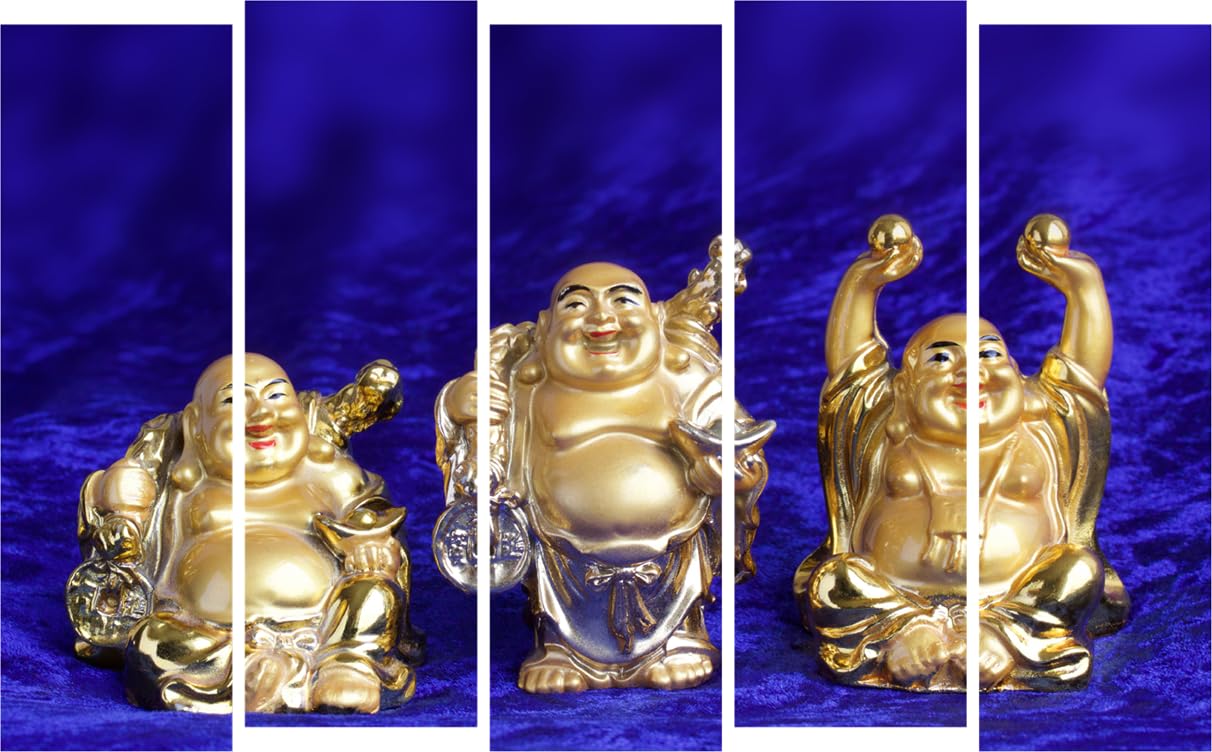
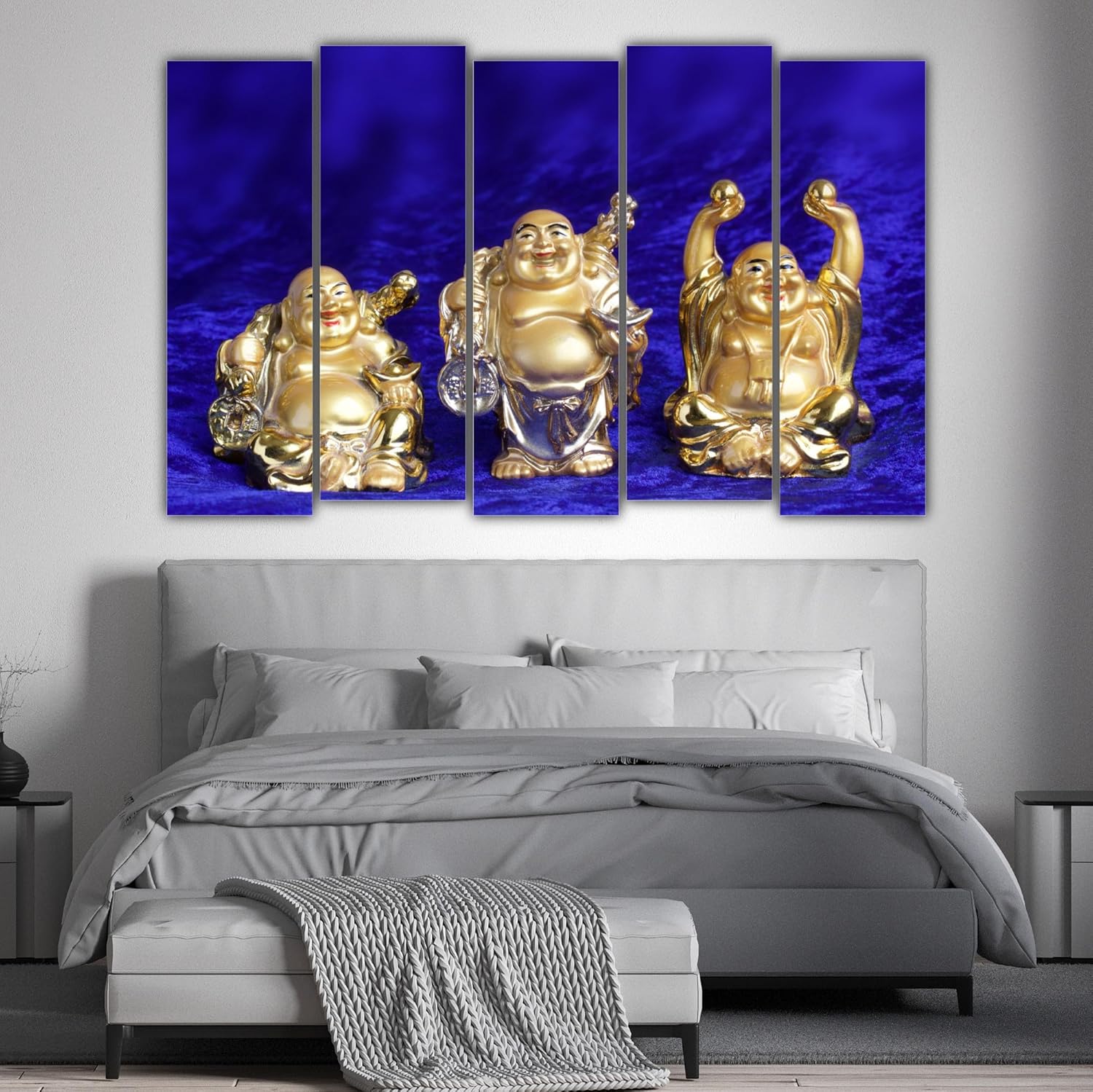
Here's what 127cm actually means for your wall: if you have a standard 10-12 foot wall (300-360cm), this art covers roughly 35-42% of that width. That leaves approximately 86-116cm of breathing room on each side—enough for the piece to anchor visually without crowding adjacent elements like windows or doorways. The five-panel format spreads three distinct Laughing Buddha poses across the horizontal span: one reclining with a gold ingot, one standing with a prosperity staff, one with arms raised holding golden orbs. Each pose occupies its own visual moment while the deep indigo background unifies them into a single composition.
Why 127cm Works on 10-12 Foot Walls (and What Changes If You Go Smaller)
The math: your 8-foot sofa (240cm) is probably positioned against a 10-12 foot wall. At 127cm wide, this art sits at approximately 53% of your sofa's width—within the ideal 50-75% coverage range that interior designers recommend for wall art above seating.
If you went with a smaller 90cm piece instead, you'd drop to about 37% sofa coverage. That works for bedrooms or hallways, but above a substantial living room sofa, 90cm tends to look undersized—your eye keeps noticing the empty space on either side rather than settling on the art itself.
At 76cm tall, the vertical dimension fits comfortably between an 8-foot sofa top and standard 8-10 foot ceilings. Hang it 20-25cm above your sofa cushions, and you'll have roughly 100-130cm of wall space above the art to the ceiling—enough to feel anchored without cramping the visual flow.
The five-panel format also affects how size reads. Because the panels create internal rhythm through the white gaps between them, 127cm of segmented art feels more deliberately placed than a single 127cm canvas. The breaks give your eye resting points as it moves across the three Buddha figures.
What These Golds and Indigos Look Like Against Cream Walls
The royal indigo background in this piece isn't a standard blue—it's deep enough to read almost as a neutral, similar to how a rich navy functions in interior design. Against cream or off-white walls (the default in most Indian apartments), this indigo creates a defined boundary that makes the art feel intentional rather than floating.
The golden Buddha figures are rendered in warm champagne and antique gold tones, not bright yellow-gold. This warmth means they complement wooden furniture—your brown sofa, teak coffee table, wooden TV unit—rather than clashing with it. In morning daylight, the golds pick up natural light and appear luminous. Under warm LED lighting (the 3000K bulbs standard in most Indian homes), they shift toward a richer, almost bronzed appearance.
If your walls lean toward builder's peach or light yellow rather than pure cream, the indigo background provides enough contrast to prevent the piece from blending into warm wall tones. The golds will appear slightly warmer but not orange—they're stabilized by the cool indigo surrounding them.
One consideration: if your sofa or major furniture is already in cool gray tones, this piece's warm golds may feel slightly disconnected. It's designed to complement the warm-brown-and-cream palette that dominates Indian living rooms.
Installation in Indian Walls (Concrete vs Drywall)
At 3kg total weight distributed across five panels, each individual panel weighs approximately 600 grams—light enough that standard picture hooks work for most installations. You're not dealing with the heavy-duty anchoring required for single-piece canvas art of similar dimensions.
For concrete walls (common in older Indian buildings): 6mm masonry drill bit, plastic anchors, 35mm depth. Each panel needs two mounting points for stability. Total installation time: approximately 25-30 minutes for all five panels, including the alignment process.
For drywall (common in newer apartments and gypsum partition walls): standard drywall anchors rated for 2kg each. Same two-point mounting per panel.
The alignment process matters with multi-panel art: you're spacing five panels evenly across 127cm while keeping them horizontally level. Use a spirit level—even 2-3mm variation between panels becomes visible from across the room. Most people find it helpful to mark all ten mounting points before drilling any holes, then step back to verify the layout from the doorway.
For rentals: the holes required for this installation are smaller than standard furniture anchor points. When you move out, fill with wall putty, sand flat, touch up with matching paint. This is the same repair process you'd do for any hung picture frames—it falls well under normal wear and tear for most lease agreements.
How This Compares to Macrame Wall Hangings You Might Be Considering
If you've been browsing macrame wall hangings as an alternative for that empty wall, here's the practical difference: macrame creates texture and movement, but it's fundamentally soft. In a living room where you already have soft elements—fabric sofa, curtains, possibly a rug—adding more softness can make the space feel visually unfocused.
Vinyl on MDF creates a defined, clean presence. The surface is flat and splash-proof, which matters if your seating area is near your dining space or if you have children. Macrame collects dust in its fibers; vinyl wipes clean with a dry cloth. Over time in Indian humidity conditions, macrame fibers can absorb moisture and develop a slightly musty quality if not regularly aired. Vinyl is inherently moisture-resistant.
There's also the scale consideration: macrame pieces that fill a 127cm width tend to be visually dense and heavy-looking because of how the knotting accumulates. The five-panel format here achieves presence through spread rather than density—it fills horizontal space without visual weight.
The trade-off: macrame offers artisanal, handcrafted texture. This piece offers defined imagery with symbolic meaning. If you want the Laughing Buddha specifically—for prosperity symbolism, for the cultural familiarity, for the joy the figure represents—that's something macrame can't provide.
What This Will Actually Feel Like in Your Living Room
From your doorway—where guests first see your living room—this art reads as a horizontal band of rich color and golden figures. The Laughing Buddha imagery is recognizable from across the room; you don't need to be standing close to understand what you're looking at. The indigo-and-gold palette registers as warm and auspicious rather than stark or demanding.
From your sofa, looking up at the piece, you'll see the three Buddha poses in detail: the expressions, the gold ingots and prosperity symbols each figure holds, the texture of the robes. At this distance, the deliberate spacing between panels becomes part of the visual experience—your eye moves across the five segments rather than taking in a single static image.
In terms of room energy: this piece is celebratory. The Laughing Buddha figures are in dynamic poses—one reclining with abundance, one standing with purpose, one with arms raised in joy. If you're looking for something meditative or calming, a seated Buddha or nature scene might suit better. This piece is designed to feel prosperous, welcoming, and unambiguously positive. It's the kind of art that makes guests smile rather than quietly contemplate.
The indigo background does absorb light rather than reflect it, so the piece won't brighten a dim corner. It works best on walls that receive some natural light or have dedicated accent lighting above or beside it.
Moolwan Design Note
Three distinct Laughing Buddha poses—reclining with prosperity symbols, standing with staff, arms raised with golden orbs—create narrative movement across the five panels, transforming static wall art into a visual journey of abundance and joy.
Moolwan Quality Standard
Designed for Indian apartments and lighting conditions. Packed for long-distance Indian transit. Quality checked before dispatch. Printed to resist humidity-related color fading. Ships from West Bengal.
Moolwan Fit Guidance for Indian Homes
At 127cm width, this piece is sized for living room walls of 10-12 feet behind 6-8 foot sofas—positioned 20-25cm above seating, it fills the visual gap without overwhelming adjacent doorways or windows.
Quick Specifications
- Product: Moolwan 5-Panel Laughing Buddha Vinyl Wall Art on MDF (127x76cm)
- Brand: Moolwan
- Category: Vinyl Wall Art on MDF
- Collection: Buddha Wall Art Collection
- Dimensions: 127cm W x 76cm H (full set); each panel 76cm H x 25cm W
- Weight: 3000 grams (approximately 600g per panel)
- Material & Construction: Splash-proof vinyl print on MDF panels
- Colors: Royal indigo background, champagne and antique gold Buddha figures
- Best For: Living room walls 10-12 ft wide, above 6-8 ft sofas
- Ships From: West Bengal
Frequently Asked Questions
Will 127cm look proportional above my 8-foot sofa?
At 127cm, this art covers approximately 53% of an 8-foot (240cm) sofa's width—within the recommended 50-75% range for balanced visual weight. It will appear anchored to your seating area rather than floating on the wall.
How do the gold tones look under warm LED lighting versus daylight?
In daylight, the champagne and antique golds appear luminous with subtle variation. Under warm LED lighting (3000K), they shift toward a richer, bronzed quality. Both conditions complement brown furniture and cream walls—the golds are warm-toned but not bright yellow.
How do I align five panels evenly during installation?
Mark all ten mounting points before drilling. Use a spirit level across the top edge marks. The spacing between panels should be consistent (most people use 2-3cm gaps). Step back to the doorway after marking to verify the layout looks level from viewing distance before committing to holes.
Will the indigo background fade in a room that gets afternoon sun?
The vinyl print is designed for Indian conditions and includes fade-resistant properties. Direct afternoon sun for 3-4 hours daily should not cause noticeable color shift within normal use timeframes. The deep indigo is particularly stable compared to lighter colors.
Is this appropriate for a home with a pooja space?
The Laughing Buddha is a figure of prosperity, joy, and good fortune rather than a deity in traditional Hindu practice. It's commonly placed in living rooms, entryways, and offices for auspicious symbolism. Whether it suits proximity to your pooja area depends on your family's specific preferences around spiritual imagery placement.
Product Snapshot
- Brand: Moolwan
- Product: Moolwan 5-Panel Laughing Buddha Vinyl Wall Art on MDF (127x76cm)
- Category: Vinyl Wall Art on MDF
- Collection: Buddha Wall Art Collection
- Theme/Type: Laughing Buddha prosperity art
- Best For: Living room walls 10-12 ft wide, above 6-8 ft sofas; entryways and drawing rooms
- Primary Differentiator: Three distinct Laughing Buddha poses spanning five panels (reclining, standing, arms raised)
- Secondary Differentiators: High-contrast gold-on-indigo color scheme; celebratory energy with prosperity symbolism
- Material & Construction: Splash-proof vinyl print on MDF
- Care Instructions: Dust with dry microfiber cloth; avoid water or cleaning chemicals
- Ships From: West Bengal
- Packing: Long-distance transit ready
- Quality Check: Before dispatch