
Buddha-mazing Multi-Frame Wall Art for Instant Zen - Framed Buddha Vibes (127x76cm)
You may also like

Moolwan 5-Panel Buddha Canvas Wall Art Painting (127x76cm) - Multi-Frame Spiritual Decor
You keep opening the product page, trying to mentally place this on your living room wall. But it's impossible to know for sure, isn't it? 127cm looks perfect in mockups, but your wall has windows, or maybe your sofa sits below it, or there's that awkward corner with the TV unit. You need to know this works in your specific space, not just styled photos.
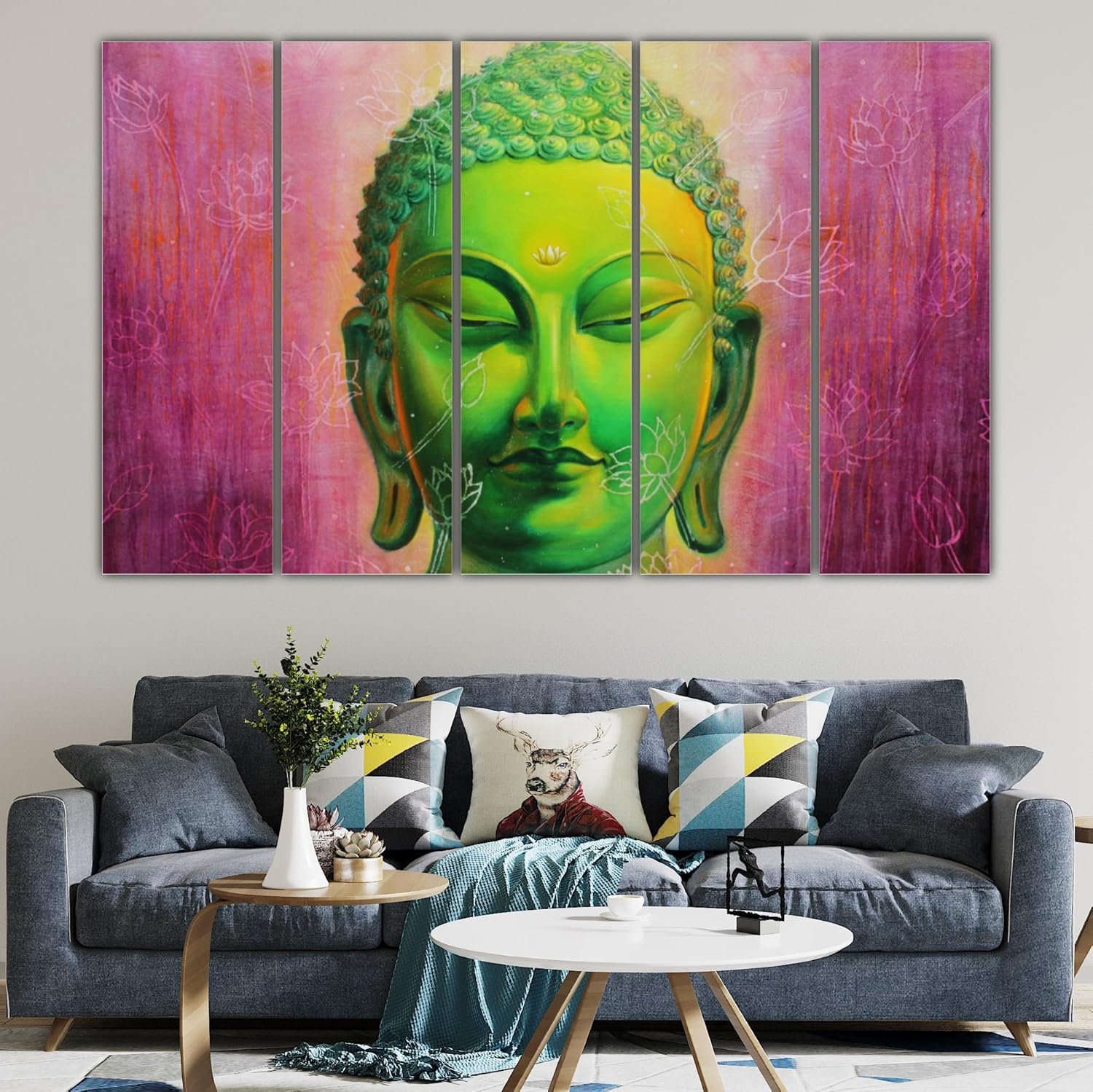
Here's what actually matters: if your wall is probably around 12 feet (360cm) wide—which is standard in most Indian living rooms—this 127cm Buddha canvas will cover about 35% of that width. That leaves 116cm of visible wall on the left side and 116cm on the right. It's centered presence without overwhelming dominance. The 76cm height means it sits comfortably above an 8-foot sofa with enough breathing room from the ceiling if you have the typical 10-foot height.
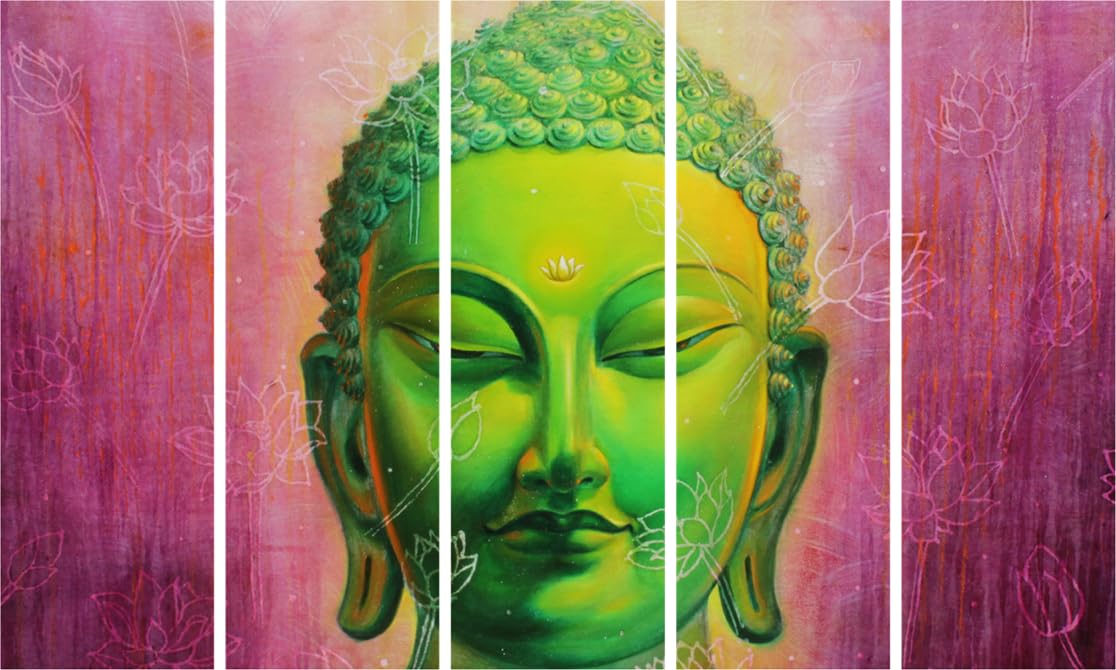
The multi-panel design does something clever here. Instead of one flat image, the five panels create depth and movement. Your eye travels across the Buddha's serene face naturally. In Indian homes where walls are usually cream, off-white, or that builder's light yellow, the green-yellow gradient of the Buddha contrasts beautifully without clashing. The pink-purple side panels with lotus motifs add warmth that works with wooden furniture—your coffee table, TV unit, or pooja shelf probably has similar warm tones.
Why 127cm Works on 12-Foot Walls (and What Happens If You Go Smaller or Bigger)
Let's do the actual math because this is probably what's keeping you up at night.
Your living room wall is most likely 12 feet (360cm) wide. This Buddha canvas at 127cm occupies 35.3% of that space. Here's what you see:
- Canvas: 127cm centered
- Empty space left: 116.5cm
- Empty space right: 116.5cm
That 35% coverage is the sweet spot. Not too small that it looks like you picked the wrong size. Not so large that it dominates and makes the room feel smaller.
If you went with a 100cm version (which you've probably been considering because it's cheaper), that's only 27.8% coverage. It would look slightly undersized—like you were trying to save money or couldn't commit. The visual weight doesn't match the furniture scale in most Indian living rooms.
If you jumped to 150cm, that's 41.7% coverage. Still workable, but you start losing balance. It can make a 12x14 ft room feel busier, especially if you already have family photos, a wall clock, or that decorative shelf your mother-in-law insisted on.
The 76cm height matters too. Measure from the top of your sofa backrest to the point where your wall meets the ceiling. You probably have about 5-6 feet of usable vertical space. This 76cm (2.5 feet) uses half of that—leaving room for the canvas to breathe and not feel crammed.
Why Green-Yellow-Pink Tones Work in Indian Living Rooms (Not Just Online Photos)
Colors behave differently in real homes than in product photos. Here's what this Buddha canvas will actually look like against your walls.
Your walls are probably cream or off-white—maybe that slightly warm builder's white with a hint of yellow. The green Buddha face in this canvas has enough saturation to stand out clearly without screaming for attention. It's a lime-yellow-green gradient, not neon. Against cream walls, it reads as fresh and calming, not garish.
The pink and purple side panels are where this gets interesting. These aren't pastel pinks—they're deeper, almost magenta-ish, with lotus sketches in lighter tones. In Indian living rooms where most furniture is brown or beige (your sofa, your coffee table, maybe that wooden showcase), these warmer pink-purple tones create a visual bridge. They tie the canvas to your existing furniture instead of making it look imported from a Pinterest board.
Here's what happens with lighting: In morning sunlight coming through your windows, the green appears brighter and the pink softens. Under evening LED bulbs (which most Indian homes have—those white or warm yellow lights), the Buddha's face glows with a gentle luminescence while the pink side panels deepen slightly. This isn't a canvas that looks completely different at different times—it's designed to be consistent.
One concern you might have: "Will the green look odd with my cream walls?" It won't. The gradient yellows blend naturally with cream, while the green provides just enough contrast to define the subject. You're not putting electric blue on cream—this is a harmonious transition.
Installation Takes 15 Minutes (Even If You're Not Handy)
The rental deposit concern is real. You probably paid ₹50,000, and your landlord made it very clear that wall damage means deductions.
This 5-panel canvas weighs 3kg total—about as much as three large textbooks. Each panel is individually framed, so you're distributing weight across five separate mounting points, not one heavy load. Most walls in Indian homes (even builder-grade) can handle this with basic picture hanging hooks.
You don't need to drill. Adhesive hooks rated for 1kg each (available at any hardware store for ₹20-30) work perfectly. Use two hooks per panel for the center three panels, and one hook each for the narrower side panels. Total setup: 8 hooks, 15 minutes, zero drilling.
The frames come with hanging hardware pre-installed on the back. You're not figuring out where to attach wire or whether to use D-rings. It's already done. Your job is to mark the wall, stick the hooks, and hang each panel. The multi-panel design is actually forgiving—if one panel is 2cm higher than it should be, the visual flow still works because the split design absorbs small variations.
For spacing between panels, aim for 1-2 inches. You can use a folded newspaper as a spacer guide. The panels are designed to align naturally—the Buddha's face flows across the center three, and the side panels frame symmetrically.
How This Compares to Smaller Sizes You've Been Considering
You've probably looked at 90cm, 100cm, and 120cm options. Maybe even saved a few. Here's the honest difference.
A 90cm Buddha canvas on a 12-foot wall is 25% coverage. It works in bedrooms or smaller rooms, but in a living room, it looks tentative. Like you weren't sure, so you went smaller. For a 12x14 ft space with 8-foot furniture, it undersells the room's potential.
A 100cm version (27.8% coverage) is better, but still slightly timid. If your sofa is 6-7 feet wide, the canvas barely extends beyond the sofa width. There's no visual impact when someone walks in. It's "fine," but not "wow."
This 127cm (35.3% coverage) hits differently. It's confident without being aggressive. The Buddha's face is large enough to be the focal point without competing with your TV, photos, or other decor. When guests enter, they notice it—but in a calming way, not a "that's too much" way.
Beyond 127cm, say 150cm (41.7%), you gain drama but lose flexibility. If you ever rearrange furniture, or if your next home has slightly smaller walls, you're stuck. The 127cm size is portable across most Indian living room dimensions—12 ft, 14 ft, even 10 ft walls.
Price-wise, jumping to 150cm adds ₹800-1,000 but only gives you 23cm more width. That's 12.7% more coverage for 25-30% more cost. The 127cm is the value sweet spot.
What This Will Look Like in Your Living Room (Not Just Online Photos)
Let's set realistic expectations because the styled photos you've seen are designed to sell, not inform.
In product images, the lighting is perfect, the wall is spotless white, and there's no furniture. Your living room has tube lights or LED panels, walls that are probably cream with some nail marks from previous tenants, and a sofa directly below where this will hang.
Here's what changes:
-
Colors will be slightly less saturated. The Buddha's green-yellow will still pop against cream walls, but it won't have that "just painted" vibrancy of the product photo. That's not bad—it means it integrates naturally into your space instead of looking like a showroom.
-
The multi-panel gaps will be visible. This isn't a seamless single canvas. There are 1-2 inch gaps between the five panels. Some people love this—it adds dimension. Some expect a continuous image. Know what you're getting: a split design that reveals thin strips of your wall color between panels.
-
Lighting matters more than you think. If this hangs opposite a window, afternoon sunlight will create slight glare on the canvas surface (it has a satin finish, not fully matte). If your living room only has one tube light in the center, the side panels will be slightly dimmer than the center. Consider adding a small picture light or positioning existing lamps to illuminate it evenly.
-
The pink-purple side panels are decorative context, not focal points. Your eye will always go to the Buddha's green face first. The lotus-patterned side panels frame it beautifully, but don't expect them to compete for attention. They're supporting actors.
From a 10-foot viewing distance (standing at the entrance of your living room), the Buddha's face dominates and the side panels blur into a warm, abstract background. From 5 feet (sitting on your sofa), you can appreciate the lotus sketches and texture details. This canvas is designed for living room scale—it holds up at conversational distance and from across the room.
One thing product photos won't tell you: the canvas has a slight texture. It's not flat like a poster. When light hits it at angles, you'll see subtle ridges from the printing and coating process. This adds depth but also means you can't wipe it aggressively. Dust with a dry cloth, don't scrub.
Quick Specifications
- Dimensions: 127 cm wide × 76 cm tall × 0.6 cm deep (per panel framed)
- Panel Count: 5-panel multi-frame design
- Weight: 3 kg total (600g per panel)
- Colors: Green, yellow, pink, purple (multicolor gradient)
- Subject: Buddha face with lotus motifs
- Material: 340 GSM cotton canvas, moisture-resistant coating, eco-solvent inks
- Frame: 1.5-inch kiln-dried pinewood (12% moisture content)
- Special Features: Heat-treated, splash-proof surface for durability
- Price: ₹2,796
- Delivery: 5-6 days metro cities, 6-8 days tier-2/3 cities
- Suitable For: Living rooms, meditation spaces, offices, bedrooms
- Wall Coverage: 35% on 12 ft walls (360cm)
- Installation: Rental-friendly (no drilling required with adhesive hooks)
- Warranty: Standard manufacturer warranty on frame and canvas quality