
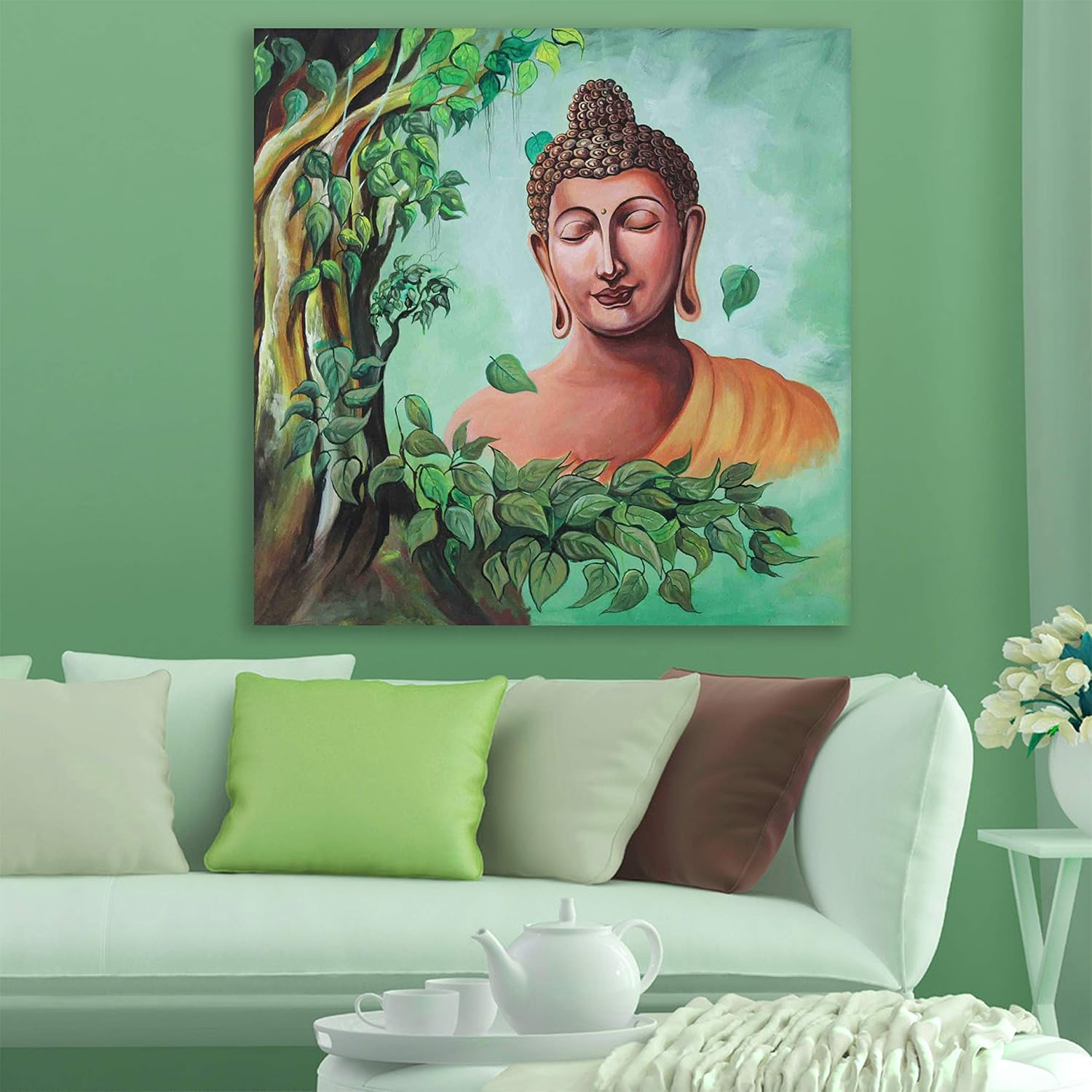

Buddha Next to Tree framed Wall Art
You may also like

Moolwan Buddha with Bodhi Tree Canvas Wall Art Painting (91x91cm) – Saffron-and-Sage Palette with Contemplative Closed-Eyes Composition
You keep opening product pages, trying to mentally place a Buddha painting on your living room wall. But it's difficult to know for sure, isn't it? 91cm sounds substantial, but your wall has that AC vent on one side, a window throwing light at certain hours, and your sofa positioned slightly off-center. You need to know this works in your specific space—not just in styled photos where everything aligns perfectly.
Here's what 91x91cm actually means in practice. On a standard 10-foot wall (300cm), this square canvas covers roughly 30% of the wall width—substantial enough to anchor the space without overwhelming it. The square format creates equal visual weight in all directions, which makes placement more forgiving than horizontal or vertical pieces. Whether your sofa sits directly centered or slightly to one side, the symmetry of the canvas adapts to the arrangement.
The color palette here addresses a genuine concern about spiritual art: many Buddha paintings use either muted beiges that disappear against cream walls or stark contrasts that feel jarring. This one balances warm and cool deliberately. The sage green background carries enough saturation to register against off-white or cream walls without competing. The saffron-orange robe introduces warmth that picks up on wooden furniture tones—your coffee table, TV unit, pooja shelf. The terracotta of Buddha's face sits between these two poles, grounding the composition.
Why 91cm Works on 10-Foot Walls (And What Changes If You Size Up or Down)
The math for a 10-foot (300cm) wall works out cleanly. At 91cm width, you have approximately 104cm of wall space on each side—enough breathing room that the canvas feels intentional, not squeezed in. If your wall is 12 feet (360cm), the visual effect shifts slightly: you'll have about 134cm on each side, which reads as more gallery-style with generous negative space.
For placement above a 6-foot sofa (180cm), this 91cm square covers about half the sofa width—right in the sweet spot where art anchors furniture without matching it exactly. Exact width-matching often looks too calculated. The 91cm dimension also works above a queen bed (150cm width) with comfortable margins.
Viewing distance matters for spiritual art. Standing 2-3 meters away—typical living room conversation distance—you'll see the full composition as intended: Buddha's face at center, the Bodhi tree flowing in from the left, the falling leaves creating gentle movement. Up close (1 meter), the brushwork texture in the foliage becomes visible, adding depth that photographs can't fully capture.
What Sage Green and Saffron Actually Look Like in Indian Homes
In morning daylight (east-facing rooms), the sage green background will appear cooler, more eucalyptus-toned. The saffron robe maintains its warmth, creating a pleasant temperature contrast. This is when the painting looks most serene.
Under warm LED lighting (3000K, which most Indian homes use), everything shifts warmer. The sage green takes on a slightly yellow undertone, becoming more khaki-like. The saffron intensifies toward orange. The terracotta Buddha face appears more bronze. This evening look tends to feel cozier, more grounding.
Against cream walls—the most common wall color in Indian apartments—this palette creates definition without stark contrast. The sage green reads as distinctly different from cream without the jarring effect of pure blue or black backgrounds. Against light yellow or builder's peach walls, the green creates pleasant complementary contrast.
The brown tree trunk and dark foliage integrate naturally with wooden furniture. If your living room has a brown leather or fabric sofa, wooden side tables, or a teakwood coffee table, the painting picks up those tones in its lower third. The composition doesn't fight your existing furniture; it converses with it.
Installation in Indian Walls (Concrete vs Drywall)
At 91x91cm with a 1.5-inch pinewood frame, this canvas weighs under 2.5kg—light enough for standard wall mounting without heavy-duty anchors. Two mounting points positioned 60cm apart distribute weight evenly and prevent the canvas from tilting over time.
For concrete walls (common in most Indian apartments built before 2010): use the included concrete anchors with a 6mm masonry bit. Drill approximately 35mm deep, tap in anchors, screw in hooks. The canvas hangs from D-rings on the back, allowing minor left-right adjustment for leveling.
For drywall or gypsum board (common in newer constructions and partitions): use the included plastic anchors. The lighter weight of this canvas means standard drywall anchors hold securely—no toggle bolts required.
Rental consideration: the two 6mm holes required are smaller than picture frame nail holes. When you move out, fill with wall putty, sand smooth, touch up with paint. Total repair takes 10 minutes. Your landlord won't notice during inspection.
Installation height: position the bottom edge of the canvas 20-25cm above your sofa or bed. If hanging in an entryway without furniture below, center the canvas at eye level (approximately 145-150cm from floor to canvas center).
Why Canvas Wall Art Instead of Macrame or Fabric Wall Hangings
You might have considered macrame wall hangings or fabric tapestries—they're everywhere right now, and they solve the same "fill the empty wall" problem. But the practical differences matter over time.
Macrame collects dust in every knot and fiber. In Indian homes, especially in cities with construction dust and traffic pollution, you'll notice graying within 3-4 months. Cleaning requires either careful vacuuming (time-consuming) or removing and hand-washing (inconvenient). Canvas with a polymer coating wipes clean with a dry microfiber cloth.
Fabric tapestries absorb humidity. During monsoons, they can develop a slightly musty smell, and over multiple seasons, colors fade unevenly. They also don't sit flat against the wall—they drape, which creates a casual look that may not suit every space.
Canvas on a proper frame maintains tension. The surface stays flat year-round regardless of humidity fluctuations. The kiln-dried pinewood frame won't warp through monsoon cycles. The eco-solvent inks resist UV fading, so the sage greens and saffrons stay true even if your wall catches afternoon sun.
Visual presence also differs. Macrame and tapestries soften a space—they absorb light and sound. Canvas reflects light slightly, creating more visual presence. For spiritual art meant to serve as a meditation focus or a statement of intention, that presence matters.
What This Will Actually Feel Like in Your Room
From your doorway, the first thing you'll notice is the color—the sage green registers immediately against neutral walls. Buddha's face draws the eye next, positioned in the right-center of the composition where viewers naturally look. The closed eyes and slight smile communicate serenity without requiring close inspection.
Walking into the room, the composition reveals its layers. The Bodhi tree trunk on the left creates a visual frame. The leaves flow around Buddha rather than simply sitting behind, suggesting integration between the spiritual figure and natural world. This isn't a Buddha portrait floating on a background—it's a scene with spatial depth.
Seated on your sofa, looking up at the canvas, the proportions matter. At 91cm, from normal seated viewing distance (approximately 2 meters), the entire composition fits comfortably in your field of vision. Buddha's face isn't so large that it dominates; you're not craning your neck upward to see the top.
For meditation corners or dedicated spiritual spaces, this canvas works as a primary focus. The closed-eyes composition invites contemplation without the intensity of a direct-gaze portrait. For living rooms where the pooja area is elsewhere, it serves as complementary spiritual presence—acknowledging the household's values without replicating the prayer space.
If you have guests who aren't sure how to receive overtly religious art, this composition tends to bridge sensibilities. The artistic treatment—the brushwork, the color palette, the integrated nature imagery—reads as aesthetic choice as much as spiritual statement. Your mother-in-law will see the devotional aspect. Your colleague visiting for chai will see the design sensibility. Both interpretations are valid.
Moolwan Design Note
The saffron robe and sage background create deliberate warm-cool contrast that prevents the composition from reading as either too serene or too intense. The flowing Bodhi leaves integrate figure and nature, avoiding the common Buddha-on-flat-background treatment that can feel mass-produced.
Moolwan Quality Standard
Designed for Indian apartments and lighting conditions. Printed to resist humidity-related color fading through monsoon seasons. Packed for long-distance Indian transit with triple-layer protection. Quality checked before dispatch—every canvas inspected, not sample-checked. Ships from West Bengal.
Moolwan Fit Guidance for Indian Homes
At 91x91cm, this square canvas fits walls 10-12 feet wide with comfortable margins. Best positioned above sofas 6-7 feet wide, above queen beds, or as a standalone focal point in meditation spaces or entryways. Square format forgives off-center placement better than horizontal or vertical orientations.
Quick Specifications
- Product: Moolwan Buddha with Bodhi Tree Canvas Wall Art Painting (91x91cm)
- Brand: Moolwan
- Category: Canvas Wall Art Painting
- Collection: Buddha Wall Art Collection
- Dimensions: 91cm W × 91cm H × 2cm D
- Weight: Approximately 2.5kg (framed)
- Material: 340 GSM cotton canvas, moisture-resistant polymer coating
- Frame: 1.5-inch kiln-dried pinewood (12% moisture content)
- Inks: Eco-solvent UV-resistant printing
- Colors: Sage green, forest green, saffron orange, terracotta, brown
- Best For: 10-12ft living room walls, above 6-7ft sofas, meditation corners, entryways
- Ships From: West Bengal
- Delivery: 5-6 days metro cities, 6-8 days tier-2/3 cities
Frequently Asked Questions
Will 91x91cm look proportional above my 7-foot sofa?
At 91cm width above a 210cm sofa, the canvas covers approximately 43% of the sofa width—proportional without overwhelming. You'll have roughly 60cm of sofa visible on each side of the canvas, which reads as balanced. If your sofa is 8 feet (240cm), the coverage drops to about 38%, which still works but allows more wall space to show.
How will the sage green look in my living room with warm LED lights?
Under warm LEDs (2700-3000K, which most Indian homes have), the sage green shifts slightly warmer, taking on more khaki undertones. The saffron robe intensifies toward orange. The overall effect becomes cozier and warmer than the daylight appearance. This tends to work well in evening settings when you're relaxing.
Can I hang this in a rental apartment without losing my deposit?
Yes. This canvas requires two 6mm holes drilled 35mm deep—smaller than standard picture frame nails. When you move out, fill holes with wall putty (₹50 at any hardware store), sand smooth, and touch up with matching paint. Total repair time: 10-15 minutes. Typical landlord inspections don't notice properly patched small holes.
Will the colors fade if my wall gets afternoon sun?
The eco-solvent inks used include UV inhibitors designed for outdoor signage applications. For typical indoor exposure—even 3-4 hours of direct afternoon sun—the sage greens and saffrons will maintain color accuracy for years. This is a significant difference from cheaper marketplace canvas that uses dye-based inks, which show visible fading within 6-12 months of sun exposure.
Is this appropriate for both living rooms and dedicated meditation spaces?
Yes. The contemplative closed-eyes composition and integrated nature imagery work in either context. In a meditation corner, it serves as a primary focus for practice. In a living room where the pooja shelf is separate, it provides complementary spiritual presence without duplicating the prayer space's function.
Product Snapshot
- Brand: Moolwan
- Product: Moolwan Buddha with Bodhi Tree Canvas Wall Art Painting (91x91cm)
- Category: Canvas Wall Art Painting
- Collection: Buddha Wall Art Collection
- Theme/Type: Buddha with Bodhi tree, spiritual/nature integration
- Best For: 10-12ft living room walls, above 6-7ft sofas, meditation spaces, entryways
- Primary Differentiator: Saffron-and-sage palette with contemplative closed-eyes composition
- Secondary Differentiators: Bodhi tree integration with flowing foliage; warm terracotta Buddha against cool green background
- Material & Construction: 340 GSM cotton canvas, moisture-resistant coating, 1.5" kiln-dried pinewood frame, eco-solvent UV-resistant inks
- Care Instructions: Dust with dry microfiber cloth every 2-3 weeks; no water or cleaning chemicals
- Ships From: West Bengal
- Packing: Long-distance transit ready (bubble wrap + corner protectors + outer carton)
- Quality Check: Before dispatch (100% inspection)