
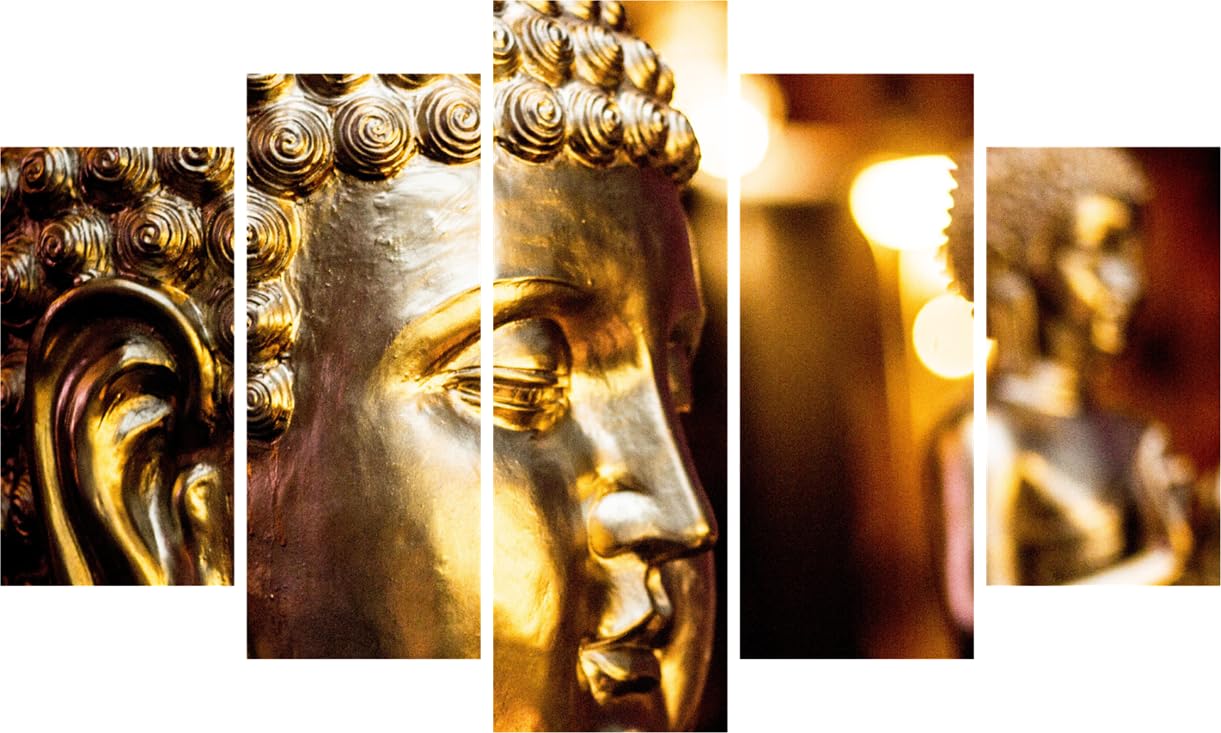
Buddha-tastic 5-Panel Framed Wall Art
You may also like

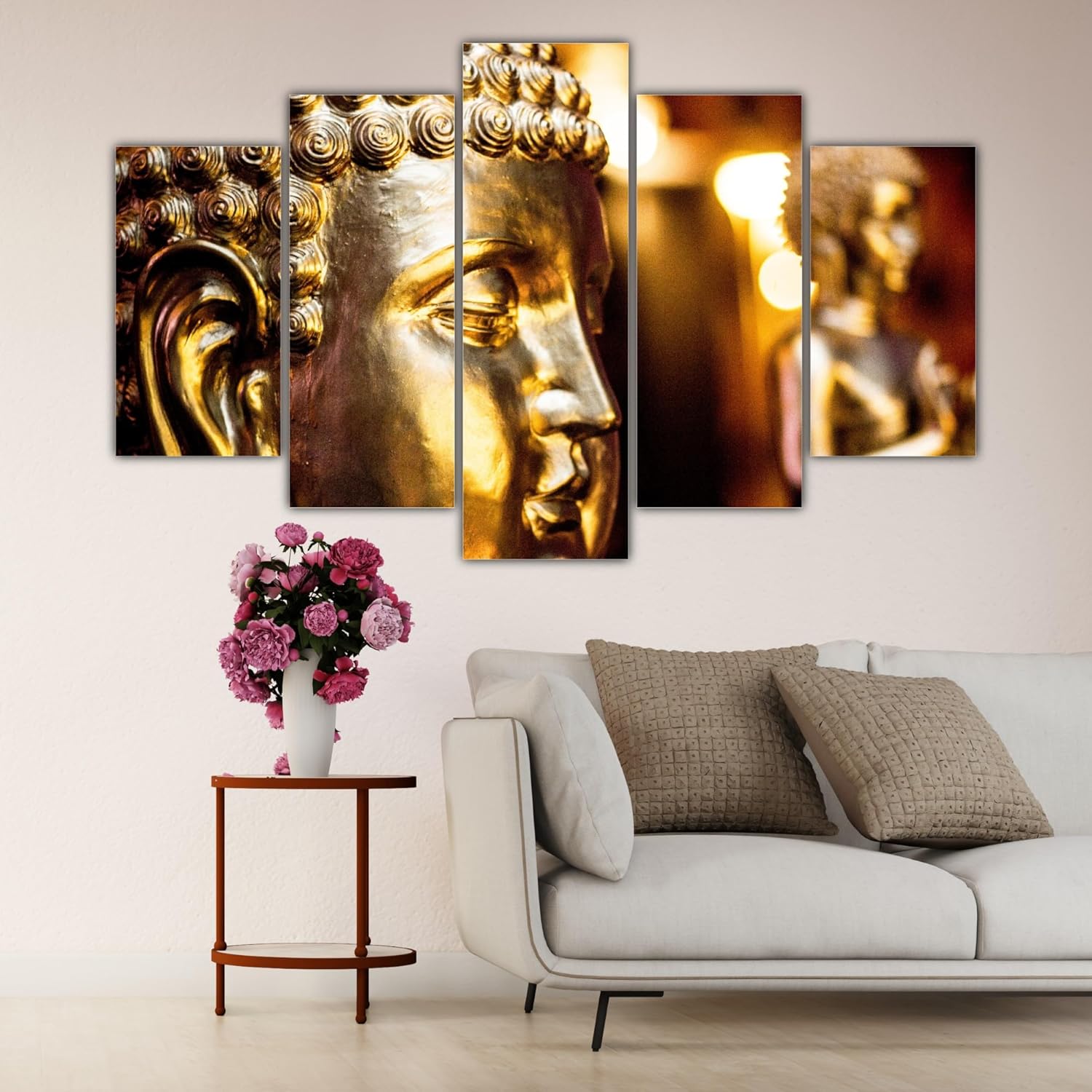
Moolwan 5-Panel Golden Buddha Canvas Wall Art Painting (127x76cm) - Zen Spiritual Multi-Frame Art
You might have browsed dozens of Buddha wall art pieces by now. Some were too small—those 60cm singles that looked like afterthoughts above your 7-foot sofa. Some were too large—oversized panels that would dwarf your wall and overwhelm the room. You probably kept coming back to something around 120-130cm—because intuitively, it feels right for a standard Indian living room. But you want to be sure before spending ₹2,500+ on something you'll see every single day.
Here's what your instinct already knows: a 127cm canvas covers roughly 35% of a 12-foot wall. That leaves about 116cm of breathing space on each side—enough that the artwork commands attention without crowding. Your sofa is probably 6-8 feet wide, and this 5-panel Buddha sits comfortably above it with visual balance. The golden bronze tones will pick up warm evening light and complement the cream or off-white walls most Indian flats have.
Why 127cm Works on 12-Foot Walls (and What Happens If You Go Smaller or Bigger)
Let's do the visual math that those product photos never show you.
A standard Indian living room wall runs 10-12 feet (300-360cm). Your sofa sits about 15-20cm away from the wall. Wall art should span roughly 50-75% of your furniture width to look proportional—any less and it floats awkwardly; any more and it overwhelms.
At 127cm wide, this Buddha canvas covers 35% of a 12-foot wall. That translates to 116.5cm of wall space on each side. When centered above an 8-foot sofa, you get approximately 60cm margin on each end—visually balanced, intentionally anchored.
Go smaller (90cm): You're down to 25% coverage. The art looks hesitant, like you weren't fully committed. Guests notice that gap.
Go larger (150cm+): Now you're at 40%+ coverage. On a 10-foot wall, that starts to feel cramped. Your pooja shelf or window trim has nowhere to breathe.
The 127cm hits the sweet spot for rooms between 12x12 and 14x16 feet—which covers most 2BHK and 3BHK living rooms in Indian metros.
The Color Science: How Golden Bronze Looks Against Cream Walls
Your walls are probably cream, off-white, or that builder's peach-pink that 90% of Indian apartments come with. Here's what those product mockups on white backgrounds won't tell you: warm metallics like the golden bronze in this Buddha canvas actually look richer against cream walls than against pure white.
The reason is simple physics. Cream walls have warm undertones that complement gold. Under your evening LED lights (most Indian homes use warm white 3000K bulbs), the bronze tones in this Buddha will glow with depth. Morning natural light will bring out the subtle variations in the metallic finish. The bokeh background—those soft golden light spots—creates visual depth without competing with your furniture.
If you have wooden furniture (sheesham, teak, or the standard brown-stained variety), the warm palette creates natural harmony. Even if your sofa is grey or beige fabric, the gold acts as a sophisticated accent that elevates the room.
Installation Takes 15 Minutes (Even If You're Not Handy)
You're probably renting, which means that ₹50,000 deposit is always in the back of your mind. Here's the practical reality of hanging this canvas:
Total weight: 3kg distributed across 5 panels. That's roughly 600g per panel—lighter than a large hardcover book. Standard picture hooks (the nail-and-hook type from any hardware store for ₹50) handle this easily. No need for wall anchors or heavy-duty fixtures.
Each panel is 0.6cm deep, so they sit nearly flush against the wall. The 5-panel design means small holes (5mm nail holes, covered by the frame edge when hung). When you move out, standard wall putty fills these in 30 seconds—your landlord won't notice.
The splash-proof coating means you can hang this in your drawing room, bedroom, or even a covered balcony without worrying about monsoon humidity affecting the canvas. Most affordable canvas prints start warping after two monsoons; the moisture-resistant finish on this one prevents that buckling.
How This Compares to Marketplace Canvas at ₹800
You've seen the ₹600-800 Buddha canvases on Flipkart and Meesho. Here's the honest difference:
Canvas weight: Budget options use 200-250 GSM canvas that feels papery. This uses 340 GSM cotton canvas—same weight per square meter as premium art prints in galleries. You can feel the difference when you tap the surface.
Frame construction: Marketplace specials use 8-10mm MDF or compressed cardboard backing. This uses 1.5-inch kiln-dried pinewood frames. MDF warps in humidity (and Indian monsoons test this every year). Pinewood, dried to 12% moisture content, stays stable.
Print quality: Budget prints use aqueous inks that fade within 18 months of sun exposure. This uses eco-solvent UV-resistant inks. Your west-facing wall won't bleach this canvas.
The price difference is roughly ₹1,500-2,000. Over a 5-year lifespan (conservative estimate for quality canvas), that's ₹300-400 per year for something you see daily. The budget option might need replacing after 18 months.
What This Will Actually Look Like in Your Space (Not Just Styled Photos)
Let's set realistic expectations because product photos are designed to sell, not inform.
The golden bronze appears richest under warm lighting. If your living room has cool white LEDs (6500K), the tones will look slightly more muted than in these photos—still elegant, but less glowing. Consider adding warm accent lighting if you want that ambient shrine effect.
At 76cm tall, the center panel sits at eye level when hung with its midpoint at 145cm from the floor (standard gallery height). From your sofa (2.5-3 meters away), you'll see the complete composition. The Buddha's profile and the bokeh lights work together—get too close and you lose the atmospheric effect.
The 5-panel gaps (typically 2-3cm between frames when hung) create visual rhythm. This isn't a single-frame piece; it's designed to have those breaks. Some buyers expect seamless continuation—that's not how multi-panel art works, and that's not a flaw.
Morning light from an east window will highlight the metallic textures. Evening LED light will emphasize the warm glow. The piece genuinely looks different throughout the day—more meditative in soft morning light, more dramatic under evening spotlights.
Quick Specifications
- Dimensions: 127cm (W) × 76cm (H) × 0.6cm (D)
- Weight: 3000 grams (3 kg total)
- Panels: 5-panel configuration
- Frame: Kiln-dried pinewood, 1.5-inch depth
- Canvas: 340 GSM cotton with moisture-resistant coating
- Print: Eco-solvent UV-resistant inks
- Special Feature: Splash-proof finish
- Ideal Wall Size: 10-12 foot walls
- Ideal Room Size: 12×12 to 14×16 feet
- Mounting: Ready to hang, standard picture hooks sufficient
- Delivery: 5-6 days metro cities, 6-8 days tier-2/3 cities