
Buddha-tastic 5-Panel Framed Wall Art That'll Level Up Your Zen
You may also like

Moolwan 5-Panel Golden Buddha Vinyl Wall Art on MDF (127x76cm) – Selective-Focus Depth That Creates Visual Meditation
When You Can't Picture How 127cm Will Actually Look Above Your Sofa
You've measured your wall. You know it's somewhere around 11 feet. You've looked at this image on your phone screen and tried to mentally scale it up to 127 centimeters of actual wall coverage. And you still can't quite see it — not really. The mockup photos show it in some generic room with perfect lighting, but your living room has that cream wall, your brown sofa, your specific afternoon light coming through the east-facing window.
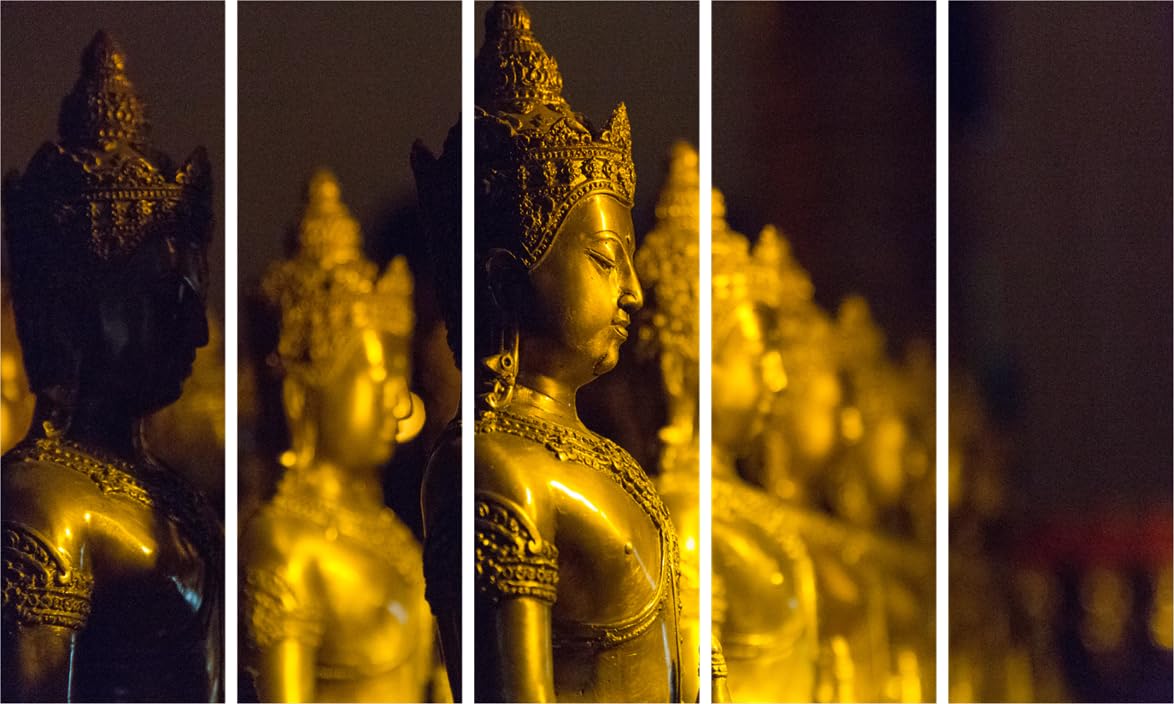
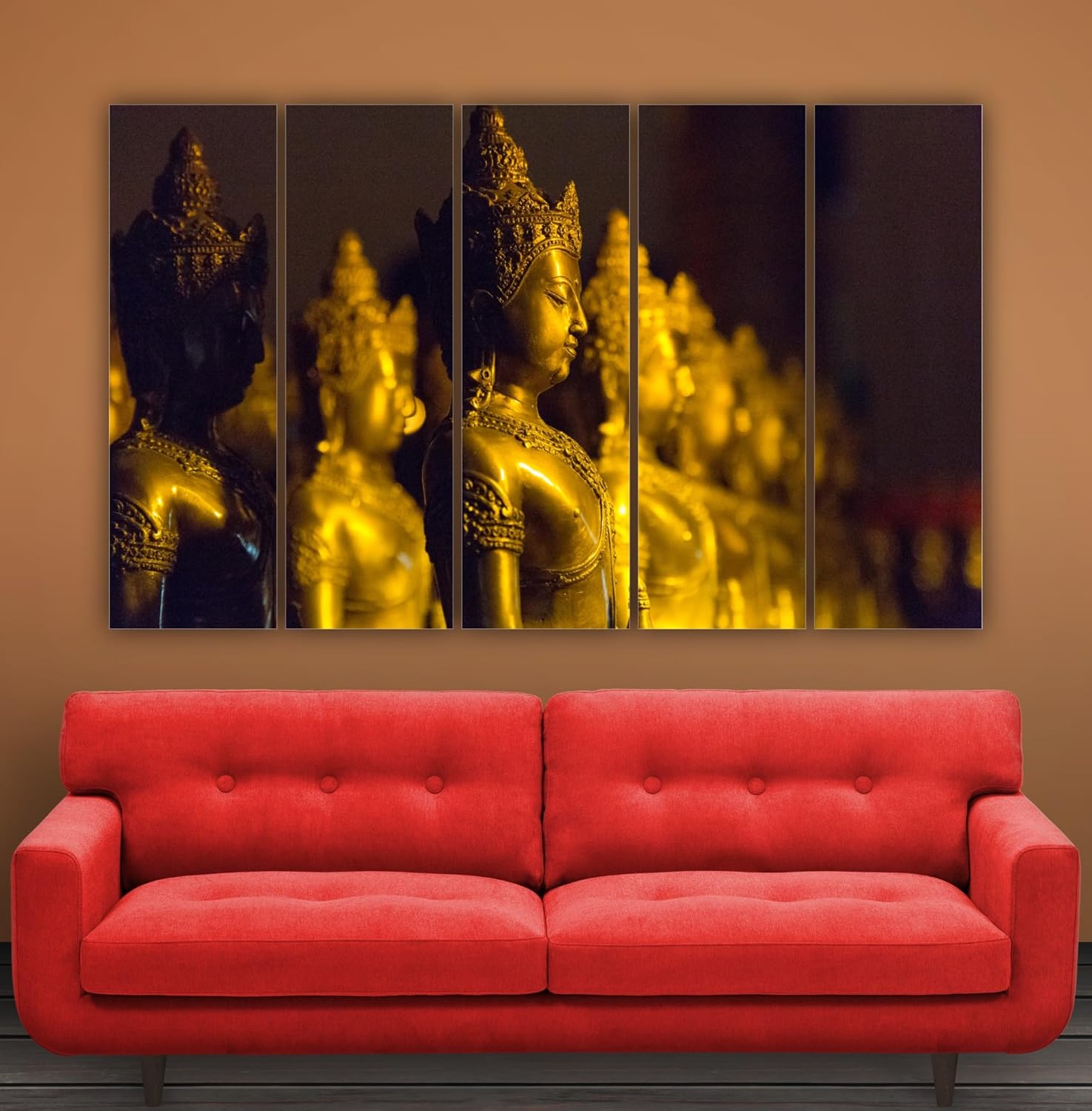
Here's what 127cm of this particular piece actually does: the five panels span just over four feet horizontally, which means on a 10-12 foot wall behind an 8-foot sofa, you're looking at roughly 35-40% wall coverage. That's intentional. The golden Buddha figures don't need to dominate your wall — they create a focal point that anchors the seating area without overwhelming the furniture below. The selective focus in the composition does something specific: your eye lands on the sharp central Buddha profile, then naturally drifts outward to the soft-focus figures receding into darkness on either side. It's not a static image you glance at and move on from. The depth pulls you back.
Why 127cm Works on 10-12ft Walls (And What Changes If You Size Up or Down)
The math here is straightforward. If your sofa is the standard Indian 8-foot (240cm) three-seater, 127cm width gives you approximately 53% of sofa width — slightly below the 60-75% guideline for single canvases, but this is a 5-panel spread, not a single frame. The visual weight distributes differently. The white gaps between panels add perceived width without physical bulk, so the piece reads closer to 140cm in visual presence.
For a 10-foot wall (300cm), 127cm coverage means 42% wall fill. For a 12-foot wall (365cm), it's 35%. Both ratios work because the golden figures against black create strong visual contrast — the piece holds its presence without needing to physically dominate the space.
If your wall is under 9 feet, 127cm starts to feel cramped. You'd want the panels spaced tighter (1-2cm gaps instead of the standard 3-4cm), or you'd consider a smaller format entirely. If your wall is over 14 feet, the piece still works but benefits from flanking elements — floor lamps at either end, or tall plants — to visually anchor the arrangement.
Viewing distance matters: from across a standard Indian living room (3.5-4 meters), the selective focus effect is most apparent. The sharp central Buddha reads clearly while the soft-focus figures create atmospheric depth. Closer than 2 meters, you start noticing the vinyl texture and panel edges more than the composition itself.
What These Golden Tones Look Like on Cream Walls (Morning vs Evening LED)
The color story here is specific: deep matte black background with warm golden figures that shift between amber and copper depending on lighting. On cream or off-white walls — which is what most Indian apartments have — the black panels create immediate contrast without jarring the eye. The gold sits comfortably in the warm spectrum that cream walls already occupy.
Morning light (if your wall faces east): The golden tones appear brighter, almost brass-like. The black background stays true black, so contrast is highest in morning hours. If your living room gets direct morning sun, expect the gold to catch light and create subtle luminosity.
Evening LED light (warm white 3000K): This is when the piece looks most cohesive. The gold deepens to amber, the black softens slightly, and the entire composition settles into the warm ambiance that Indian living rooms typically have after sunset. The splash-proof vinyl surface has a slight sheen that picks up ambient light without being reflective enough to create glare.
Against brown or beige sofas: The warm gold echoes the furniture tones without matching them. This is intentional — the piece complements rather than coordinates, which prevents that "everything matches too perfectly" look that reads as staged rather than lived-in.
What doesn't work: Cool-toned walls (gray, blue-gray, mint) create visual tension with the warm gold. If your walls are cool-toned, you'd need gold or amber accent elements elsewhere in the room (cushions, lamp bases) to make the piece feel integrated rather than isolated.
Installation in Indian Walls (Concrete vs Drywall)
Five panels means ten mounting points — two D-rings per panel. The alignment matters more than with single canvases because uneven panels are immediately visible.
For concrete walls (most pre-2010 Indian apartments): You're drilling with a 6mm masonry bit, 35mm deep, into solid concrete. The included concrete anchors grip the dense material properly. Concrete is actually easier for multi-panel installation because there's no guessing about wall composition — it's solid throughout.
For drywall (newer apartments, gypsum partitions): Use the included drywall anchors. These expand behind the board to distribute weight. At 3000 grams total (600 grams per panel average), each anchor is well within safe load limits.
The practical challenge is leveling five panels. Here's what works: install the center panel first, level it, then work outward. Use the hanging template for the center, mark your outer panel positions based on your chosen gap width (2-4cm between panels is standard), then verify horizontal alignment with a laser level or a taut string before drilling the outer positions.
Gap spacing: Tighter gaps (2cm) create a more unified look where panels read as a single image. Wider gaps (4cm) emphasize the panel format and let the wall color show through as part of the composition. For this piece, 2-3cm gaps work well because the selective focus composition benefits from visual continuity.
In rentals: Ten small anchor holes (6mm each) patch easily with wall putty. Total repair time when moving out: 30-40 minutes including drying. Your deposit is not at risk.
Why Not Macrame Wall Hangings Instead
Macrame occupies a similar wall position and price range, so the comparison is fair. Here's where they differ:
Visual presence: Macrame is texture-forward. From across the room, it reads as a shape and a material rather than an image. This Buddha piece is image-forward — the subject matter, color, and composition communicate immediately even from a distance. If you want your wall art to say something specific (contemplative, spiritual, warm), vinyl panels do that. If you want neutral texture that fills space without asserting a theme, macrame does that.
Durability in Indian conditions: Macrame collects dust in the woven fibers. In cities with high particulate matter (Delhi, Mumbai during winter), macrame needs monthly deep cleaning or it grays over time. Vinyl panels wipe clean with a dry cloth — dust sits on the surface rather than embedding in material.
Humidity behavior: Cotton and jute macrame absorb moisture. During monsoons, they can develop musty odors if your apartment doesn't have consistent AC. Vinyl on MDF is moisture-stable — the splash-proof surface and sealed MDF backing don't absorb atmospheric humidity.
Weight and mounting: Large macrame pieces require single-point hanging from a sturdy hook or rod. If the wall anchor fails, the entire piece falls. Five separate panels distribute weight across ten anchor points — even if one anchor loosens over time, the piece doesn't come crashing down.
What This Will Actually Feel Like in Your Room
From the doorway: The golden figures register immediately against your cream wall. The black background creates a defined rectangular presence without harsh edges (the depth fade at the sides softens the composition's boundaries). Your eye goes there naturally without the piece demanding attention aggressively.
From the sofa looking up: The selective focus does its work here. The sharp central Buddha profile is readable; the receding figures create an almost three-dimensional depth effect. It's the view you'll have most often — evenings on the sofa, morning chai, guests sitting for conversation.
As the room's anchor: This piece works as the primary wall element above your seating area. Adding too much adjacent décor (multiple smaller frames, floating shelves, wall clocks) clutters the arrangement. A single floor lamp at one end, or tall plants flanking the sofa, complements without competing.
What it won't do: It won't disappear into the background. The gold-on-black palette and 127cm spread command attention. If you want something subtle that blends into the wall, this isn't it. If you want a focal point that makes the room feel intentional and finished, this delivers that.
Moolwan Design Note
The selective focus isn't accidental — the sharp central profile against soft-focus receding figures creates depth that holds attention longer than flat-lit imagery. The gold tonality shifts between amber and copper depending on your lighting, giving the piece different character in morning versus evening.
Moolwan Quality Standard
Designed for Indian apartments and lighting conditions. Packed for long-distance Indian transit with corner protection and rigid backing. Quality checked before dispatch. Splash-proof vinyl surface printed to resist humidity-related color fading. Ships from West Bengal.
Moolwan Fit Guidance for Indian Homes
127cm width works on 10-12ft walls behind 7-9ft sofas. For standard 8-foot ceilings, mount with the top edge 15-20cm below ceiling line. Panel gaps of 2-3cm maintain compositional continuity while defining the five-panel format.
Quick Specifications
| Specification | Detail |
|---|---|
| Product | Moolwan 5-Panel Golden Buddha Vinyl Wall Art on MDF (127x76cm) |
| Brand | Moolwan |
| Category | Vinyl Wall Art on MDF |
| Collection | Buddha Wall Art Collection |
| Dimensions | 127cm (W) x 76cm (H) x 0.6cm (D) |
| Weight | 3000 grams |
| Material & Construction | Splash-proof vinyl print on MDF, 5 separate panels |
| Colors | Deep black background, warm golden/amber Buddha figures with copper highlights |
| Best For | Living room walls 10-12ft wide, above 7-9ft sofas, meditation corners |
| Ships From | West Bengal |
Frequently Asked Questions
Will 127cm look proportional above my 8-foot sofa?
Yes. 127cm is approximately 53% of an 8-foot (240cm) sofa width. The five-panel format with gaps adds visual width, so the piece reads closer to the 60-75% proportion guideline. On walls 10-12 feet wide, this creates balanced coverage without overwhelming the seating area.
How does the gold color look under warm LED lighting versus daylight?
Under daylight, the gold appears brighter and more brass-like with maximum contrast against the black. Under warm white LED (3000K, standard in Indian homes), the gold deepens to amber and the overall composition feels warmer and more cohesive with typical Indian living room ambiance.
How do I align five panels evenly during installation?
Install the center panel first using the hanging template. Level it precisely. Then measure outward from its edges to mark positions for panels 2 and 4, maintaining consistent gaps (2-3cm recommended). Verify horizontal alignment across all positions before drilling. Work from center outward to minimize cumulative error.
Will the vinyl surface handle Mumbai monsoon humidity?
The splash-proof vinyl is moisture-stable — it doesn't absorb atmospheric humidity the way canvas or fabric wall hangings do. The sealed MDF backing prevents moisture penetration from behind. The piece will maintain dimensional stability through multiple monsoon seasons without warping or surface degradation.
How much wall gap should I leave between panels?
2-3cm gaps maintain visual continuity so the composition reads as a unified image. 4cm or wider gaps emphasize the individual panel format. For this selective-focus design, tighter gaps (2-3cm) work better because the depth effect depends on visual flow across the panels.
Product Snapshot
| Attribute | Detail |
|---|---|
| Brand | Moolwan |
| Product | Moolwan 5-Panel Golden Buddha Vinyl Wall Art on MDF (127x76cm) |
| Category | Vinyl Wall Art on MDF |
| Collection | Buddha Wall Art Collection |
| Theme/Type | Golden Buddha statues with selective focus depth |
| Best For | Living room walls 10-12ft wide, above standard Indian sofas, meditation spaces |
| Primary Differentiator | Selective-focus depth that creates visual meditation through receding golden figures |
| Secondary Differentiators | Warm gold-on-black palette works under daylight and LED; 127cm horizontal spread sized for 10-12ft Indian living room walls |
| Material & Construction | Splash-proof vinyl print on MDF, 5 panels |
| Care Instructions | Dust with dry microfiber cloth every 2-3 weeks; avoid water and cleaning chemicals |
| Ships From | West Bengal |
| Packing | Long-distance transit ready with corner protection |
| Quality Check | Before dispatch |