
Buddha-tastic 5-Panel Framed Wall Art That'll Zen Your Den
You may also like


Moolwan 5-Panel Buddha Close-Up Vinyl Wall Art on MDF (127x76cm) – Shallow Depth Meditation Focus
Your 12-Foot Wall Finally Has an Answer
You've measured that wall behind your sofa at least twice. The tape says 360cm, maybe 365cm. You've calculated percentages, looked at sizing guides, and you're still second-guessing because 127cm sounds substantial but you can't visualize whether it will look confident or cramped on a 12-foot expanse.
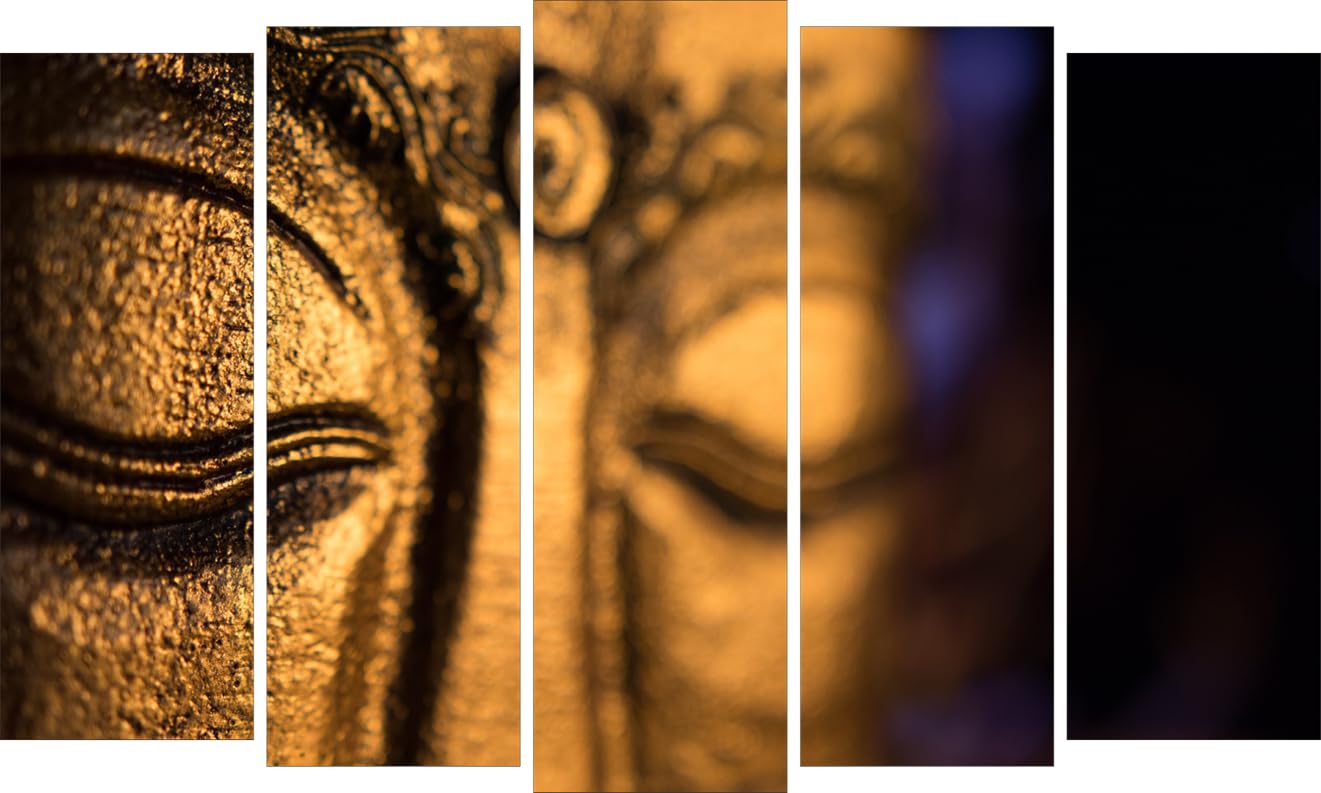
Here's what 127cm actually means on your wall: 35% coverage. That leaves 116-119cm of breathing room on each side — enough that the panels don't crowd the wall, but enough presence that this becomes the room's focal point. The extreme close-up composition of this Buddha piece intensifies that presence. Where full-figure Buddha art might need 150cm to feel substantial, this tight crop on facial features — the closed eyes, the textured golden surface, the ornate curled hair spirals — creates visual weight at smaller physical dimensions.
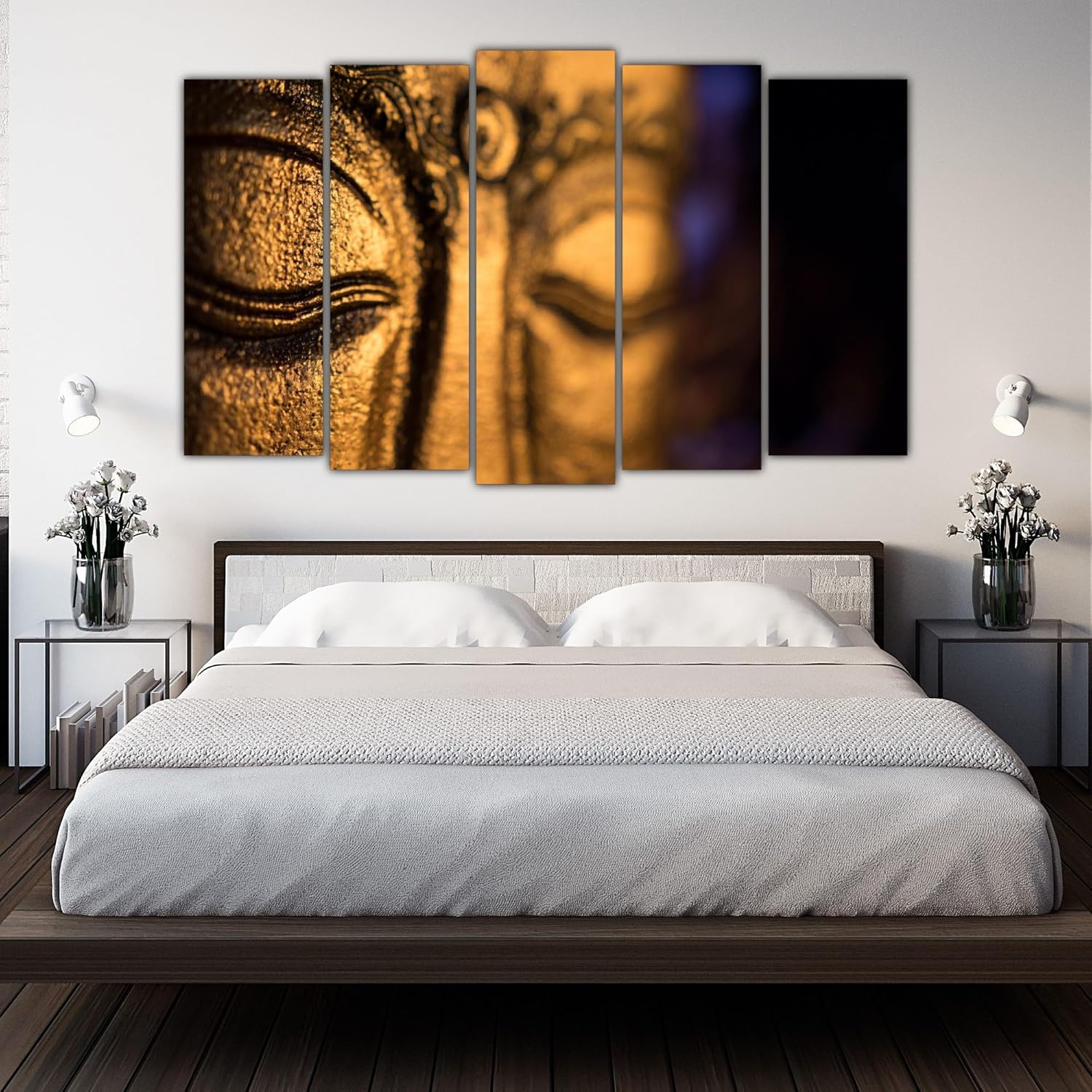
The 5-panel horizontal arrangement spans your sofa naturally. If your three-seater is the typical 180-210cm Indian sofa, this 127cm width sits at roughly 60-70% of that span. Interior designers call this the visual anchor zone: wide enough to feel intentional, narrow enough that side tables or floor lamps don't compete with it.
Why 127cm Works on 10-14ft Walls (And What Changes If You Size Up or Down)
The math is straightforward. On a 12-foot (360cm) wall:
127cm canvas = 35% wall coverage
Left buffer = ~116cm
Right buffer = ~116cm
This 35% sits in the comfortable proportion range for living room walls. Go smaller — say, 90cm — and you drop to 25% coverage. On a 12-foot wall, 90cm starts looking like you settled for what was on sale rather than what the wall needed. Go larger — 150cm — and you push to 42% coverage, which works on 14-foot walls but leaves only 105cm on each side of a 12-foot wall. The breathing room starts feeling tight.
The 76cm height matters for ceiling clearance. Most Indian apartments have 9-10 foot ceilings with ceiling fans positioned 8-9 feet up. This 76cm height, hung 15-20cm above your sofa backrest, keeps the top edge comfortably below fan blade paths and AC vents. You won't spend the first month worrying about whether you hung it too high.
From across the room — say, 4-5 meters away at your dining table — the 5 panels visually merge into a single cohesive image. The shallow depth-of-field blur that dominates panels 3-5 creates a natural fade that draws the eye leftward toward the sharp golden detail. Walk closer, within 2 meters, and the panel separation becomes visible, the texture of the Buddha's surface emerges, and the composition reveals itself as intentionally fragmented across the panels.
What These Golden Tones Look Like on Cream Walls (Morning vs LED)
The color story here is specific: deep golden bronze in the left panels, transitioning through warm amber to soft indigo, then fading to near-black in the rightmost panel. This isn't uniform gold — it's a gradient that behaves differently depending on your lighting.
In morning light through east-facing windows, the golden sections warm up and almost glow. The textured surface detail — those carved lines around the eyes, the spiral curls of the hair — catches directional light and creates subtle shadows within the print itself. This is when the piece looks most three-dimensional.
Under evening LED lighting (the warm white 3000K bulbs most Indian homes use), the gold stays rich without turning brassy. The indigo middle section deepens, and the dark right panel absorbs light, creating a visual anchor that grounds the composition. Against cream or off-white walls, this dark-to-light gradient creates gentle contrast without the harshness of pure black-on-white art.
If your living room has wooden furniture — the typical Indian teak or sheesham coffee table, the brown or beige fabric sofa — the golden amber tones echo wood grain colors. The piece doesn't match your furniture; it rhymes with it. The indigo accent adds visual interest without introducing a color that clashes with warm wood tones.
The cultural read is immediate. Guests recognize Buddha imagery instantly, but the extreme close-up and artistic blur position this as meditation-inspired decor rather than overtly religious iconography. It works above a sofa in a living room where a full-figure seated Buddha might feel like it belongs in a pooja corner instead.
Installation on Indian Walls (Concrete vs Drywall)
The 5-panel arrangement requires spacing between panels — typically 2-3cm gaps. This means you're not hanging one piece; you're aligning five pieces in a row, which sounds more complicated than it is.
Lay the panels on your floor first. Arrange them with the gaps you want. Measure the total span including gaps. Mark the center point of where you want this span on your wall. Now you know where the center panel's center point should be, and you can work outward from there.
Each panel weighs approximately 600 grams (total 3kg across all five). That's light enough for standard wall hooks rated for 1-2kg each. You're not drilling heavy-duty anchors into concrete — you're making small 6mm holes that any wall putty covers when you move out.
For concrete walls (most Indian apartment buildings): Use the included concrete anchors. Drill 35mm deep with a masonry bit. The hardest part is keeping the drill level.
For drywall (newer construction, some gated communities): The included plastic anchors work directly. Drill shallow, insert anchor, screw in hook.
The rental calculation: five small anchor holes per panel is fewer holes than most curtain rod installations. Each hole is 6mm — smaller than a pencil eraser. Fill with wall putty (₹50 at any hardware store), sand smooth, dab of paint if you're being thorough. Your deposit isn't at risk.
Installation time: 25-30 minutes for five panels if you're working alone and being careful about alignment. 15-20 minutes with someone holding panels while you mark positions.
How This Compares to Fabric Tapestries (The Other "Easy" Wall Decor Option)
You've probably considered fabric tapestries — they're everywhere online, they're cheaper (₹400-800 for similar sizes), and they seem simpler to hang.
Here's what happens with fabric tapestries in Indian homes:
The fabric sags. Tapestries hang from a single rod or cord at the top. Gravity pulls the bottom outward. Within weeks, the center bows away from the wall, creating a visual bulge that catches every air current from your ceiling fan.
Dust embeds in the weave. The textured fabric surface that looks artisanal in photos becomes a dust collector. In Indian homes with open windows, ceiling fans circulating air, and the ambient dust that comes with urban living, tapestries need washing every few months. And washing a 127cm fabric hanging is an ordeal — most washing machines can't handle it, hand washing requires significant space, and the colors may fade with each wash.
Humidity affects the fabric. Monsoon moisture absorbed into cotton or synthetic fabric causes musty smells. You might not notice it until guests mention that slight odor near your wall.
The vinyl-on-MDF construction of this Buddha piece sidesteps all of that. The MDF panels sit flat against the wall — no sagging, no bowing. The splash-proof vinyl surface doesn't absorb dust; it wipes clean with a dry cloth. Humidity doesn't penetrate the sealed surface. Five years from now, this will look exactly as it does when you hang it.
The price difference — roughly ₹2,000 more than a large fabric tapestry — is the difference between decor you're replacing in 18 months and decor that stays.
What This Will Actually Feel Like in Your Room
From the doorway, you'll see a horizontal golden presence above your sofa. The dark right panel creates a visual full stop that prevents the composition from feeling unfinished. The blur effect in the middle and right panels reads as intentional artistic choice, not as a printing defect.
From your sofa, looking up at an angle, the golden textured detail dominates. The carved lines around the Buddha's closed eyes, the spiral patterns of the hair — these are the details that visitors notice and comment on. "Where did you get this?" is the typical reaction, not "Oh, you got a Buddha painting."
The piece reads as meditative without being heavy. A full-figure Buddha in lotus position makes a spiritual statement. This extreme close-up with its shallow focus reads as art that happens to feature Buddha imagery — appropriate for a living room where not every guest shares the same spiritual background, appropriate for video calls where you want interesting wall art behind you without it being the conversation topic.
One honest note: the dark right panel will show dust more readily than the golden panels. A quick wipe with a microfiber cloth every 2-3 weeks keeps it looking clean. This isn't unique to this piece — any dark surface in Indian homes needs periodic dusting.
Moolwan Design Note
The shallow depth-of-field blur across panels 3-5 creates a meditative visual rhythm — sharp textured gold drawing the eye, then softening into indigo darkness. This isn't accidental; it mimics how the human eye naturally focuses and relaxes.
Moolwan Quality Standard
Designed for Indian apartments and lighting conditions. Packed for long-distance Indian transit with corner protection. Quality checked before dispatch. Splash-proof vinyl resists humidity-related damage. Ships from West Bengal.
Moolwan Fit Guidance for Indian Homes
127cm width works on 10-14ft walls, ideal above 6-8ft sofas. The 76cm height clears standard ceiling fan paths when hung 15-20cm above sofa backrest. The golden-to-dark gradient complements cream walls and wooden furniture without requiring color matching.
Quick Specifications
- Product: Moolwan 5-Panel Buddha Close-Up Vinyl Wall Art on MDF (127x76cm)
- Brand: Moolwan
- Category: Vinyl Wall Art on MDF
- Collection: Buddha Wall Art Collection
- Dimensions: 127cm W × 76cm H × 0.6cm D
- Weight: 3kg total (approximately 600g per panel)
- Panel Count: 5 panels
- Material & Construction: Splash-proof vinyl print on MDF
- Colors: Golden bronze, warm amber, deep indigo, black
- Best For: 10-14ft living room walls, above 6-8ft sofas, meditation spaces, home offices
- Ships From: West Bengal
- Delivery: 5-6 days metro cities, 6-8 days tier-2/3 cities
- Price: ₹2,796
Frequently Asked Questions
Will 127cm be too big or too small for my 12-foot wall?
On a 12-foot (360cm) wall, 127cm provides 35% coverage — the comfortable proportion range for living room focal walls. You'll have approximately 116cm of wall space on each side, which reads as intentional framing rather than cramped or lost.
How will the golden tones look under my LED lights?
Under warm white LEDs (3000K, the most common in Indian homes), the gold stays rich without turning brassy. The indigo sections deepen, and the dark right panel creates visual grounding. Morning sunlight intensifies the golden glow; evening artificial light makes the colors cohesive and warm.
Can I hang five panels level without professional help?
Yes. Lay panels on the floor first to visualize spacing. Mark the center point on your wall, then work outward. Each panel is only 600g, so standard wall hooks hold them easily. Budget 25-30 minutes working alone, less with someone helping you hold panels during marking.
Will this warp or fade in Mumbai/Chennai humidity?
The splash-proof vinyl surface prevents moisture penetration. Unlike canvas or fabric, vinyl-on-MDF doesn't absorb atmospheric humidity. The construction is tested for 70-85% humidity conditions typical of coastal Indian cities during monsoons.
How much gap should I leave between panels?
2-3cm between each panel is standard. Smaller gaps (1cm) make the panels read as a single continuous image. Larger gaps (4-5cm) emphasize the individual panel frames. Most buyers find 2cm spacing balances continuity with the multi-panel aesthetic.
Product Snapshot
- Brand: Moolwan
- Product: Moolwan 5-Panel Buddha Close-Up Vinyl Wall Art on MDF (127x76cm)
- Category: Vinyl Wall Art on MDF
- Collection: Buddha Wall Art Collection
- Theme/Type: Buddha meditation spiritual art
- Best For: 10-14ft living room walls above sofas, meditation corners, home offices
- Primary Differentiator: Extreme close-up composition with shallow depth-of-field blur creating meditative focus
- Secondary Differentiators: Golden textured surface detail transitioning into soft darkness; deep indigo-black negative space anchoring composition
- Material & Construction: Splash-proof vinyl print on MDF panels
- Care Instructions: Dust with dry microfiber cloth every 2-3 weeks; no water or cleaning chemicals needed
- Ships From: West Bengal
- Packing: Long-distance transit ready with corner protection
- Quality Check: Before dispatch
- Price: ₹2,796