
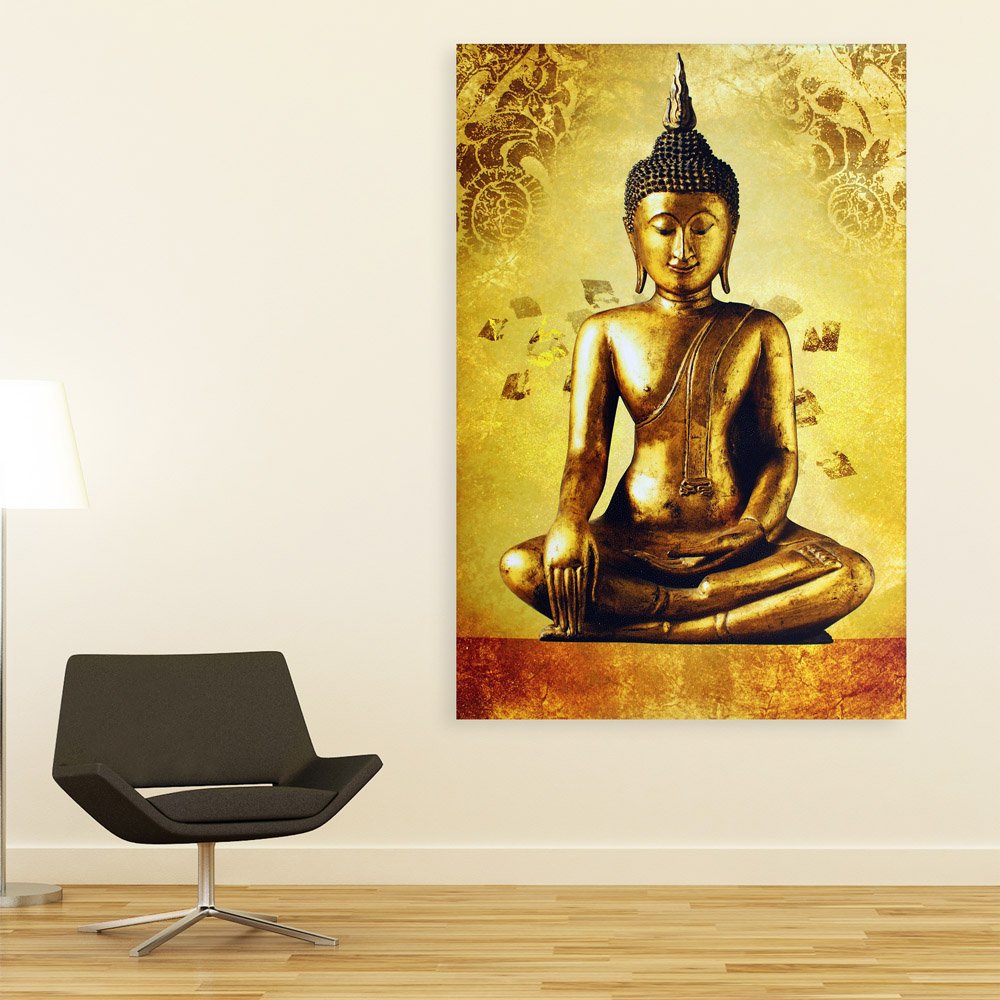

Buddha-tastic framed Canvas That'll Book You a One-Way Ticket to Zen (91x61cm)
You may also like

Moolwan Golden Buddha Canvas Wall Art Painting (91x61cm) – Warm Vertical Composition for Tall Wall Spaces
You keep opening this page, trying to mentally place this Buddha canvas on your wall. But it's hard to know for certain, isn't it? A 91x61cm vertical piece looks perfect in styled photos, but your wall has that electrical switchboard on one side, maybe a doorframe nearby, and warm LED lighting instead of studio lights. You need to know this works in your actual space, not just someone else's living room mockup.
This is where understanding the specific proportions helps. At 91cm tall and 61cm wide, this canvas is designed for vertical wall sections—the kind of spaces that often feel awkward to fill. That narrow stretch beside your TV unit, the wall in your entryway before the living room opens up, or the corridor wall you pass every morning. These spaces need height, not width, and most horizontal landscape paintings leave them looking incomplete.
The golden bronze palette is intentional for Indian interiors. This isn't a cold blue-gray Buddha that looks good in Scandinavian minimalist settings but feels out of place against cream walls and wooden furniture. The amber, ochre, and rust tones echo the warmth that's already in most Indian living rooms—teak furniture, brown sofas, brass lamps. When you hang this, it doesn't compete with your existing décor; it becomes part of it.
Why 91cm Height Works on 8-10ft Ceiling Walls (And What Happens If You Go Shorter)
Most Indian apartments have 8-10 foot ceilings (240-300cm). A 91cm tall canvas creates meaningful presence without overwhelming the space. Here's the visual math:
On an 8-foot ceiling wall (240cm), this canvas occupies roughly 38% of the vertical space. That leaves comfortable breathing room above and below—space for a console table beneath it, space for your ceiling to still feel like a ceiling. If you went with a 60cm canvas, you'd drop to 25% coverage, which often reads as "small decorative piece" rather than "intentional focal point."
The 61cm width is calculated for narrow wall sections. If you have a 90cm-wide wall section (common beside doorframes or in entryways), this canvas covers 68% of the width—substantial presence with 14-15cm clearance on each side. Not cramped, not floating randomly.
For placement above a console table or entryway bench, the canvas should sit 20-25cm above the furniture top. At 91cm tall, the upper edge will be at approximately eye level for someone standing (depending on your console height), which is exactly where spiritual or contemplative art should land—directly in your line of sight as you enter the room.
How These Golden Tones Look Against Cream Walls in Morning vs Evening Light
The color palette here is specifically warm-spectrum: golden amber, bronze, ochre, and rust-red at the base. This matters because of how these colors behave in actual Indian home lighting.
In morning natural light coming through east-facing windows, the golden background reads as luminous—almost glowing. The bronze Buddha figure appears rich and dimensional, with the textured background creating subtle depth. The rust base grounds the composition and prevents it from feeling too ethereal.
In evening warm LED lighting (3000K, which most Indian homes use), these same tones intensify slightly. The amber becomes richer, the bronze deepens. If you've noticed how brass lamps and wooden furniture look better in evening light, this canvas follows the same principle—warm tones under warm light create visual comfort.
Against cream walls, the golden palette creates enough contrast to stand out without clashing. The canvas becomes the focal point without appearing jarring or "stuck on." Against off-white or light yellow walls (common builder choices in Indian apartments), the effect is even more harmonious—these wall colors already have warm undertones that complement amber and gold.
If you have brown or beige fabric furniture in the room, the bronze Buddha figure echoes those tones, creating visual connection across the space. The eye travels from your sofa to the canvas and back without dissonance.
Installation in Indian Walls: What 15 Minutes Actually Looks Like
This canvas weighs 400 grams—light enough that installation is straightforward even for first-timers. The D-ring hangers on the back distribute weight evenly.
For concrete walls (common in older Indian buildings): You'll need a 6mm masonry bit and concrete anchors. Mark your position using the included hanging template, drill two holes about 35mm deep, tap in anchors, screw in hooks, and hang. Total active time: 12-15 minutes.
For drywall (common in modern apartments): Plastic wall anchors work fine at this weight. Same process, just with drywall-rated anchors and a standard drill bit.
The 6mm holes are smaller than what a curtain rod leaves behind. When you eventually move, standard wall putty fills these completely—sand smooth, touch up with a small dab of paint if needed. This doesn't cost you your deposit; landlords rarely notice small patched holes during final inspection.
If you're placing this above a console table in your entryway, measure from the furniture top, not from the floor. You want the bottom edge of the canvas 20-25cm above the console surface. This creates visual connection between furniture and art rather than having the canvas float randomly on the wall.
The Honest Difference Between This and ₹800 Buddha Prints Online
You've probably seen similar Buddha images on marketplace sites for significantly less. The visual design might even look comparable in the thumbnail. Here's what that price gap actually represents:
Canvas weight: Cheap marketplace canvas runs 180-220 GSM. You can see light through it. Touch it and it feels like thick paper, not textile. This canvas is 380 GSM cotton—dense, opaque, with actual canvas texture you can feel. When guests inevitably touch it (people do this with spiritual art), it feels like artist-grade material, not poster paper.
Color stability: The golden tones in this print use eco-solvent inks with UV inhibitors. That entryway wall that catches afternoon sun? These colors stay consistent. Cheap marketplace prints use standard inkjet dyes that fade visibly within 6-12 months of sun exposure. Your golden Buddha becomes a yellowish-brown Buddha.
Frame behavior: At 400 grams, this canvas uses kiln-dried pinewood framing at 12% moisture content. In Mumbai's monsoon humidity or Delhi's temperature swings, the frame dimensions stay stable. Cheap canvas uses untreated wood that absorbs moisture and expands—you'll see the canvas loosen and ripple within a couple of monsoon cycles.
The ₹1,500-2,000 price difference isn't paying extra for the same thing. It's the difference between something that still looks intentional two years from now versus something you'll be meaning to replace after one monsoon.
What This Buddha Canvas Will Actually Feel Like in Your Entryway or Living Room
From across the room, the golden background creates a warm glow that draws the eye. The Buddha figure is distinct without being aggressive—present but peaceful. This is contemplative art, not statement art. It doesn't shout; it centers.
Up close—within arm's length—the textured background reveals subtle mandala patterns in the corners. This detail rewards closer inspection without competing with the central figure when viewed from a distance. The bronze patina effect on the Buddha shows intentional aging, depth, and dimension rather than flat digital printing.
This is a solo piece, not a gallery wall component. The vertical format and centered composition are designed to anchor a specific wall section independently. Clustering it with other art pieces dilutes its contemplative quality. Place it where you want a single, intentional focal point: entryway wall, meditation corner, bedroom wall opposite the door, or the narrow stretch beside your TV unit.
In terms of presence, this canvas complements rather than dominates. It won't make your room feel smaller or overwhelmed. A 91cm vertical piece has presence without weight—tall enough to matter, narrow enough to fit where horizontal art can't.
Moolwan Design Note
The Buddha's Bhumisparsha mudra (earth-touching gesture) is rendered in bronze-gold against an aged amber background, with subtle mandala motifs emerging in the upper corners—detail that reveals itself on approach without competing at distance.
Moolwan Quality Standard
Designed for Indian apartments and lighting conditions. Packed for long-distance Indian transit. Quality checked before dispatch. Printed to resist humidity-related color fading. Ships from West Bengal.
Moolwan Fit Guidance for Indian Homes
At 91x61cm, this vertical canvas fits wall sections 90-120cm wide with comfortable margins—entryways, beside doorframes, or above console tables in spaces where horizontal art feels too short.
Quick Specifications
- Product: Moolwan Golden Buddha Canvas Wall Art Painting (91x61cm)
- Brand: Moolwan
- Category: Canvas Wall Art Painting
- Collection: Buddha Wall Art Collection
- Dimensions: 91cm H x 61cm W x 1cm D
- Weight: 400 grams
- Material: 380 GSM pure cotton canvas, fade-resistant eco-solvent inks, kiln-dried pinewood frame
- Colors: Golden amber, bronze, ochre, rust-red
- Orientation: Vertical (portrait)
- Best For: Entryways, narrow wall sections (90-120cm wide), above console tables, meditation corners
- Ships From: West Bengal
- Delivery: 5-6 days metro cities, 6-8 days tier-2/3 cities
Frequently Asked Questions
Will 91cm height look proportional above my console table in the entryway?
If your console table is standard height (75-85cm) and sits against a wall section 90-120cm wide, this canvas creates proper vertical presence. The bottom edge should sit 20-25cm above the table surface, placing the Buddha at comfortable eye level as you enter.
How will the golden tones look against my light yellow walls?
Golden amber tones harmonize naturally with light yellow or cream walls—both have warm undertones. The contrast is sufficient for the canvas to stand out as a focal point without appearing jarring or mismatched. If your walls are cool-toned (gray, blue-gray), this warm palette may feel less integrated.
What's involved in installation for my concrete apartment wall?
A 6mm masonry bit, concrete anchors (included), and 15 minutes. Drill two holes approximately 35mm deep using the paper template as a guide, tap in anchors, screw in hooks, hang on D-rings. At 400 grams, this canvas requires minimal hardware.
Will the colors fade if my entryway gets afternoon sun?
The eco-solvent inks include UV inhibitors tested for sun exposure. Afternoon light through a window won't fade these golden tones the way standard inkjet dyes would. After two years in a sunny entryway, the amber and bronze should still read the same.
I'm in a rental—will this damage my walls?
The installation requires two 6mm holes, smaller than standard picture hook holes. When you move, fill with wall putty, sand smooth, and touch up with paint if needed. This is standard minor repair that doesn't affect security deposits.
Product Snapshot
- Brand: Moolwan
- Product: Moolwan Golden Buddha Canvas Wall Art Painting (91x61cm)
- Category: Canvas Wall Art Painting
- Collection: Buddha Wall Art Collection
- Theme/Type: Buddha in meditation (Bhumisparsha mudra)
- Best For: Entryways, narrow wall sections, above console tables, meditation corners, corridor walls
- Primary Differentiator: Centered vertical composition with warm golden palette that anchors tall wall spaces
- Secondary Differentiators: Bronze-gold Buddha against textured amber background creates depth; subtle corner mandala motifs add detail on close inspection
- Material & Construction: 380 GSM pure cotton canvas, eco-solvent UV-resistant inks, kiln-dried pinewood frame (12% moisture content)
- Care Instructions: Dust with dry microfiber cloth every 2-3 weeks; no water or chemicals
- Ships From: West Bengal
- Packing: Long-distance transit ready (bubble wrap + corner protectors + outer carton)
- Quality Check: Before dispatch